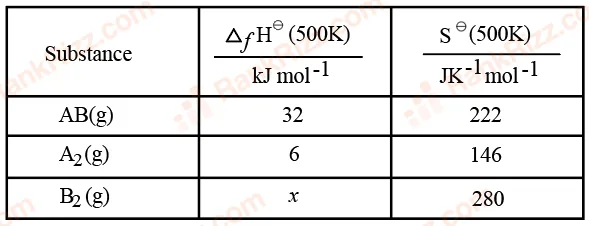
Use the following data :
One mole each of and are taken in a 1 L closed flask and allowed to establish the equilibrium at 500K
The value of x in is ____ . (Nearest integer)
(Given: log K=2.2 R= 8.3 kJ )
Every Chemical Thermodynamics question JEE Main has set from 2004–2026, grouped by the idea it tests rather than the order of the syllabus. 229 questions across 7 distinct ideas. Free to read, answer key on every one.
DATA UPDATED
Questions
229
Distinct ideas
7
Share of marks
4.6%
Difficulty
MEDIUM
A chapter is not one subject — it is a handful of procedures the examiner reuses. These are the ones Chemical Thermodynamics questions actually test.
21–40 OF 229 · NEWEST FIRST
Use the following data :
One mole each of and are taken in a 1 L closed flask and allowed to establish the equilibrium at 500K
The value of x in is ____ . (Nearest integer)
(Given: log K=2.2 R= 8.3 kJ )
Consider the following data :
(methane, g) = - X kJ
Enthalpy of sublimation of graphite = Y kJ
Dissociation enthalpy of = Zkj
The bond enthalpy of C - H bond is given by :
X + Y + Z
For an isothermal free expansion of an ideal gas into vacuum, which one of the following set of values is correct?
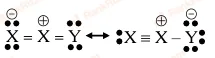
Resonance in can be represented as

The enthalpy of formation of X_2Y\left( X\equiv X(g)+\frac{1}{2}Y=Y(g)\rightarrow X_2 Y(g)\right) is 80 kJ mol. The magnitude of resonance energy of is _____ kJ mol (nearest integer value). Given: Bond energies of , , and are 940, 410, 500 and 602 kJ mol respectively.
valence X : 3, Y : 2
Total enthalpy change for freezing of 1 mol water at 10 degrees C to ice at -10 degrees C is ______
(Given : kJ/mol, J mol K, J mol K)
The hydration energies of and are and kJ/mol respectively. If lattice energy of KCl is kJ/mol, then the heat of solution of KCl is :
The correct statement amongst the following is :
The term 'standard state' implies that the temperature is 0°C
The standard state of pure gas is the pure gas at a pressure of 1 bar and temperature 273 K
is zero for O(g)
is zero for
Let us consider a reversible reaction at temperature, T. In this reaction, both and were observed to have positive values. If the equilibrium temperature is , then the reaction becomes spontaneous at:
One mole of an ideal gas expands isothermally and reversibly from 10 to 20 at 300 K. , q and work done in the process respectively are: (Given: , , , )
0, 21.84 kJ, -1.26 kJ
0, -17.18 kJ, 1.718 J
0, 21.84 kJ, 21,84 kJ
0, 1718 kJ, -1.718 kJ
Consider the given data :
(a) , kJ mol
(b) , kJ mol
Choose the correct statement :
Dissolution of gas in water is an endothermic process
The heat of solution depends on the amount of solvent.
The heat of dilution for HCl ( to )is 3.78 kJ/
The heat of formation of HCl solution is represented by both (a) and (b)
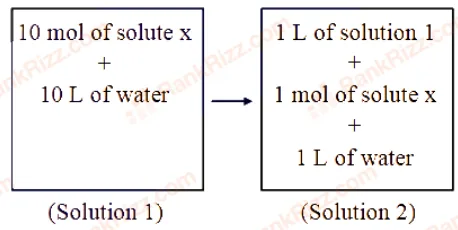
Which of the following properties will change when system containing solution 1 will become solution 2 ?

Molar heat capacity
Density
Concentration
Gibbs free energy
Given :
kJ mol
kJ mol
kJ mol
kJ mol
The for is _________ kJ mol
(nearest integer value)
Given below are two statements:
Statement I: When a system containing ice in equilibrium with water (liquid) is heated, heat is absorbed by the system and there is no change in the temperature until whole ice gets melted.
Statement II: At melting point of ice, there is absorption of heat in order to overcome intermolecular forces of attraction within the molecules of water in ice and kinetic energy of molecules is not increased at melting point.
In the light of above statements, Choose the correct answer from the options given below :
Statement I is true but Statement II is false
Both Statement I and Statement II are false
Both Statement I and Statement II are true
Statement I is false but Statement II is true
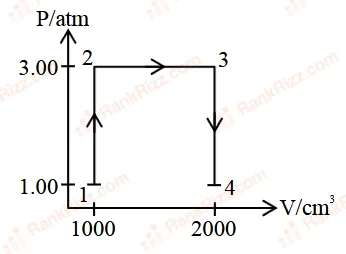
A perfect gas (0.1 mol) having (independent of temperature) undergoes the transformation from point 1 to point 4 as shown in the P-V diagram. If each step is reversible, the total work done (w) while going from point 1 to point 4 is (-) \text{____} J (nearest integer).
[Given: L atm ]
A sample of n-octane (1.14 g) was completely burnt in excess of oxygen in a bomb calorimeter, whose heat capacity is 5 kJ . As a result of combustion reaction, the temperature of the calorimeter is increased by 5 K. The magnitude of the heat of combustion of octane at constant volume is ________ kJ mol (nearest integer).
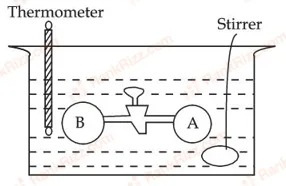
Two vessels A and B are connected via stopcock. The vessel A is filled with a gas at a certain pressure. The entire assembly is immersed in water and is allowed to come to thermal equilibrium with water. After opening the stopcock the gas from vessel A expands into vessel B and no change in temperature is observed in the thermometer. Which of the following statement is true?
The pressure in the vessel B before opening the stopcock is zero.
Arrange the following in order of magnitude of work done by the system / on the system at constant temperature :
(a) for expansion in infinite stage.
(b) for expansion in single stage.
(c) for compression in infinite stage.
(d) for compression in single stage.
Choose the correct answer from the options given below :
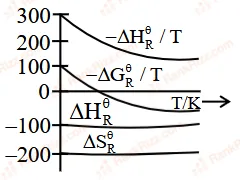
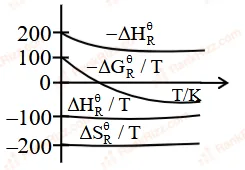
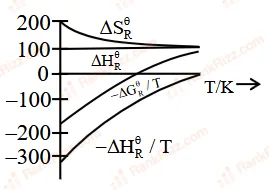
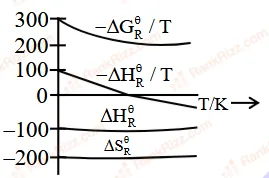
Which of the following graphs correctly represents the variation of thermodynamic properties of Haber's process ?


500J of energy is transferred as heat to 0.5 mol of Argon gas at 298 K and 1.00 atm. The final temperature and the change in internal energy respectively are: Given :
378 K and 500 J
368 K and 500 J
348 K and 300 J
378 K and 300 J
If at constant temperature. Then
X=-Y+Z
-X=Y+Z
X=Y+Z
X=Y-Z
JEE Advanced has set 40 Chemical Thermodynamics questions too. Chemical Thermodynamics JEE Advanced PYQs →
OTHER CHEMISTRY CHAPTERS