RankRizz

Chemical Thermodynamics — JEE Main Previous Year Questions

Every Chemical Thermodynamics question JEE Main has set from 2004–2026, grouped by the idea it tests rather than the order of the syllabus. 229 questions across 7 distinct ideas. Free to read, answer key on every one.

DATA UPDATED

Questions

229

Distinct ideas

7

Share of marks

4.6%

Difficulty

MEDIUM

The ideas inside Chemical Thermodynamics

A chapter is not one subject — it is a handful of procedures the examiner reuses. These are the ones Chemical Thermodynamics questions actually test.

Every Chemical Thermodynamics question

181–200 OF 229 · NEWEST FIRST

JEE MAIN 2018 · 15 APR S1First law: work, heat and internal energy

An ideal gas undergoes a cyclic process as shown in Figure.
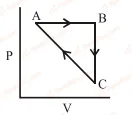
Figure for JEE Main 2018 Chemistry question on First law: work, heat and internal energy
ΔUBC=−5\Delta U_{BC} = -5 kJ mol−1^{-1}, qAB=2q_{AB} = 2 kJ mol−1^{-1}
WAB=−5W_{AB} = -5 kJ mol−1^{-1}, WCA=3W_{CA} = 3 kJ mol−1^{-1}
Heat absorbed by the system during process CA is:

  1. A

    -5 kJ mol−1^{-1}

  2. B

    +5 kJ mol−1^{-1}

  3. C

    18 kJ mol−1^{-1}

  4. D

    -18 kJ mol−1^{-1}

JEE MAIN 2018 · 15 APR S2Gibbs energy and spontaneity

ΔrG∘\Delta_r G^\circ at 500 K for substance 'S' in liquid state and gaseous state are +100.7 kcal mol−1^{-1} and +103 kcal mol−1^{-1}, respectively. Vapour pressure of liquid 'S' at 500 K is approximately equal to: (R = 2 cal K−1^{-1} mol−1^{-1})

  1. A

    100 atm

  2. B

    1 atm

  3. C

    10 atm

  4. D

    0.1 atm

JEE MAIN 2018 · 15 APR S2Gibbs energy and spontaneity

Given (i) 2Fe2_2O3_3(s) →\rightarrow 4Fe(s) + 3O2_2(g); ΔrG∘\Delta_r G^\circ = +1487.0 kJ mol−1^{-1}
(ii) 2CO(g) + O2_2(g) →\rightarrow 2CO2_2(g); ΔrG∘\Delta_r G^\circ = -514.4 kJ mol−1^{-1}
Free energy change, ΔrG∘\Delta_r G^\circ for the reaction 2Fe2_2O3_3(s) + 6CO(g) →\rightarrow 4Fe(s) + 6CO2_2(g) will be:

  1. A

    -112.4 kJ mol−1^{-1}

  2. B

    -56.2 kJ mol−1^{-1}

  3. C

    -208.0 kJ mol−1^{-1}

  4. D

    -168.2 kJ mol−1^{-1}

JEE MAIN 2018 · 08 APR OFFLINEFirst law: work, heat and internal energy

The combustion of benzene (l) gives CO2_2(g) and H2_2O(l). Given that heat of combustion of benzene at constant volume is −3263.9-3263.9 kJ mol−1^{-1} at 25∘^\circC; the heat of combustion (in kJ mol−1^{-1}) of benzene at constant pressure will be:
(R = 8.314 JK−1^{-1} mol−1^{-1})

  1. A

    -3267.6

  2. B

    4152.6

  3. C

    -452.46

  4. D

    3260

JEE MAIN 2017 · 09 APR ONLINEHeat capacity and calorimetry

An ideal gas undergoes isothermal expansion at constant pressure. During the process:

  1. A

    Enthalpy remains constant but entropy increases

  2. B

    Enthalpy decreases but entropy increases

  3. C

    Enthalpy increases but entropy decreases

  4. D

    Both enthalpy and entropy remain constant

JEE MAIN 2017 · 09 APR ONLINEFirst law: work, heat and internal energy

A gas undergoes change from state A to state B. In this process, the heat absorbed and work done by the gas is 5 J and 8 J, respectively. Now gas is brought back to A by another process during which 3 J of heat is evolved. In this reverse process of B to A.

  1. A

    6 J of the work will be done by the gas

  2. B

    6 J of the work will be done by the surroundings on gas

  3. C

    10 J of the work will be done by the surroundings on gas

  4. D

    10 J of the work will be done by the gas on gas

JEE MAIN 2017 · 08 APR ONLINEEnthalpies of reaction and Hess's law

The enthalpy change on freezing of 1 mol of water at 5°C to ice at −5-5°C is: (Given ΔfusH=6\Delta_{fus}H = 6 kJ mol−1^{-1} at 0°C, Cp(H2O,l)=75.3C_p(H_2O, l) = 75.3 J mol−1^{-1} K−1^{-1}, Cp(H2O,s)=36.8C_p(H_2O, s) = 36.8 J mol−1^{-1} K−1^{-1})

  1. A

    6.00 kJ mol−1^{-1}

  2. B

    5.81 kJ mol−1^{-1}

  3. C

    5.44 kJ mol−1^{-1}

  4. D

    6.56 kJ mol−1^{-1}

JEE MAIN 2017 · 08 APR ONLINEEnthalpies of reaction and Hess's law

For a reaction, A(g)→A(l)A(g) \to A(l); ΔH=−3RT\Delta H = -3RT. The correct statement for the reaction is:

  1. A

    ΔH=ΔU=0\Delta H = \Delta U = 0

  2. B

    ∣ΔH∣<∣ΔU∣|\Delta H| < |\Delta U|

  3. C

    ∣ΔH∣>∣ΔU∣|\Delta H| > |\Delta U|

  4. D

    ΔH=ΔU≠0\Delta H = \Delta U \neq 0

JEE MAIN 2017 · 02 APR OFFLINEEnthalpies of reaction and Hess's law

Given:
C(graphite) + O2_{2}(g) →\rightarrow CO2_{2}(g); Δr\Delta_{r}H° = -393.5 kJ mol−1^{-1}
H2_{2}(g) + 12\frac{1}{2}O2_{2}(g) →\rightarrow H2_{2}O(l); Δr\Delta_{r}H° = -285.8 kJ mol−1^{-1}
CO2_{2}(g) + 2H2_{2}O(l) →\rightarrow CH4_{4}(g) + 2O2_{2}(g); Δr\Delta_{r}H° = +890.3 kJ mol−1^{-1}
Based on the above thermochemical equations, the value of Δr\Delta_{r}H° at 298 K for the reaction
C(graphite) + 2H2_{2}(g) →\rightarrow CH4_{4}(g) will be:

  1. A

    +144.0 kJ mol−1^{-1}

  2. B

    -74.8 kJ mol−1^{-1}

  3. C

    -144.0 kJ mol−1^{-1}

  4. D

    +74.8 kJ mol−1^{-1}

JEE MAIN 2017 · 02 APR OFFLINEFirst law: work, heat and internal energy

ΔU\Delta U is equal to:

  1. A

    Isobaric work

  2. B

    Adiabatic work

  3. C

    Isothermal work

  4. D

    Isochoric work

JEE MAIN 2016 · 10 APR ONLINEFirst law: work, heat and internal energy

If 100 mole of H2O2H_2O_2 decompose at 1 bar and 300 K, the work is done (kJ) by one mole of O2(g)O_2(g) as it expands against 1 bar pressure is:
2H2O2(l)⇌2H2O(l)+O2(g)2H_2O_2(l) \rightleftharpoons 2H_2O(l) + O_2(g)
(R=8.3(R = 8.3 J K−1^{-1} mol−1)^{-1})

  1. A

    124.50

  2. B

    249.00

  3. C

    498.00

  4. D

    62.25

JEE MAIN 2016 · 09 APR ONLINEGibbs energy and spontaneity

For the reaction,
A(g)+B(g)→C(g)+D(g)A(g) + B(g) \to C(g) + D(g), ΔH°\Delta H° and ΔS°\Delta S° are, respectively, −29.8-29.8 kJ mol−1^{-1} and −0.100-0.100 kJ K−1^{-1} mol−1^{-1} at 298 K. The equilibrium constant for the reaction at 298 K is:

  1. A

    1.0×10−101.0 \times 10^{-10}

  2. B

    10

  3. C

    1

  4. D

    1.0×10101.0 \times 10^{10}

JEE MAIN 2016 · 09 APR ONLINEGibbs energy and spontaneity

A reaction at 1 bar is non-spontaneous at low temperature but becomes spontaneous at high temperature. Identify the correct statement about the reaction among the following:

  1. A

    ΔH\Delta H is negative while ΔS\Delta S is positive

  2. B

    Both ΔH\Delta H and ΔS\Delta S are negative

  3. C

    ΔH\Delta H is positive while ΔS\Delta S is negative

  4. D

    Both ΔH\Delta H and ΔS\Delta S are positive

JEE MAIN 2016 · 09 APR ONLINEGibbs energy and spontaneity

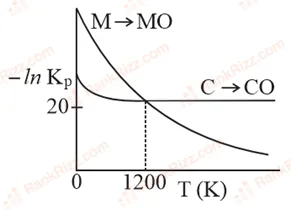
The plot shows the variation of −ln⁡KP-\ln K_P versus temperature for the two reactions.
M(s)+12O2(g)→MO(s)M(s) + \frac{1}{2}O_2(g) \to MO(s) and
C(s)+12O2(g)→CO(s)C(s) + \frac{1}{2}O_2(g) \to CO(s)

Figure for JEE Main 2016 Chemistry question on Gibbs energy and spontaneity


Identify the correct statement:

  1. A

    At T < 1200 K, oxidation of carbon is unfavourable

  2. B

    Oxidation of carbon is favourable at all temperatures

  3. C

    At T < 1200 K, the reaction MO(s)+C(s)→M(s)+CO(g)MO(s) + C(s) \to M(s) + CO(g) is spontaneous

  4. D

    At T > 1200 K, carbon will reduce MO(s)MO_{(s)} to M(s)M_{(s)}.

JEE MAIN 2016 · 03 APR OFFLINEEnthalpies of reaction and Hess's law

The heats of combustion of carbon and carbon monoxide are −393.5-393.5 and −283.5-283.5 kJ mol−1^{-1}, respectively. The heat of formation (in kJ) of carbon monoxide per mole is:

  1. A

    −676.5-676.5

  2. B

    −110-110

  3. C

    110.5

  4. D

    676.5

JEE MAIN 2015 · 10 APR ONLINEBond enthalpy, atomisation, phase-change and solution enthalpies

The heat of atomization of methane and ethane are 360 kJ mol−1^{-1} and 620 kJ mol−1^{-1}, respectively. The longest wavelength of light capable of breaking the C - C bond is (Avogadro's number = 6.023×10236.023 \times 10^{23}, h = 6.62×10−346.62 \times 10^{-34} J s)

  1. A

    2.48×1042.48 \times 10^4 nm

  2. B

    1.49×1041.49 \times 10^4 nm

  3. C

    2.48×1032.48 \times 10^3 nm

  4. D

    1.49×1031.49 \times 10^3 nm

JEE MAIN 2015 · 04 APR OFFLINEGibbs energy and spontaneity

The following reaction is performed at 298 K.
2NO(g)+O2(g)⇌2NO2(g)2NO(g) + O_2(g) \rightleftharpoons 2NO_2(g)
The standard free energy of the formation of NO(g)NO(g) is 86.6 kJ mol−1^{-1} at 298 K. What is the standard free energy of the formation of NO2(g)NO_2(g) at 298 K? (KP=1.6×10¹²)(K_P = 1.6 \times 10^{12})

  1. A

    0.5[2×86,600−R(298)ln⁡(1.6×10¹²)]0.5[2 \times 86,600 - R(298)\ln(1.6 \times 10^{12})]

  2. B

    R(298)ln⁡(1.6×10¹²)−86,600R(298)\ln(1.6 \times 10^{12}) - 86,600

  3. C

    86,600+R(298)ln⁡(1.6×10¹²)86,600 + R(298)\ln(1.6 \times 10^{12})

  4. D

    86,600−ln⁡(1.6×10¹²)R(298)86,600 - \frac{\ln(1.6 \times 10^{12})}{R(298)}

JEE MAIN 2014 · 12 APR ONLINEGibbs energy and spontaneity

The (S°) of the following substances are: CH4_4(g) 186.2 JK−1^{-1} mol−1^{-1}, O2_2(g) 205.2 JK−1^{-1} mol−1^{-1}, CO2_2(g) 213.6 JK−1^{-1} mol−1^{-1}, H2_2O(g) 69.9 JK−1^{-1} mol−1^{-1}. The entropy change (ΔS∘\Delta S^\circ) for the reaction CH4_4(g) + 2O2_2(g) →\rightarrow CO2_2(g) + 2H2_2O(l) is:

  1. A

    −312.5-312.5 J K−1^{-1} mol−1^{-1}

  2. B

    −242.8-242.8 JK−1^{-1} mol−1^{-1}

  3. C

    −108.1-108.1 JK−1^{-1} mol−1^{-1}

  4. D

    −37.6-37.6 J K−1^{-1} mol−1^{-1}

JEE MAIN 2014 · 12 APR ONLINEEnthalpies of reaction and Hess's law

The standard enthalpy of formation (ΔfH298∘\Delta_fH^\circ_{298}) for methane, CH4_4 is −74.9-74.9 kJ mol−1^{-1}. In order to calculate the average energy given out in the formation of a C-H bond from this it is necessary to know which one of the following?

  1. A

    The dissociation energy of the hydrogen molecule, H2_2.

  2. B

    The first four ionisation energies of carbon.

  3. C

    The dissociation energy of H2_2 and enthalpy and sublimation of carbon (graphite).

  4. D

    The first four ionisation energies of carbon and electron affinity of hydrogen.

JEE MAIN 2014 · 11 APR ONLINEGibbs energy and spontaneity

The molar heat capacity (Cp_p) of CD2_2O is 10 cals at 1000 K. The change of entropy associated with cooling of 32 g of CD2_2O vapour from 1000 K to 100 K at constant pressure will be: (D = deuterium, atomic mass = 2u)

  1. A

    23.03 cal deg−1^{-1}

  2. B

    −23.03-23.03 cal deg−1^{-1}

  3. C

    2.303 cal deg−1^{-1}

  4. D

    −2.303-2.303 cal deg−1^{-1}