RankRizz

Chemical Thermodynamics — JEE Advanced Previous Year Questions

Chemical Thermodynamics has been asked in 19 of the 20 JEE Advanced years from 2007 to 2026: 40 questions in all. In 2026 it averaged 1.0 questions per paper (2 across 2 papers), 5.9% of Chemistry questions, up from 3.1% in 2025. Across the last 20 papers it carried 5.7% of Chemistry questions. By type: 15 single-correct, 12 numerical, 12 multiple-correct and 1 match-the-list. Of the 40 with a difficulty tag, 40% are easy, 45% medium and 15% hard. Most asked: First law: work, heat and internal energy (13, 33%), Gibbs energy and spontaneity (12, 30%) and Enthalpies of reaction and Hess's law (9, 23%).

DATA UPDATED

Questions

40

Distinct ideas

6

Share of marks

5.7%

Difficulty

EASY

Chemical Thermodynamics weightage, year by year

The share of each year’s Chemistry questions that came from Chemical Thermodynamics, counted from the 19 papers we hold for the last 10 years, and paper by paper inside a year.

Falling: 4.0% of Chemistry questions in 2024–2026, down from 6.8% in 2017–2023. Its heaviest year was 2021, at 10.5%.

Chemical Thermodynamics questions per year, per paper, and as a share of Chemistry questions
YEARQSPER PAPERSHARE OF CHEMISTRYCHANGE
20262 / 341.05.9%+2.8 pts
20251 / 320.53.1%+0.2 pts
20241 / 340.52.9%−5.9 pts
20233 / 341.58.8%+3.2 pts
20222 / 361.05.6%−4.9 pts
20214 / 382.010.5%+4.9 pts
20202 / 361.05.6%+2.8 pts
20191 / 360.52.8%−2.8 pts
20181 / 181.05.6%−2.7 pts
20173 / 361.58.3%—

“QS” is Chemical Thermodynamics questions out of all Chemistry questions that year; “per paper” is that count over the year’s papers, and “change” is the share against the year before. A year with more sittings asks more questions, which is why the share, not the count, is the number to compare.

The ideas inside Chemical Thermodynamics

A chapter is not one subject — it is a handful of procedures the examiner reuses. These are the ones Chemical Thermodynamics questions actually test.

01System, surroundings and state functionsset 3×
02First law: work, heat and internal energyset 13×
03Heat capacity and calorimetryset 1×
04Enthalpies of reaction and Hess's lawset 9×
05Bond enthalpy, atomisation, phase-change and solution enthalpiesNot set in Advanced
06Entropy and the second lawset 2×
07Gibbs energy and spontaneityset 12×

All 40 Chemical Thermodynamics questions, by topic

Every JEE Advanced Chemical Thermodynamics question we hold, newest first inside each topic. Open one for its options, answer key and solution.

First law: work, heat and internal energy13 QUESTIONS

  1. An ideal gas (0.5 mol), initially at 2 bar pressure, is compressed at a constant temperature of 600 K in two steps: first, against a…2026 · PAPER 1
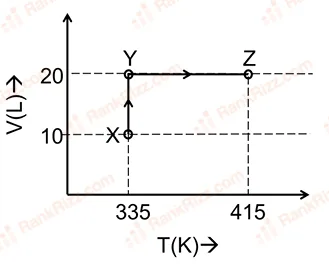
  2. Consider the following volume-temperature (V-T) diagram for the expansion of 5 moles of an ideal monoatomic gas. Considering only P-V work…2024 · PAPER 1
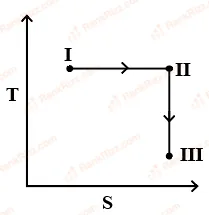
  3. An ideal gas undergoes a reversible isothermal expansion from state I to state II followed by a reversible adiabatic expansion from state…2021 · PAPER 1
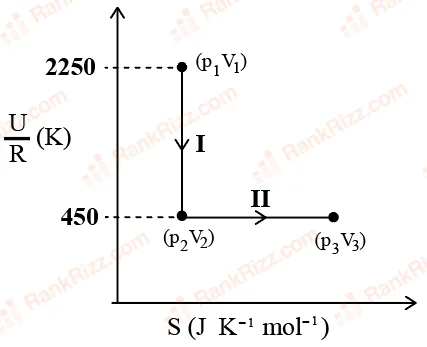
  4. One mole of an ideal gas at 900 K, undergoes two reversible processes, I followed by II, as shown below. If the work done by the gas in the…2021 · PAPER 2
  5. In thermodynamics, the 𝑃 − 𝑉 work done is given by w = - ∫ dV P_(ext). For a system undergoing a particular process, the work done is, w…2020 · PAPER 1
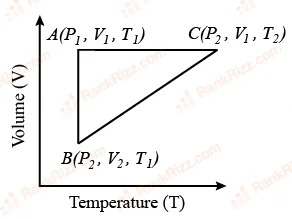
  6. A reversible cyclic process for an ideal gas is shown below. Here, P, V, and T are pressure, volume and temperature, respectively. The…2018 · PAPER 1
  7. An ideal gas is expanded from (p₁, V₁, T₁) to (p₂, V₂, T₂) under different conditions. The correct statement(s) among the following is(are)2017 · PAPER 1
  8. An ideal gas in a thermally insulated vessel at internal pressure = P₁, volume = V₁ and absolute temperature = T₁ expands irreversibly…2014 · PAPER 1
  9. The succeeding operations that enable this transformation of states are2013 · PAPER 2
  10. The reversible expansion of an ideal gas under adiabatic and isothermal conditions is shown in the figure. Which of the following…2012 · PAPER 2
  11. The species which by definition has ZERO standard molar enthalpy of formation at 298 K is2010 · PAPER 1
  12. One mole of an ideal gas is taken from a to b along two paths denoted bythe solid and the dashed lines as shownin the graph below. If the…2010 · PAPER 2
  13. For the process H₂O(l) (1 bar, 373 K) → H₂O(g)(1 bar, 373 K), the correct set of thermodynamic parameters is2007 · PAPER 2

Gibbs energy and spontaneity12 QUESTIONS

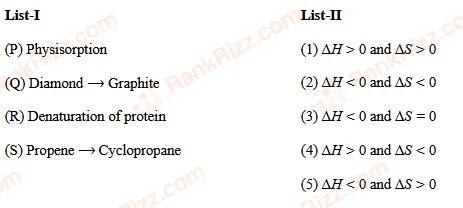
  1. List-I contains various physical/chemical processes, and List-II contains combinations of changes in enthalpy (Δ H) and entropy (Δ S)…2026 · PAPER 1
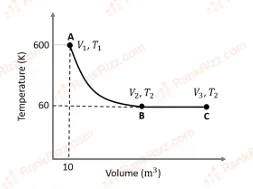
  2. One mole of an ideal monoatomic gas undergoes two reversible processes (A → B and B → C) as shown in the given figure: A → B is an…2023 · PAPER 1
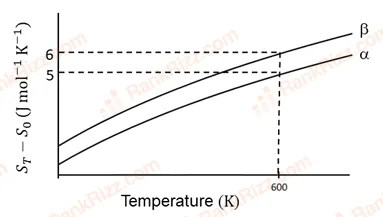
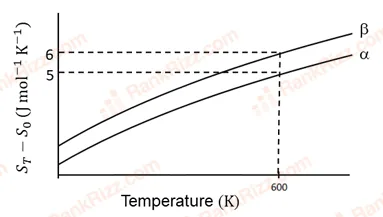
  3. The value of entropy change, S_β - S_α (in J mol⁻¹ K⁻¹), at 300 K is ____. [Use: ln 2 = 0.69] [Given: S_β - S_α = 0 at 0 K]2023 · PAPER 2
  4. The correct option(s) about entropy (S) is(are) [R = gas constant, F = Faraday constant, T = Temperature]2022 · PAPER 2
  5. The value of S (in JK⁻¹ mol⁻¹) for the given reaction, at 1000 K is ___.2021 · PAPER 1
  6. Tin is obtained from cassiterite by reduction with coke. Use the data given below to determine the minimum temperature (in K) at which the…2020 · PAPER 2
  7. The standard state Gibbs free energies of formation of C(graphite) and C(diamond) at T = 298 K are _(f)G⁰[C(graphite)]=0 kJ mol⁻¹…2017 · PAPER 2
  8. For a reaction taking place in a container in equilibrium with its surroundings, the effect of temperature on its equilibrium constant K in…2017 · PAPER 2
  9. One mole of an ideal gas at 300 K in thermal contact with surroundings expands isothermally from 1.0 L to 2.0 L against a constant pressure…2016 · PAPER 1
  10. For the process H₂O (l) → H₂O (g) at T = 100° C and 1 atmosphere pressure, the correct choice is2014 · PAPER 2
  11. Benzene and naphthalene form an ideal solution at room temperature. For this process, the true statement(s) is(are)2013 · PAPER 1
  12. The value of log ₁₀ K for a reaction A ⇌ B is (Given: _rH_(298K)° = -54.07 kJ mol⁻¹, _rS_(298K)° = 10 JK⁻¹ mol⁻¹ and R = 8.314 JK⁻¹ mol⁻¹…2007 · PAPER 1

FREE PDF

Chemical Thermodynamics JEE Advanced PYQs with answer key

All 40 questions on A4, by topic, with the answer key at the end. No sign-up, no email: your browser saves it as a PDF.

Download free PDF

UNIQUE CONCEPTS

Chemical Thermodynamics: one question per idea

7 ideas, each with the latest past question that tested it, drawn from 269 JEE Main and Advanced questions.

Chemical Thermodynamics Unique Concepts sheet →

JEE MAIN

Chemical Thermodynamics in JEE Main

JEE Main has set 229 Chemical Thermodynamics questions, 2004–2026.

Chemical Thermodynamics JEE Main PYQs →

Chemical Thermodynamics: quick answers

Is Chemical Thermodynamics asked every year in JEE Advanced?

Not every year. It has been asked in 19 of the 20 JEE Advanced years from 2007 to 2026; the year without a Chemical Thermodynamics question was 2015.

Which Chemical Thermodynamics topic is asked most in JEE Advanced?

First law: work, heat and internal energy: 13 of the 40 questions (33%). Next come Gibbs energy and spontaneity (12) and Enthalpies of reaction and Hess's law (9).

What share of Chemistry questions does Chemical Thermodynamics carry in JEE Advanced?

About 5.7% of Chemistry questions across the last 20 papers. In 2026 it was 5.9% (2 of 34 Chemistry questions).

When was Chemical Thermodynamics last asked in JEE Advanced?

In JEE Advanced 2026 Paper 1, the latest sitting with a Chemical Thermodynamics question.

How many Chemical Thermodynamics questions has JEE Advanced asked?

40 from 2007 to 2026, across 6 topics. Every one is listed on this page by topic and links to its own page, with the answer key and solution wherever we have them. Free, no sign-up.

Every Chemical Thermodynamics question

1–20 OF 40 · NEWEST FIRST

JEE ADVANCED 2026 · PAPER 1First law: work, heat and internal energy

An ideal gas (0.5 mol)(0.5\ \mathrm{mol}), initially at 22 bar pressure, is compressed at a constant temperature of 600 K600\ \mathrm{K} in two steps: first, against a constant external pressure of PP bar (2<P<8)(2 \lt P \lt 8), and then against constant external pressure of 88 bar. At each step, the compression is stopped only when the pressure of the gas becomes equal to the external pressure. The total work done on the gas in these steps is WW. Considering all possible values of PP (2<P<8)(2 \lt P \lt 8) and taking the gas constant as RR (in J K−1 mol−1\mathrm{J\ K^{-1}\ mol^{-1}}), the minimum value of ∣W∣|W| (in J\mathrm{J}) is

  1. A

    207R207R

  2. B

    600R600R

  3. C

    630R630R

  4. D

    900R900R

JEE ADVANCED 2026 · PAPER 1Gibbs energy and spontaneity

List-I contains various physical/chemical processes, and List-II contains combinations of changes in enthalpy (ΔH)(\Delta H) and entropy (ΔS)(\Delta S). Match each entry in List-I to the appropriate entry in List-II, and choose the correct option.

Figure for JEE Advanced 2026 Chemistry question on Gibbs energy and spontaneity
  1. A

    (P)→\to(2), (Q)→\to(3), (R)→\to(5), (S)→\to(4)

  2. B

    (P)→\to(4), (Q)→\to(3), (R)→\to(5), (S)→\to(1)

  3. C

    (P)→\to(2), (Q)→\to(5), (R)→\to(1), (S)→\to(4)

  4. D

    (P)→\to(2), (Q)→\to(5), (R)→\to(1), (S)→\to(3)

JEE ADVANCED 2025 · PAPER 1Heat capacity and calorimetry

Considering ideal gas behavior, the expansion work done (in kJ) when 144 g of water is electrolyzed completely under constant pressure at 300 K is ________.

Use: Universal gas constant (R) = 8.3 J K−1^{-1} mol−1^{-1}; Atomic mass (in amu): H = 1, O = 16

JEE ADVANCED 2024 · PAPER 1First law: work, heat and internal energy

Consider the following volume-temperature (V-T) diagram for the expansion of 5 moles of an ideal monoatomic gas.

Figure for JEE Advanced 2024 Chemistry question on First law: work, heat and internal energy

Considering only P-V work is involved, the total change in enthalpy (in Joule) for the transformation of state in the sequence X→Y→ZX \rightarrow Y \rightarrow Z is ______.

[Use the given data: Molar heat capacity of the gas for the given temperature range, CV,m=12C_{V,m} = 12 J K−1K^{-1} mol−1mol^{-1} and gas constant, R=8.3R = 8.3 J K−1K^{-1} mol−1mol^{-1}]

JEE ADVANCED 2023 · PAPER 1Gibbs energy and spontaneity

One mole of an ideal monoatomic gas undergoes two reversible processes (A →\to B and B →\to C) as shown in the given figure:

Figure for JEE Advanced 2023 Chemistry question on Gibbs energy and spontaneity

A →\to B is an adiabatic process. If the total heat absorbed in the entire process (A →\to B and B →\to C) is RT2ln⁡10RT_2 \ln 10, the value of 2log⁡V32 \log V_3 is ________.

[Use, molar heat capacity of the gas at constant pressure, Cp,m=52RC_{p,m} = \frac{5}{2}R]

JEE ADVANCED 2023 · PAPER 2Gibbs energy and spontaneity

The value of entropy change, Sβ−SαS_\beta - S_\alpha (in J mol−1^{-1} K−1^{-1}), at 300 K is ____.

[Use: ln 2 = 0.69]

[Given: Sβ−Sα=0S_\beta - S_\alpha = 0 at 0 K]

Figure for JEE Advanced 2023 Chemistry question on Gibbs energy and spontaneity
JEE ADVANCED 2023 · PAPER 2Enthalpies of reaction and Hess's law

The value of enthalpy change, Hβ−HαH_\beta - H_\alpha (in J mol−1^{-1}), at 300 K is ____.

Figure for JEE Advanced 2023 Chemistry question on Enthalpies of reaction and Hess's law
JEE ADVANCED 2022 · PAPER 1Enthalpies of reaction and Hess's law

2 mol of Hg(g) is combusted in a fixed volume bomb calorimeter with excess of O2O_2 at 298 K and 1 atm into HgO(s). During the reaction, temperature increases from 298.0 K to 312.8 K. If heat capacity of the bomb calorimeter and enthalpy of formation of Hg(g) are 20.00 kJ K−1^{-1} and 61.32 kJ mol−1^{-1} at 298 K, respectively, the calculated standard molar enthalpy of formation of HgO(s) at 298 K is X kJ mol−1^{-1}. The value of |X| is ______.

[Given : Gas constant R = 8.3 J K−1^{-1} mol−1^{-1}]

JEE ADVANCED 2022 · PAPER 2Gibbs energy and spontaneity

The correct option(s) about entropy (S) is(are)

[R = gas constant, F = Faraday constant, T = Temperature]

  1. A

    For the reaction, M(s) + 2H+^+(aq) →\to H2_2(g) + M2+^{2+}(aq), if dEcelldT=RF\dfrac{dE_{cell}}{dT} = \dfrac{R}{F}, then the entropy change of the reaction is R (assume that entropy and internal energy changes are temperature independent).

  2. B

    The cell reaction, Pt(s) | H2_2(g, 1bar) | H+^+(aq, 0.01M) || H+^+(aq, 0.1M) | H2_2(g, 1bar) | Pt(s), is an entropy driven process.

  3. C

    For racemization of an optically active compound, Δ\DeltaS > 0.

  4. D

    Δ\DeltaS > 0, for [Ni(H2_2O)6_6]2+^{2+} + 3 en →\to [Ni(en)3_3]2+^{2+} + 6H2_2O (where en = ethylenediamine).

JEE ADVANCED 2021 · PAPER 1Enthalpies of reaction and Hess's law

The value of standard enthalpy, △H⊖\triangle H^{\ominus} (in kJ mol−1^{-1}) for the given reaction is ___.

JEE ADVANCED 2021 · PAPER 1Gibbs energy and spontaneity

The value of △S⊖\triangle S^{\ominus} (in JK−1^{-1} mol−1^{-1}) for the given reaction, at 1000 K is ___.

JEE ADVANCED 2021 · PAPER 1First law: work, heat and internal energy

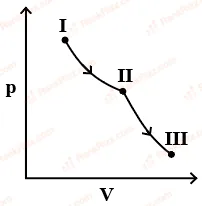
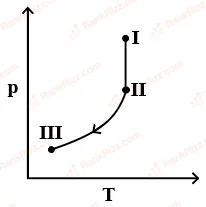
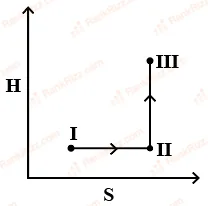
An ideal gas undergoes a reversible isothermal expansion from state I to state II followed by a reversible adiabatic expansion from state II to state III. The correct plot(s) representing the changes from state I to state III is(are)
(p: pressure, V: volume, T: temperature, H: enthalpy, S: entropy)

  1. A
    Figure for JEE Advanced 2021 Chemistry question on First law: work, heat and internal energy
  2. B
    Figure for JEE Advanced 2021 Chemistry question on First law: work, heat and internal energy
  3. C
    Figure for JEE Advanced 2021 Chemistry question on First law: work, heat and internal energy
  4. D
    Figure for JEE Advanced 2021 Chemistry question on First law: work, heat and internal energy
JEE ADVANCED 2021 · PAPER 2First law: work, heat and internal energy
Figure for JEE Advanced 2021 Chemistry question on First law: work, heat and internal energy

One mole of an ideal gas at 900 K, undergoes two reversible processes, I followed by II, as shown below. If the work done by the gas in the two processes are same, the value of ln⁡V3V2\ln \frac{V_3}{V_2} is ___.

(U: internal energy, S: entropy, p: pressure, V: volume, R: gas constant)
(Given: molar heat capacity at constant volume, 𝐶𝑉,𝑚𝐶_{𝑉,𝑚} of the gas is 52R\frac{5}{2}R)

JEE ADVANCED 2020 · PAPER 1First law: work, heat and internal energy

In thermodynamics, the 𝑃 − 𝑉 work done is given by
w=−∫dVPextw = - \int_{}^{} dV P_{ext}.
For a system undergoing a particular process, the work done is,
w=−∫dV(𝑅𝑇V−b−aV2)w = − \int_{}^{} dV \left(\frac{𝑅𝑇}{V - b} - \frac{a}{V^{2}}\right)
This equation is applicable to a

  1. A

    system that satisfies the van der Waals equation of state.

  2. B

    process that is reversible and isothermal.

  3. C

    process that is reversible and adiabatic.

  4. D

    process that is irreversible and at constant pressure

JEE ADVANCED 2020 · PAPER 2Gibbs energy and spontaneity

Tin is obtained from cassiterite by reduction with coke. Use the data given below to determine the minimum temperature (in K) at which the reduction of cassiterite by coke would take place.
At 298K:△fH0(SnO2(s))=−581.0298 K: \triangle_fH^0(SnO_2(s)) = -581.0 KJ mol−1^{−1}, △fH0(CO2(g))=−394.0\triangle_fH^0 (CO_2(g)) = -394.0 KJ mol−1^{−1}, S0(SnO2(s))=56.0JK−1mol−1S^0(SnO_2(s)) = 56.0 J K^{-1} mol^{-1}, S0(Sn(s))=52.0JK−1mol−1S^0(Sn(s)) = 52.0 J K^{-1} mol^{-1} , S0(C(s))=6.0JK−1mol−1S^0(C(s)) = 6.0 J K^{-1} mol^{-1}, S0(CO2(g))=210.0JK−1mol−1S^0(CO_2(g)) = 210.0 J K^{-1} mol^{-1}.
Assume that the enthalpies and the entropies are temperature independent.

JEE ADVANCED 2019 · PAPER 1Enthalpies of reaction and Hess's law

Choose the reaction(s) from the following options, for which the standard enthalpy of reaction is equal to the standard enthalpy of formation.

  1. A

    2H2(g)+O2(g)→2H2O(l)2H_2(g) + O_2(g) \rightarrow 2H_2O (l)

  2. B

    2C(g)+3H2(g)→C2H6(g)2C(g) + 3H_2(g) \rightarrow C_2H_6(g)

  3. C

    32O2(g)→O3(g)\frac{3}{2} O_2(g) \rightarrow O_3(g)

  4. D

    18S8(s)+O2(g)→SO2(g)\frac{1}{8}S_8(s) + O_2 (g) \rightarrow SO_2(g)

JEE ADVANCED 2018 · PAPER 1First law: work, heat and internal energy

A reversible cyclic process for an ideal gas is shown below. Here, P, V, and T are pressure, volume and temperature, respectively. The thermodynamic parameters q, w, H and U are heat, work, enthalpy and internal energy, respectively.

Figure for JEE Advanced 2018 Chemistry question on First law: work, heat and internal energy


The correct options(s) is (are)

  1. A

    qAC=△UBCq_{AC}=\triangle U_{BC} and WAB=P2(V2−V1)W_{AB}=P_{2}(V_{2}-V_{1})

  2. B

    WBC=P2(V2−V1)W_{BC}=P_{2}(V_{2}-V_{1}) and qBC=△HACq_{BC}=\triangle_{H_{AC}}

  3. C

    △HCA<△UCA\triangle H_{CA}<\triangle U_{CA} and QAC=△UBCQ_{AC}=\triangle U_{BC}

  4. D

    △qBC=△HAC\triangle q_{BC}=\triangle H_{AC} and △HCA>△UCA\triangle H_{CA}>\triangle U_{CA}

JEE ADVANCED 2017 · PAPER 1First law: work, heat and internal energy

An ideal gas is expanded from (p1,V1,T1)(p_1, V_1, T_1) to (p2,V2,T2)(p_2, V_2, T_2) under different conditions. The correct statement(s) among the following is(are)

  1. A

    The work done on the gas is maximum when it is compressed irreversibly from (p2,V2)(p_2, V_2) to (p1,V1)(p_1, V_1) against constant pressure p1p_1

  2. B

    If the expansion is carried out freely, it is simultaneously both isothermal as well as adiabatic

  3. C

    The work done by the gas is less when it is expanded reversibly from V1V_1 to V2V_2 under adiabatic conditions as compared to that when expanded reversibly from V1V_1 to V2V_2 under isothermal conditions

  4. D

    The change in internal energy of the gas is (i) zero, if it is expanded reversibly with T1=T2T_1 = T_2, and (ii) positive, if it is expanded reversibly under adiabatic conditions with T1≠T2T_1 \neq T_2

JEE ADVANCED 2017 · PAPER 2Gibbs energy and spontaneity

The standard state Gibbs free energies of formation of C(graphite) and C(diamond) at T = 298 K are
△fG0[C(graphite)]=0kJ mol−1\triangle_{f}G^{0}[C(graphite)]=0 kJ\ mol^{-1}
△fG0[C(diamond)]=2.9kJ mol−1\triangle_{f}G^{0}[C(diamond)]=2.9 kJ\ mol^{-1}
The standard state means that the pressure should be 1 bar, and substance should be pure at a given temperature. The conversion of graphite [C(graphite)] to diamond [C(diamond)] reduces its volume by 2×10⁻⁶m3mol−12\times10^{-6}m^{3}mol^{-1} If C(graphite) is converted to C(diamond) isothermally at T = 298 K, the pressure at which C(graphite) is in equilibrium with
[Useful information: 1 J = 1 kg m2s−2m^{2}s^{-2};1 Pa=1kg m−1s−2m^{-1}s^{-2}; 1bar=105Pa1 bar = 10^{5} Pa] C(diamond), is

  1. A

    14501 bar

  2. B

    58001 bar

  3. C

    1450 bar

  4. D

    29001 bar

JEE ADVANCED 2017 · PAPER 2Gibbs energy and spontaneity

For a reaction taking place in a container in equilibrium with its surroundings, the effect of temperature on its equilibrium constant K in terms of change in entropy is described by

  1. A

    With increase in temperature, the value of K for exothermic reaction decreases because the entropy change of the system is positive

  2. B

    With increase in temperature, the value of K for endothermic reaction increases because unfavourable change in entropy of the surroundings decreases

  3. C

    With increase in temperature, the value of K for endothermic reaction increases because the entropy change of the system is negative

  4. D

    With increase in temperature, the value of K for exothermic reaction decreases because favourable change in entropy of the surroundings decreases