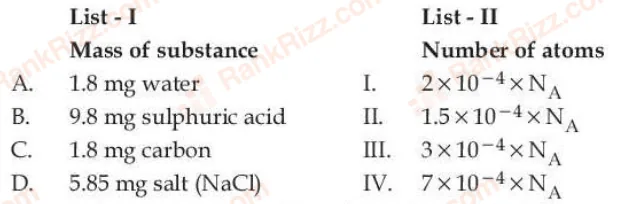
Match List - I with List - II.
Choose the correct answer from the options given below :
- A
A-IV, B-III, C-I, D-II
- B
A-III, B-II, C-IV, D-I
- C
A-III, B-IV, C-II, D-I
- D
A-III, B-IV, C-I, D-II
Some Basic Concepts of Chemistry has been asked in 20 of the 23 JEE Main years from 2004 to 2026: 252 questions in all. In 2026 it averaged 1.1 questions per paper (20 across 19 papers), 4.2% of Chemistry questions, down from 5.9% in 2025. Across the last 20 papers it carried 4.4% of Chemistry marks. By type: 129 MCQs and 123 numerical-answer questions. Of the 232 with a difficulty tag, 69% are easy, 30% medium and 1% hard. Most asked: Concentration terms and their interconversion (88, 35%), Mole concept, atomic and molar mass (74, 29%) and Stoichiometry, limiting reagent and percentage yield (71, 28%).
DATA UPDATED
Questions
252
Distinct ideas
5
Share of marks
4.4%
Difficulty
EASY
The share of each year’s Chemistry questions that came from Some Basic Concepts of Chemistry, counted from the 168 papers we hold for the last 10 years, and session by session inside a year.
Rising: 5.0% of Chemistry questions in 2024–2026, up from 4.3% in 2017–2023. Its heaviest year was 2025, at 5.9%.
| YEAR | QS | PER PAPER | SHARE OF CHEMISTRY | CHANGE | |
|---|---|---|---|---|---|
| 2026 | 20 / 480 | 1.1 | 4.2% | −1.7 pts | JAN 3.6%APR 4.8% |
| 2025 | 28 / 475 | 1.5 | 5.9% | +1.1 pts | JAN 4.8%APR 7.1% |
| 2024 | 29 / 600 | 1.4 | 4.8% | +0.1 pts | JAN 5.0%APR 4.7% |
| 2023 | 35 / 750 | 1.4 | 4.7% | −0.3 pts | JAN 5.1%APR 4.2% |
| 2022 | 33 / 660 | 1.5 | 5.0% | +1.1 pts | JUN 4.4%JUL 5.7% |
| 2021 | 28 / 720 | 1.2 | 3.9% | −0.9 pts | FEB 3.3%MAR 4.7%JUL 4.3%AUG 3.3% |
| 2020 | 19 / 400 | 1.2 | 4.8% | +1.5 pts | JAN 6.0%SEP 4.0% |
| 2019 | 16 / 480 | 1.0 | 3.3% | level | JAN 2.9%APR 3.8% |
| 2018 | 4 / 120 | 1.0 | 3.3% | −1.1 pts | 4 PAPERS, ONE SESSION |
| 2017 | 4 / 90 | 1.3 | 4.4% | — | 3 PAPERS, ONE SESSION |
“QS” is Some Basic Concepts of Chemistry questions out of all Chemistry questions that year; “per paper” is that count over the year’s papers, and “change” is the share against the year before. A year with more sittings asks more questions, which is why the share, not the count, is the number to compare.
How Some Basic Concepts of Chemistry compares: every Chemistry chapter by weightage · most repeated JEE Main topics
A chapter is not one subject — it is a handful of procedures the examiner reuses. These are the ones Some Basic Concepts of Chemistry questions actually test.
Every JEE Main Some Basic Concepts of Chemistry question we hold, newest first inside each topic. Open one for its options, answer key and solution.
FREE PDF
All 252 questions on A4, by topic, with the answer key at the end. No sign-up, no email: your browser saves it as a PDF.
Download free PDFUNIQUE CONCEPTS
5 ideas, each with the latest past question that tested it, drawn from 265 JEE Main and Advanced questions.
Some Basic Concepts of Chemistry Unique Concepts sheet →JEE ADVANCED
JEE Advanced has set 15 Some Basic Concepts of Chemistry questions, 2009–2023.
Some Basic Concepts of Chemistry JEE Advanced PYQs →Not every year. It has been asked in 20 of the 23 JEE Main years from 2004 to 2026; the years without a Some Basic Concepts of Chemistry question were 2008, 2009 and 2010.
Concentration terms and their interconversion: 88 of the 252 questions (35%). Next come Mole concept, atomic and molar mass (74) and Stoichiometry, limiting reagent and percentage yield (71).
About 4.4% across the last 20 papers. Every JEE Main question carries the same marks, so that is also its share of Chemistry questions. In 2026 it was 4.2% (20 of 480 Chemistry questions).
In JEE Main 08 Apr 2026, Shift 2, the latest sitting with a Some Basic Concepts of Chemistry question.
252 from 2004 to 2026, across 5 topics. Every one is listed on this page by topic and links to its own page, with the answer key and solution wherever we have them. Free, no sign-up.
1–20 OF 252 · NEWEST FIRST
Match List - I with List - II.
Choose the correct answer from the options given below :
A-IV, B-III, C-I, D-II
A-III, B-II, C-IV, D-I
A-III, B-IV, C-II, D-I
A-III, B-IV, C-I, D-II
An oxide of iron contains 69.9% iron, its empirical formula, is:
(Given: Molar mass of Fe and O are 56 and 16 g mol respectively.)
FeO
FeO
FeO
FeO
Which of the following contain the same number of atoms?
(Given : Molar mass in g mol of H, He, O and S are 1, 4, 16 and 32 respectively)
A. 2 g of O gas
B. 4 g of SO gas
C. 1400 mL of O at STP
D. 0.05 L of He at STP
E. 0.0625 mol of H gas
Choose the correct answer from the options given below :
A and B only
B and C only
C and D only
A, C and E only
How many grams of residue is obtained by heating 2.76 g of silver carbonate? (Given: Molar mass of C, O and Ag are 12, 16 and 108 g mol respectively)
What is the mole fraction of water in 10% by weight (w/w) of aqueous urea solution? [Given: Molar mass of H, O, C and N are 1, 16, 12 and 14 g mol respectively.]
What volume of hydrogen gas at STP would be liberated by action of 50 mL of of 50% purity (density = 1.3 g mL) on 20 g of zinc?
Given : Molar mass of H, O, S, Zn are 1, 16, 32, 65 g mol respectively.
5.824 L
7.428 L
6.892 L
8.375 L
Number of moles and number of molecules in 1.4187 L of at STP respectively are :
The correct order of total number of atoms in: (A) 2 moles of cyclohexane, (B) 684 g of sucrose, (C) 90.8 L of dihydrogen at STP, is :
C > A > B
C > B > A
B > C > A
B > A > C
The mass of iron converted into FeO by the action of 18 g of steam is : (Given : Molar mass of H, O and Fe are 1, 16 and 56 g mol respectively) Assume iron is present in excess :
g
g
g
g
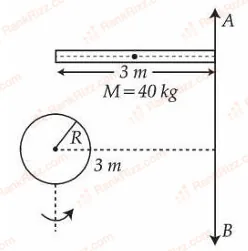
Moment of inertia about an axis for a rod of mass 40 kg and length 3 m is same as that of a solid sphere of mass 10 kg and radius about an axis parallel to axis with separation of 3 m as shown in figure. The value of is given as . The value of is _________.

The ratio of mass percentage (w/w) of C : H in a hydrocarbon is 12 : 1. It has two carbon atoms. The weight (in g) of CO(g) formed when 3.38 g of this hydrocarbon is completely burnt in oxygen is : (Given: Molar mass in g mol C : 12, H : 1, O : 16)
For the given reaction;
If 90 g is added to 300 mL of HCI which contains 38.55% HCI by mass and has density 1.13 g , then which of the following option is correct ?
Given molar mass of H, Cl, Ca and Oare 1, 35.5, 40 and 16 g respectively.
32.85 g of remains unreacted
64. 97 g of HCl remains unreacted
97.30 g of HCl reacted
60.32 g of HCl remains unreacted
0.25 g of an organic compound "A" containing carbon, hydrogen and oxygen was analysed using the combustion method. There was an increase in mass of tube and potash tube at the end of the experiment. The amount was found to be 0.15 g and 0.1837 g, respectively. The percentage of oxygen in compound A is __ %. (Nearest integer)
(Given: molar massing H : 1, C : 12, O : 16)
x mg of pure HCl was used to make an aqueous solution. 25.0 mL of 0.1 M solution is used when the HCl solution was titrated against it. The numerical value of x is ______. (nearest integer)
Given : Molar mass of HCl and are 36.5 and 171.0 g respectively.
In the reaction,
is consumed for every produced.
is produced regardless of temperatur and pressure for every mole of Al that reacts.
at STP is produced for every mole of Al that reacts.
at STP is produced for every mole of HCl consumed.
36.0 g of ' A' (Molar mass : 60 g ) and 56.0 g of 'B' (Molar mass: 80 g ) are allowed to react. Which of the following statements are correct?
A. 'A' is the limiting reagent.
B. 77.0 g of is formed.
C. Molar mass of mol^{-1}$$
D. 15.0 g of A is left unreacted after the completion of reaction.
Choose the correct answer from the options given below :
C and D Only
A and B Only
B and D Only
A and C Only
At T(K), 100 g of 98% (w /w) aqueous solution is mixed with 100 g of 49% (w /w) aqueous solution. What is the mole fraction of in the resultant solution?
(Given: Atomic mass H=1 u ; s=32 u ; 0 = 16 u).
(Assume that temperature after mixing remains constant)
0.9
0.1
0.663
0.337
80 mL of a hydrocarbon on mixing with 264 mL of oxygen in a closed U-tube undergoes complete combustion. The residual gases after cooling to 273 K occupy 224 mL. When the system is treated with KOH solution, the volume decreases to 64 ml. The formula of the hydrocarbon is:
14.0 g of calcium metal is allowed to react with excess HCI at 1.0 atm pressure and 273 K
Which of the following statements is incorrect?
[Given : Molar mass in g of Ca-40, Cl-35.5, H-1]
The limiting reagent is calcimn metal
7.84 L of gas is evolved.
0.35 mol of gas is evolved.
33.3 g of is produced.
Aqueous HCI reacts with to form , and . What is the weight (in g) of liberated when 8.7 g of is reacted with excess aqueous HCI solution ?
(Given Molar mass in g Mn = 55, Cl = 35.5, 0 = 16, H = l )
14.2
21.3
71
7.1
OTHER CHEMISTRY CHAPTERS