JEE MAIN 2026 · 08 APR S2Enthalpies of reaction and Hess's law
Consider the reaction
The magnitude of enthalpy change for the reaction in kJ mol is __________. (Nearest integer)
Given :
kJ mol
kJ mol
kJ mol
Chemical Thermodynamics has been asked in every one of the 23 JEE Main years from 2004 to 2026: 229 questions in all. In 2026 it averaged 1.2 questions per paper (22 across 19 papers), 4.6% of Chemistry questions, down from 6.5% in 2025. Across the last 20 papers it carried 4.6% of Chemistry marks. By type: 128 MCQs and 101 numerical-answer questions. Of the 203 with a difficulty tag, 49% are easy, 49% medium and 2% hard. Most asked: Enthalpies of reaction and Hess's law (75, 33%), First law: work, heat and internal energy (55, 24%) and Gibbs energy and spontaneity (54, 24%).
DATA UPDATED
Questions
229
Distinct ideas
7
Share of marks
4.6%
Difficulty
MEDIUM
The share of each year’s Chemistry questions that came from Chemical Thermodynamics, counted from the 168 papers we hold for the last 10 years, and session by session inside a year.
Rising: 4.8% of Chemistry questions in 2024–2026, up from 3.5% in 2017–2023. Its heaviest year was 2017, at 6.7%.
| YEAR | QS | PER PAPER | SHARE OF CHEMISTRY | CHANGE | |
|---|---|---|---|---|---|
| 2026 | 22 / 480 | 1.2 | 4.6% | −1.9 pts | JAN 4.0%APR 5.2% |
| 2025 | 31 / 475 | 1.6 | 6.5% | +2.8 pts | JAN 6.4%APR 6.7% |
| 2024 | 22 / 600 | 1.1 | 3.7% | +0.4 pts | JAN 3.3%APR 4.0% |
| 2023 | 25 / 750 | 1.0 | 3.3% | +0.1 pts | JAN 3.1%APR 3.6% |
| 2022 | 21 / 660 | 1.0 | 3.2% | +0.1 pts | JUN 3.1%JUL 3.3% |
| 2021 | 22 / 720 | 0.9 | 3.1% | +0.1 pts | FEB 3.3%MAR 2.0%JUL 3.3%AUG 3.3% |
| 2020 | 12 / 400 | 0.8 | 3.0% | −1.6 pts | JAN 4.0%SEP 2.4% |
| 2019 | 22 / 480 | 1.4 | 4.6% | −0.4 pts | JAN 5.4%APR 3.8% |
| 2018 | 6 / 120 | 1.5 | 5.0% | −1.7 pts | 4 PAPERS, ONE SESSION |
| 2017 | 6 / 90 | 2.0 | 6.7% | — | 3 PAPERS, ONE SESSION |
“QS” is Chemical Thermodynamics questions out of all Chemistry questions that year; “per paper” is that count over the year’s papers, and “change” is the share against the year before. A year with more sittings asks more questions, which is why the share, not the count, is the number to compare.
How Chemical Thermodynamics compares: every Chemistry chapter by weightage · most repeated JEE Main topics
A chapter is not one subject — it is a handful of procedures the examiner reuses. These are the ones Chemical Thermodynamics questions actually test.
Every JEE Main Chemical Thermodynamics question we hold, newest first inside each topic. Open one for its options, answer key and solution.
FREE PDF
All 229 questions on A4, by topic, with the answer key at the end. No sign-up, no email: your browser saves it as a PDF.
Download free PDFUNIQUE CONCEPTS
7 ideas, each with the latest past question that tested it, drawn from 269 JEE Main and Advanced questions.
Chemical Thermodynamics Unique Concepts sheet →JEE ADVANCED
JEE Advanced has set 40 Chemical Thermodynamics questions, 2007–2026.
Chemical Thermodynamics JEE Advanced PYQs →Yes. It has been asked in every one of the 23 JEE Main years from 2004 to 2026, 229 questions in all.
Enthalpies of reaction and Hess's law: 75 of the 229 questions (33%). Next come First law: work, heat and internal energy (55) and Gibbs energy and spontaneity (54).
About 4.6% across the last 20 papers. Every JEE Main question carries the same marks, so that is also its share of Chemistry questions. In 2026 it was 4.6% (22 of 480 Chemistry questions).
In JEE Main 08 Apr 2026, Shift 2, the latest sitting with a Chemical Thermodynamics question.
229 from 2004 to 2026, across 7 topics. Every one is listed on this page by topic and links to its own page, with the answer key and solution wherever we have them. Free, no sign-up.
1–20 OF 229 · NEWEST FIRST
Consider the reaction
The magnitude of enthalpy change for the reaction in kJ mol is __________. (Nearest integer)
Given :
kJ mol
kJ mol
kJ mol
Arrange the following isothermal processes in order of the magnitude of the work (p - V) involved between states 1 and 2.
A. Expansion in single stage
B. Expansion in multi stages
C. Compression in single stage
D. Compression in multi stages
Choose the correct option.
Consider the reaction X Y at 300 K. If and K are 28.40 kJ mol and at the same temperature, then the magnitude of for the reaction in J K mol is _______. (Nearest integer)
(Given: R = 8.3 J K mol, ln 10 = 2.3, log 3 = 0.48, log 2 = 0.30)
Match List - I with List - II.
Given and are initial and final volumes respectively.
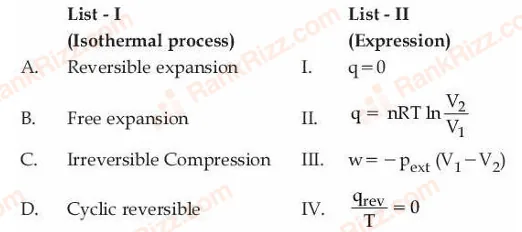
Choose the correct answer from the options given below :
A-II, B-III, C-I, D-IV
A-II, B-I, C-IV, D-III
A-II, B-I, C-III, D-IV
A-I, B-II, C-III, D-IV
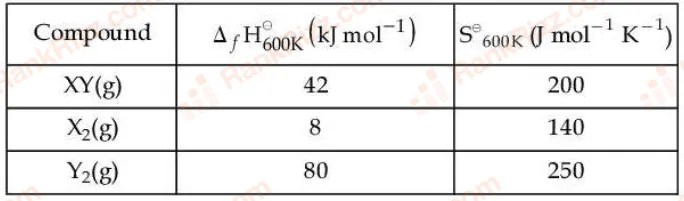
Consider the following data for the reaction
at 600 K. The (in ) for the reaction is :
The correct order of molar heat capacities measured at 298 K and 1 bar is :
Given below are two statements:
Statement I: For an ideal gas, heat capacity at constant volume is always greater than the heat capacity at constant pressure.
Statement II: In a constant volume process, no work is produced and all the heat withdrawn goes into the chaotic motion and is reflected by a temperature increase of the ideal gas.
In the light of the above statement, choose the correct answer from the options given below.
Both Statement I and Statement II are true
Both Statement I and Statement II are false
Statement I is true but Statement II is false
Statement I is false but Statement II is true
If 3.365 g of ethanol (l) is burnt completely in a bomb calorimeter at 298.15 K, the heat produced is 99.472 kJ. The of ethanol at 298.15 K is _________ kJ mol. (Nearest integer)
Given: Standard enthalpy for combustion of graphite = kJ mol
Standard enthalpy of formation of water (l) = kJ mol
Molar mass in g mol of C, H, O are 12, 1 and 16 respectively
Consider the following data.
(i) 2Al(s) + 6HCl(aq) AlCl(aq) + 3H(g) + 1200 kJ/mol
(ii) H(g) + Cl(g) 2HCl(g) + 164 kJ/mol.
(iii) HCl(g) + aq HCl(aq) + 83 kJ/mol.
(iv) AlCl(s) + aq AlCl(aq) + 663 kJ/mol
The enthalpy of formation of anhydrous solid AlCl is :
kJ mol
kJ mol
kJ mol
kJ mol
At the transition temperature T, A B and ΔG = 105 − 35 log T where A and B are two states of substance X. The transition temperature in °C when pressure is 1 atm is __________. (Nearest integer)
5 moles of unknown gas is heated at constant volume from 10 °C to 20 °C. The molar specific heat of this gas at constant pressure cal/mol.°C and J/mol.°C. The change in internal energy of the gas is _________ calorie.
Gas 'A' undergoes change from state 'X' to state 'Y'. In this process, the heat absorbed and work done by the gas is 10 J and 18 J respectively. Now gas is brought back to state 'X' by another process during which 6 J of heat is evolved. In the reverse process of 'Y' to 'X' :
18 J of the work is done by the gas 'A'
2 J of the work is done by the gas 'A'
12 J of the work is done on the gas 'A' by the surrounding
14 J of the work is done on the gas 'A' by the surrounding
20.0 of an ideal gas 'X' at 600 K and 0.5 MPa undergoes isothermal reversible expansion until pressure of the gas is 0.2 MPa. Which of the following option is correct?
(Given: )
w = +4.1kJ, U = 0, H = 0; q = -4.1kJ
w = 9.1kJ, U = 9.1J, H = 0; q = 0
w = -3.9kJ, U = 0, H = 0; q = 3.9kJ
w = -9.1kJ, U = 0, H = 0; q = 9.1kJ
Match the LIST-I with LIST-II
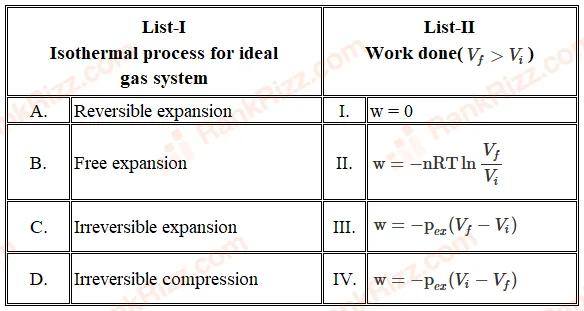
Choose the correct answer from the options given befow:
A-IV, B-II, C-III, D-I
A-II, B-I, C-III, D-IV
A-IV, B-I, C-III, D-II
A-I, B-III, C-II, D-IV
The heat of atomisation of methane and ethane are 'x' kJ and 'y' kJ respectively. The longest wavelength () of light capable of breaking the C-C bond
can be expressed in SI unit as:
A cup of water at 5°C (system) is placed in a microwave oven and the oven is turned on for one minute during which the water begins to boil. Which of the following option is true ?
q = + ve, w = 0, = - ve
q = + ve, w = - ve, = - ve
q = + ve, w = - ve, = + ve
q = - ve, w = - ve, = - ve
Match the LIST-I with LIST-II
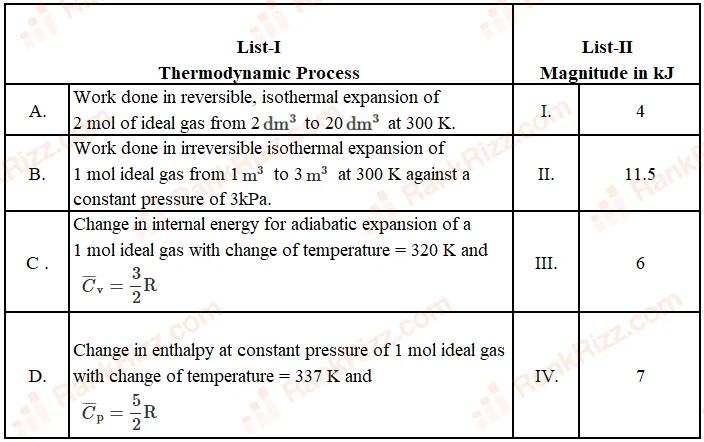
Choose the correct answer from the options given below:
A-I, B-II, C-III, D-IV
A-II, B-III, C-I, D-IV
A-II, B-I, C-III, D-IV
A-III, B-II, C-IV, D-1
If the enthalpy of sublimation of Li is 155 kJ , enthalpy of dissociation of is 150 kJ , ionization enthalpy of Li is 520 kJ , electron gain enthalpy of F is - 313 kJ , standard enthalpy of formation of LiF is - 594 kJ . The magnitude of lattice enthalpy of LiF is _________ kJ . (Nearest Integer)
Which of the following graphs between pressure 'p' versus volume 'V' represents the maximum work done?
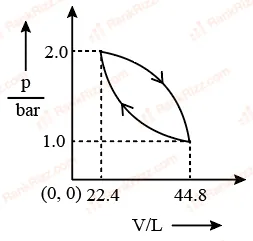
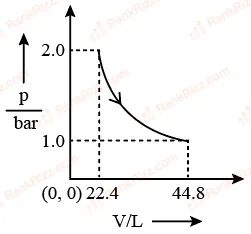
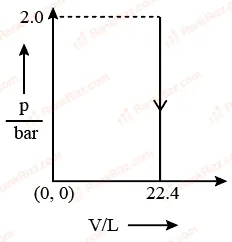
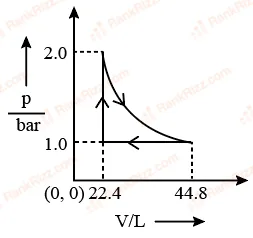
For the reaction , graph is plotted as shown below. Identify correct statements.
A. Standard free energy change for the reaction is .
B. As in graph is positive, will not dissociate into at all.
C. Reverse reaction will go to completion.
D. When 1 mole of changes into equilibrium mixture, value of = -0.84kJ .
E. When 2 mole of changes into equilibrium mixture, for equilibrium mixture is -6.24kJ .
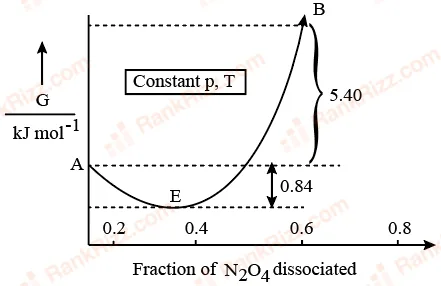
Choose the correct answer from the options given below:
D andE only
B andC only
A and D only
C and E only
OTHER CHEMISTRY CHAPTERS