RankRizz

First law: work, heat and internal energy — JEE Main Previous Year Questions

First law: work, heat and internal energy has been asked 55 times in JEE Main, in 14 different years between 2004 and 2026, and in all of the last five exam years (2022–2026), 34 questions in all. That is 24% of Chemical Thermodynamics, one of its three most-asked topics. Last asked in JEE Main 06 Apr 2026, Shift 2. 31 are multiple choice and 24 numerical-value; 31 easy and 19 medium by our difficulty labels. All of them are below, newest first, free to read.

Questions

55

Years asked

14

Since

2004

Of the chapter

24%

When JEE Main asked it

Questions on First law: work, heat and internal energy in every year it was asked, newest first.

JEE Main questions on First law: work, heat and internal energy by year, 2004–2026
YearRelative frequencyQuestions
202610
20257
20248
20234
20225
20214
20203
20195
20182
20172
20161
20132
20061
20041
Total55

Every First law: work, heat and internal energy question

1–20 OF 55 · NEWEST FIRST

JEE MAIN 2026 · 06 APR S1First law: work, heat and internal energy

Arrange the following isothermal processes in order of the magnitude of the work (p - V) involved between states 1 and 2.

A. Expansion in single stage wAw_A
B. Expansion in multi stages wBw_B
C. Compression in single stage wCw_C
D. Compression in multi stages wDw_D

Choose the correct option.

  1. A

    ∣wB∣>∣wA∣>∣wC∣>∣wD∣|w_B| > |w_A| > |w_C| > |w_D|

  2. B

    ∣wC∣>∣wD∣>∣wA∣>∣wB∣|w_C| > |w_D| > |w_A| > |w_B|

  3. C

    ∣wC∣>∣wD∣>∣wB∣>∣wA∣|w_C| > |w_D| > |w_B| > |w_A|

  4. D

    ∣wB∣>∣wA∣>∣wD∣>∣wC∣|w_B| > |w_A| > |w_D| > |w_C|

JEE MAIN 2026 · 06 APR S2First law: work, heat and internal energy

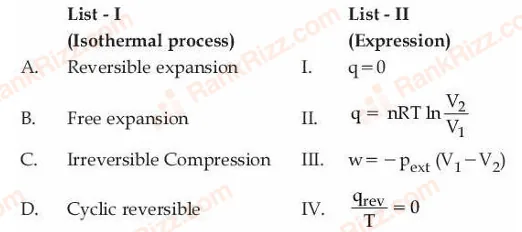
Match List - I with List - II.
Given V1V_1 and V2V_2 are initial and final volumes respectively. 

Figure for JEE Main 2026 Chemistry question on First law: work, heat and internal energy

Choose the correct answer from the options given below :

  1. A

    A-II, B-III, C-I, D-IV

  2. B

    A-II, B-I, C-IV, D-III

  3. C

    A-II, B-I, C-III, D-IV

  4. D

    A-I, B-II, C-III, D-IV

JEE MAIN 2026 · 04 APR S1First law: work, heat and internal energy

Given below are two statements:
Statement I: For an ideal gas, heat capacity at constant volume is always greater than the heat capacity at constant pressure.
Statement II: In a constant volume process, no work is produced and all the heat withdrawn goes into the chaotic motion and is reflected by a temperature increase of the ideal gas.
In the light of the above statement, choose the correct answer from the options given below.  

  1. A

    Both Statement I and Statement II are true

  2. B

    Both Statement I and Statement II are false

  3. C

    Statement I is true but Statement II is false

  4. D

    Statement I is false but Statement II is true

JEE MAIN 2026 · 02 APR S2First law: work, heat and internal energy

Gas 'A' undergoes change from state 'X' to state 'Y'. In this process, the heat absorbed and work done by the gas is 10 J and 18 J respectively. Now gas is brought back to state 'X' by another process during which 6 J of heat is evolved. In the reverse process of 'Y' to 'X' :

  1. A

    18 J of the work is done by the gas 'A'

  2. B

    2 J of the work is done by the gas 'A'

  3. C

    12 J of the work is done on the gas 'A' by the surrounding

  4. D

    14 J of the work is done on the gas 'A' by the surrounding

JEE MAIN 2026 · 28 JAN S1First law: work, heat and internal energy

20.0 dm3dm^{3} of an ideal gas 'X' at 600 K and 0.5 MPa undergoes isothermal reversible expansion until pressure of the gas is 0.2 MPa. Which of the following option is correct?
(Given: log⁡2=0.3010andlog⁡5=0.6989\log 2 = 0.3010 and \log 5 = 0.6989)

  1. A

    w = +4.1kJ, Δ\Delta U = 0, Δ\Delta H = 0; q = -4.1kJ

  2. B

    w = 9.1kJ, Δ\Delta U = 9.1J, Δ\Delta H = 0; q = 0

  3. C

    w = -3.9kJ, Δ\Delta U = 0, Δ\Delta H = 0; q = 3.9kJ

  4. D

    w = -9.1kJ, Δ\Delta U = 0, Δ\Delta H = 0; q = 9.1kJ

JEE MAIN 2026 · 24 JAN S1First law: work, heat and internal energy

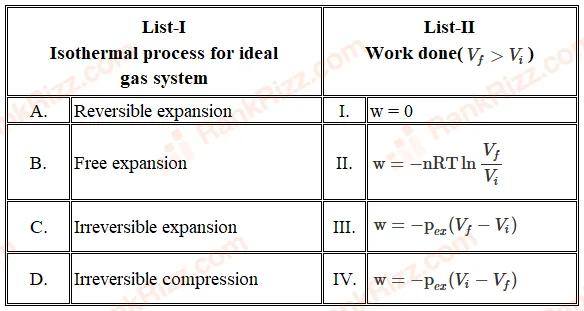
Match the LIST-I with LIST-II

Screenshot_59


Choose the correct answer from the options given befow:

  1. A

    A-IV, B-II, C-III, D-I

  2. B

    A-II, B-I, C-III, D-IV

  3. C

    A-IV, B-I, C-III, D-II

  4. D

    A-I, B-III, C-II, D-IV

JEE MAIN 2026 · 23 JAN S1First law: work, heat and internal energy

A cup of water at 5°C (system) is placed in a microwave oven and the oven is turned on for one minute during which the water begins to boil. Which of the following option is true ?

  1. A

    q = + ve, w = 0, △U\triangle U = - ve

  2. B

    q = + ve, w = - ve, △U\triangle U = - ve

  3. C

    q = + ve, w = - ve, △U\triangle U = + ve

  4. D

    q = - ve, w = - ve, △U\triangle U = - ve

JEE MAIN 2026 · 22 JAN S1First law: work, heat and internal energy

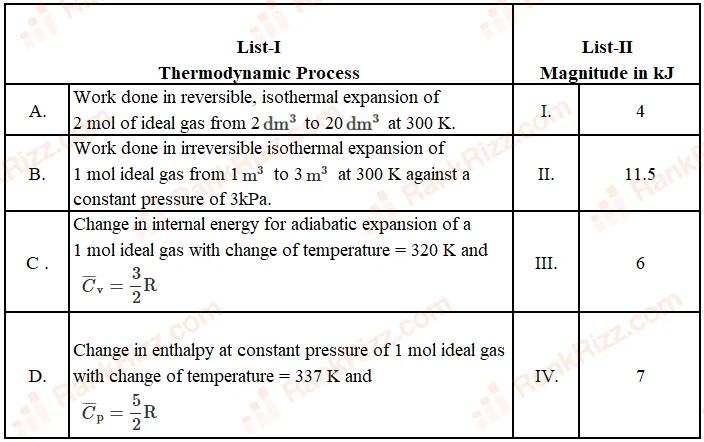
Match the LIST-I with LIST-II

Screenshot_50

Choose the correct answer from the options given below:

  1. A

    A-I, B-II, C-III, D-IV

  2. B

    A-II, B-III, C-I, D-IV

  3. C

    A-II, B-I, C-III, D-IV

  4. D

    A-III, B-II, C-IV, D-1

JEE MAIN 2026 · 21 JAN S1First law: work, heat and internal energy

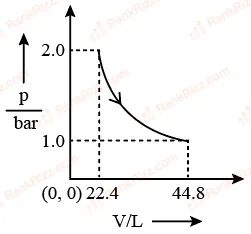
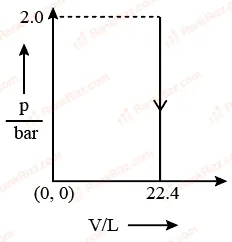
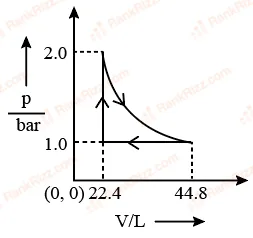
Which of the following graphs between pressure 'p' versus volume 'V' represents the maximum work done?

  1. A
    Screenshot_16
  2. B
    Screenshot_17
  3. C
    Screenshot_18
  4. D
    Screenshot_19
JEE MAIN 2026First law: work, heat and internal energy

For an isothermal free expansion of an ideal gas into vacuum, which one of the following set of values is correct?

  1. A

    ΔU=0, q>0, w<0\Delta U=0,\ q>0,\ w<0

  2. B

    ΔU>0, q>0, w=0\Delta U>0,\ q>0,\ w=0

  3. C

    ΔU<0, q=0, w<0\Delta U<0,\ q=0,\ w<0

  4. D

    ΔU=0, q=0, w=0\Delta U=0,\ q=0,\ w=0

JEE MAIN 2025 · 04 APR S1First law: work, heat and internal energy

One mole of an ideal gas expands isothermally and reversibly from 10 dm3dm^3 to 20 dm3dm^3 at 300 K. ΔU\Delta U, q and work done in the process respectively are: (Given: R=8.3JK−1mol−1R = 8.3 J K^{-1} mol^{-1}, ln⁡10=2.3\ln 10 = 2.3, log⁡2=0.30\log 2 = 0.30, log⁡3=0.48\log 3 = 0.48)

  1. A

    0, 21.84 kJ, -1.26 kJ

  2. B

    0, -17.18 kJ, 1.718 J

  3. C

    0, 21.84 kJ, 21,84 kJ

  4. D

    0, 1718 kJ, -1.718 kJ

JEE MAIN 2025 · 03 APR S2First law: work, heat and internal energy
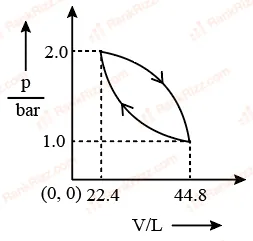
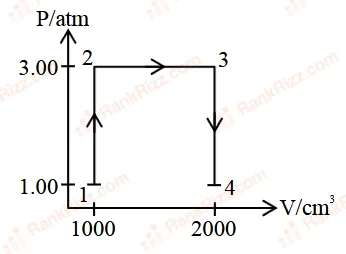
Figure for JEE Main 2025 Chemistry question on First law: work, heat and internal energy

A perfect gas (0.1 mol) having Cˉv=1.50R\bar{C}_v = 1.50 R (independent of temperature) undergoes the transformation from point 1 to point 4 as shown in the P-V diagram. If each step is reversible, the total work done (w) while going from point 1 to point 4 is (-) \text{____} J (nearest integer).
[Given: R=0.082R = 0.082 L atm K−1mol−1K^{-1} mol^{-1}]

JEE MAIN 2025 · 03 APR S2First law: work, heat and internal energy

A sample of n-octane (1.14 g) was completely burnt in excess of oxygen in a bomb calorimeter, whose heat capacity is 5 kJ K−1K^{-1}. As a result of combustion reaction, the temperature of the calorimeter is increased by 5 K. The magnitude of the heat of combustion of octane at constant volume is ________ kJ mol−1^{-1} (nearest integer).

JEE MAIN 2025 · 02 APR S1First law: work, heat and internal energy
Figure for JEE Main 2025 Chemistry question on First law: work, heat and internal energy

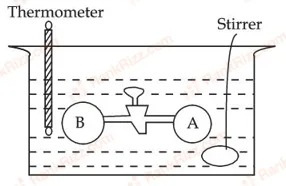
Two vessels A and B are connected via stopcock. The vessel A is filled with a gas at a certain pressure. The entire assembly is immersed in water and is allowed to come to thermal equilibrium with water. After opening the stopcock the gas from vessel A expands into vessel B and no change in temperature is observed in the thermometer. Which of the following statement is true?

  1. A

    dw≠0dw \neq 0

  2. B

    dq≠0dq \neq 0

  3. C

    dU≠0dU \neq 0

  4. D

    The pressure in the vessel B before opening the stopcock is zero.

JEE MAIN 2025 · 29 JAN S1First law: work, heat and internal energy

500J of energy is transferred as heat to 0.5 mol of Argon gas at 298 K and 1.00 atm. The final temperature and the change in internal energy respectively are: Given : R=8.3JK−1mol−1R = 8.3 J K^{-1}mol^{-1}

  1. A

    378 K and 500 J

  2. B

    368 K and 500 J

  3. C

    348 K and 300 J

  4. D

    378 K and 300 J

JEE MAIN 2025 · 28 JAN S2First law: work, heat and internal energy
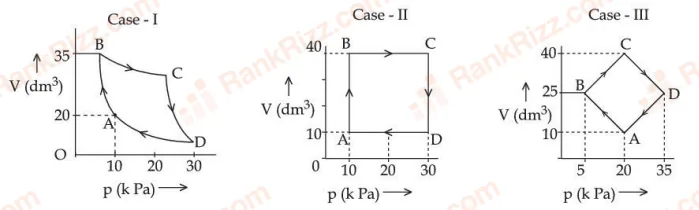
page11_img2

An ideal gas undergoes a cyclic transformation starting from the point A and coming back to the same point by tracing the path A→B→C→D→AA \rightarrow B \rightarrow C \rightarrow D \rightarrow A as shown in the three cases above. Choose the correct option regarding ΔU\Delta U :

  1. A

    ΔU(Case-I)=ΔU(Case-II)=ΔU(Case-III)\Delta U(\text{Case-I}) = \Delta U(\text{Case-II}) = \Delta U(\text{Case-III})

  2. B

    ΔU(Case-I)>ΔU(Case-III)>ΔU(Case-II)\Delta U(\text{Case-I}) > \Delta U(\text{Case-III}) > \Delta U(\text{Case-II})

  3. C

    ΔU(Case-III)>ΔU(Case-II)>ΔU(Case-I)\Delta U(\text{Case-III}) > \Delta U(\text{Case-II}) > \Delta U(\text{Case-I})

  4. D

    ΔU(Case-I)>ΔU(Case-II)>ΔU(Case-III)\Delta U(\text{Case-I}) > \Delta U(\text{Case-II}) > \Delta U(\text{Case-III})

JEE MAIN 2025 · 22 JAN S1First law: work, heat and internal energy

A liquid when kept inside a thermally insulated closed vessel 25oC25^{o}C at was mechanically stirred from outside. What will be the correct option for the following thermodynamic parameters ?

  1. A

    △U<0,q=0,w>0\triangle U \lt 0, q=0, w\gt 0

  2. B

    △U=0,q=0,w=0\triangle U = 0, q=0, w=0

  3. C

    △U>0,q=0,w>0\triangle U \gt 0, q=0, w\gt 0

  4. D

    △U=0,q<0,w>0\triangle U = 0, q\lt 0, w\gt 0

JEE MAIN 2024 · 08 APR S1First law: work, heat and internal energy
Figure for JEE Main 2024 Chemistry question on First law: work, heat and internal energy

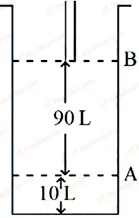
Consider the figure provided. 1 mol of an ideal gas is kept in a cylinder, fitted with a piston, at the position A, at 18°C18°C. If the piston is moved to position B, keeping the temperature unchanged, then 'xx' L atm work is done in this reversible process. x=x = ______ L atm. (nearest integer) [Given: Absolute temperature =°C+273.15= °C + 273.15, R=0.08206 L atm mol−1K−1R = 0.08206 \text{ L atm mol}^{-1} \text{K}^{-1}]

JEE MAIN 2024 · 08 APR S2First law: work, heat and internal energy

ΔvapH⊖\Delta_{vap}H^{\ominus} for water is +40.79 kJ mol−1+40.79 \text{ kJ mol}^{-1} at 1 bar and 100°C100°C. Change in internal energy for this vapourisation under same condition is _____ kJ mol−1\text{kJ mol}^{-1}. (Given R=8.3 JK−1mol−1R = 8.3 \text{ JK}^{-1}\text{mol}^{-1})

JEE MAIN 2024 · 06 APR S1First law: work, heat and internal energy

An ideal gas, Cˉv=52R\bar{C}_v = \frac{5}{2}R, is expanded adiabatically against a constant pressure of 1 atm until it doubles in volume. If the initial temperature and pressure is 298 K298 \text{ K} and 5 atm5 \text{ atm}, respectively then the final temperature is _______ K (nearest integer). [Cˉv\bar{C}_v is the molar heat capacity at constant volume]

First law: work, heat and internal energy: common questions

How many First law questions have come in JEE Main?
First law has been asked 55 times in JEE Main, in 14 different years between 2004 and 2026. It came up in all of the last five exam years (2022–2026), 34 questions in all.
Is First law important for JEE Main?
It is one of the three most-asked topics in Chemical Thermodynamics: 55 of the chapter's 229 JEE Main questions (24%). It came up in all of the last five exam years (2022–2026), 34 questions in all.
When was First law last asked in JEE Main?
Most recently in JEE Main 06 Apr 2026, Shift 2. Questions on this page are newest first, so the latest ones are at the top.
What kind of First law questions does JEE Main ask?
31 are multiple choice and 24 numerical-value; 31 easy and 19 medium by our difficulty labels. Each question shows its answer key and worked solution where we have them.