RankRizz

Electrochemistry — JEE Main Previous Year Questions

Electrochemistry has been asked in every one of the 23 JEE Main years from 2004 to 2026: 227 questions in all. In 2026 it averaged 1.1 questions per paper (21 across 19 papers), 4.4% of Chemistry questions, down from 5.3% in 2025. Across the last 20 papers it carried 4.4% of Chemistry marks. By type: 136 MCQs and 91 numerical-answer questions. Of the 199 with a difficulty tag, 33% are easy, 63% medium and 4% hard. Most asked: Electrode potentials, electrochemical series and cell EMF (106, 47%), Conductance, conductivity and molar conductivity (70, 31%) and Batteries, fuel cells and corrosion (17, 7%).

DATA UPDATED

Questions

227

Distinct ideas

8

Share of marks

4.4%

Difficulty

MEDIUM

Electrochemistry weightage, year by year

The share of each year’s Chemistry questions that came from Electrochemistry, counted from the 168 papers we hold for the last 10 years, and session by session inside a year.

Rising: 4.8% of Chemistry questions in 2024–2026, up from 3.3% in 2017–2023. Its heaviest year was 2025, at 5.3%.

Electrochemistry questions per year, per paper, and as a share of Chemistry questions
YEARQSPER PAPERSHARE OF CHEMISTRYCHANGE
202621 / 4801.14.4%−0.9 pts
202525 / 4751.35.3%+0.5 pts
202429 / 6001.44.8%+1.2 pts
202327 / 7501.13.6%+0.4 pts
202221 / 6601.03.2%+0.7 pts
202118 / 7200.82.5%−1.5 pts
202016 / 4001.04.0%+0.7 pts
201916 / 4801.03.3%+0.8 pts
20183 / 1200.82.5%−1.9 pts
20174 / 901.34.4%—

“QS” is Electrochemistry questions out of all Chemistry questions that year; “per paper” is that count over the year’s papers, and “change” is the share against the year before. A year with more sittings asks more questions, which is why the share, not the count, is the number to compare.

How Electrochemistry compares: every Chemistry chapter by weightage · most repeated JEE Main topics

The ideas inside Electrochemistry

A chapter is not one subject — it is a handful of procedures the examiner reuses. These are the ones Electrochemistry questions actually test.

All 227 Electrochemistry questions, by topic

Every JEE Main Electrochemistry question we hold, newest first inside each topic. Open one for its options, answer key and solution.

Electrode potentials, electrochemical series and cell EMF106 QUESTIONSTopic page →

  1. Given at 298 K: E^ _(Fe²⁺/Fe) = X Volt E^ _(Fe³⁺/Fe) = Y Volt The E^ _(Fe³⁺/Fe²⁺) in Volt at 298 K is given by:2026 · 08 APR S2
  2. For a general redox reaction Anode: Red₁ → Ox₁^(n₁+) + n₁ e⁻ Cathode: Ox₂ + n₂ e⁻ → Red₂^(n₂-) Which of the following statement is…2026 · 06 APR S2
  3. One half cell in a voltaic cell is constructed by dipping silver rod in AgNO₃ solution of unknown concentration, other half cell is Zn rod…2026 · 05 APR S2
  4. An electrochemical cell, consist of the following two redox couples, M^(x+)(aq)/M(s) [E_(red)^(Θ) = +0.15 V] and Fe³⁺(aq)/Fe(s)…2026 · 04 APR S2
  5. An electrochemical cell is constructed using half cells in the direction of spontaneous change Fe(OH)₂(s) + 2e⁻ → Fe(s) + 2OH⁻(aq) E⁰ =…2026 · 02 APR S1
  6. Consider the following redox reaction taking place in acidic medium BH₄⁻(aq)+ClO₃⁻(aq)→ H₂BO₃⁻(aq)+Cl⁻(aq) If the Nerst equation for the…2026 · 28 JAN S1
  7. A volume of x mL of 5 M NaHCO₃ solution was mixed with 10 mL of 2 M H₂CO₃ solution to make an electrolytic buffer. If the same buffer was…2026 · 28 JAN S2
  8. In the given electrochemical cell, Ag(s)|AgCl(s)|FeCl₂(aq), FeCl₃(aq)|Pt(s) at298 K, theceU potential E_(cell) will increase when: A…2026 · 23 JAN S1
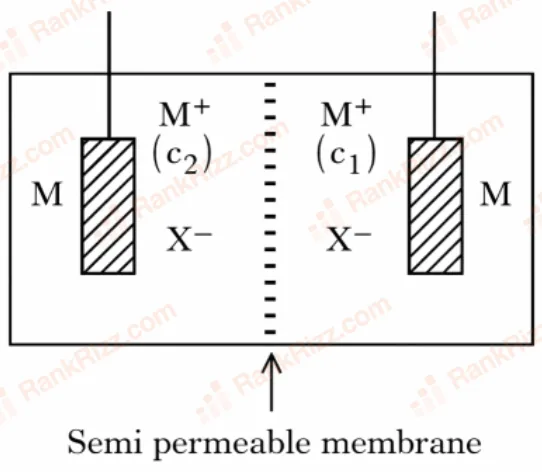
  9. Consider the above electrochemical cell where a metal electrode (M) is undergoing redox reaction by forming M⁺(M→ M⁺+e⁻). The cation M⁺ is…2026 · 23 JAN S2
  10. Consider the following electrochemical cell at 298K Pt HSnO₂⁻(aq) Sn(OH)₆²⁻(aq) OH⁻(aq) Bi₂O₃(s) Bi(s). If the reaction quotient at a given…2026 · 22 JAN S1
  11. Consider the following reduction processes: Al³⁺ + 3e⁻ → Al(s), E° = -1.66V Fe³⁺ + e⁻ → Fe²⁺, E° = +0.77V Co³⁺ + e⁻ → Co²⁺, E° = +1.81V…2026 · 22 JAN S2
  12. Consider the following electrochemical cell: Pt| O₂(g)(1 bar) | HCl(aq)||M²⁺(aq, 1.0M)|M(s) The pH above which, oxygen gas would start to…2026 · 22 JAN S2
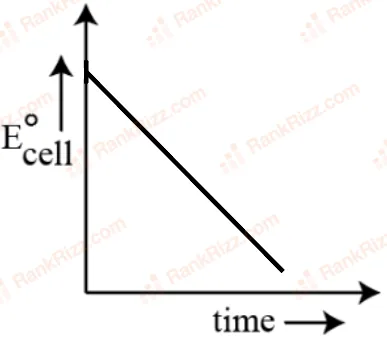
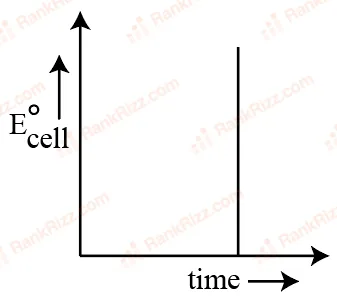
  13. For a closed circuit Daniell cell, which of the following plots is the accurate one at a given temperature?2026 · 21 JAN S2
  14. MX is a sparingly soluble salt that follows the given solubility equilibrium at 298 K. MX(s) ⇌ M⁺ (aq)+X⁻(aq); K_(sp)=10⁻¹⁰ If the standard…2026 · 21 JAN S2
  15. Consider the following half cell reaction: Cr₂O₇²⁻(aq) + 6e⁻ + 14H⁺(aq) → 2Cr³⁺(aq) + 7H₂O(l). The reaction was conducted with the ratio of…2025 · 08 APR S2
  16. 1 Faraday electricity was passed through Cu²⁺ (1.5 M, 1 L)/Cu and 0.1 Faraday was passed through Ag⁺ (0.2 M, 1 L)/Ag electrolytic cells…2025 · 07 APR S1
  17. Consider the following electrochemical cell at standard condition. Au(s)|QH₂,Q|NH₄X(0.01M)||Ag⁺(1M)|Ag(s) E_(cell) = +0.4V The couple QH₂/Q…2025 · 02 APR S1
  18. The standard reduction potential values of some of the p-block ions are given below. Predict the one with the strongest oxidising capacity.2025 · 29 JAN S1
  19. For a Mg|Mg²⁺(aq)||Ag⁺(aq)|Ag the correct Nernst Equation is:2025 · 29 JAN S1
  20. For the given cell Fe²⁺_(aq) + Ag⁺_(aq) → Fe³⁺_(aq) + Ag_(s), the standard cell potential of the above reaction is Given: Ag⁺ + e⁻ → Ag E°…2025 · 24 JAN S1
  21. Based on the data given below: E°_(Cr₂O₇²⁻/Cr³⁺) = 1.33 V E°_(Cl₂/Cl⁻⁾ = 1.36 V °_(MnO₄⁻/Mn²⁺) = 1.51 V E°_(Cr³⁺/Cr) = -0.74 V the…2025 · 24 JAN S2
  22. FeO₄²⁻ +2.0_(V) Fe³⁺ 0.8_(V) Fe²⁺ -0.5_(V)Fe⁰ In the above diagram, the standard electrode potentials are given in volts (over the arrow)…2025 · 23 JAN S1
  23. Standard electrode potentials for a few half cells are mentioned below: E_(Cu²⁺/Cu)°=0.34 V,E_(Zn²⁺/Zn)°=-0.76 V _(Ag⁺/Ag)°=0.80…2025 · 23 JAN S2
  24. The standard reduction potentials at 298 K for the following half cells are given below: Cr₂O₇²⁻ + 14H⁺ + 6e⁻ → 2Cr³⁺ + 7H₂O, E° = 1.33 V…2024 · 09 APR S1
  25. The emf of cell It could be increased by:2024 · 08 APR S2
  26. The reaction; 1/2H_(2(g)) + AgCl_(s) → H⁺_(aq) + Cl^-_(aq) + Ag_(s) occurs in which of the following galvanic cell:2024 · 08 APR S2
  27. How can an electrochemical cell be converted into an electrolytic cell?2024 · 06 APR S2
  28. For the electrochemical cell, if E⁰_(M²⁺/M) = 0.46 V and E⁰_(X/X²⁻) = 0.34 V. Which of the following is correct?2024 · 05 APR S2
  29. What pressure (bar) of H₂ would be required to make emf of hydrogen electrode zero in pure water at 25°C?2024 · 04 APR S1
  30. One of the commonly used electrode is calomel electrode. Under which of the following categories, calomel electrode comes?2024 · 04 APR S1
  31. The potential for the given half cell at 298K is - x × 10⁻² V. 2H⁺_(aq) + 2e⁻ → H₂(g), [H⁺] = 1 M, P_(H₂) = 2 atm. (Given 2.303 RT/F = 0.06…2024 · 01 FEB S1
  32. Consider the following redox reaction: MnO₄⁻ + H⁺ + H₂C₂O₄ ⇌ Mn²⁺ + H₂O + CO₂ The standard reduction potentials are given as below…2024 · 01 FEB S2
  33. Reduction potential of ions are given below: ClO₄⁻: E° = 1.19 V; IO₄⁻: E° = 1.65 V; BrO₄⁻: E° = 1.74 V The correct order of their oxidising…2024 · 30 JAN S2
  34. The hydrogen electrode is dipped in a solution of pH = 3 at 25°C. The potential of the electrode will be - _____ × 10⁻² V. 2.303RT/F =…2024 · 27 JAN S2
  35. At 298 K, the standard reduction potential for Cu²⁺/Cu electrode is 0.34 V. Given: K_(sp)Cu(OH)₂ = 1 × 10⁻²⁰. Take 2.303RT/F = 0.059 V. The…2023 · 13 APR S2
  36. In an electrochemical reaction of lead, at standard temperature, if E⁰_(Pb²⁺/Pb) = m Volt and E⁰_(Pb⁴⁺/Pb) = n Volt, then the value of…2023 · 11 APR S1
  37. The number of correct statements from the following is _______ A. E_(cell) is an intensive parameter B. A negative E° means that the redox…2023 · 11 APR S2
  38. FeO₄²⁻ →(+2.2 V) Fe³⁺ →(+0.70 V) Fe²⁺ →(-0.45 V) Fe⁰ E⁰_(FeO₄²⁻/Fe²⁺) is x × 10⁻³ V. The value of x is _______.2023 · 10 APR S1
  39. The reaction occurs in which of the given galvanic cell? 1/2H₂(g) + AgCl(s) ⇌ H⁺(aq) + Cl⁻⁽aq) + Ag(s)2023 · 08 APR S1
  40. The incorrect statements from the following is: A. The electrical work that a reaction can perform at constant pressure and temperature is…2023 · 08 APR S2
  41. The standard electrode potential of M⁺/M in aqueous solution does not depend on2023 · 06 APR S1
  42. The standard reduction potentials at 295 K for the following half cells are given below: NO₃⁻ + 4H⁺ + 3e⁻ → NO(g) + 2H₂O E° = 0.97 V…2023 · 06 APR S2
  43. At what pH, given half cell MnO₄⁻(0.1M) | Mn²⁺(0.001 M) will have electrode potential of 1.282 V? (Nearest Integer) Given E⁰_(MnO₄⁻/Mn²⁺) =…2023 · 01 FEB S1
  44. The logarithm of equilibrium constant for the reaction Pd²⁺ + 4Cl⁻ ⇌ PdCl₄²⁻ is (Nearest integer) Given: 2.303RT/F = 0.06 V Pd²⁺_(aq) + 2e⁻…2023 · 31 JAN S1
  45. Consider the cell Pt, H₂(g, 1 atm) | H⁺ aq, 1M | Fe³⁺ aq, Fe²⁺ aq | Pt s When the potential of the cell is 0.712 V at 298 K, the ratio…2023 · 30 JAN S1
  46. The electrode potential of the following half cell at 298 K X|X²⁺(0.001M)||Y²⁺(0.01M)|Y is ______ × 10⁻² V (Nearest integer) Given…2023 · 30 JAN S2
  47. The standard electrode potential (M³⁺/M²⁺) for V, Cr, Mn & Co are -0.26 V, -0.41 V, +1.57 V and +1.97 V, respectively. The metal ions which…2023 · 29 JAN S1
  48. The equilibrium constant for the reaction Zn(s) + Sn²⁺(aq) ⇌ Zn²⁺(aq) + Sn(s) is 1 × 10²⁰ at 298 K. The magnitude of standard electrode…2023 · 29 JAN S2
  49. Consider the cell Pt(s)|H₂(s)(1atm)|H⁺(aq, [H⁺] = 1)||Fe³⁺(aq), Fe²⁺(aq)|Pt(s) Given: E_(Fe³⁺/Fe²⁺)° = 0.771 V and E_(H⁺/1/2H₂)° = 0 V, T =…2023 · 25 JAN S1
  50. Pt(s)|H₂(g)(1 bar)|H⁺(aq)(1M)||M³⁺(aq), M⁺(aq)|Pt(s) The E_(cell) for the given cell is 0.1115 V at 298 K When [M⁺(aq)][M³⁺(aq)] = 10^a The…2023 · 25 JAN S2
  51. At 298 K, a 1 litre solution containing 10 mmol of Cr₂O₇²⁻ and 100 mmol of Cr³⁺ shows a pH of 3.0. Given: Cr₂O₇²⁻ → Cr³⁺; E⁰ = 1.330 V and…2023 · 24 JAN S1
  52. At 298 K, a 1 litre solution containing 10 mmol of Cr₂O₇²⁻ and 100 mmol of Cr³⁺ shows a pH of 3.0. Given: Cr₂O₇²⁻ → Cr³⁺; E⁰ = 1.330 V and…2023 · 24 JAN S1
  53. For a cell, Cu(s)|Cu²⁺(0.001 M)||Ag⁺(0.01 M)|Ag(s), the cell potential is found to be 0.43 V at 298 K. The magnitude of standard electrode…2022 · 29 JUL S2
  54. The cell potential for Zn | Zn²⁺(aq) || Sn^(x+) | Sn is 0.801 V at 298 K. The reaction quotient for the above reaction is 10⁻². The number…2022 · 25 JUL S1
  55. The cell potential for the given cell at 298 K Pt|H₂(g, 1 bar)|H⁺(aq)||Cu²⁺(aq)|Cu(s) is 0.31 V. The pH of the acidic solution is found to…2022 · 29 JUN S2
  56. For the given reactions Sn²⁺ + 2e⁻ → Sn Sn⁴⁺ + 4e⁻ → Sn the electrode potentials are; E°_(Sn²⁺/Sn) = -0.140 V and E°_(Sn⁴⁺/Sn) = 0.010 V…2022 · 28 JUN S2
  57. For the reaction taking place in the cell: Pt(s)|H₂(g)|H⁺(aq) || Ag⁺(aq)|Ag(s) E_(cell) = +0.5332 V. The value of Δ_r G° is ______ kJ…2022 · 27 JUN S2
  58. The ((∂ E)/(∂ T))_P of different types of half cells are as follows: A: 1 × 10⁻⁴, B: 2 × 10⁻⁴, C: 0.1 × 10⁻⁴, D: 0.2 × 10⁻⁴ (Where E is the…2022 · 26 JUN S1
  59. Cu(s) + Sn²⁺(0.001M) → Cu²⁺(0.01M) + Sn(s) The Gibbs free energy change for the above reaction at 298 K is x × 10⁻¹ kJ mol⁻¹. The value of…2022 · 26 JUN S2
  60. In a cell, the following reactions take place Fe²⁺ → Fe³⁺ + e⁻ E°_(Fe³⁺/Fe²⁺) = 0.77 V 2I⁻ → I₂ + 2e⁻ E°_(I₂/I⁻⁾ = 0.54 V The standard…2022 · 25 JUN S1
  61. The correct order of reduction potentials of the following pairs is A. Cl₂/Cl⁻ B. I₂/I⁻ C. Ag⁺/Ag D. Na⁺/Na E. Li⁺/Li Choose the correct…2022 · 25 JUN S2
  62. The cell potential for the following cell Pt|H₂(g)|H⁺(aq)||Cu²⁺(0.01 M)|Cu(s) is 0.576 V at 298 K. The pH of the solution is (Nearest…2022 · 24 JUN S1
  63. Consider the following cell reaction Cd(s) + Hg₂SO₄(s) + 9/5H₂O(l) ⇌ CdSO₄.9/5H₂O(s) + 2Hg(l). The value of E⁰_(cell) is 4.315 V at 25°C…2021 · 31 AUG S1
  64. These are physical properties of an element: (A) Sublimation enthalpy (B) Ionisation enthalpy (C) Hydration enthalpy (D) Electron gain…2021 · 26 AUG S1
  65. For the galvanic cell, Zn(s) + Cu²⁺(0.02M) → Zn²⁺(0.04M) + Cu(s) E_(cell) = _________ × 10⁻² V (Nearest integer) [Use: E⁰ Cu/Cu²⁺ = -0.34…2021 · 26 AUG S2
  66. For the cell Cu(s)|Cu²⁺(aq)(0.1M)||Ag⁺(aq)(0.01M)|Ag(s) the cell potential E₁ = 0.3095 V. For the cell…2021 · 27 JUL S2
  67. Consider the cell at 25°C Zn|Zn²⁺ aq, 1 M || Fe³⁺(aq), Fe²⁺aq|Pt The fraction of total iron present as Fe³⁺ ion at the cell potential of…2021 · 25 JUL S1
  68. Assume a cell with the following reaction Cu_(s) + 2Ag⁺(1 × 10⁻³M) → Cu²⁺(0.250M) + 2Ag_(s) E°_(cell) = 2.97 V E_(cell) for the above…2021 · 22 JUL S1
  69. Emf of the following cell at 298 K in V is x × 10⁻² Zn|Zn²⁺(0.1M)||Ag⁺(0.01M)|Ag The value of x is ______ (Rounded off to the nearest…2021 · 26 FEB S2
  70. Copper reduces NO₃⁻ into NO and NO₂ depending upon the concentration of HNO₃ in solution. (Assuming fixed [Cu²⁺] and P_(NO) = P_(NO₂)), the…2021 · 25 FEB S2
  71. The magnitude of the change in oxidising power of the MnO₄⁻ / Mn²⁺ couple is x × 10⁻⁴ V if the H⁺ concentration is decreased from 1 M to…2021 · 24 FEB S2
  72. For the given cell; Cu(s)|Cu²⁺(C₁ M)||Cu²⁺(C₂ M)|Cu(s) change in Gibbs energy (Δ G) is negative, it:2020 · 06 SEP S2
  73. An oxidation-reduction reaction in which 3 electrons are transferred has a Δ G⁰ of 17.37 kJ mol⁻¹ at 25°C. The value of E⁰_(cell) (in V) is…2020 · 05 SEP S1
  74. Identify the incorrect statement from the options below for the above cell: E⁰_(Cu²⁺|Cu) = +0.34 V, E⁰_(Zn²⁺|Zn) = -0.76 V2020 · 04 SEP S1
  75. The photoelectric current from Na (work function, w₀ = 2.3 eV) is stopped by the output voltage of the cell Pt(s)|H₂(g, 1 bar)|HCl(aq, pH =…2020 · 03 SEP S1
  76. The Gibbs energy change (in J) for the given reaction at [Cu²⁺] = [Sn²⁺] = 1 M and 298 K is: Cu(s) + Sn²⁺(aq.) → Cu²⁺(aq.) + Sn(s)…2020 · 02 SEP S1
  77. For the disproportionation reaction 2Cu⁺(aq) ⇌ Cu(s) + Cu²⁺(aq) at 298K, ln K (where K is the equilibrium constant) is ___________ × 10⁻¹…2020 · 02 SEP S2
  78. What would be the electrode potential for the given half-cell reaction at pH = 5? 2H₂O → O₂ + 4H⁺ + 4e⁻; E_(red)⁰ = 1.23 V (R = 8.314 J…2020 · 08 JAN S1
  79. For an electrochemical cell Sn(s)|Sn²⁺(aq, 1M)||Pb²⁺(aq, 1M)|Pb(s) the ratio [Sn²⁺][Pb²⁺] when this cell attains equilibrium is __________…2020 · 08 JAN S2
  80. Given that the standard potentials (E°) of Cu²⁺/Cu and Cu⁺/Cu are 0.34V and 0.522V respectively, the E° of Cu²⁺/Cu⁺ is:2020 · 07 JAN S1
  81. Given: Co³⁺ + e⁻ → Co²⁺; E° = +1.81V Pb³⁺ + 2e⁻ → Pb²⁺; E° = +1.67V Ce⁴⁺ + e⁻ → Ce³⁺; E° = +1.61V Bi³⁺ + 3e⁻ → Bi; E° = +0.20V Oxidizing…2019 · 12 APR S1
  82. The standard Gibbs energy for the given cell reaction in kJ mol⁻¹ at 298 K is: Zn(s) + Cu²⁺(aq) → Zn²⁺(aq) + Cu(s), E⁰ = 2 V at 298 K…2019 · 09 APR S1
  83. Given that, E⁰_(O₂/H₂O) = +1.23 V; E⁰_(S₂O₈²⁻/SO₄²⁻) = 2.05 V; E⁰_(Br₂/Br⁻) = +1.09 V; E⁰_(Au³⁺/Au) = 1.4 V The strongest oxidizing agent…2019 · 08 APR S1
  84. Calculate the standard cell potential (in V) of the cell in which the following reaction takes place: Fe²⁺(aq) + Ag⁺(aq) → Fe³⁺(aq) + Ag(s)…2019 · 08 APR S2
  85. The standard electrode potential E° and its temperature coefficient (dE/dT) for a cell are 2 V and -5 × 10⁻⁴ V K⁻¹ at 300 K, respectively…2019 · 12 JAN S1
  86. For the cell Zn(s) | Zn²⁺(aq) || M^(x+)(aq) | M(s), different half cells and their standard electrode potentials are given below: If…2019 · 11 JAN S1
  87. Given the equilibrium constant: K_C of the reaction: Cu(s) + 2Ag⁺(aq) → Cu²⁺(aq) + 2Ag(s) is 10 × 10¹⁵. Calculate the E°_(cell) of this…2019 · 11 JAN S2
  88. Consider the following reduction processes: Zn²⁺ + 2e⁻ → Zn(s); E° = -0.76 V Ca²⁺ + 2e⁻ → Ca(s); E° = -2.87 V Mg²⁺ + 2e⁻ → Mg(s); E° =…2019 · 10 JAN S1
  89. In the cell, Pt(s)|H₂(g, 1 bar)|HCl(aq)|AgCl(s)|Ag(s)|Pt(s), the cell potential is 0.92 V when a 10⁻⁶ molar HCl solution is used. The…2019 · 10 JAN S2
  90. If the standard electrode potential for a cell is 2 V at 300 K, the equilibrium constant (K) for the reaction. Zn(s) + Cu²⁺(aq) ⇌ Zn²⁺(aq)…2019 · 09 JAN S2
  91. To find the standard potential of M³⁺/M electrode, the following cell is constituted: Pt | M/M³⁺ (0.001 mol L⁻¹) / Ag⁺ (0.01 mol L⁻¹) / Ag…2017 · 09 APR ONLINE
  92. Consider the following standard electrode potentials (E° in volts) in aqueous solution: Element M³⁺/M M⁺/M Al -1.66 +0.55 Tl +1.26 -0.34…2017 · 08 APR ONLINE
  93. What is the standard reduction potential (E°) for Fe³⁺ → Fe? Given that: Fe²⁺ + 2e⁻ → Fe; E°_(Fe²⁺/Fe) = -0.47 V Fe³⁺ + e⁻ → Fe²⁺…2017 · 08 APR ONLINE
  94. Given E°_Cl₂/Cl⁻ = 1.36 V, E°_(Cr³⁺/Cr) = -0.74 V E°_Cr₂O₇²⁻/Cr³⁺ = 1.33 V, E°_MnO₄⁻/Mn²⁺ = 1.51 V Among the following, the strongest…2017 · 02 APR OFFLINE
  95. What will happen when a block of copper metal is dropped into a beaker containing a solution of 1 M ZnSO₄?2016 · 09 APR ONLINE
  96. Given: Fe³⁺(aq) + e⁻ → Fe²⁺(aq); E⁰ = +0.77 V Al³⁺(aq) + 3e⁻ → Al(s); E⁰ = -1.66 V Br₂(aq) + 2e⁻ → 2Br⁻; E⁰ = +1.09 V Considering the…2014 · 11 APR ONLINE
  97. The standard electrode potentials (E°_(M⁺/M)) of four metals A, B, C and D are -1.2 V, 0.6 V, 0.85 V and -0.76 V, respectively. The…2014 · 09 APR ONLINE
  98. Given below are the half-cell reactions: Mn²⁺ + 2e⁻ → Mn; E° = -1.18 V 2(Mn³⁺ + e⁻ → Mn²⁺); E° = +1.51 V The E° for 3Mn²⁺ → Mn + 2Mn³⁺ will…2014 · 06 APR OFFLINE
  99. The Gibbs energy for the decomposition of Al₂O₃ at 500°C is as follows: 2/3Al₂O₃ → 4/3Al + O₂, Δ_r G = +940 kJ mol⁻¹ The potential…2013 · 25 APR ONLINE
  100. Given: E°_(1/2Cl₂/Cl⁻⁾ = 1.36 V, E°_(Cr³⁺/Cr) = -0.74 V E°_(Cr₂O₇²⁻/Cr³⁺) = 1.33 V, E°_(MnO₄⁻/Mn²⁺) = 1.51 V The correct order of reducing…2013 · 23 APR ONLINE
  101. Electrode potentials (E°) are given below: Cu⁺/Cu = +0.52 V, Fe³⁺/Fe²⁺ = +0.77 V, 1/2I₂(s)/I⁻ = +0.54 V, Ag⁺/Ag = +0.88 V. Based on the…2013 · 09 APR ONLINE
  102. Given: E°_(Cr³⁺/Cr) = -0.74 V; E°_(MnO₄⁻/Mn²⁺) = 1.51 V E°_(Cr₂O₇²⁻/Cr³⁺) = 1.33 V; E°_(Cl₂/Cl⁻⁾ = 1.36 V Based on the data given above…2013 · 07 APR ONLINE
  103. The standard reduction potentials for Zn²⁺/Zn, Ni²⁺/Ni, and Fe²⁺/Fe are -0.76, -0.23 and -0.44 V respectively. The reaction X + Y²⁺ → X²⁺ +…2012
  104. Given E°_(Cu²⁺/Cu) = 0.34 V, E°_(Cu²⁺/Cu⁺) = 0.15 V. Standard electrode potential for the half cell Cu⁺/Cu is2012
  105. Given: E°_(Fe³⁺/Fe) = -0.036 V, E°_(Fe²⁺/Fe) = -0.439 V. The value of standard electrode potential for the change, Fe³⁺_(aq) + e⁻ →…2009
  106. Consider the following E° values: E°_(Fe³⁺/Fe²⁺) = 0.77 V; E°_(Sn²⁺/Sn) = -0.14 V. Under standard conditions the potential for the reaction…2004

Conductance, conductivity and molar conductivity70 QUESTIONSTopic page →

  1. Consider the following data. Electrolyte Λ°_m (S cm² mol⁻¹) BaCl₂ x₁ H₂SO₄ x₂ HCl x₃ BaSO₄ is sparingly soluble in water. If the…2026 · 06 APR S1
  2. At 298 K, the molar conductivity of an x\% (w/w) MX solution is 123.5 S cm² mol⁻¹. The conductance of same solution is 1.9 × 10⁻³ S. The…2026 · 05 APR S2
  3. For strong electrolyte λ_m increases slowly with dilution and can be represented by the equation Λ_m = Λ_m° - A c^(1/2) Molar conductivity…2026 · 28 JAN S2
  4. Electricity is passed through an acidic solution of Cu²⁺ till all the Cu2+ was exhausted, leading to the deposition of 300 mg of Cu metal…2026 · 24 JAN S1
  5. Molar conductivity of a weak acid HQ of concentration 0.18 M was found to be 1/30 of the molar conductivity of another weak acid HZ with…2026 · 24 JAN S2
  6. The pH and conductance of a weak acid (HX) was found to be 5 and 4×10⁻⁵S. respectively. The conductance was measured under standard…2026 · 21 JAN S1
  7. Given below are two statements: 1 M aqueous solution of each of Cu(NO₃)₂, AgNO₃, Hg₂(NO₃)₂; Mg(NO₃)₂ are electrolysed using inert…2025 · 07 APR S2
  8. Correct order of limiting molar conductivity for cations in water at 298 K is:2025 · 03 APR S1
  9. 40 mL of a mixture of CH₃COOH and HCl (aqueous solution) is titrated against 0.1 M NaOH conductometrically. Which of the following…2025 · 03 APR S2
  10. 0.2 % (w/v) solution of NaOH is measured to have resistivity 870.0 mΩ m. The molar conductivity of the solution will be _________ × 10² mS…2025 · 02 APR S2
  11. The molar conductivity of a weak electrolyte when plotted against the square root of its concentration, which of the following is expected…2025 · 29 JAN S1
  12. O₂ gas will be evolved as a product of electrolysis of: (A) an aqueous solution of AgNO₃ using silver electrodes. (B) an aqueous solution…2025 · 29 JAN S2
  13. Given below is the plot of the molar conductivity vs √concentration for KCl in aqueous solution. If, for the higher concentration of KCl…2025 · 28 JAN S1
  14. Electrolysis of 600 mL aqueous solution of NaCl for 5 min changes the pH of the solution to 12. The current in Amperes used for the given…2025 · 28 JAN S2
  15. Which of the following electrolyte can be used to obtain H₂ S₂ O₈ by the process of electrolysis?2025 · 22 JAN S1
  16. The molar conductivity for electrolytes A and B are plotted against C^(1/2) as shown below. Electrolytes A and B respectively are2024 · 09 APR S1
  17. Which out of the following is a correct equation to show change in molar conductivity with respect to concentration for a weak electrolyte…2024 · 09 APR S2
  18. A conductivity cell with two electrodes (dark side) are half filled with infinitely dilute aqueous solution of a weak electrolyte. If…2024 · 06 APR S1
  19. Molar ionic conductivities of divalent cation and anion are 57 S cm² mol⁻¹ and 73 S cm² mol⁻¹ respectively. The molar conductivity of…2024 · 05 APR S1
  20. For a strong electrolyte, a plot of molar conductivity against (concentration)^(1/2) is a straight line, with a negative slope, the correct…2024 · 04 APR S2
  21. Identify the factor from the following that does not affect electrolytic conductance of a solution.2024 · 31 JAN S1
  22. One Faraday of electricity liberates x × 10⁻¹ gram atom of copper from copper sulphate, x is ______.2024 · 31 JAN S1
  23. The values of conductivity of some materials at 298.15 K in S m⁻¹ are 2.1 × 10³, 1.0 × 10⁻¹⁶, 1.2 × 10, 3.91, 1.5 × 10⁻², 1 × 10⁻⁷, 1.0 ×…2024 · 31 JAN S2
  24. The mass of zinc produced by the electrolysis of zinc sulphate solution with a steady current of 0.015 A for 15 minutes is _______ × 10⁻⁴…2024 · 29 JAN S1
  25. The mass of silver (Molar mass of Ag: 108 g mol⁻¹) displaced by a quantity of electricity which displaces 5600 mL of O₂ at S.T.P. will be…2024 · 27 JAN S1
  26. The number of correct statements from the following is _____ (A) Conductivity always decreases with decrease in concentration for both…2023 · 15 APR S1
  27. A metal surface of 100 cm² area has to be coated with nickel layer of thickness 0.001 mm. A current of 2A was passed through a solution of…2023 · 13 APR S1
  28. The specific conductance of 0.0025M acetic acid is 5 × 10⁻⁵ S cm⁻¹ at a certain temperature. The dissociation constant of acetic acid is…2023 · 10 APR S2
  29. 1 × 10⁻⁵ M AgNO₃ is added to 1 L of saturated solution of AgBr. The conductivity of this solution at 298 K is _______ × 10⁻⁸ S m⁻¹. [Given…2023 · 01 FEB S2
  30. Which one of the following statements is correct for electrolysis of brine solution?2023 · 31 JAN S1
  31. The resistivity of a 0.8M solution of an electrolyte is 5 × 10⁻³ Ωcm. Its molar conductivity is 10⁴ Ω⁻¹ cm² mol⁻¹. (Nearest integer)2023 · 31 JAN S2
  32. Following figure shows dependence of molar conductance of two electrolytes on concentration. Λ⁰_m is the limiting molar conductivity. The…2023 · 29 JAN S1
  33. Choose the correct representation of conductometric titration of benzoic acid vs sodium hydroxide.2023 · 24 JAN S2
  34. Resistance of a conductivity cell (cell constant 129 m⁻¹) filled with 74.5 ppm solution of KCl is 100 Ω (labelled as solution 1). When the…2022 · 29 JUL S1
  35. Given below are two statements: Statement I: For KI, molar conductivity increases steeply with dilution. Statement II: For carbonic acid…2022 · 27 JUL S2
  36. The molar conductivity of a conductivity cell filled with 10 moles of 20 mL NaCl solution is Λ_(m1) and that of 20 moles of another…2022 · 25 JUL S2
  37. A dilute solution of sulphuric acid is electrolysed using a current of 0.10 A for 2 hours to produce hydrogen and oxygen gas. The total…2022 · 29 JUN S1
  38. The solubility product of a sparingly soluble salt A₂X₃ is 1.1 × 10⁻²³. If specific conductance of the solution is x × 10⁻³ S m² mol⁻¹. The…2022 · 28 JUN S1
  39. The quantity of electricity in Faraday needed to reduce 1 mol of Cr₂O₇²⁻ to Cr³⁺ is ______2022 · 28 JUN S1
  40. The limiting molar conductivities of NaI, NaNO₃ and AgNO₃ are 12.7, 12.0 and 13.3 mS m² mol⁻¹, respectively (all at 25°C). The limiting…2022 · 27 JUN S1
  41. A solution of Fe₂(SO₄)₃ is electrolyzed for 'x' min with a current of 1.5 A to deposit 0.3482 g of Fe. The value of x is ______ [nearest…2022 · 25 JUN S2
  42. The resistance of a conductivity cell containing 0.01 MKCl solution at 298 K is 1750 Ω. If the conductivity of 0.01 MKCl solution at 298 K…2022 · 24 JUN S2
  43. If the conductivity of mercury at 0°C is 1.07 × 10⁶ S m⁻¹ and the resistance of a cell containing mercury is 0.243Ω, then the cell constant…2021 · 01 SEP S2
  44. Match List - I with List - II: List - I (Parameter) List - II (Unit) (a) Cell constant (i) S cm² mol⁻¹ (b) Molar conductivity (ii)…2021 · 31 AUG S2
  45. The resistance of conductivity cell with cell constant 1.14 cm⁻¹, containing 0.001M KCl at 298 K is 1500Ω. The molar conductivity of 0.001M…2021 · 27 AUG S2
  46. Given below are two statements: Statement I: The limiting molar conductivity of KCl (strong electrolyte) is higher compared to that of…2021 · 26 AUG S1
  47. The conductivity of a weak acid HA of concentration 0.001 mol L⁻¹ is 2.0 × 10⁻⁵ S cm⁻¹. If Λ_m⁰(HA) = 190 S cm² mol⁻¹, the ionization…2021 · 27 JUL S1
  48. Potassium chlorate is prepared by electrolysis of KCl in basic solution as shown by following equation. 6 OH⁻ + Cl⁻ → ClO₃⁻ + 3H₂O + 6e⁻ A…2021 · 20 JUL S2
  49. A KCl solution of conductivity 0.14 S m⁻¹ shows a resistance of 4.19Ω in a conductivity cell. If the same cell is filled with an HCl…2021 · 17 MAR S2
  50. A 5.0 m mol dm⁻³ aqueous solution of KCl has a conductance of 0.55 mS when measured in a cell constant 1.3 cm⁻¹. The molar conductivity of…2021 · 16 MAR S2
  51. Potassium chlorate is prepared by the electrolysis of KCl in basic solution 6OH⁻ + Cl⁻ → ClO₃⁻ + 3H₂O + 6e⁻. If only 60% of the current is…2020 · 06 SEP S1
  52. The variation of molar conductivity with concentration of an electrolyte (X) in aqueous solution is shown in the given figure. The…2020 · 05 SEP S2
  53. 250 mL of a waste solution obtained from the workshop of a goldsmith contains 0.1 M AgNO₃ and 0.1 M AuCl. The solution was electrolyzed at…2020 · 04 SEP S2
  54. Let C_(NaCl) and C_(BaSO₄), be the conductances (in S) measured for saturated aqueous solutions of NaCl and BaSO₄ respectively, at a…2020 · 03 SEP S1
  55. An acidic solution of dichromate is electrolyzed for 8 minutes using 2 A current. As per the following equation Cr₂O₇²⁻ + 14H⁺ + 6e⁻ →…2020 · 03 SEP S2
  56. 108 g of silver (molar mass 108 gmol⁻¹) is deposited at cathode from AgNO₃(aq) solution by a certain quantity of electricity. The volume…2020 · 09 JAN S1
  57. The equation that is incorrect is:2020 · 07 JAN S2
  58. The decreasing order of electrical conductivity of the following aqueous solutions is: (A) 0.1 M Formic acid, (B) 0.1 M Acetic acid, (C)…2019 · 12 APR S2
  59. Consider the statements S1 and S2: S1: Conductivity always increases with decreases in the concentration of electrolyte. S2: Molar…2019 · 10 APR S1
  60. Which one of the following graphs between molar conductivity Λ_m versus √C is correct?2019 · 10 APR S2
  61. A solution of Ni(NO₃)₂ is electrolyzed between platinum electrode 0.1 Faraday electricity. How many mole of Ni will be deposited at the…2019 · 09 APR S2
  62. Λ_m° for NaCl, HCl and NaA are 126.4, 425.9 and 100.5 S cm² mol⁻¹ respectively. If the conductivity of 0.001 M HA is 5 × 10⁻⁵ S cm⁻¹…2019 · 12 JAN S2
  63. When 9.65 ampere current was passed for 1.0 hour into nitrobenzene in acidic medium, the amount of p-aminophenol produced is:2018 · 16 APR ONLINE
  64. When an electric current is passes through acidified water, 112 mL of hydrogen gas at N.T.P. was collected at the cathode in 965 seconds…2018 · 15 APR S1
  65. Oxidation of succinate ion produces ethylene and carbon dioxide gases. On passing 0.2 Faraday electricity through an aqueous solution of…2016 · 10 APR ONLINE
  66. Two Faraday of electricity is passed through a solution of CuSO₄. The mass of copper deposited at the cathode is: (Atomic mass of Cu = 63.5…2015 · 04 APR OFFLINE
  67. Resistance of 0.2 M solution of an electrolyte is 50 Ω. The specific conductance of the solution is 1.4 S m⁻¹. The resistance of 0.5 M…2014 · 06 APR OFFLINE
  68. The equivalent conductance of NaCl at concentration C and at infinite dilution are λ_C and λ_(∞), respectively. The correct relationship…2014 · 06 APR OFFLINE
  69. Resistance of a conductivity cell filled with a solution of an electrolyte of concentration 0.1 M is 100 Ω. The conductivity of this…2006
  70. The highest electrical conductivity of the following aqueous solutions is of2005

Batteries, fuel cells and corrosion17 QUESTIONSTopic page →

  1. Consider the following two half-cell reactions along with the standard reduction potential given: A fuel cell was set up using the above…2026 · 02 APR S2
  2. On charging the lead storage battery, the oxidation state of lead changes from x₁ to y₁ at the anode and from x₂ to y₂ at the cathode. The…2025 · 04 APR S1
  3. The standard cell potential (E^ _(cell)) of a fuel cell based on the oxidation of methanol in air that has been used to power television…2025 · 03 APR S2
  4. Match List - I with List - II: Choose the correct answer from the options given below:2025 · 29 JAN S2
  5. Given below are two statements: Statement (I): Corrosion is an electrochemical phenomenon in which pure metal acts as an anode and impure…2025 · 22 JAN S2
  6. Match List I with List II: Choose the correct answer from the options given below:2024 · 09 APR S2
  7. The reaction at cathode in the cells commonly used in clocks involves.2024 · 05 APR S1
  8. Fuel cell, using hydrogen and oxygen as fuels: A. has been used in spaceship, B. has an efficiency of 40% to produce electricity, C. uses…2024 · 04 APR S2
  9. The metals that are employed in the battery industries are A. Fe, B. Mn, C. Ni, D. Cr, E. Cd. Choose the correct answer from the options…2024 · 31 JAN S1
  10. Which of the following statements is not correct about rusting of iron?2024 · 27 JAN S2
  11. For lead storage battery pick the correct statements A. During charging of battery, PbSO₄ on anode is converted into PbO₂ B. During…2023 · 12 APR S1
  12. Match List-I with List-II. List-I List-II A. Cd(s) + 2Ni(OH)₃(s) → CdO(s) + 2Ni(OH)₂(s) + H₂O(l) I. Primary battery B. Zn(Hg) + HgO(s) →…2022 · 28 JUL S1
  13. Identify the correct statement:2016 · 10 APR ONLINE
  14. Galvanization is applying a coating of:2016 · 03 APR OFFLINE
  15. Copper becomes green when exposed to moist air for a long period. This is due to:2014 · 12 APR ONLINE
  16. In a fuel cell methanol is used as fuel and oxygen gas is used as an oxidizer. The reaction is CH₃OH(ℓ) + 3/2O₂(g) → CO₂(g) + 2H₂O(ℓ) At…2009
  17. In hydrogen-oxygen fuel cell, combustion of hydrogen occurs to2004

Electrolysis and Faraday's laws16 QUESTIONSTopic page →

  1. A solution of aluminium chloride is electrolysed for 30 minutes using a current of 2 A. The amount of the aluminium deposited at the…2025 · 22 JAN S1
  2. The quantity of silver deposited when one coulomb charge is passed through AgNO₃ solution:2024 · 05 APR S2
  3. The amount of electricity in Coulomb required for the oxidation of 1 mol of H₂O to O₂ is ______ × 10⁵ C.2024 · 01 FEB S2
  4. A constant current was passed through a solution of AuCl₄⁻ ion between gold electrodes. After a period of 10.0 minutes, the increase in…2024 · 29 JAN S2
  5. The amount of charge in F (Faraday) required to obtain one mole of iron from Fe₃O₄ is ______. (Round off to the nearest integer)2022 · 26 JUL S1
  6. The anodic half-cell of lead-acid battery is recharged using electricity of 0.05 Faraday. The amount of PbSO₄ electrolyzed in g during the…2019 · 09 JAN S1
  7. How long (approximate) should water be electrolysed by passing through 100 amperes current so that the oxygen released can completely burn…2018 · 08 APR OFFLINE
  8. A 2 V battery is connected across AB as shown in the figure. The value of the current supplied by the battery when in first case battery's…2015 · 11 APR ONLINE
  9. How many electrons would be required to deposit 6.35 g of copper at the cathode during the electrolysis of an aqueous solution of copper…2014 · 12 APR ONLINE
  10. A current of 10.0 A flows for 2.00 h through an electrolytic cell containing a molten salt of metal X. This results in the decomposition of…2014 · 09 APR ONLINE
  11. A solution of copper sulphate (CuSO₄) is electrolysed for 10 minutes with a current of 1.5 amperes. The mass of copper deposited at the…2013 · 25 APR ONLINE
  12. A battery is constructed of Cr and Na₂Cr₂O₇. The unbalanced chemical equation when such a battery discharges is following…2012
  13. The standard potentials of Ag⁺/Ag, Hg₂²⁺/2Hg, Cu²⁺/Cu and Mg²⁺/Mg electrodes are 0.80, 0.79, 0.34 and -2.37 V, respectively. An aqueous…2012
  14. Two voltameters one of copper and another of silver, are joined in parallel. When a total charge q flows through the voltameters, equal…2005
  15. Aluminium oxide may be electrolysed at 1000°C to furnish aluminium metal (Atomic mass = 27 amu; 1 Faraday = 96,500 Coulombs). The cathode…2005
  16. The electrochemical equivalent of a metal is 3.3 × 10⁻⁷ kg per coulomb. The mass of the metal liberated at the cathode when a 3 A current…2004

FREE PDF

Electrochemistry JEE Main PYQs with answer key

All 227 questions on A4, by topic, with the answer key at the end. No sign-up, no email: your browser saves it as a PDF.

Download free PDF

UNIQUE CONCEPTS

Electrochemistry: one question per idea

8 ideas, each with the latest past question that tested it, drawn from 258 JEE Main and Advanced questions.

Electrochemistry Unique Concepts sheet →

JEE ADVANCED

Electrochemistry in JEE Advanced

JEE Advanced has set 32 Electrochemistry questions, 2007–2026.

Electrochemistry JEE Advanced PYQs →

Electrochemistry: quick answers

Is Electrochemistry asked every year in JEE Main?

Yes. It has been asked in every one of the 23 JEE Main years from 2004 to 2026, 227 questions in all.

Which Electrochemistry topic is asked most in JEE Main?

Electrode potentials, electrochemical series and cell EMF: 106 of the 227 questions (47%). Next come Conductance, conductivity and molar conductivity (70) and Batteries, fuel cells and corrosion (17).

What share of Chemistry marks does Electrochemistry carry in JEE Main?

About 4.4% across the last 20 papers. Every JEE Main question carries the same marks, so that is also its share of Chemistry questions. In 2026 it was 4.4% (21 of 480 Chemistry questions).

When was Electrochemistry last asked in JEE Main?

In JEE Main 08 Apr 2026, Shift 2, the latest sitting with a Electrochemistry question.

How many Electrochemistry questions has JEE Main asked?

227 from 2004 to 2026, across 8 topics. Every one is listed on this page by topic and links to its own page, with the answer key and solution wherever we have them. Free, no sign-up.

Every Electrochemistry question

1–20 OF 227 · NEWEST FIRST

JEE MAIN 2026 · 08 APR S2Electrode potentials, electrochemical series and cell EMF

Given at 298 K :
EFe2+/Fe⊖=XE^\ominus_{\text{Fe}^{2+}/\text{Fe}} = X Volt
EFe3+/Fe⊖=YE^\ominus_{\text{Fe}^{3+}/\text{Fe}} = Y Volt
The EFe3+/Fe2+⊖E^\ominus_{\text{Fe}^{3+}/\text{Fe}^{2+}} in Volt at 298 K is given by :

  1. A

    2X−3Y2X - 3Y

  2. B

    3Y−2X3Y - 2X

  3. C

    3Y+2X3Y + 2X

  4. D

    Y+XY + X

JEE MAIN 2026 · 06 APR S1Conductance, conductivity and molar conductivity

Consider the following data.

ElectrolyteΛm∘\Lambda^\circ_m (S cm2^2 mol−1^{-1})
BaCl2_2x1x_1
H2_2SO4_4x2x_2
HClx3x_3


BaSO4_4 is sparingly soluble in water. If the conductivity of the saturated BaSO4_4 solution is xx S cm−1^{-1} then the solubility product of BaSO4_4 can be given as
(Here Λm=Λm∘\Lambda_m = \Lambda^\circ_m)

  1. A

    106x2a2(x1+x2−2x3)2\frac{10^6 x^2}{a^2(x_1 + x_2 - 2x_3)^2}

  2. B

    x2(x1+x2−2x3)2\frac{x^2}{(x_1 + x_2 - 2x_3)^2}

  3. C

    a2(x1+x2−2x3)2106x2\frac{a^2(x_1 + x_2 - 2x_3)^2}{10^6 x^2}

  4. D

    x2(x1+x2+2x3)2\frac{x^2}{(x_1 + x_2 + 2x_3)^2}

JEE MAIN 2026 · 06 APR S2Electrode potentials, electrochemical series and cell EMF

For a general redox reaction

Anode: Red1→Ox1n1++n1e−\text{Red}_1 \to \text{Ox}_1^{n_1+} + n_1 e^-

Cathode: Ox2+n2e−→Red2n2−\text{Ox}_2 + n_2 e^- \to \text{Red}_2^{n_2-}

Which of the following statement is **incorrect** ?

  1. A

    The overall reaction can be written as n2Red1+n1Ox2=n2Ox1n1++n1Red2n2−n_2\text{Red}_1 + n_1\text{Ox}_2 = n_2\text{Ox}_1^{n_1+} + n_1\text{Red}_2^{n_2-}

  2. B

    The electrons do not appear in the overall reaction because electrons produced at the anode are consumed at the cathode.
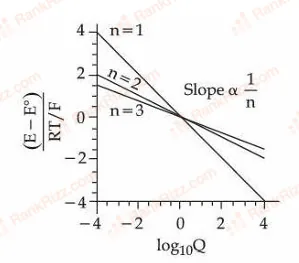
  3. C
    Figure for JEE Main 2026 Chemistry question on Electrode potentials, electrochemical series and cell EMF

    Here n is the number of electrons transferred in redox reaction.

  4. D

    If the reaction is carried out reversibly, the electrical work done is equal to the ratio of charge and potential difference through which charge is moved.

JEE MAIN 2026 · 05 APR S2Electrode potentials, electrochemical series and cell EMF

One half cell in a voltaic cell is constructed by dipping silver rod in AgNO3\text{AgNO}_3 solution of unknown concentration, other half cell is Zn rod dipped in 1 molar solution of ZnSO4\text{ZnSO}_4. A voltage of 1.60 V1.60\,\text{V} is measured at 298 K298\,\text{K} for this cell. What is the concentration of Ag+\text{Ag}^+ ions used in terms of log⁡x\log x (x=[Ag+])(x = [\text{Ag}^+])?

EZn2+/Zn⊖=−0.76 V,E^\ominus_{\text{Zn}^{2+}/\text{Zn}} = -0.76\,\text{V}, \quad EAg+/Ag⊖=+0.80 V,E^\ominus_{\text{Ag}^{+}/\text{Ag}} = +0.80\,\text{V}, \quad 2.303RTF=0.059 V\frac{2.303RT}{F} = 0.059\,\text{V}

  1. A

    23.9\frac{2}{3.9}

  2. B

    45.9\frac{4}{5.9}

  3. C

    2.92\frac{2.9}{2}

  4. D

    5.94\frac{5.9}{4}

JEE MAIN 2026 · 05 APR S2Conductance, conductivity and molar conductivity

At 298 K, the molar conductivity of an x%x\% (w/w) MX solution is 123.5 S cm2 mol−1^{2} mol^{-1}. The conductance of same solution is 1.9×10⁻³S1.9 \times 10^{-3} S. The value of x is ______ ×10−2\times 10^{-2}.
(Given: Cell constant = 1.3 cm−1^{-1}, molar mass of MX = 75 gmol−1g mol^{-1}, density of aqueous solution of MXMX at 298 K is 1.0 g mL−1g mL^{-1})

JEE MAIN 2026 · 04 APR S2Electrode potentials, electrochemical series and cell EMF

An electrochemical cell, consist of the following two redox couples, Mx+^{x+}(aq)/M(s) [EredΘ=+0.15E_{red}^{\Theta} = +0.15 V] and Fe3+^{3+}(aq)/Fe(s) [EredΘ=−0.036E_{red}^{\Theta} = -0.036 V]. The cell EMF (Ecell_{cell}) is recorded to be 0.2057 V. If the reaction quotient of the electrochemical reaction is found to be 10−210^{-2}, then the value of xx is __________. (Nearest integer)

[Given: M is a p-block metal and 2.303RTF=0.059\frac{2.303RT}{F} = 0.059 V]

JEE MAIN 2026 · 02 APR S1Electrode potentials, electrochemical series and cell EMF

An electrochemical cell is constructed using half cells in the direction of spontaneous change
Fe(OH)2_2(s) + 2e−^- →\rightarrow Fe(s) + 2OH−^-(aq)       E0^0 = −0.88 V
and AgBr(s) + e−^- →\rightarrow Ag(s) + Br−^-(aq)                 E0^0 = +0.07 V
Which of the following option is correct?

  1. A

    Overall reaction Fe(s)+2OH−^-(aq)+2AgBr(s) ⇌\rightleftharpoons Fe(OH)2_2(s)+2Ag(s)+2Br−^-(aq)

  2. B

    Ecell0=−0.95E^0_{cell} = -0.95 V

  3. C

    Fe is reduced in the electrochemical cell

  4. D

    Ecell0E^0_{cell} is an extensive property

JEE MAIN 2026 · 02 APR S2Batteries, fuel cells and corrosion

Consider the following two half-cell reactions along with the standard reduction potential given : 

Figure for JEE Main 2026 Chemistry question on Batteries, fuel cells and corrosion

A fuel cell was set up using the above two reactions such that the cell operates under the standard condition of 1 bar pressure and 298 K temperature. The fuel cell works with 80% efficiency. If the work derived from the cell using 1 mol of CH3_3OH is used to compress an ideal gas isothermally against a constant pressure of 1 kPa, then the change in the volume of the gas, ΔV=\Delta V = _____ m3^3. (nearest integer)
Given: F=96500F = 96500 C mol−1^{-1}

JEE MAIN 2026 · 28 JAN S1Electrode potentials, electrochemical series and cell EMF

Consider the following redox reaction taking place in acidic medium
BH4−(aq)+ClO3−(aq)→H2BO3−(aq)+Cl−(aq)BH_{4}^{-}(aq)+ClO_{3}^{-}(aq)\rightarrow H_{2}BO_{3}^{-}(aq)+Cl^{-}(aq)
If the Nerst equation for the above balanced reaction is Ecell=Ecell∘−RTnFlnQE_{cell}=E_{cell}^{\circ}-\frac{RT}{nF}ln Q, then the value of n is______.(Nearest integer)

JEE MAIN 2026 · 28 JAN S2Electrode potentials, electrochemical series and cell EMF

A volume of x mL of 5 M NaHCO3NaHCO_{3} solution was mixed with 10 mL of 2 M H2CO3H_{2}CO_{3} solution to make an electrolytic buffer. If the same buffer was used in the following electrochemical cell to record a cell potential of 235.3 mV, then the value of x=_______ mL (nearest integer).
Sn(s)∣Sn(OH)62−(0.5M)∣HSnO2−(0.05M)∣OH−∣Bi2O3(s)∣Bi(s)Sn(s)|Sn(OH)_{6}^{2-}(0.5 M)|HSnO_{2}^{-}(0.05 M)|OH^{-}|Bi_{2}O_{3}(s)|Bi(s)
Consider upto one place of decimal for intermediate calculations
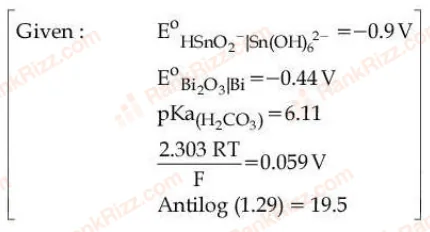
Figure for JEE Main 2026 Chemistry question on Electrode potentials, electrochemical series and cell EMF
JEE MAIN 2026 · 28 JAN S2Conductance, conductivity and molar conductivity

For strong electrolyte λm\lambda_m increases slowly with dilution and can be represented by the equation
Λm=Λm∘−Ac1/2\Lambda_m = \Lambda_m^\circ - A c^{1/2}
Molar conductivity values of the solutions of strong electrolyte AB at 18°C are given below:
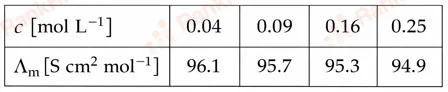
Figure for JEE Main 2026 Chemistry question on Conductance, conductivity and molar conductivity


The value of constant A based on the above data [in S cm2mol−1/(mol/L)1/2cm^{2}mol^{-1}/(mol/L)^{1/2}]unit is_______.

JEE MAIN 2026 · 24 JAN S1Conductance, conductivity and molar conductivity

Electricity is passed through an acidic solution of Cu2+Cu^{2+} till all the Cu2+ was exhausted, leading to the deposition of 300 mg of Cu metal. However, a current of 600 mA was continued to pass through the same solution for another 28 minutes by keeping the total volume of the solution fixed at 200 mL. The total volume of oxygen evolved at STP during the entire process is __ mL. (Nearest integer)
[Given:
Cu2+(aq)+2e−→Cu(s)Ered∘=+0.34VCu^{2+}(aq)+2e^{-}\rightarrow Cu(s) E_{red}^{\circ}=+0.34V
O2(g)+4H++4e−→2H2OEred∘=+1.23VO_{2}(g)+4H^{+}+4e^{-}\rightarrow 2H_{2}O E_{red}^{\circ}=+1.23V
Molar mass of Cu= 63.54 g mol−1mol^{-1}
Molar mass of O2O_{2} = 32 g mol−1mol^{-1}
Farnday Constant = 96500 C mol−1mol^{-1}
Molar volume at STP = 22.4 L]

JEE MAIN 2026 · 24 JAN S2Conductance, conductivity and molar conductivity

Molar conductivity of a weak acid HQ of concentration 0.18 M was found to be 1/30 of the molar conductivity of another weak acid HZ with concentration of 0.02M. If λ∘Q−\lambda^{\circ}{}_{Q}- happened to be equal with λ∘Z−\lambda^{\circ}{}_{Z}-, then the difference of the pKapK_{a} values of the two weak acids (pKa(HQ)−pKa(HZ))(pK_{a}(HQ) - pK_{a}(HZ)) is ___ (Nearest integer).
[Given: degree of dissociation (α\alpha) << 1 for both weak acids, λ∘\lambda^{\circ} : limiting molar conductivity of ions]

JEE MAIN 2026 · 23 JAN S1Electrode potentials, electrochemical series and cell EMF

In the given electrochemical cell, Ag(s)∣AgCl(s)∣FeCl2(aq)Ag(s)|AgCl(s)|FeCl_{2}(aq), FeCl3(aq)∣Pt(s)FeCl_{3}(aq)|Pt(s) at298 K, theceU potential EcellE_{cell} will increase when:
A. Concentration of Fe2+Fe^{2+} is increased.
B. Concentration of Fe3+Fe^{3+} is decreased.
C. Concentration of Fe2+Fe^{2+} is decreased.
D. Concentration of Fe3+Fe^{3+} is increased.
E. Concentration of Cl−Cl^{-} is increased.
Choose the correct answer from the options given below :

  1. A

    B Only

  2. B

    A and B Only

  3. C

    C, D and E Only

  4. D

    A and E Only

JEE MAIN 2026 · 23 JAN S2Electrode potentials, electrochemical series and cell EMF
Figure for JEE Main 2026 Chemistry question on Electrode potentials, electrochemical series and cell EMF

Consider the above electrochemical cell where a metal electrode (M) is undergoing redox reaction by forming M+(M→M++e−)M^{+}(M\rightarrow M^{+}+e^{-}). The cation M+M^{+} is present in two different concentrations c1c_{1} and c2c_{2} as shown above. which of the following statement is correct for generating a positive cell potential?

  1. A

    If c1c_1 is present at anode, then c1=c2c_1 = c_2.

  2. B

    If c1c_1 is present at cathode, then c1>c2c_1 > c_2.

  3. C

    If c1c_1 is present at cathode, then c1<c2c_1 < c_2.

  4. D

    If c1c_1 is present at anode then c1>c2c_1 > c_2.

JEE MAIN 2026 · 22 JAN S1Electrode potentials, electrochemical series and cell EMF

Consider the following electrochemical cell at 298K

Pt∣HSnO2−(aq)∣Sn(OH)62−(aq)∣OH−(aq)∣Bi2O3(s)∣Bi(s)Pt \mid HSnO_2{^-}(aq)\mid Sn(OH)_6{^{2-}}(aq)\mid OH^{-}(aq)\mid Bi_{2}O_{3}(s)\mid Bi(s).

If the reaction quotient at a given time is 10610^{6}, then the cell EMF(Ecell)EMF (E_{cell}) is _____ ×10−1V\times 10^{-1} V (Nearest integer).

Given the standard half-cell reduction potential as

EBi2O3/Hi,OH−o=−0.44V and ESn(OH)62−/HSnO2−,OH−o=−0.90VE_{Bi_{2}O_{3}/Hi,OH^{-}}^{o}=-0.44V \text{ and }E_{Sn(OH)_6^{2-}/HSnO_2^{-}, OH^{-}}^{o}=-0.90V

JEE MAIN 2026 · 22 JAN S2Electrode potentials, electrochemical series and cell EMF

Consider the following reduction processes :
Al3++3e−→Al(s),E∘=−1.66VAl^{3+} + 3e^{-} \rightarrow Al(s), E^{\circ} = -1.66V
Fe3++e−→Fe2+,E∘=+0.77VFe^{3+} + e^{-} \rightarrow Fe^{2+}, E^{\circ} = +0.77V
Co3++e−→Co2+,E∘=+1.81VCo^{3+} + e^{-} \rightarrow Co^{2+}, E^{\circ} = +1.81V
Cr3++3e−→Cr(s),E∘=−0.74VCr^{3+} + 3e^{-} \rightarrow Cr(s), E^{\circ} = -0.74V
The tendency to act as reducing agent decreases in the order :

  1. A

    Al>Cr>Fe2+>Co2+Al> Cr > Fe^{2+} > Co^{2+}

  2. B

    Cr>Fe2+>Al>Co2+Cr> Fe^{2+} > Al > Co^{2+}

  3. C

    Al>Cr>Co2+>Fe2+Al > Cr > Co^{2+} > Fe^{2+}

  4. D

    Al>Fe2+>Cr>Co2+Al > Fe^{2+} > Cr > Co^{2+}

JEE MAIN 2026 · 22 JAN S2Electrode potentials, electrochemical series and cell EMF

Consider the following electrochemical cell : Pt∣O2(g)(1bar)∣HCl(aq)∣∣M2+(aqPt| O_{2}(g)(1 bar) | HCl(aq)||M^{2+}(aq, 1.0M)∣M(s)1.0M)|M(s)
The pH above which , oxygen gas would start to evolve at anode is ____ (nearest integer).
[Given: EM2+/m∘=0.994VE_{M^{2+}/m}^\circ = 0.994V , EO2/H2O∘=1.23VE_{O^{2}/H_{2}O}^\circ = 1.23V are standard reduction potential and RTF(2.303)=0.059V\frac{RT}{F}(2.303)=0.059V at the given condition]

JEE MAIN 2026 · 21 JAN S1Conductance, conductivity and molar conductivity

The pH and conductance of a weak acid (HX) was found to be 5 and 4×10⁻⁵S4\times10^{-5}S. respectively. The conductance was measured under standard condition using a cell where the electrode plates having a surface area of 1 cm2cm^{2} were at a distance of 15 cm apart. The value of the limiting molar conductivity is ______ S m2mol−1m^{2}mol^{-1} (nearest integer)
(Given : degree of dissociation of the weak acid (α\alpha) < < 1)

JEE MAIN 2026 · 21 JAN S2Electrode potentials, electrochemical series and cell EMF

For a closed circuit Daniell cell, which of the following plots is the accurate one at a given temperature?
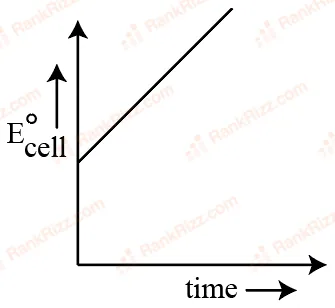
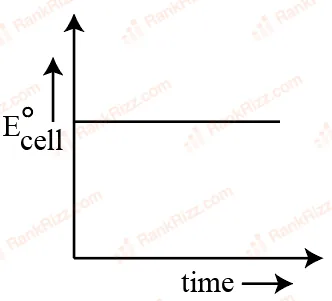
  1. A
    56 opt 1
  2. B
    56 OPT 2
  3. C
    Screenshot_37
  4. D
    56 opt 4