RankRizz

Chemical Thermodynamics — JEE Main Previous Year Questions

Every Chemical Thermodynamics question JEE Main has set from 2004–2026, grouped by the idea it tests rather than the order of the syllabus. 229 questions across 7 distinct ideas. Free to read, answer key on every one.

DATA UPDATED

Questions

229

Distinct ideas

7

Share of marks

4.6%

Difficulty

MEDIUM

The ideas inside Chemical Thermodynamics

A chapter is not one subject — it is a handful of procedures the examiner reuses. These are the ones Chemical Thermodynamics questions actually test.

Every Chemical Thermodynamics question

81–100 OF 229 · NEWEST FIRST

JEE MAIN 2023 · 11 APR S1Enthalpies of reaction and Hess's law

Solid fuel used in rocket is a mixture of Fe2_2O3_3 and Al (in ratio 1 : 2). The heat evolved (kJ) per gram of the mixture is _______
Given ΔHf0\Delta H_f^0 Al2_2O3_3 = -1700 kJ mol−1^{-1}
ΔHf0\Delta H_f^0 Fe2_2O3_3 = -840 kJ mol−1^{-1}
Molar mass of Fe, Al and O are 56, 27 and 16 g mol−1^{-1} respectively

JEE MAIN 2023 · 11 APR S2System, surroundings and state functions

The total number of intensive properties from the following is _______
Volume, Molar heat capacity, molarity, Ecell∘E^\circ_{cell}, Gibbs free energy change, Molar mass, Mole

JEE MAIN 2023 · 10 APR S1Enthalpies of reaction and Hess's law

Given
(A) 2CO(g)+O2(g)→2CO2(g)2CO(g) + O_2(g) \to 2CO_2(g), ΔH10=−x\Delta H_1^0 = -x kJ mol−1^{-1}
(B) Cgraphite+O2(g)→CO2(g)C_{graphite} + O_2(g) \to CO_2(g), ΔH20=−y\Delta H_2^0 = -y kJ mol−1^{-1}
The ΔH0\Delta H^0 for the reaction Cgraphite+12O2(g)→CO(g)C_{graphite} + \frac{1}{2}O_2(g) \to CO(g) is

  1. A

    2x−y2\frac{2x - y}{2}

  2. B

    x+2y2\frac{x + 2y}{2}

  3. C

    x−2y2\frac{x - 2y}{2}

  4. D

    2y−x2y - x

JEE MAIN 2023 · 10 APR S2Enthalpies of reaction and Hess's law

The number of endothermic process/es from the following is _______.
A. I2(g)→2I(g)I_2(g) \to 2I(g)
B. HCl(g)→H(g)+Cl(g)HCl(g) \to H(g) + Cl(g)
C. H2O(l)→H2O(g)H_2O(l) \to H_2O(g)
D. C(s)+O2(g)→CO2(g)C(s) + O_2(g) \to CO_2(g)
E. Dissolution of ammonium chloride in water

JEE MAIN 2023 · 08 APR S1First law: work, heat and internal energy

When a 60 W electric heater is immersed in a gas for 100 s in a constant volume container with adiabatic walls, the temperature of the gas rises by 5°C. The heat capacity of the given gas is JK−1^{-1} (Nearest integer)

JEE MAIN 2023 · 08 APR S2Gibbs energy and spontaneity

For complete combustion of ethene,
C2H4(g)+3O2(g)→2CO2(g)+2H2O(l)C_2H_4(g) + 3O_2(g) \to 2CO_2(g) + 2H_2O(l)
the amount of heat produced as measured in bomb calorimeter is 1406 kJ mol−1^{-1} at 300 K. The minimum value of TΔ\DeltaS needed to reach equilibrium is (−-) kJ. (Nearest integer)
Given: R = 8.3 J K−1^{-1} mol−1^{-1}

JEE MAIN 2023 · 06 APR S1Gibbs energy and spontaneity

The value of log K for the reaction A ⇌\rightleftharpoons B at 298 K is ______. (Nearest integer)
Given: ΔH°=−54.07\Delta H° = -54.07 kJ mol−1^{-1}, ΔS°=10\Delta S° = 10 J K−1^{-1} mol−1^{-1}
(Taken 2.303×8.314×298=57052.303 \times 8.314 \times 298 = 5705)

JEE MAIN 2023 · 06 APR S1Gibbs energy and spontaneity

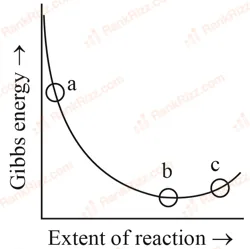
Consider the graph of Gibbs free energy G vs extent of reaction. The number of statement/s from the following which are true with respect to points (a), (b) and (c) is ______

Figure for JEE Main 2023 Chemistry question on Gibbs energy and spontaneity


A. Reaction is spontaneous at (a) and (b)
B. Reaction is at equilibrium at point (b) and non-spontaneous at point (c)
C. Reaction is spontaneous at (a) and non-spontaneous at (c)
D. Reaction is non-spontaneous at (a) and (b)

JEE MAIN 2023 · 06 APR S2Enthalpies of reaction and Hess's law

Consider the following data
Heat of combustion of H2_2(g) = -241.8 kJ mol−1^{-1}
Heat of combustion of C(s) = -393.5 kJ mol−1^{-1}
Heat of combustion of C2_2H5_5OH(l) = -1234.7 kJ mol−1^{-1}
The heat of formation of C2_2H5_5OH(l) is (-) ______ kJ mol−1^{-1} (Nearest integer)

JEE MAIN 2023 · 01 FEB S1Enthalpies of reaction and Hess's law

At 25°C, the enthalpy of the following processes are given:
H2_2(g) + O2_2(g) →\to 2OH(g) Δ\DeltaH0^0 = 78 kJ mol−1^{-1}
H2_2(g) + 1/2O2_2(g) →\to H2_2O(g) Δ\DeltaH0^0 = -242 kJ mol−1^{-1}
H2_2(g) →\to 2H(g) Δ\DeltaH0^0 = 436 kJ mol−1^{-1}
1/2O2_2(g) →\to O(g) Δ\DeltaH0^0 = 249 kJ mol−1^{-1}
H2_2O(g) →\to Hg + OHg Δ\DeltaH0^0 = X kJmol−1^{-1}
What would be the value of X for the following reaction? (Nearest integer)

JEE MAIN 2023 · 01 FEB S2Enthalpies of reaction and Hess's law

0.30.3 g of ethane undergoes combustion at 27°27°C in a bomb calorimeter. The temperature of calorimeter system (including the water) is found to rise by 0.5°0.5°C. The heat evolved during combustion of ethane at constant pressure is ______ kJ mol−1^{-1}. (Nearest integer)
[Given: The heat capacity of the calorimeter system is 2020 kJ K−1^{-1}, R =8.3= 8.3 JK−1^{-1} mol−1^{-1}. Assume ideal gas behaviour. Atomic mass of C and H are 12 and 1 g mol−1^{-1} respectively]

JEE MAIN 2023 · 31 JAN S1Enthalpies of reaction and Hess's law

The enthalpy change for the conversion of 12\dfrac{1}{2}Cl2_2(g) to Cl−^-(aq) is (-) ______ kJmol−1^{-1} (Nearest integer)
Given: ΔdisHCl2(g)0=240\Delta_{dis}H^0_{Cl_2(g)} = 240 kJmol−1^{-1}
ΔegHCl(g)o=−350\Delta_{eg}H^o_{Cl(g)} = -350 kJmol−1^{-1}
ΔhydHCl−(g)o=−380\Delta_{hyd}H^o_{Cl^-(g)} = -380 kJmol−1^{-1}

JEE MAIN 2023 · 31 JAN S2Enthalpies of reaction and Hess's law

Enthalpies of formation of CCl4_4(g), H2_2O(g), CO2_2(g) and HCl are -105, -242, -394 and -92 kJ mol−1^{-1} respectively. The magnitude of enthalpy of the reaction given below is kJmol−1^{-1}. (nearest integer)
CCl4(g)+2H2O(g)→CO2(g)+4HCl(g)CCl_4(g) + 2H_2O(g) \rightarrow CO_2(g) + 4HCl(g)

JEE MAIN 2023 · 30 JAN S1First law: work, heat and internal energy

When 2 litre of ideal gas expands isothermally into vacuum to a total volume of 6 litre, the change in internal energy is ______ J. (Nearest integer)

JEE MAIN 2023 · 30 JAN S2First law: work, heat and internal energy

1 mole of ideal gas is allowed to expand reversibly and adiabatically from a temperature of 27°27°C. The work done is 33 kJ mol−1^{-1}. The final temperature of the gas is ______ K (Nearest integer). Given Cv=20C_v = 20 J mol−1^{-1} K−1^{-1}

JEE MAIN 2023 · 29 JAN S2Heat capacity and calorimetry

Which of the following relations are correct?
(A) ΔU=q+pΔV\Delta U = q + p\Delta V
(B) ΔG=ΔH−TΔS\Delta G = \Delta H - T\Delta S
(C) ΔS=qrevT\Delta S = \frac{q_{rev}}{T}
(D) ΔH=ΔU−ΔnRT\Delta H = \Delta U - \Delta nRT
Choose the most appropriate answer from the options given below:

  1. A

    C and D only

  2. B

    B and C only

  3. C

    A and B only

  4. D

    B and D only

JEE MAIN 2023 · 25 JAN S1Enthalpies of reaction and Hess's law

An athlete is given 100 g of glucose (C6_6H12_{12}O6_6) for energy. This is equivalent to 1800 kJ of energy. The 50% of this energy gained is utilized by the athlete for sports activities at the event. In order to avoid storage of energy, the weight of extra water he would need to perspire is _____ g (Nearest integer) Assume that there is no other way of consuming stored energy.
Given: The enthalpy of evaporation of water is 45 kJ mol−1^{-1}
Molar mass of C, H & O are 12.1 and 16 g mol−1^{-1}.

JEE MAIN 2023 · 25 JAN S2Enthalpies of reaction and Hess's law

28.0 L of CO2_2 is produced on complete combustion of 16.8 L gaseous mixture of ethene and methane at 25°C and 1 atm. Heat evolved during the combustion process is _____ kJ
Given: ΔHC\Delta H_C(CH4_4) = -900 kJ mol−1^{-1}
ΔHC\Delta H_C(C2_2H4_4) = -1400 kJ mol−1^{-1}.

JEE MAIN 2023 · 24 JAN S1Gibbs energy and spontaneity

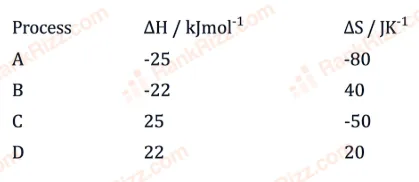
For independent process at 300 K.

Figure for JEE Main 2023 Chemistry question on Gibbs energy and spontaneity


The number of non-spontaneous process from the following is _____.

JEE MAIN 2023 · 24 JAN S1Gibbs energy and spontaneity

For independent process at 300 K.

ProcessΔH\Delta H / kJmol−1^{-1}ΔS\Delta S / JK−1^{-1}
A-25-80
B-2240
C25-50
D2220

The number of non-spontaneous process from the following is _____.