JEE MAIN 2026 · 08 APR S2Nucleophilic addition reactions of carbonyl compounds
Consider the following reaction.
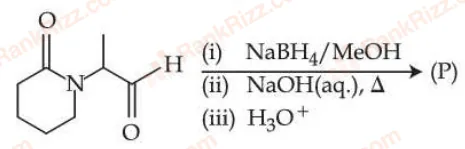
The major product (P) formed is :
- A
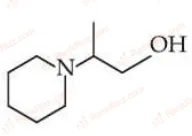
- B
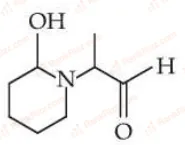
- C
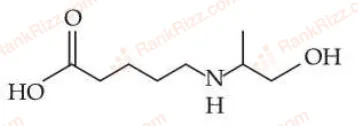
- D
Aldehydes and Ketones has been asked in 21 of the 23 JEE Main years from 2004 to 2026: 214 questions in all. In 2026 it averaged 1.2 questions per paper (22 across 19 papers), 4.6% of Chemistry questions, up from 4.4% in 2025. Across the last 20 papers it carried 4.6% of Chemistry marks. By type: 192 MCQs and 22 numerical-answer questions. Of the 196 with a difficulty tag, 19% are easy, 77% medium and 5% hard. Most asked: Nucleophilic addition reactions of carbonyl compounds (138, 64%), Distinguishing tests for aldehydes and ketones (34, 16%) and Preparation of aldehydes and ketones (25, 12%).
DATA UPDATED
Questions
214
Distinct ideas
5
Share of marks
4.6%
Difficulty
HARD
The share of each year’s Chemistry questions that came from Aldehydes and Ketones, counted from the 168 papers we hold for the last 10 years, and session by session inside a year.
Rising: 4.4% of Chemistry questions in 2024–2026, up from 3.5% in 2017–2023. Its heaviest year was 2026, at 4.6%.
| YEAR | QS | PER PAPER | SHARE OF CHEMISTRY | CHANGE | |
|---|---|---|---|---|---|
| 2026 | 22 / 480 | 1.2 | 4.6% | +0.2 pts | JAN 5.2%APR 3.9% |
| 2025 | 21 / 475 | 1.1 | 4.4% | +0.1 pts | JAN 4.4%APR 4.4% |
| 2024 | 26 / 600 | 1.3 | 4.3% | +1.1 pts | JAN 4.0%APR 4.7% |
| 2023 | 24 / 750 | 1.0 | 3.2% | level | JAN 3.8%APR 2.5% |
| 2022 | 21 / 660 | 1.0 | 3.2% | −1.1 pts | JUN 2.8%JUL 3.7% |
| 2021 | 31 / 720 | 1.3 | 4.3% | +1.5 pts | FEB 7.3%MAR 4.0%JUL 2.9%AUG 3.8% |
| 2020 | 11 / 400 | 0.7 | 2.8% | −1.2 pts | JAN 2.0%SEP 3.2% |
| 2019 | 19 / 480 | 1.2 | 4.0% | −0.2 pts | JAN 4.6%APR 3.3% |
| 2018 | 5 / 120 | 1.3 | 4.2% | +0.9 pts | 4 PAPERS, ONE SESSION |
| 2017 | 3 / 90 | 1.0 | 3.3% | — | 3 PAPERS, ONE SESSION |
“QS” is Aldehydes and Ketones questions out of all Chemistry questions that year; “per paper” is that count over the year’s papers, and “change” is the share against the year before. A year with more sittings asks more questions, which is why the share, not the count, is the number to compare.
How Aldehydes and Ketones compares: every Chemistry chapter by weightage · most repeated JEE Main topics
A chapter is not one subject — it is a handful of procedures the examiner reuses. These are the ones Aldehydes and Ketones questions actually test.
Every JEE Main Aldehydes and Ketones question we hold, newest first inside each topic. Open one for its options, answer key and solution.
FREE PDF
All 214 questions on A4, by topic, with the answer key at the end. No sign-up, no email: your browser saves it as a PDF.
Download free PDFUNIQUE CONCEPTS
5 ideas, each with the latest past question that tested it, drawn from 260 JEE Main and Advanced questions.
Aldehydes and Ketones Unique Concepts sheet →JEE ADVANCED
JEE Advanced has set 47 Aldehydes and Ketones questions, 2007–2026.
Aldehydes and Ketones JEE Advanced PYQs →Not every year. It has been asked in 21 of the 23 JEE Main years from 2004 to 2026; the years without a Aldehydes and Ketones question were 2008 and 2010.
Nucleophilic addition reactions of carbonyl compounds: 138 of the 214 questions (64%). Next come Distinguishing tests for aldehydes and ketones (34) and Preparation of aldehydes and ketones (25).
About 4.6% across the last 20 papers. Every JEE Main question carries the same marks, so that is also its share of Chemistry questions. In 2026 it was 4.6% (22 of 480 Chemistry questions).
In JEE Main 08 Apr 2026, Shift 2, the latest sitting with a Aldehydes and Ketones question.
214 from 2004 to 2026, across 5 topics. Every one is listed on this page by topic and links to its own page, with the answer key and solution wherever we have them. Free, no sign-up.
1–20 OF 214 · NEWEST FIRST
Consider the following reaction.
The major product (P) formed is :
'' is the product which is obtained from benzene by reacting it with carbon monoxide and hydrogen chloride in the presence of cuprous chloride. '' is the major product obtained from the benzene by reacting it with ethanoyl chloride in the presence of anhydrous AlCl. Product (major) obtained by heating and in the presence of alkali is . Total number of (pi) electrons in is __________.
'x' is the product which is obtained by the hydrolysis of prop-1-yne in the presence of mercuric sulphate under dilute acidic medium at 333 K. 'y' is the product which is obtained by the reaction of ethane nitrile with methyl magnesium bromide in dry ether followed by hydrolysis. IUPAC name of product obtained from 'x' and 'y' in the presence of barium hydroxide followed by heating is :
2-Methylpent-4-en-3-one
4-Methylpent-3-en-2-one
4-Methylpent-1-ene
2-Methylpent-3-one
An optically active alkyl bromide CHBr, reacts with ethanolic KOH to form major compound [A] which reacts with bromine to give compound [B]. Compound [B] reacts with ethanolic KOH and sodamide to give compound [C]. One molecule of water adds to compound [C] on warming with mercuric sulphate and dilute sulphuric acid at 333 K to form compound [D]. The functional group in compound D will be confirmed by :
Haloform test
Lucas test
Silver mirror test
Benedict test
"P" is a hydrocarbon of molecular formula: . On ozonolysis, "P" forms "Q". "Q" on treatment with alkali under reflux condition produces "R", which on treatment with /NaOH gives a yellow precipitate. Acidification of the solution gives "S". The structure of "S" is given below:-
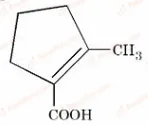
The correct structure of "P" is
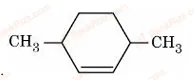
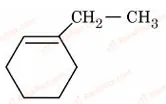
Given below are two statements:
The condensation reaction between and
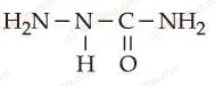
under optimum pH will produce
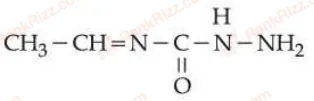
The molecule
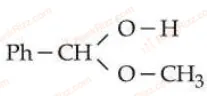
will generate in the presence of dilute acid.
In the light of the above statements, choose the correct answer from the options given below:
Both statements are true
Both statements are false
Statement I is true but Statement II is false
Statement I is false but Statement II is true
An organic compound "x" where molar ratio of C, O and H are equal, on treatment with 50% KOH under reflux followed by acidification produced "y". The most likely structure of "y" is :
[Molar mass of 'x' is 58 g mol]
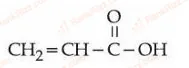

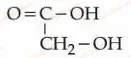
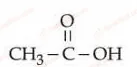
A molecule (X) with the following structure under mild acidic condition is hydrolysed to produce (Y) and (Z). Identify the correct statements about (Y) and (Z).
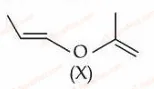
A. Both (Y) and (Z) have same molar mass.
B. (Y) and (Z) can be distinguished from each other by NaHCO.
C. (Y) and (Z) react with HCN with same rates.
D. (Y) and (Z) undergo addition reaction with 2,4-DNP.
Choose the correct answer from the options given below :
A, B and C Only
B and C Only
C and D Only
A and D Only
Identify compounds A and E in the following reaction sequence.
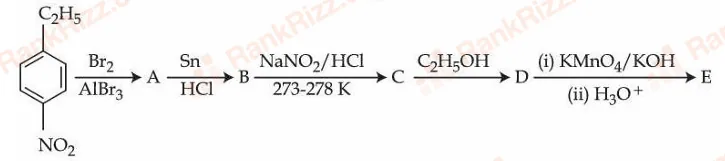
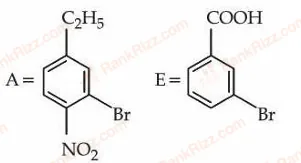
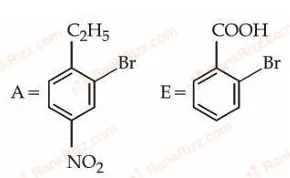
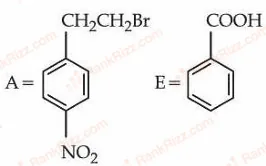
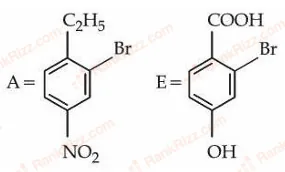
Given below are two statements for the following reaction sequence.
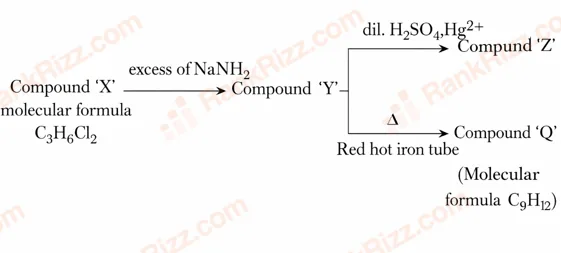
Statement I: Compound 'Z' will give yellow precipitate with NaOI.
Statement II: Compound 'Q' has two different types of'H' atoms (aromatic:aliphatic) in the ratio 1 :3.
In the light of the above statements, choose the correct answer from the options given below:
Statement I is false but Statement II is true
Statement I is true but Statement II is false
Both Statement I and Statement II are false
Both Statement I and Statement II are true
Given below are the four isomeric compounds (P, Q, R, S)
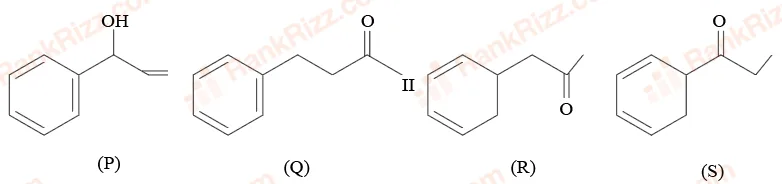
Identify correct statements from below
A. Q, R and S will give precipitate with 2, 4 - DNP.
B. P and Q will give positive Bayer's test.
C. Q and R will give sooty flame.
D. Rand S will give yellow precipitate with .
E. Q alone will deposit silver with Tollen's reagent.
Choose the correct option.
C and E only
A, B, D and E only
A, C and E only
A and E only
Consider the following two reactions A and B.
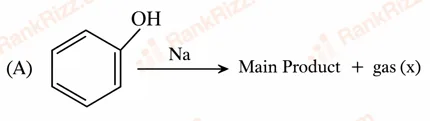
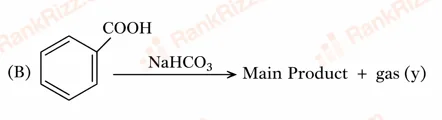
Numerical value of [ molar mass of x + molar mass of y] is __
4
46
160
88
A student is given one compound among the following compounds that gives positive test with Tollen's reagent
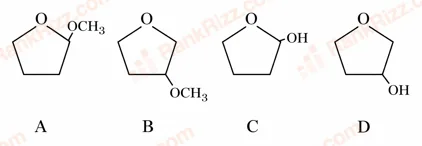
The compound is :
B
C
D
A
Given below are two statements:
Statement I: Cross aldol condensation between two different aldehydes will always produce four different products.
Statement II: When semicarbazide reacts with a mixture of benzaldehyde and acetophenone under optimum pH, it fonns a condensation product with acetophenone only.
In the light of the above statements, choose the correct answer from the options given below
Statement I is true but Statement II is false
Both Statement I and Statement II are false
Statement I is false but Statement II is true
Both Statement I and Statement II are true
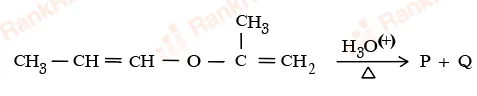
The unsaturated ether On acidic hydrolysis produces carbonyl compom1ds as shown below:-
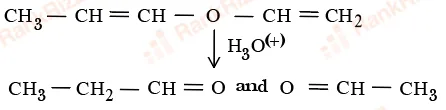
Based On this, predict the solution/reagent that will help to distillguish "P" and "Q" obtained in the following reaction:-
2, 4 - DNP reagent
Fehling solution
Saturated solution
Lucas reagent
'x' is the product which is obtained &om propanenitrile and stannous chloride in the presence of hydrochloric acid followed by hydrolysis. 'y' is the product which is obtained from the but-2-ene by the ozonolysis followed by hydrolysis. From the followu1g, which product is not obtained when one mole of 'x' and one mole of 'y' react with, each other in the presence of alkali followed by heating?
Pent-2-enal
3-Methylbut-2-enal
2-Methylbut-2-enal
2-Methylpent-2-enal
Iodoform test can differentiate between
A. Methanol and Ethanol
B. and
C. Cyclohexene and cyclohexanone
D. Diethyl ether and Pentan-3-one
E. Anisole and acetone
Choose the correct answer from the options given below:
B, C & E Only
A & D Only
A & E Only
A, B & E Only
Which of the following statements are TRUE about Haloform reaction?:
A. Sodium hypochlorite reacts with KI to give KOI.
B. KOI is a reducing agent.
C. -unsaturated methylketone will give iodoform reaction.
D. Isopropyl alcohol will not give iodoform test.
E. Methanoic acid will give positive iodoform test.
Choose the correct answer from the options given below:
A, B & C Only
A, C & E Only
B, D & E Only
A & C Only
Match the LIST-I with LIST-II
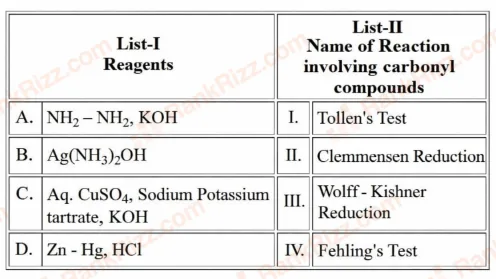
Choose the correct answer from the options given below:
A-III, B-IV, C-I, D-II
A-IV, B-III, C-II, D-I
A-II, B-I, C-IV, D-III
A-III, B-I, C-IV, D-II
The compound A, reacts with acetophenone to form a single product via cross-Aldol condensation. The compound A on reaction with cone. NaOH forms a substituted benzyl alcohol as one of the two products. The compound A is :
2-hydroxy acetophenone
4-hydroxy benzylaldehyde
4-methyl benzoic acid
4-methoxy benzaldehyde
OTHER CHEMISTRY CHAPTERS