RankRizz

Chemical Thermodynamics — JEE Main Previous Year Questions

Every Chemical Thermodynamics question JEE Main has set from 2004–2026, grouped by the idea it tests rather than the order of the syllabus. 229 questions across 7 distinct ideas. Free to read, answer key on every one.

DATA UPDATED

Questions

229

Distinct ideas

7

Share of marks

4.6%

Difficulty

MEDIUM

The ideas inside Chemical Thermodynamics

A chapter is not one subject — it is a handful of procedures the examiner reuses. These are the ones Chemical Thermodynamics questions actually test.

Every Chemical Thermodynamics question

41–60 OF 229 · NEWEST FIRST

JEE MAIN 2025 · 28 JAN S1Enthalpies of reaction and Hess's law

The formation enthalpies, ΔHf⊖\Delta H_{f}\ominus for HgH_{g} and OgO_{g} are 220.0 and 250.0kJmol−1250.0 kJ mol^{-1}, respectively, at 298.15 K , and ΔHf⊖\Delta H_{f}\ominus for H2OgH_{2}O_{g} is −242.5kJmol−1-242.5 kJ mol^{-1} at the same temperature. The average bond enthalpy of the O−HO-H bond in water at 298.15 K is __________kJmol−1kJ mol^{-1}(nearest integer).

JEE MAIN 2025 · 28 JAN S2First law: work, heat and internal energy
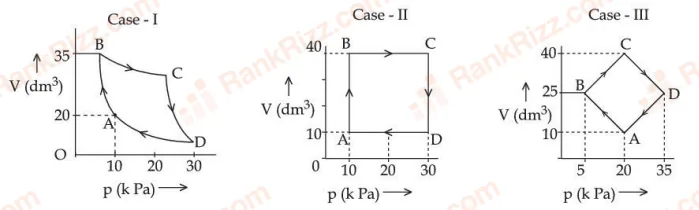
page11_img2

An ideal gas undergoes a cyclic transformation starting from the point A and coming back to the same point by tracing the path A→B→C→D→AA \rightarrow B \rightarrow C \rightarrow D \rightarrow A as shown in the three cases above. Choose the correct option regarding ΔU\Delta U :

  1. A

    ΔU(Case-I)=ΔU(Case-II)=ΔU(Case-III)\Delta U(\text{Case-I}) = \Delta U(\text{Case-II}) = \Delta U(\text{Case-III})

  2. B

    ΔU(Case-I)>ΔU(Case-III)>ΔU(Case-II)\Delta U(\text{Case-I}) > \Delta U(\text{Case-III}) > \Delta U(\text{Case-II})

  3. C

    ΔU(Case-III)>ΔU(Case-II)>ΔU(Case-I)\Delta U(\text{Case-III}) > \Delta U(\text{Case-II}) > \Delta U(\text{Case-I})

  4. D

    ΔU(Case-I)>ΔU(Case-II)>ΔU(Case-III)\Delta U(\text{Case-I}) > \Delta U(\text{Case-II}) > \Delta U(\text{Case-III})

JEE MAIN 2025 · 28 JAN S2Enthalpies of reaction and Hess's law

Consider the following data : Heat of formation of CO2CO_{2}(g)= -393.5 kJ mol−1mol^{-1} Heat of formation of H20H_{2}0(l) = - 286.0 kJ mol−1mol^{-1} Heat of combustion of benzene =-3267.0 kJ mol−1mol^{-1} The heat of formation of benzene is _ . (Nearest integer)

JEE MAIN 2025 · 24 JAN S1Gibbs energy and spontaneity

Let us consider an endothermic reaction which is non-spontaneous at the freezing point of water. However, the reaction is spontaneous at boiling point of water. Choose the correct option.

  1. A

    Both ΔH and ΔS are (−ve)\text{Both } \Delta H \text{ and } \Delta S \text{ are } (-\text{ve})

  2. B

    ΔH is (−ve) but ΔS is (+ve)\Delta H \text{ is } (-\text{ve}) \text{ but } \Delta S \text{ is } (+\text{ve})

  3. C

    ΔH is (+ve) but ΔS is (−ve)\Delta H \text{ is } (+\text{ve}) \text{ but } \Delta S \text{ is } (-\text{ve})

  4. D

    Both ΔH and ΔS are (+ve)\text{Both } \Delta H \text{ and } \Delta S \text{ are } (+\text{ve})

JEE MAIN 2025 · 24 JAN S1Gibbs energy and spontaneity

Standard entropies of  X2, Y2X_2,\ Y_2  and  XY5XY_5  are  70, 5070,\ 50  and  110 J K−1mol−1110\,J\,K^{-1}mol^{-1} respectively. The temperature in Kelvin at which the reaction 12X2+52Y2⇌XY5ΔH⊖=−35 kJ mol−1\frac{1}{2}X_2 + \frac{5}{2}Y_2 \rightleftharpoons XY_5 \Delta H^\ominus = -35\,kJ\,mol^{-1} will be at equilibrium is ‾\underline{\hspace{2cm}}  (Nearest integer).} 

JEE MAIN 2025 · 24 JAN S2Enthalpies of reaction and Hess's law

Which of the following mixing of 1 M base and 1 M acid leads to the largest increase in temperature?

  1. A

    30 ml CH3COOH and 30 ml NaOH30\,\text{ml } CH_3COOH \text{ and } 30\,\text{ml } NaOH

  2. B

    45 ml CH3COOH and 25 ml NaOH45\,\text{ml } CH_3COOH \text{ and } 25\,\text{ml } NaOH

  3. C

    30 ml HCl and 30 ml NaOH30\,\text{ml } HCl \text{ and } 30\,\text{ml } NaOH

  4. D

    50 ml HCl and 20 ml NaOH50\,\text{ml } HCl \text{ and } 20\,\text{ml } NaOH

JEE MAIN 2025 · 24 JAN S2Enthalpies of reaction and Hess's law

S(g)+32O2(g)→SO3(g)+2x kcalSO2(g)+12O2(g)→SO3(g)+y kcalThe heat of formation of SO2(g) is given by:S(g) + \frac{3}{2}O_2(g) \rightarrow SO_3(g) + 2x\,\text{kcal} \\SO_2(g) + \frac{1}{2}O_2(g) \rightarrow SO_3(g) + y\,\text{kcal}\\\text{The heat of formation of } SO_2(g) \text{ is given by:}

  1. A

    x+y kcalx + y \,\text{kcal}

  2. B

    y−2x kcaly - 2x \,\text{kcal}

  3. C

    2xy kcal\frac{2x}{y} \,\text{kcal}

  4. D

    2x+y kcal2x + y \,\text{kcal}

JEE MAIN 2025 · 23 JAN S1Gibbs energy and spontaneity

Ice at −5∘C-5^{\circ}C is heated to become vapor with temperature of 110∘C110^{\circ}C at atmospheric pressure. The entropy change associated with this process can be obtained from

  1. A

    ∫268K273KCp ,mdT+ΔHm,fusionTf+ΔHm,vaporisationTb+∫273K373KCp m dT+∫373K383KCp m dT\int_{268K}^{273K} C_p\,, _{m}{dT} + \frac{\Delta H_{m,\text{fusion}}}{T_f} + \frac{\Delta H_{m,\text{vaporisation}}}{T_b} + \int_{273K}^{373K} C_p\, m\, dT + \int_{373K}^{383K} C_p\, m\, dT

  2. B

    ∫268K273KCp ,mT dT+ΔHm,fusionTf+ΔHm,vaporisationTb+∫273K373KCp. mT dT+∫373K383KCp. mdTT\int_{268K}^{273K} \frac{C_p\,, m}{T}\, dT + \frac{\Delta H_{m,\text{fusion}}}{T_f} + \frac{\Delta H_{m,\text{vaporisation}}}{T_b} + \int_{273K}^{373K} \frac{C_p.\, m}{T}\, dT + \int_{373K}^{383K} \frac{C_p.\, m dT}{T}

  3. C

    ∫268K383KCp dT+qrevT\int_{268K}^{383K} C_p\, dT + \frac{q_{\text{rev}}}{T}

  4. D

    ∫268K383KCp dT+ΔHmelting273+ΔHboiling373\int_{268K}^{383K} C_p\, dT + \frac{\Delta H_{\text{melting}}}{273} + \frac{\Delta H_{\text{boiling}}}{373}

JEE MAIN 2025 · 23 JAN S1Gibbs energy and spontaneity

The standard enthalpy and standard entropy of decomposition of N2O4N_{2}O_{4} to NO2NO_{2} are 55.0 kJ mol−1mol^{-1} and 175.0 J/K/mol respectively. The standard free energy change for this reaction at 25∘C25^{\circ}C in J mol−1mol^{-1} is ______ (Nearest integer)

JEE MAIN 2025 · 23 JAN S2Gibbs energy and spontaneity

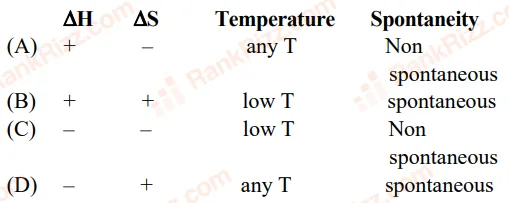
The effect of temperature on spontaneity of reactions are represented as :

page8_img5
  1. A

    (B) and (C) only

  2. B

    (B) and (D) only

  3. C

    (A) and (D) only

  4. D

    (A) and (C) only

JEE MAIN 2025 · 23 JAN S2Enthalpies of reaction and Hess's law

The bond dissociation enthalpy of X2X_2 (ΔHbond) calculated from the given data is ____________ kJmol−1kJmol^{-1}. (Nearest integer)

  • M+X−M^+X^-(s) →\rightarrow M+M^+(g) +X−X^-(g)                ΔH°lattice = 800 kJmol−1kJmol^{-1}
  • M(s) →\rightarrow M(g)                                                ΔH°sub = 100 kJmol−1kJmol^{-1}
  • M(g) →\rightarrow M+(g)+e−(g)M^+(g)+e^{_-}(g)                       ΔHi = 500 kJmol−1kJmol^{-1}
  • X(g) →\rightarrow e−(g)→X−(g)e^-(g)\rightarrow X^-(g)                           ΔH°eg = -300 kJmol−1kJmol^{-1}
  • M(g) + ½X2(g) →\rightarrow M+X−M^+X^-(s)                   ΔH°f = -400 kJmol−1kJmol^{-1}

[Given: (M+X−M^+X^-) is a pure ionic compound and X forms a diatomic molecule (X2X_2) in gaseous state]

JEE MAIN 2025 · 22 JAN S1First law: work, heat and internal energy

A liquid when kept inside a thermally insulated closed vessel 25oC25^{o}C at was mechanically stirred from outside. What will be the correct option for the following thermodynamic parameters ?

  1. A

    △U<0,q=0,w>0\triangle U \lt 0, q=0, w\gt 0

  2. B

    △U=0,q=0,w=0\triangle U = 0, q=0, w=0

  3. C

    △U>0,q=0,w>0\triangle U \gt 0, q=0, w\gt 0

  4. D

    △U=0,q<0,w>0\triangle U = 0, q\lt 0, w\gt 0

JEE MAIN 2025 · 22 JAN S2Gibbs energy and spontaneity
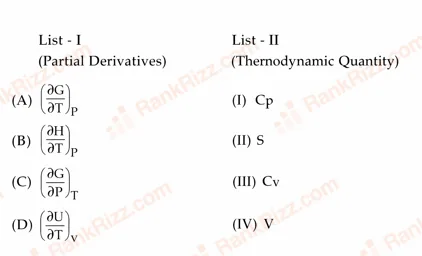
Figure for JEE Main 2025 Chemistry question on Gibbs energy and spontaneity


Match List - I with List - II.
Choose the correct answer from the options given below :

  1. A

    (A)-(II), (B)-(I), (C)-(III), (D)-(IV)

  2. B

    (A)-(I), (B)-(II), (C)-(IV), (D)-(III)

  3. C

    (A)-(II), (B)-(I), (C)-(IV), (D)-(III)

  4. D

    (A)-(II), (B)-(III), (C)-(I), (D)-(IV)

JEE MAIN 2025 · 22 JAN S2Enthalpies of reaction and Hess's law

Consider the following cases of standard enthalpy of reaction (ΔHr∘\Delta H_{r}^{\circ} in kJ mol−1mol^{-1})
C2H6(g)+72O2(g)→2CO2(g)+3H2O(1)ΔH1∘=−1550C_{2}H_{6}(g)+\frac{7}{2}O_{2}(g) \rightarrow 2CO_{2}(g)+3H_{2}O(1)\Delta H_{1}^{\circ}=-1550
C(graphite)+O2(g)→CO2(g)C(graphite)+O_{2}(g)\rightarrow CO_{2}(g) ΔH2∘=−393.5\Delta H_{2}^{\circ}=-393.5 The magnitude of ΔHfC2H6(g)∘\Delta H_{fC_{2}H_{6}(g)}^{\circ} is_______
H2(g)+12O2(g)→H2O(1)H_{2}(g)+\frac{1}{2}O_{2}(g)\rightarrow H_{2}O(1) ΔH3∘=−286\Delta H_{3}^{\circ}=-286
kJmol−1kJ mol^{-1} (Nearest integer).

JEE MAIN 2024 · 09 APR S1Enthalpies of reaction and Hess's law

When equal volume of 11 M HCl and 11 M H2SO4H_2SO_4 are separately neutralised by excess volume of 11 M NaOH solution. xx and yy kJ of heat is liberated respectively. The value of y/xy/x is _______

JEE MAIN 2024 · 09 APR S1Enthalpies of reaction and Hess's law

The heat of solution of anhydrous CuSO4CuSO_4 and CuSO4⋅5H2OCuSO_4 \cdot 5H_2O are −70-70 kJ mol−1^{-1} and +12+12 kJ mol−1^{-1} respectively. The heat of hydration of CuSO4CuSO_4 to CuSO4⋅5H2OCuSO_4 \cdot 5H_2O is −x-x kJ. The value of xx is ______ (nearest integer).

JEE MAIN 2024 · 09 APR S2Gibbs energy and spontaneity

When ΔHvap=30 kJ/mol\Delta H_{vap} = 30 \text{ kJ/mol} and ΔSvap=75 J mol−1K−1\Delta S_{vap} = 75 \text{ J mol}^{-1} \text{K}^{-1}, then the temperature of vapour, at one atmosphere is ______ K.

JEE MAIN 2024 · 08 APR S1First law: work, heat and internal energy
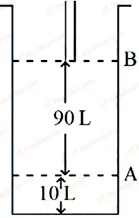
Figure for JEE Main 2024 Chemistry question on First law: work, heat and internal energy

Consider the figure provided. 1 mol of an ideal gas is kept in a cylinder, fitted with a piston, at the position A, at 18°C18°C. If the piston is moved to position B, keeping the temperature unchanged, then 'xx' L atm work is done in this reversible process. x=x = ______ L atm. (nearest integer) [Given: Absolute temperature =°C+273.15= °C + 273.15, R=0.08206 L atm mol−1K−1R = 0.08206 \text{ L atm mol}^{-1} \text{K}^{-1}]

JEE MAIN 2024 · 08 APR S2First law: work, heat and internal energy

ΔvapH⊖\Delta_{vap}H^{\ominus} for water is +40.79 kJ mol−1+40.79 \text{ kJ mol}^{-1} at 1 bar and 100°C100°C. Change in internal energy for this vapourisation under same condition is _____ kJ mol−1\text{kJ mol}^{-1}. (Given R=8.3 JK−1mol−1R = 8.3 \text{ JK}^{-1}\text{mol}^{-1})

JEE MAIN 2024 · 06 APR S1First law: work, heat and internal energy

An ideal gas, Cˉv=52R\bar{C}_v = \frac{5}{2}R, is expanded adiabatically against a constant pressure of 1 atm until it doubles in volume. If the initial temperature and pressure is 298 K298 \text{ K} and 5 atm5 \text{ atm}, respectively then the final temperature is _______ K (nearest integer). [Cˉv\bar{C}_v is the molar heat capacity at constant volume]