RankRizz

Heat capacity and calorimetry — JEE Main Previous Year Questions

Heat capacity and calorimetry has been asked 21 times in JEE Main, in 13 different years between 2005 and 2026, and in all of the last five exam years (2022–2026), 11 questions in all. That is 9% of Chemical Thermodynamics. Last asked in JEE Main 05 Apr 2026, Shift 2. 17 are multiple choice and 4 numerical-value; 7 easy, 8 medium and 1 hard by our difficulty labels. All of them are below, newest first, free to read.

Questions

21

Years asked

13

Since

2005

Of the chapter

9%

When JEE Main asked it

Questions on Heat capacity and calorimetry in every year it was asked, newest first.

JEE Main questions on Heat capacity and calorimetry by year, 2005–2026
YearRelative frequencyQuestions
20262
20253
20241
20232
20223
20211
20201
20193
20171
20121
20071
20061
20051
Total21

Every Heat capacity and calorimetry question

1–20 OF 21 · NEWEST FIRST

JEE MAIN 2026 · 05 APR S2Heat capacity and calorimetry

The correct order of molar heat capacities measured at 298 K and 1 bar is :

  1. A

    Copper(s)>Bromine2(l)>Helium(g)\text{Copper}(s) > \text{Bromine}_2(l) > \text{Helium}(g)

  2. B

    Bromine2(l)>Copper(s)>Helium(g)\text{Bromine}_2(l) > \text{Copper}(s) > \text{Helium}(g)

  3. C

    Helium(g)>Bromine2(l)>Copper(s)\text{Helium}(g) > \text{Bromine}_2(l) > \text{Copper}(s)

  4. D

    Helium(g)>Bromine2(l)=Copper(s)\text{Helium}(g) > \text{Bromine}_2(l) = \text{Copper}(s)

JEE MAIN 2026 · 02 APR S2Heat capacity and calorimetry

5 moles of unknown gas is heated at constant volume from 10 °C to 20 °C. The molar specific heat of this gas at constant pressure cp=8c_p = 8 cal/mol.°C and R=8.36R = 8.36 J/mol.°C. The change in internal energy of the gas is _________ calorie.

JEE MAIN 2025 · 03 APR S1Heat capacity and calorimetry

Which of the following properties will change when system containing solution 1 will become solution 2 ?
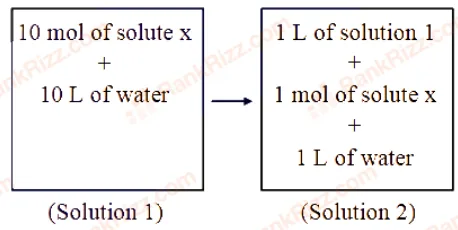
Figure for JEE Main 2025 Chemistry question on Heat capacity and calorimetry
  1. A

    Molar heat capacity

  2. B

    Density

  3. C

    Concentration

  4. D

    Gibbs free energy

JEE MAIN 2025 · 03 APR S2Heat capacity and calorimetry

Given below are two statements:
Statement I: When a system containing ice in equilibrium with water (liquid) is heated, heat is absorbed by the system and there is no change in the temperature until whole ice gets melted.
Statement II: At melting point of ice, there is absorption of heat in order to overcome intermolecular forces of attraction within the molecules of water in ice and kinetic energy of molecules is not increased at melting point.
In the light of above statements, Choose the correct answer from the options given below :

  1. A

    Statement I is true but Statement II is false

  2. B

    Both Statement I and Statement II are false

  3. C

    Both Statement I and Statement II are true

  4. D

    Statement I is false but Statement II is true

JEE MAIN 2025 · 02 APR S2Heat capacity and calorimetry

Arrange the following in order of magnitude of work done by the system / on the system at constant temperature :
(a) ∣wreversible∣|w_{\text{reversible}}| for expansion in infinite stage.
(b) ∣wirreversible∣|w_{\text{irreversible}}| for expansion in single stage.
(c) ∣wreversible∣|w_{\text{reversible}}| for compression in infinite stage.
(d) ∣wirreversible∣|w_{\text{irreversible}}| for compression in single stage.

Choose the correct answer from the options given below :

  1. A

    a>b>c>da \gt b \gt c \gt d

  2. B

    d>c=a>bd \gt c = a \gt b

  3. C

    c=a>d>bc = a \gt d \gt b

  4. D

    a>c>b>da \gt c \gt b \gt d

JEE MAIN 2024 · 05 APR S1Heat capacity and calorimetry

The heat of combustion of solid benzoic acid at constant volume is −321.30 kJ-321.30 \text{ kJ} at 27°C27°C. The heat of combustion at constant pressure is (−321.30−xR) kJ(-321.30 - xR) \text{ kJ}, the value of xx is ______.

JEE MAIN 2023 · 13 APR S2Heat capacity and calorimetry

What happens when methane undergoes combustion in systems A and B respectively?
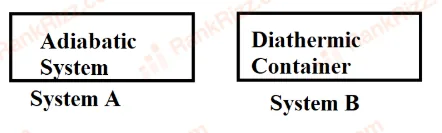
Figure for JEE Main 2023 Chemistry question on Heat capacity and calorimetry
  1. A

    System A: Temperature rises; System B: Temperature remains same

  2. B

    System A: Temperature remains same; System B: Temperature rises

  3. C

    System A: Temperature falls; System B: Temperature remains same

  4. D

    System A: Temperature falls; System B: Temperature rises

JEE MAIN 2023 · 29 JAN S2Heat capacity and calorimetry

Which of the following relations are correct?
(A) ΔU=q+pΔV\Delta U = q + p\Delta V
(B) ΔG=ΔH−TΔS\Delta G = \Delta H - T\Delta S
(C) ΔS=qrevT\Delta S = \frac{q_{rev}}{T}
(D) ΔH=ΔU−ΔnRT\Delta H = \Delta U - \Delta nRT
Choose the most appropriate answer from the options given below:

  1. A

    C and D only

  2. B

    B and C only

  3. C

    A and B only

  4. D

    B and D only

JEE MAIN 2022 · 28 JUL S1Heat capacity and calorimetry

Which of the following relation is not correct?

  1. A

    ΔH=ΔU−PΔV\Delta H = \Delta U - P\Delta V

  2. B

    ΔU=q+W\Delta U = q + W

  3. C

    ΔSsys+ΔSsurr≥0\Delta S_{sys} + \Delta S_{surr} \geq 0

  4. D

    ΔG=ΔH−TΔS\Delta G = \Delta H - T\Delta S

JEE MAIN 2022 · 27 JUN S1Heat capacity and calorimetry

Match List - I with List - II.

List-IList-II
(A) Spontaneous process(I) ΔH<0\Delta H < 0
(B) Process with ΔP=0,ΔT=0\Delta P = 0, \Delta T = 0(II) ΔGT,P<0\Delta G_{T,P} < 0
(C) ΔHreaction\Delta H_{reaction}(III) Isothermal and isobaric process
(D) Exothermic Process(IV) [Bond energies in reactants] - [Bond energies in products]

Choose the correct answer from the options given below

  1. A

    A-(III), B-(II), C-(IV), D-(I)

  2. B

    A-(II), B-(III), C-(IV), D-(I)

  3. C

    A-(II), B-(III), C-(I), D-(IV)

  4. D

    A-(II), B-(I), C-(III), D-(IV)

JEE MAIN 2022 · 27 JUN S2Heat capacity and calorimetry

When 5 moles of He gas expand isothermally and reversibly at 300300 K from 1010 litre to 2020 litre, the magnitude of the maximum work obtained is ______ J. [nearest integer] (Given : R=8.3R = 8.3 J K−1^{-1} mol−1^{-1} and log⁡2=0.3010\log 2 = 0.3010)

JEE MAIN 2021 · 27 AUG S2Heat capacity and calorimetry

Two flasks I and II shown below are connected by a valve of negligible volume.
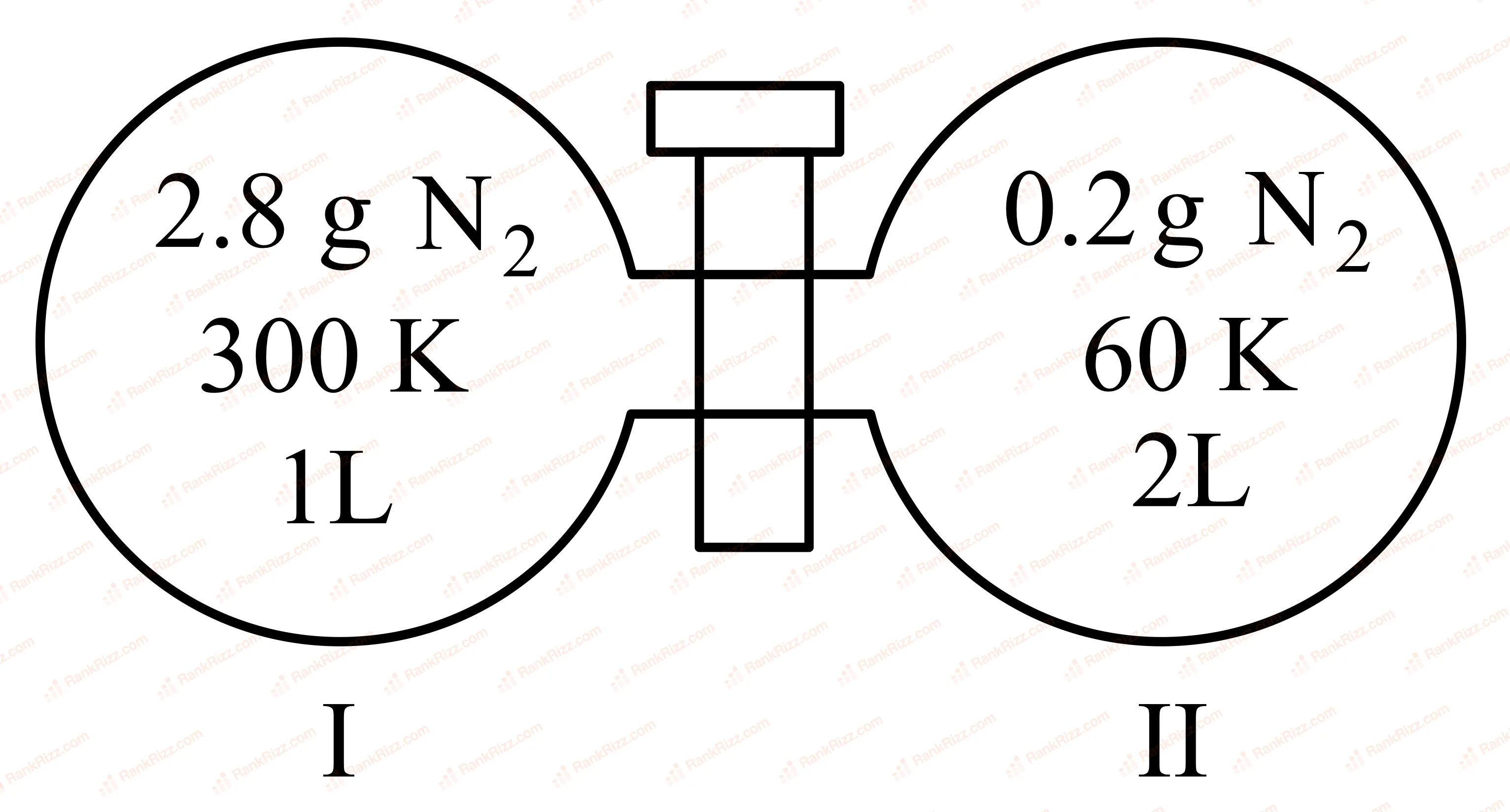
Figure for JEE Main 2021 Chemistry question on Heat capacity and calorimetry


When the valve is opened, the final pressure of the system in bar is x×10−2x \times 10^{-2}. The value of x is _________. (Integer answer)
[Assume : Ideal gas; 1 bar = 10510^5 Pa; Molar mass of N2_2 = 28.0 mol−1^{-1}; R = 8.31 J mol−1^{-1} K−1^{-1}]

JEE MAIN 2020 · 04 SEP S1Heat capacity and calorimetry

For one mole of an ideal gas, which of these statements must be true?
(a) Internal energy (U) and enthalpy (H) each depends on temperature.
(b) Compressibility factor Z is not equal to 1
(c) CP,m−CV,m=RC_{P,m} - C_{V,m} = R
(d) dU=CvdTdU = C_v dT for any process

  1. A

    (a) and (c)

  2. B

    (b), (c) and (d)

  3. C

    (c) and (d)

  4. D

    (a), (c) and (d)

JEE MAIN 2019 · 12 JAN S1Heat capacity and calorimetry

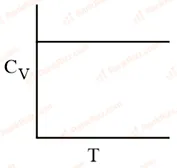
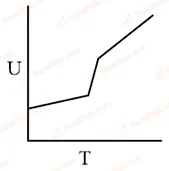
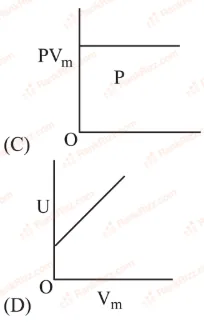
For a diatomic ideal gas in a closed system, which of the following plots does not correctly describe the relation between various thermodynamic quantities?
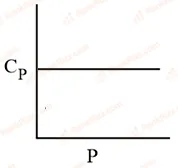
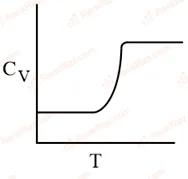
  1. A
    Figure for JEE Main 2019 Chemistry question on Heat capacity and calorimetry
  2. B
    Figure for JEE Main 2019 Chemistry question on Heat capacity and calorimetry
  3. C
    Figure for JEE Main 2019 Chemistry question on Heat capacity and calorimetry
  4. D
    Figure for JEE Main 2019 Chemistry question on Heat capacity and calorimetry
JEE MAIN 2019 · 12 JAN S2Heat capacity and calorimetry

The combination of plots which does not represent isothermal expansion of an ideal gas is
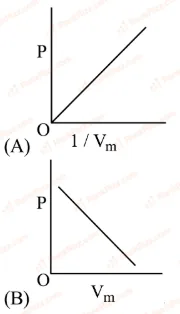
Figure for JEE Main 2019 Chemistry question on Heat capacity and calorimetry Figure for JEE Main 2019 Chemistry question on Heat capacity and calorimetry
  1. A

    (A) and (D)

  2. B

    (B) and (C)

  3. C

    (B) and (D)

  4. D

    (A) and (C)

JEE MAIN 2019 · 09 JAN S1Heat capacity and calorimetry

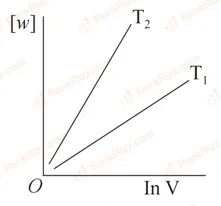
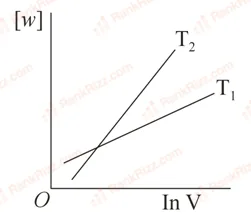
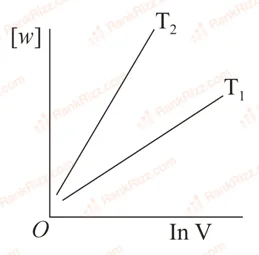
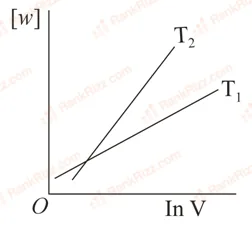
Consider the reversible isothermal expansion of an ideal gas in a closed system at two different temperatures T1T_1 and T2T_2 (T1<T2T_1 < T_2). The correct graphical depiction of the dependence of work done ww vs the final volume VV is:

  1. A
    Figure for JEE Main 2019 Chemistry question on Heat capacity and calorimetry
  2. B
    Figure for JEE Main 2019 Chemistry question on Heat capacity and calorimetry
  3. C
    Figure for JEE Main 2019 Chemistry question on Heat capacity and calorimetry
  4. D
    Figure for JEE Main 2019 Chemistry question on Heat capacity and calorimetry
JEE MAIN 2017 · 09 APR ONLINEHeat capacity and calorimetry

An ideal gas undergoes isothermal expansion at constant pressure. During the process:

  1. A

    Enthalpy remains constant but entropy increases

  2. B

    Enthalpy decreases but entropy increases

  3. C

    Enthalpy increases but entropy decreases

  4. D

    Both enthalpy and entropy remain constant

JEE MAIN 2012Heat capacity and calorimetry

The difference between the reaction enthalpy change (ΔrH\Delta_r H) and reaction internal energy change (ΔrU\Delta_r U) for the reaction: 2C6H6(l)+15O2(g)⟶2\text{C}_6\text{H}_6(l) + 15\text{O}_2(g) \longrightarrow$ at 300300 K is (R=8.314R = 8.314 J mol−1^{-1} K−1^{-1})

  1. A

    00 J mol−1^{-1}

  2. B

    24902490 J mol−1^{-1}

  3. C

    −2490-2490 J mol−1^{-1}

  4. D

    −7482-7482 J mol−1^{-1}

JEE MAIN 2007Heat capacity and calorimetry

Assuming that water vapour is an ideal gas, the internal energy (ΔU\Delta U) when 1 mol of water is vapourised at 1 bar pressure and 100∘C100^\circ C, (Given: Molar enthalpy of vapourization of water at 1 bar and 373 K = 41 kJ mol−1mol^{-1} and R = 8.3 J mol−1K−1mol^{-1} K^{-1}) will be

  1. A

    4.100 kJ mol−1mol^{-1}

  2. B

    3.7904 kJ mol−1mol^{-1}

  3. C

    37.904 kJ mol−1mol^{-1}

  4. D

    41.00 kJ mol−1mol^{-1}

JEE MAIN 2006Heat capacity and calorimetry

(ΔH−ΔU)(\Delta H - \Delta U) for the formation of carbon monoxide (CO) from its elements at 298 K298\,K is (R=8.314 J K−1 mol−1)(R = 8.314\,J\,K^{-1}\,mol^{-1})

  1. A

    −1238.78 J mol−1-1238.78\,J\,mol^{-1}

  2. B

    1238.78 J mol−11238.78\,J\,mol^{-1}

  3. C

    −2477.57 J mol−1-2477.57\,J\,mol^{-1}

  4. D

    2477.57 J mol−12477.57\,J\,mol^{-1}

Heat capacity and calorimetry: common questions

How many Heat capacity and calorimetry questions have come in JEE Main?
Heat capacity and calorimetry has been asked 21 times in JEE Main, in 13 different years between 2005 and 2026. It came up in all of the last five exam years (2022–2026), 11 questions in all.
Is Heat capacity and calorimetry important for JEE Main?
It is part of Chemical Thermodynamics: 21 of the chapter's 229 JEE Main questions (9%). It came up in all of the last five exam years (2022–2026), 11 questions in all.
When was Heat capacity and calorimetry last asked in JEE Main?
Most recently in JEE Main 05 Apr 2026, Shift 2. Questions on this page are newest first, so the latest ones are at the top.
What kind of Heat capacity and calorimetry questions does JEE Main ask?
17 are multiple choice and 4 numerical-value; 7 easy, 8 medium and 1 hard by our difficulty labels. Each question shows its answer key and worked solution where we have them.