Bromine trifluoride autoionizes to form and . The shapes of the cation and anion are respectively __________, and __________.
- A
bent, square planar
- B
linear, square planar
- C
bent, see-saw
- D
linear, tetrahedral

Chemical Bonding and Molecular Structure has been asked in 22 of the 23 JEE Main years from 2004 to 2026: 316 questions in all. In 2026 it averaged 1.3 questions per paper (24 across 19 papers), 5.0% of Chemistry questions, up from 4.6% in 2025. Across the last 20 papers it carried 4.8% of Chemistry marks. By type: 256 MCQs and 60 numerical-answer questions. Of the 271 with a difficulty tag, 46% are easy, 54% medium and 0% hard. Most asked: VSEPR theory and shapes of molecules and ions (118, 37%), Molecular orbital theory of diatomic species (79, 25%) and Hydrogen bonding and intermolecular forces (31, 10%).
DATA UPDATED
Questions
316
Distinct ideas
11
Share of marks
4.8%
Difficulty
MEDIUM
The share of each year’s Chemistry questions that came from Chemical Bonding and Molecular Structure, counted from the 168 papers we hold for the last 10 years, and session by session inside a year.
Rising: 6.0% of Chemistry questions in 2024–2026, up from 4.6% in 2017–2023. Its heaviest year was 2018, at 11.7%.
| YEAR | QS | PER PAPER | SHARE OF CHEMISTRY | CHANGE | |
|---|---|---|---|---|---|
| 2026 | 24 / 480 | 1.3 | 5.0% | +0.4 pts | JAN 5.2%APR 4.8% |
| 2025 | 22 / 475 | 1.2 | 4.6% | −3.4 pts | JAN 4.4%APR 4.9% |
| 2024 | 48 / 600 | 2.4 | 8.0% | +3.3 pts | JAN 7.3%APR 8.7% |
| 2023 | 35 / 750 | 1.4 | 4.7% | +0.2 pts | JAN 4.1%APR 5.3% |
| 2022 | 30 / 660 | 1.4 | 4.5% | +0.3 pts | JUN 3.6%JUL 5.7% |
| 2021 | 30 / 720 | 1.3 | 4.2% | −1.1 pts | FEB 4.7%MAR 3.3%JUL 3.8%AUG 4.8% |
| 2020 | 21 / 400 | 1.3 | 5.3% | +2.4 pts | JAN 5.3%SEP 5.2% |
| 2019 | 14 / 480 | 0.9 | 2.9% | −8.8 pts | JAN 1.7%APR 4.2% |
| 2018 | 14 / 120 | 3.5 | 11.7% | +6.1 pts | 4 PAPERS, ONE SESSION |
| 2017 | 5 / 90 | 1.7 | 5.6% | — | 3 PAPERS, ONE SESSION |
“QS” is Chemical Bonding and Molecular Structure questions out of all Chemistry questions that year; “per paper” is that count over the year’s papers, and “change” is the share against the year before. A year with more sittings asks more questions, which is why the share, not the count, is the number to compare.
How Chemical Bonding and Molecular Structure compares: every Chemistry chapter by weightage · most repeated JEE Main topics
A chapter is not one subject — it is a handful of procedures the examiner reuses. These are the ones Chemical Bonding and Molecular Structure questions actually test.
Every JEE Main Chemical Bonding and Molecular Structure question we hold, newest first inside each topic. Open one for its options, answer key and solution.
FREE PDF
All 316 questions on A4, by topic, with the answer key at the end. No sign-up, no email: your browser saves it as a PDF.
Download free PDFUNIQUE CONCEPTS
11 ideas, each with the latest past question that tested it, drawn from 347 JEE Main and Advanced questions.
Chemical Bonding and Molecular Structure Unique Concepts sheet →JEE ADVANCED
JEE Advanced has set 33 Chemical Bonding and Molecular Structure questions, 2007–2026.
Chemical Bonding and Molecular Structure JEE Advanced PYQs →Not every year. It has been asked in 22 of the 23 JEE Main years from 2004 to 2026; the year without a Chemical Bonding and Molecular Structure question was 2010.
VSEPR theory and shapes of molecules and ions: 118 of the 316 questions (37%). Next come Molecular orbital theory of diatomic species (79) and Hydrogen bonding and intermolecular forces (31).
About 4.8% across the last 20 papers. Every JEE Main question carries the same marks, so that is also its share of Chemistry questions. In 2026 it was 5.0% (24 of 480 Chemistry questions).
In JEE Main 08 Apr 2026, Shift 2, the latest sitting with a Chemical Bonding and Molecular Structure question.
316 from 2004 to 2026, across 11 topics. Every one is listed on this page by topic and links to its own page, with the answer key and solution wherever we have them. Free, no sign-up.
1–20 OF 316 · NEWEST FIRST
Bromine trifluoride autoionizes to form and . The shapes of the cation and anion are respectively __________, and __________.
bent, square planar
linear, square planar
bent, see-saw
linear, tetrahedral
The pairs among
, , , and that do not have similar Lewis dot structure are:
A, B and E
A and E
B, C and D
C and D
Arrange the following compounds according to increasing order of boiling points.
n-CHOH (A), n-CHNH (B), n-CH (C) and CHNHCH (D).
C < B < A < D
D < C < B < A
C < D < B < A
D < B < A < C
Given below are two statements :
Statement I : The number of compounds among SO, SO, SF, SF and HS in which sulphur does not obey the Octet rule is 3.
Statement II : Among [HO, ClF, SF], [NH, BrF, SF], [BrF, ClF, XeF] and [XeF, ClF, HO], the number of sets in which all the molecules have one lone pair of electrons on the central atom is 1.
In the light of the above statements, choose the correct answer from the options given below :
Both Statement I and Statement II are true
Both Statement I and Statement II are false
Statement I is true but Statement II is false
Statement I is false but Statement II is true
Given below are two statements :
Statement I : is the correct trend in terms of bond angle.
Statement II : SiF, SnF and PbF are ionic in nature.
In the light of the above statements, choose the correct answer from the options given below :
Both Statement I and Statement II are true
Both Statement I and Statement II are false
Statement I is true but Statement II is false
Statement I is false but Statement II is true
Consider the following species:
, , , , , , , , ,
Number of species having hybridized central atom is _______.
The covalent radii of atoms A and B are and respectively. The covalent bond length and total length of molecule are respectively :
,
,
,
,
According to Lewis theory, the total number of bond-pairs and lone pair of electrons around the central atom of ion is _____.
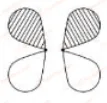
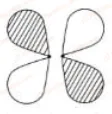
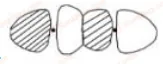
Which of the following pictorial diagram most correctly represents the ( - antibonding) molecular orbital between two atoms if the internuclear axis is taken to be in the z-direction ?


Given below are two statements : **Statement (I) :** The correct sequence of bond lengths in the following species is : **Statement (II) :** The correct sequence of number of unpaired electrons in the following species is : In the light of the above statements, choose the correct answer from the options given below :
Both Statement I and Statement II are true
Both Statement I and Statement II are false
Statement I is true but Statement II is false
Statement I is false but Statement II is true
is isostructural with :
A.
B.
C.
D.
E.
Choose the correct answer from the options given below :
C Only
C and E Only
A and D Only
B and E Only
Given below are two statements:
Statement I: The number of species among ,that have unequal E-F bond lengths is two. Here, E is the central atom.
Satement II: Among has the highest bond order.
In the light of the above statements, choose the correct answer from the options given below
Statement I is false but Statement II is true
Both Statement I and Statement II are true
Statement I is true but Statement II is false
Both Statement I and Statement II are false
Match List - I with List - Il according to shape.
List - I List - II
A. I.
B. II.
C. III.
D. IV.
Choose the correct answer from the options given below:
A-II, B-III, C-I, D-IV
A-II, B-III, C-IV, D-I
A-III, B-Il, C-IV, D-I
A-II, B-I, C-III, D-IV
Given below are statements about some molecules/ions.
Identify the CORRECT statements.
A The dipole moment value of is higher than that of .
B. The dipole moment value of is zero.
C. The bond order of and is same.
D. The formal charge on the central oxygen atom of ozone is -1 .
E. In , all the three atoms satisfy the octet rule, hence it is very stable.
Choose the correct answer from the options given below:
A, C & D Only
A, B, C, D &E
B & C Only
B, C & D Only
Among the following, the CORRECT combinations are
Choose the correct answer from the options given below:
B, C and D Only
A, B and C Only
A and B Only
A, B, C and D
Pair of species among the following having same bond order as well as paramagnetic character will be-
ldentify the molecule (X) with maximum number of lone pairs of electrons (obtained using Lewis dot structure) among . Choose the correct bond angle made by the central atom of the molecule (X).
Which statements are NOT TRUE about ?
A. It has a see-saw shape.
B. Xe has 5 electron pairs in its valence shell in .
C. The bond angle is close to .
D. The bond angle is close to .
E. has 16 valence electrons in .
Choose the correct answer from the options given below:
B, C and E Only
B and D Only
Aand D Only
B, D and E Only
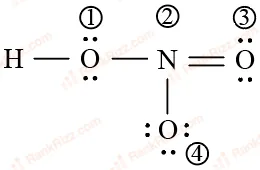
The formal charges on the atoms marked as (1) to (4) in the Lew is representation
of molecule respectively are

0, +1, 0, -1
+1, 0, 0, - 1
0,0, - 1,+1
0, -1, 0, +1
Two p-block elements and form fluorides of the type . The fluoride compound is a Lewis acid and is a Lewis base. The hybridizations of the central atoms of and respectively are
Both
and
Both
and
OTHER CHEMISTRY CHAPTERS