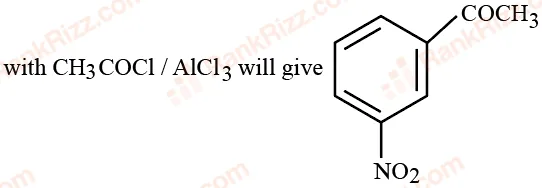
n-Butane on monochlorination under photochemical condition gives an optically active compound "P". "P" on further chlorination gives dichloro compounds. The number of dichloro compounds obtained (ignore stereoisomers) is :
- A
3
- B
4
- C
5
- D
6
Hydrocarbons has been asked in 22 of the 23 JEE Main years from 2004 to 2026: 201 questions in all. In 2026 it averaged 1.2 questions per paper (23 across 19 papers), 4.8% of Chemistry questions, up from 4.4% in 2025. Across the last 20 papers it carried 4.8% of Chemistry marks. By type: 171 MCQs and 30 numerical-answer questions. Of the 170 with a difficulty tag, 18% are easy, 79% medium and 3% hard. Most asked: Electrophilic addition to alkenes (68, 34%), Reactions of alkanes (29, 14%) and Reactions of alkynes (27, 13%).
DATA UPDATED
Questions
201
Distinct ideas
10
Share of marks
4.8%
Difficulty
HARD
The share of each year’s Chemistry questions that came from Hydrocarbons, counted from the 168 papers we hold for the last 10 years, and session by session inside a year.
Rising: 4.4% of Chemistry questions in 2024–2026, up from 3.0% in 2017–2023. Its heaviest year was 2026, at 4.8%.
| YEAR | QS | PER PAPER | SHARE OF CHEMISTRY | CHANGE | |
|---|---|---|---|---|---|
| 2026 | 23 / 480 | 1.2 | 4.8% | +0.4 pts | JAN 4.0%APR 5.7% |
| 2025 | 21 / 475 | 1.1 | 4.4% | +0.2 pts | JAN 6.0%APR 2.7% |
| 2024 | 25 / 600 | 1.3 | 4.2% | +1.3 pts | JAN 5.0%APR 3.3% |
| 2023 | 22 / 750 | 0.9 | 2.9% | +0.6 pts | JAN 3.1%APR 2.8% |
| 2022 | 15 / 660 | 0.7 | 2.3% | −0.8 pts | JUN 2.5%JUL 2.0% |
| 2021 | 22 / 720 | 0.9 | 3.1% | −0.4 pts | FEB 3.3%MAR 4.0%JUL 3.3%AUG 1.9% |
| 2020 | 14 / 400 | 0.9 | 3.5% | level | JAN 4.7%SEP 2.8% |
| 2019 | 17 / 480 | 1.1 | 3.5% | −0.7 pts | JAN 3.3%APR 3.8% |
| 2018 | 5 / 120 | 1.3 | 4.2% | +3.1 pts | 4 PAPERS, ONE SESSION |
| 2017 | 1 / 90 | 0.3 | 1.1% | — | 3 PAPERS, ONE SESSION |
“QS” is Hydrocarbons questions out of all Chemistry questions that year; “per paper” is that count over the year’s papers, and “change” is the share against the year before. A year with more sittings asks more questions, which is why the share, not the count, is the number to compare.
How Hydrocarbons compares: every Chemistry chapter by weightage · most repeated JEE Main topics
A chapter is not one subject — it is a handful of procedures the examiner reuses. These are the ones Hydrocarbons questions actually test.
Every JEE Main Hydrocarbons question we hold, newest first inside each topic. Open one for its options, answer key and solution.
FREE PDF
All 201 questions on A4, by topic, with the answer key at the end. No sign-up, no email: your browser saves it as a PDF.
Download free PDFUNIQUE CONCEPTS
10 ideas, each with the latest past question that tested it, drawn from 228 JEE Main and Advanced questions.
Hydrocarbons Unique Concepts sheet →JEE ADVANCED
JEE Advanced has set 28 Hydrocarbons questions, 2007–2026.
Hydrocarbons JEE Advanced PYQs →Not every year. It has been asked in 22 of the 23 JEE Main years from 2004 to 2026; the year without a Hydrocarbons question was 2009.
Electrophilic addition to alkenes: 68 of the 201 questions (34%). Next come Reactions of alkanes (29) and Reactions of alkynes (27).
About 4.8% across the last 20 papers. Every JEE Main question carries the same marks, so that is also its share of Chemistry questions. In 2026 it was 4.8% (23 of 480 Chemistry questions).
In JEE Main 08 Apr 2026, Shift 2, the latest sitting with a Hydrocarbons question.
201 from 2004 to 2026, across 10 topics. Every one is listed on this page by topic and links to its own page, with the answer key and solution wherever we have them. Free, no sign-up.
1–20 OF 201 · NEWEST FIRST
n-Butane on monochlorination under photochemical condition gives an optically active compound "P". "P" on further chlorination gives dichloro compounds. The number of dichloro compounds obtained (ignore stereoisomers) is :
3
4
5
6
Given below are two statements:
Statement I: Methane can be prepared by decarboxylation of sodium ethanoate, Kolbe's electrolysis of sodium acetate and reaction of CHMgBr with water.
Statement II: Methane cannot be prepared from unsaturated hydrocarbons and by Wurtz reaction.
In the light of the above statements, choose the correct answer from the options given below:
Both Statement I and Statement II are true
Both Statement I and Statement II are false
Statement I is true but Statement II is false
Statement I is false but Statement II is true
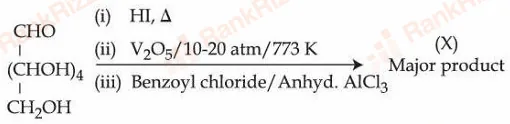
Consider the following reactions. Total number of electrons in the bonds and lone pair of electrons in the product (X) is :

12
16
14
18
An alkane (Y) requires 8 moles of oxygen for complete combustion and on chlorination with Cl/h, (Y) gives only one monochlorinated product (Z). The total number of primary carbon atoms in (Y) is __________.
For the following Friedel Craft's alkylation reaction, which of the statements are correct?
A. Major product is n-propyl benzene.
B. iso-propyl carbocation intermediate is also generated.
C. Multiple substitution is inevitable.
D. Introducing electron-donating substituent on benzene will not produce any alkyl benzene.
Choose the correct answer from the options given below:
A and D only
B and C only
A and C only
B and D only
IUPAC name of the some alkenes are given below.
Find out the correct stability order.
2-Methylbut-2-ene
-But-2-ene
2,3-Dimethylbut-2-ene
Prop-1-ene
Choose the correct answer from the options given below:
C > A > B > D
C > A > D > B
B > D > A > C
A > B > C > D
Identify the correct IUPAC name of hydrocarbon (x) containing three primary carbons atoms and with molar mass g mol :
1,1-Dimethylcyclopropane
2,2-Dimethylpropane
2-Methylbutane
n-Pentane
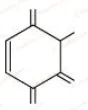
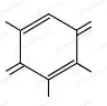
An alkene on ozonolysis followed by reduction gives following products:
The alkene is :


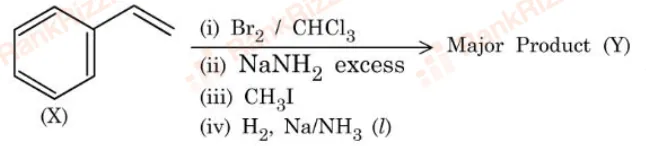
Compound (X) is subjected to the sequence of reactions as shown above:
Molar mass of the major product (Y) formed is ______ g mol.
(Given molar mass in g mol C:12, H: 1, O: 16)
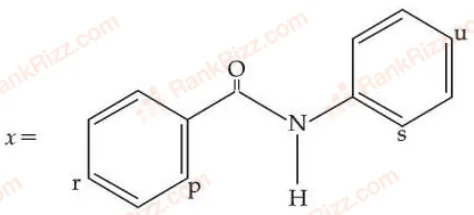
For the given molecule, "x", the preferred site for the attack of the electrophile is :

Predominantly at "r"
"r" and "u"
"p" and "s"
Predominantly at "u"
Consider the isomers of hydrocarbon with molecular formula CH. These isomers do not decolourise KMnO solution. These isomers are subjected to chlorination with chlorine in presence of light to give monochloro compounds. The total number of monochloro compounds (structural isomers only) formed is __________.
One mole of an alkane (x) requires 8 mole oxygen for complete combustion. Sum of number of carbon and hydrogen atoms in the alkane (x) is __________.
The compound (X) on
(i) on heating in the presence of anhydrous AlCl and HCl gas gives 2,4-dimethyl pentane
(ii) aromatization gives toluene and
(iii) cyclisation gives methyl cyclohexane
The correct name of compound (X) is :
Hept-2-ene
Hept-1,3,5-triene
Heptane
Hept-2,4,6-triene
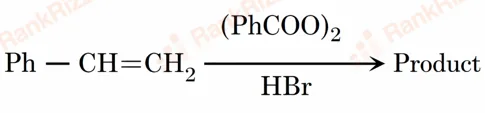
Consider the above reaction
A. The reaction proceeds through a more stable radical intermediate.
B. The role of peroxide is to generate (Hydrogen radical).
C. During this reaction, benzene is formed as a byproduct.
D. 1-Bromo-2- phenylethane is formed as the minor product.
E. The same reaction in absence of peroxide proceeds via carbocation intermediate.
Identify the correct statements. Choose the correct answer from the options given below:
A, C & E Only
A & E Only
A, B & D Only
C, D & E Only
Identify the conect statements:
The presence of - group in benzene ring
A. activates the ring towards electrophilic substitutions.
B. deactivates the ring towards electrophilic substitutions.
C. activates the ring towards nucleophilic substitutions.
D. deactivates the ring towards nucleophilic substitutions.
choose the correct answer from the options given below :
C and A Only
B and C Only
B and D Only
A and D Only
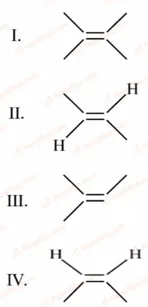
Anange the following alkenes in decreasing order of stability.
Choose the correct answer from the options given below:
I > III > IV > II
III > I > II > IV
I > III > II > IV
III > II > I > IV
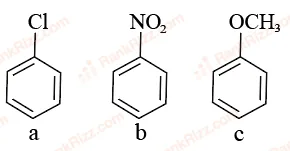
Consider the following compounds
Arrange these compounds in the increasing order of reactivity with nitrating mixture.
b < a < c
c < b < a
b < c < a
c < a < b
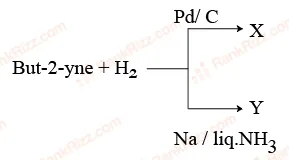
But-2-yne and hydrogen (one mole each) are separately treated with (i) Pd/C and (ii) Na/ liq. NH3 to give the products X and Y respectively.
Identify the incorrect statements.
A. X and Y are stereoisomers.
B. Dipole moment of X is zero.
C. Boiling point of X is higher than Y.
D. X and Y react with to give different products.
Choose the correct answer from the options given below :
B and D Only
A and B Only
B and C Only
A and C Only
Consider the following reaction of benzene.
In compound (Q), the percentage of oxygen is ___ %. (Nearest integer)
Given below are two statements:
Statement I: Benzene is nitrated to give nitrobenzene, which on further treatment
Statement II: - group is a m-directing, and deactivating group.
In the light of the above statements, choose the most appropriate answer from the options given below
Statement I is incorrect but Statement II is correct
Both Statement I and Statement II are incorrect
Both Statement I and Statement II are correct
Statement I is correct but Statement II is incorrect
OTHER CHEMISTRY CHAPTERS