At C and atm pressure, the enthalpy of combustion of benzene and acetylene are kJ mol and kJ mol, respectively. The change in enthalpy for the reaction
, is
- A
kJ mol
- B
kJ mol
- C
kJ mol
- D
kJ mol
Every Chemical Thermodynamics question JEE Main has set from 2004–2026, grouped by the idea it tests rather than the order of the syllabus. 229 questions across 7 distinct ideas. Free to read, answer key on every one.
DATA UPDATED
Questions
229
Distinct ideas
7
Share of marks
4.6%
Difficulty
MEDIUM
A chapter is not one subject — it is a handful of procedures the examiner reuses. These are the ones Chemical Thermodynamics questions actually test.
121–140 OF 229 · NEWEST FIRST
At C and atm pressure, the enthalpy of combustion of benzene and acetylene are kJ mol and kJ mol, respectively. The change in enthalpy for the reaction
, is
kJ mol
kJ mol
kJ mol
kJ mol
At C and 1 atm pressure, the enthalpies of combustion are as given below:
| Substance | C (graphite) | ||
|---|---|---|---|
The enthalpy of formation of ethane is
kJ mol
kJ mol
kJ mol
kJ mol
For the reaction 2NO(g) NO(g), when J K and kJ mol the magnitude of at 298 K for the reaction is _________ kJ mol. (Nearest integer)
The incorrect expression among the following is:
For isothermal process
(at constant P)
200 mL of 0.2 M HCl is mixed with 300 mL of 0.1 M NaOH. The molar heat of neutralization of this reaction is -57.1 kJ. The increase in temperature in °C of the system on mixing is . The value of x is _________. (Nearest integer)
[Given: Specific heat of water = 4.18 J g K
Density of water = 1.00 g cm]
(Assume no volume change on mixing)
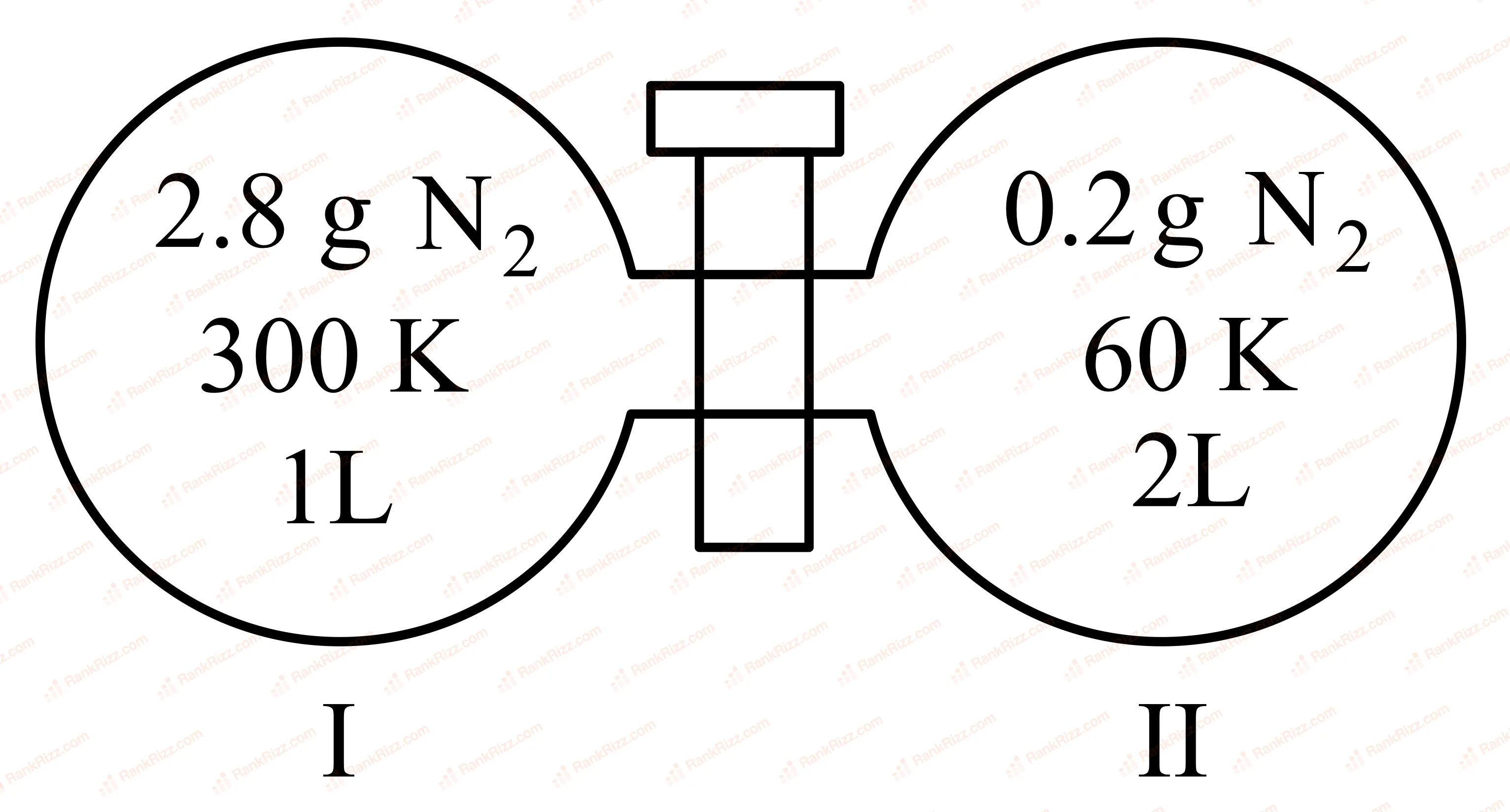
Two flasks I and II shown below are connected by a valve of negligible volume.
When the valve is opened, the final pressure of the system in bar is . The value of x is _________. (Integer answer)
[Assume : Ideal gas; 1 bar = Pa; Molar mass of N = 28.0 mol; R = 8.31 J mol K]
Data given for the following reaction is as follows:
FeO + C Fe + CO
Substance (kJ mol) (J mol K)
FeO -266.3 57.49
C 0 5.74
Fe 0 27.28
CO -110.5 197.6
The minimum temperature in K at which the reaction becomes spontaneous is _________. (Integer answer)
The Born-Haber cycle for KCl is evaluated with the following data:
for KCl = kJ mol; for K = 89.2 kJ mol;
for K = 419.0 kJ mol; for Cl = kJ mol
for Cl = 243.0 kJ mol
The magnitude of lattice enthalpy of KCl in kJ mol is _________ (Nearest integer)
For water kJ mol at 373 K and 1 bar pressure. Assuming that water vapour is an ideal gas that occupies a much larger volume than liquid water, the internal energy change during evaporation of water is _________ (kJ mol):
[Use: R = 8.3 J mol K]
For water at 100°C and 1 bar,
J mol
(Round off to the Nearest Integer)
[Use: R = 8.31 J mol K]
[Assume volume of HO(l) is much smaller than volume of HO(g). Assume HO(g) treated as an ideal gas]
When 400 mL of 0.2 M HSO solution is mixed with 600 mL of 0.1 M NaOH solution, the increase in temperature of the final solution is _________ K. (Round off to the nearest integer).
[Use: H(aq) + OH(aq) HO: kJ mol
Specific heat of HO = 4.18 J K g, density of HO = 1.0 g cm
Assume no change in volume of solution on mixing.]
At 298 K, the enthalpy of fusion of a solid X is 2.8 kJ mol and the enthalpy of vaporisation of the liquid X is 98.2 kJ mol. The enthalpy of sublimation of the substance X in kJ mol is ___. (in nearest integer)
A system does 200 J of work and at the same time absorbs 150 J of heat. The magnitude of the change in internal energy is _________J. (Nearest integer)
If the standard molar enthalpy change for combustion of graphite powder is kJ mol, the amount of heat generated on combustion of 1 g of graphite powder in kJ (Nearest integer):
An average person needs about 10000 kJ energy per day. The amount of glucose (molar mass = 180.0 g mol) needed to meet this energy requirement is ___ g.
(Use : H (glucose) = -2700 kJ mol)
For a given chemical reaction A B at 300 K the free energy change is -49.4 kJ mol and the enthalpy of reaction is 51.4 kJ mol. The entropy change of the reaction is ___ JK mol.
The standard enthalpies of formation of and CaO are kJ mol and kJ mol respectively. For the reaction the standard reaction enthalpy = ________ kJ. (Round off to the Nearest Integer).
During which of the following processes, does entropy decrease?
(A) Freezing of water to ice at 0°C
(B) Freezing of water to ice at -10°C
(C) N(g) + 3H(g) 2NH(g)
(D) Adsorption of CO(g) and lead surface
(E) Dissolution of NaCl in water
(A), (B), (C) and (D) only
(B) and (C) only
(A) and (E) only
(A), (C) and (E) only
At 25°C, 50 g of iron reacts with HCl to form . The evolved hydrogen gas expands against a constant pressure of 1 bar. The work done by the gas during this expansion is ________ J. (Round off to the Nearest Integer)
[Given: J mol K. Assume, hydrogen is an ideal gas]
[Atomic mass of Fe is 55.85 u]
The average S - F bond energy in kJ mol of is ______. (Rounded off to the nearest integer)
[Given: The values of standard enthalpy of formation of , and are , 275 and 80 kJ mol respectively.]
JEE Advanced has set 40 Chemical Thermodynamics questions too. Chemical Thermodynamics JEE Advanced PYQs →
OTHER CHEMISTRY CHAPTERS