One mole of an ideal monoatomic gas is subjected to changes as shown in the graph. The magnitude of the work done (by the system or on the system) is _____ J (nearest integer)
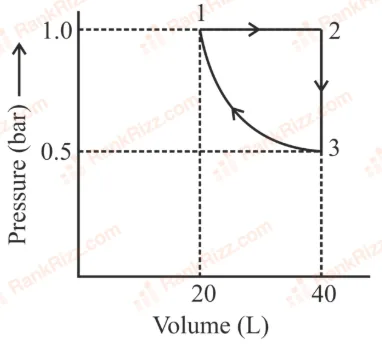
Given: log 2 = 0.3, ln 10 = 2.3
Every Chemical Thermodynamics question JEE Main has set from 2004–2026, grouped by the idea it tests rather than the order of the syllabus. 229 questions across 7 distinct ideas. Free to read, answer key on every one.
DATA UPDATED
Questions
229
Distinct ideas
7
Share of marks
4.6%
Difficulty
MEDIUM
A chapter is not one subject — it is a handful of procedures the examiner reuses. These are the ones Chemical Thermodynamics questions actually test.
101–120 OF 229 · NEWEST FIRST
One mole of an ideal monoatomic gas is subjected to changes as shown in the graph. The magnitude of the work done (by the system or on the system) is _____ J (nearest integer)
Given: log 2 = 0.3, ln 10 = 2.3
When 600 mL of 0.2 M is mixed with 400 mL of 0.1 M NaOH solution in a flask, the rise in temperature of the flask is _____ °C (Enthalpy of neutralisation = 57 kJ mol and Specific heat of water = 4.2 J K g) (Neglect heat capacity of flask)
Which of the following relation is not correct?
Given below are two statements: One is labelled as Assertion A and the other is labelled as Reason R
Assertion A: The reduction of a metal oxide is easier if the metal formed is in liquid state than solid state.
Reason R: The value of becomes more on negative side as entropy is higher in liquid state than solid state.
In the light of the above statements, choose the most appropriate answer from the options given below
Both A and R are correct and R is the correct explanation of A
Both A and R are correct but R is NOT the correct explanation of A
A is correct but R is not correct
A is not correct but R is correct
Among the following the number of state variable is
Internal energy (U), Volume (V), Heat (q), Enthalpy (H)
The molar heat capacity for an ideal gas at constant pressure is . The change in internal energy is upon heating it from to . The number of moles of the gas at constant volume is ______ (Given: )
A gas (Molar mass = 280 g mol) was burnt in excess in a constant volume calorimeter and during combustion the temperature of calorimeter increased from 298.0 K to 298.45 K. If the heat capacity of calorimeter is 2.5 kJ K and enthalpy of combustion of gas is 9 kJ mol then amount of gas burnt is _____ g.
coal is burnt in a bomb calorimeter in excess of oxygen at and pressure. The temperature of the calorimeter rises from to . The enthalpy change during the combustion of coal is . The value of is ______ (Given: Heat capacity of bomb calorimeter . Assume coal to be pure carbon)
For the reaction
at
The enthalpy change for the above reaction is ______ (nearest integer) (Given: )
The enthalpy of combustion of propane, graphite and dihydrogen at are: , and respectively. The magnitude of enthalpy of formation of propane () is ______ . (Nearest integer)
While performing a thermodynamics experiment, a student made the following observations:
The enthalpy of ionization of as calculated by the student is ______ .
17.0 g of NH completely vapourises at °C and 1 bar pressure and the enthalpy change in the process is 23.4 kJ mol. The enthalpy change for the vapourisation of 85 g of NH under the same conditions is ______ kJ.
2.2 g of nitrous oxide (NO) gas is cooled at a constant pressure of 1 atm from 310 K to 270 K causing the compression of the gas from 217.1 mL to 167.75 mL. The change in internal energy of the process, U is '-x'J. The value of 'x' is ______.
[nearest integer]
(Given: atomic mass of N = 14 g mol and of O = 16 g mol. Molar heat capacity of NO is 100 JK mol)
L of an ideal gas is allowed to expand isothermally into vacuum until the total volume is L. The amount of heat absorbed in this expansion is ______ L atm.
For combustion of one mole of magnesium in an open container at 300 K and 1 bar pressure, kJ mol, the magnitude of change in internal energy for the reaction is ______ kJ. (Nearest integer)
(Given: R = 8.3 J K mol)
Match List - I with List - II.
| List-I | List-II |
|---|---|
| (A) Spontaneous process | (I) |
| (B) Process with | (II) |
| (C) | (III) Isothermal and isobaric process |
| (D) Exothermic Process | (IV) [Bond energies in reactants] - [Bond energies in products] |
Choose the correct answer from the options given below
A-(III), B-(II), C-(IV), D-(I)
A-(II), B-(III), C-(IV), D-(I)
A-(II), B-(III), C-(I), D-(IV)
A-(II), B-(I), C-(III), D-(IV)
When 5 moles of He gas expand isothermally and reversibly at K from litre to litre, the magnitude of the maximum work obtained is ______ J. [nearest integer] (Given : J K mol and )
For complete combustion of methanol
the amount of heat produced as measured by bomb calorimeter is kJ mol at C. The enthalpy of combustion for the reaction is kJ mol, where is ______
(Given : J K mol)
A fish swimming in water body when taken out from the water body is covered with a film of water of weight g. When it is subjected to cooking at C, then the internal energy for vaporization in kJ mol is ______ [integer]
[Assume steam to be an ideal gas. Given for water at K and bar is kJ mol : J K mol]
The standard entropy change for the reaction
is J K at K
[Given : The standard enthalpy change for the reaction is kJ mol]. The temperature in K at which the reaction attains equilibrium is (Nearest Integer) ______
JEE Advanced has set 40 Chemical Thermodynamics questions too. Chemical Thermodynamics JEE Advanced PYQs →
OTHER CHEMISTRY CHAPTERS