JEE MAIN 2023 · 15 APR S1Concentration of ores, calcination and roasting
Which one of the following is not an example of calcination?
- A
CaCO CaO + CO
- B
FeO xHO FeO + xHO
- C
2PbS + 3O 2PbO + 2SO
- D
CaCO MgCO CaO + MgO + 2CO
General Principles and Processes of Isolation of Metals has been asked in 14 of the 23 JEE Main years from 2004 to 2026: 120 questions in all. It was not set in any of the 19 2026 papers. Across the last 20 papers it carried 0% of Chemistry marks. By type: 116 MCQs and 4 numerical-answer questions. Of the 111 with a difficulty tag, 88% are easy, 12% medium and 0% hard. Most asked: Extraction of Fe, Cu, Zn, Al, Ag and Au (35, 29%), Occurrence of metals: minerals and ores (23, 19%) and Refining of metals (23, 19%).
DATA UPDATED
Questions
120
Distinct ideas
5
Share of marks
0%
Difficulty
EASY
The share of each year’s Chemistry questions that came from General Principles and Processes of Isolation of Metals, counted from the 168 papers we hold for the last 10 years, and session by session inside a year.
Falling: 0.0% of Chemistry questions in 2024–2026, down from 3.2% in 2017–2023. Its heaviest year was 2021, at 3.9%. Not asked at all in 2017, 2024, 2025, 2026.
| YEAR | QS | PER PAPER | SHARE OF CHEMISTRY | CHANGE | |
|---|---|---|---|---|---|
| 2026 | 0 / 480 | 0.0 | 0.0% | level | JAN 0.0%APR 0.0% |
| 2025 | 0 / 475 | 0.0 | 0.0% | level | JAN 0.0%APR 0.0% |
| 2024 | 0 / 600 | 0.0 | 0.0% | −2.9 pts | JAN 0.0%APR 0.0% |
| 2023 | 22 / 750 | 0.9 | 2.9% | −0.4 pts | JAN 3.1%APR 2.8% |
| 2022 | 22 / 660 | 1.0 | 3.3% | −0.6 pts | JUN 3.6%JUL 3.0% |
| 2021 | 28 / 720 | 1.2 | 3.9% | +1.1 pts | FEB 6.0%MAR 3.3%JUL 3.3%AUG 3.3% |
| 2020 | 11 / 400 | 0.7 | 2.8% | −0.7 pts | JAN 2.7%SEP 2.8% |
| 2019 | 17 / 480 | 1.1 | 3.5% | +1.8 pts | JAN 3.3%APR 3.8% |
| 2018 | 2 / 120 | 0.5 | 1.7% | +1.7 pts | 4 PAPERS, ONE SESSION |
| 2017 | 0 / 90 | 0.0 | 0.0% | — | 3 PAPERS, ONE SESSION |
“QS” is General Principles and Processes of Isolation of Metals questions out of all Chemistry questions that year; “per paper” is that count over the year’s papers, and “change” is the share against the year before. A year with more sittings asks more questions, which is why the share, not the count, is the number to compare.
How General Principles and Processes of Isolation of Metals compares: every Chemistry chapter by weightage · most repeated JEE Main topics
A chapter is not one subject — it is a handful of procedures the examiner reuses. These are the ones General Principles and Processes of Isolation of Metals questions actually test.
Every JEE Main General Principles and Processes of Isolation of Metals question we hold, newest first inside each topic. Open one for its options, answer key and solution.
FREE PDF
All 120 questions on A4, by topic, with the answer key at the end. No sign-up, no email: your browser saves it as a PDF.
Download free PDFUNIQUE CONCEPTS
5 ideas, each with the latest past question that tested it, drawn from 142 JEE Main and Advanced questions.
General Principles and Processes of Isolation of Metals Unique Concepts sheet →JEE ADVANCED
JEE Advanced has set 22 General Principles and Processes of Isolation of Metals questions, 2007–2023.
General Principles and Processes of Isolation of Metals JEE Advanced PYQs →Not every year. It has been asked in 14 of the 23 JEE Main years from 2004 to 2026; it was missing in 9 of them, most recently 2026.
Extraction of Fe, Cu, Zn, Al, Ag and Au: 35 of the 120 questions (29%). Next come Occurrence of metals: minerals and ores (23) and Refining of metals (23).
About 0% across the last 20 papers. Every JEE Main question carries the same marks, so that is also its share of Chemistry questions. In 2026 it was 0.0% (0 of 480 Chemistry questions).
In JEE Main 15 Apr 2023, Shift 1, the latest sitting with a General Principles and Processes of Isolation of Metals question. It has not been set since 2023, though the bank holds JEE Main papers up to 2026.
120 from 2004 to 2023, across 5 topics. Every one is listed on this page by topic and links to its own page, with the answer key and solution wherever we have them. Free, no sign-up.
1–20 OF 120 · NEWEST FIRST
Which one of the following is not an example of calcination?
CaCO CaO + CO
FeO xHO FeO + xHO
2PbS + 3O 2PbO + 2SO
CaCO MgCO CaO + MgO + 2CO
Which one of the following is most likely a mismatch?
Zinc-Liquation
Copper-Electrolysis
Nickel-Mond process
Titanium-van Arkel Method
Given below are two statements related to Ellingham diagram :
Statement I : Ellingham diagrams can be constructed for formation of oxides, sulphides and halides of metals.
Statement II : It consists of plots of vs T for formation of oxides of elements.
In the light of the above statements, choose the most appropriate answer from the options given below :
Both Statement I and Statement II are correct
Both Statement I and Statement II are incorrect
Statement I is correct but Statement II is incorrect
Statement I is incorrect but Statement II is correct
Given below are two statements: one is labelled as Assertion A and the other is labelled as Reason R
Assertion A: In the Ellingham diagram, a sharp change in slope of the line is observed from Mg MgO at ~1120°C
Reason R: There is a large change of entropy associated with the change of state
In the light of the above statements, choose the correct answer from the options given below
Both A and R are true but R is NOT the correct explanation of A
A is false but R is true
Both A and R are true and R is the correct explanation of A
A is true but R is false
In the extraction process of copper, the product obtained after carrying out the reactions
(i)
(ii) is called
Blister copper
Reduced copper
Copper scrap
Copper matte
Given below are two statements:
Statement I: In the metallurgy process, sulphide ore is converted to oxide before reduction.
Statement II: Oxide ores in general are easier to reduce.
In the light of the above statements, choose the most appropriate answer from the options below:
Statement I is correct but Statement II is incorrect
Both Statement I and Statement II are incorrect
Statement I is incorrect but Statement II is correct
Both Statement I and Statement II are correct
Which of the following is used as a stabilizer during the concentration of sulphide ores?
Pine oils
Fatty acids
Xanthates
Cresols
Gibbs energy vs T plot for the formation of oxides is given below. For the given diagram, the correct statement is-
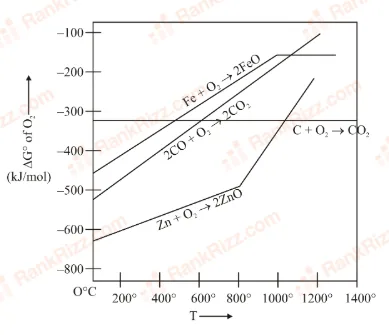
At 600C, CO cannot reduce FeO
At 600C, CO can reduce ZnO
At 600C, C can reduce ZnO
At 600C, C can reduce FeO
Which of the following metals can be extracted through alkali leaching technique?
Sn
Pb
Au
Cu
In Hall-Heroult process, the following is used for reducing AlO:-
Magnesium
NaAlF
Graphite
CaF
Given below are two statements:
Assertion A: In an Ellingham diagram, the oxidation of carbon to carbon monoxide shows a negative slope with respect to temperature.
Reason R: CO tends to get decomposed at higher temperature.
Both A and R are correct and R is the correct explanation of A
A is not correct but R is correct
Both A and R are correct but R is NOT the correct explanation of A
A is correct but R is not correct
Among following compounds, the number of those present in copper matte is ______
A. CuCO
B. CuS
C. CuO
D. FeO
The methods NOT involved in concentration of ore are
(A) Liquation
(B) Leaching
(C) Electrolysis
(D) Hydraulic washing
(E) Froth floatation
Choose the correct answer from the options given below:
B, D and C only
C, D and E only
A and C only
B, D and E only
Which one of the following statements is incorrect?
van Arkel method is used to purify tungsten.
The malleable iron is prepared from cast iron by oxidising impurities in a reverberatory furnace.
Cast iron is obtained by melting pig iron with scrap iron and coke using hot air blast.
Boron and Indium can be purified by zone refining method.
In the extraction of copper, its sulphide ore is heated in a reverberatory furnace after mixing with silica to:
separate CuO as CuSiO
remove calcium as CaSiO
decrease the temperature needed for roasting of CuS
remove FeO as FeSiO
Given below are two statements:
Statement I: During Electrolytic refining, the pure metal is made to act as anode and its impure metallic form is used as cathode.
Statement II: During the Hall-Heroult electrolysis process, purified AlO is mixed with NaAlF to lower the melting point of the mixture.
In the light of the above statements, choose the most appropriate answer from the options given below:
Statement I is incorrect but Statement II is correct
Both Statement I and Statement II are incorrect
Statement I is correct but Statement II is incorrect
Both Statement I and Statement II are correct
The reaction representing the Mond process for metal refining is ______
The major component of which of the following ore is sulphide based mineral?
Calamine
Siderite
Sphalerite
Malachite
Which one of the following reactions does not occur during extraction of copper?
2CuS + 3O 2CuO + 2SO
2FeS + 3O 2FeO + 2SO
CaO + SiO CaSiO
FeO + SiO FeSiO
Given below are two statements:-
Statement I: In froth floatation method a rotating paddle agitates the mixture to drive air out of it.
Statement II: Iron pyrites are generally avoided for extraction of iron due to environmental reasons.
In the light of the above statements, choose the correct answer:
Both Statement I and Statement II are true
Statement I is false but Statement II is true
Statement I is true but Statement II is false
Both Statement I and Statement II are false
OTHER CHEMISTRY CHAPTERS