Chemical Thermodynamics JEE Main PYQs with answer key
CHEMISTRY · 229 PAST QUESTIONS · 7 TOPICS · 2004–2026
HOW TO USE THIS SHEET
Every JEE Main Chemical Thermodynamics question we hold, grouped by topic, most-asked topic first and newest first inside each. The answer key is at the end (221 of 229 questions have a checked key); the worked solution is on each question’s page, printed beside it.
Enthalpies of reaction and Hess's law 75
Consider the reaction
The magnitude of enthalpy change for the reaction in kJ mol is __________. (Nearest integer)
Given :
kJ mol
kJ mol
kJ molAnswer: ____________
rr2.rankrizz.com/jee-main/chemistry/chemical-thermodynamics/q/8-apr-2026-s2-q74
If 3.365 g of ethanol (l) is burnt completely in a bomb calorimeter at 298.15 K, the heat produced is 99.472 kJ. The of ethanol at 298.15 K is _________ kJ mol. (Nearest integer)
Given: Standard enthalpy for combustion of graphite = kJ mol
Standard enthalpy of formation of water (l) = kJ mol
Molar mass in g mol of C, H, O are 12, 1 and 16 respectively
Answer: ____________
rr2.rankrizz.com/jee-main/chemistry/chemical-thermodynamics/q/4-apr-2026-s2-q71
Consider the following data.
(i) 2Al(s) + 6HCl(aq) AlCl(aq) + 3H(g) + 1200 kJ/mol
(ii) H(g) + Cl(g) 2HCl(g) + 164 kJ/mol.
(iii) HCl(g) + aq HCl(aq) + 83 kJ/mol.
(iv) AlCl(s) + aq AlCl(aq) + 663 kJ/mol
The enthalpy of formation of anhydrous solid AlCl is :- (A)
kJ mol
- (B)
kJ mol
- (C)
kJ mol
- (D)
kJ mol
rr2.rankrizz.com/jee-main/chemistry/chemical-thermodynamics/q/2-apr-2026-s1-q54
- (A)
The heat of atomisation of methane and ethane are 'x' kJ and 'y' kJ respectively. The longest wavelength () of light capable of breaking the C-C bond
can be expressed in SI unit as:- (A)
- (B)
- (C)
- (D)
rr2.rankrizz.com/jee-main/chemistry/chemical-thermodynamics/q/24-jan-2026-s2-q58
- (A)
Consider the following data :
(methane, g) = - X kJ
Enthalpy of sublimation of graphite = Y kJ
Dissociation enthalpy of = Zkj
The bond enthalpy of C - H bond is given by :- (A)
- (B)
- (C)
X + Y + Z
- (D)
rr2.rankrizz.com/jee-main/chemistry/chemical-thermodynamics/q/21-jan-2026-s2-q58
- (A)
Total enthalpy change for freezing of 1 mol water at 10 degrees C to ice at -10 degrees C is ______
(Given : kJ/mol, J mol K, J mol K)- (A)
- (B)
- (C)
- (D)
rr2.rankrizz.com/jee-main/chemistry/chemical-thermodynamics/q/2025-apr-7-s1-q54
- (A)
The correct statement amongst the following is :
- (A)
The term 'standard state' implies that the temperature is 0°C
- (B)
The standard state of pure gas is the pure gas at a pressure of 1 bar and temperature 273 K
- (C)
is zero for O(g)
- (D)
is zero for
rr2.rankrizz.com/jee-main/chemistry/chemical-thermodynamics/q/2025-apr-7-s2-q58
- (A)
Consider the given data :
(a) , kJ mol
(b) , kJ mol
Choose the correct statement :- (A)
Dissolution of gas in water is an endothermic process
- (B)
The heat of solution depends on the amount of solvent.
- (C)
The heat of dilution for HCl ( to )is 3.78 kJ/
- (D)
The heat of formation of HCl solution is represented by both (a) and (b)
rr2.rankrizz.com/jee-main/chemistry/chemical-thermodynamics/q/2025-apr-4-s2-q62
- (A)
Given :
kJ mol
kJ mol
kJ mol
kJ mol
The for is _________ kJ mol
(nearest integer value)Answer: ____________
rr2.rankrizz.com/jee-main/chemistry/chemical-thermodynamics/q/2025-apr-03-s1-q73
If at constant temperature. Then
- (A)
X=-Y+Z
- (B)
-X=Y+Z
- (C)
X=Y+Z
- (D)
X=Y-Z
rr2.rankrizz.com/jee-main/chemistry/chemical-thermodynamics/q/29-jan-2025-s2-q70
- (A)
The formation enthalpies, for and are 220.0 and , respectively, at 298.15 K , and for is at the same temperature. The average bond enthalpy of the bond in water at 298.15 K is __________(nearest integer).
Answer: ____________
rr2.rankrizz.com/jee-main/chemistry/chemical-thermodynamics/q/28-jan-2025-s1-q71
Consider the following data : Heat of formation of (g)= -393.5 kJ Heat of formation of (l) = - 286.0 kJ Heat of combustion of benzene =-3267.0 kJ The heat of formation of benzene is _ . (Nearest integer)
Answer: ____________
rr2.rankrizz.com/jee-main/chemistry/chemical-thermodynamics/q/28-jan-2025-s2-q74
Which of the following mixing of 1 M base and 1 M acid leads to the largest increase in temperature?
- (A)
- (B)
- (C)
- (D)
rr2.rankrizz.com/jee-main/chemistry/chemical-thermodynamics/q/24-jan-2025-s2-q69
- (A)
- (A)
- (B)
- (C)
- (D)
rr2.rankrizz.com/jee-main/chemistry/chemical-thermodynamics/q/24-jan-2025-s2-q70
- (A)
The bond dissociation enthalpy of (ΔHbond) calculated from the given data is ____________ . (Nearest integer)
- (s) (g) +(g) ΔH°lattice = 800
- M(s) M(g) ΔH°sub = 100
- M(g) ΔHi = 500
- X(g) ΔH°eg = -300
- M(g) + ½X2(g) (s) ΔH°f = -400
[Given: () is a pure ionic compound and X forms a diatomic molecule () in gaseous state]
Answer: ____________
rr2.rankrizz.com/jee-main/chemistry/chemical-thermodynamics/q/23-jan-2025-s2-q74
Consider the following cases of standard enthalpy of reaction ( in kJ )
The magnitude of is_______
(Nearest integer).Answer: ____________
rr2.rankrizz.com/jee-main/chemistry/chemical-thermodynamics/q/22-jan-2025-s2-q73
When equal volume of M HCl and M are separately neutralised by excess volume of M NaOH solution. and kJ of heat is liberated respectively. The value of is _______
Answer: ____________
rr2.rankrizz.com/jee-main/chemistry/chemical-thermodynamics/q/9-apr-2024-s1-q53
The heat of solution of anhydrous and are kJ mol and kJ mol respectively. The heat of hydration of to is kJ. The value of is ______ (nearest integer).
Answer: ____________
rr2.rankrizz.com/jee-main/chemistry/chemical-thermodynamics/q/9-apr-2024-s1-q54
Given below are two statements : One is labelled as Assertion (A) and the other is labelled as Reason (R).
Assertion (A) : Enthalpy of neutralisation of strong monobasic acid with strong monoacidic base is always .
Reason (R) : Enthalpy of neutralisation is the amount of heat liberated when one mole of ions furnished by acid combine with one mole of ions furnished by base to form one mole of water.
In the light of the above statements, choose the correct answer from the options given below.
- (A)
(A) is true but (R) is false
- (B)
Both (A) and (R) are true but (R) is not the correct explanation of (A)
- (C)
Both (A) and (R) are true and (R) is the correct explanation of (A)
- (D)
(A) is false but (R) is true
rr2.rankrizz.com/jee-main/chemistry/chemical-thermodynamics/q/5-apr-2024-s1-q35
- (A)
Combustion of 1 mole of benzene is expressed at . The standard enthalpy of combustion of 2 mol of benzene is kJ. ______ Given: 1. Standard enthalpy of formation of 1 mol of , for the reaction is . 2. Standard enthalpy of formation of 1 mol of , for the reaction is . 3. Standard enthalpy of formation of 1 mol of , for the reaction is .
Answer: ____________
rr2.rankrizz.com/jee-main/chemistry/chemical-thermodynamics/q/05-apr-2024-s2-q53
The enthalpy of formation of ethane (C₂H₆) from ethylene by addition of hydrogen where the bond-energies of C−H, C−C, C=C, H−H are 414 kJ, 347 kJ, 615 kJ and 435 kJ respectively is ______ kJ.
Answer: ____________
rr2.rankrizz.com/jee-main/chemistry/chemical-thermodynamics/q/04-apr-2024-s1-q53
Two reactions are given below:
, kJ/mol
, kJ/mol
Then enthalpy change for following reaction:Answer: ____________
rr2.rankrizz.com/jee-main/chemistry/chemical-thermodynamics/q/30-jan-2024-s2-q52
Standard enthalpy of vapourisation for is kJ mol. Heat required for vapourisation of g of at constant temperature is ______ kJ. (Given molar mass in g mol; C = 12, Cl = 35.5)
Answer: ____________
rr2.rankrizz.com/jee-main/chemistry/chemical-thermodynamics/q/29-jan-2024-s2-q54
A + B 2AB. kJ mol
AB, A and B are diatomic molecules. If the bond enthalpies of A, B and AB are in the ratio 1 : 0.5 : 1, then the bond enthalpy of A is _____ kJ mol (Nearest integer)Answer: ____________
rr2.rankrizz.com/jee-main/chemistry/chemical-thermodynamics/q/13-apr-2023-s1-q53
Solid fuel used in rocket is a mixture of FeO and Al (in ratio 1 : 2). The heat evolved (kJ) per gram of the mixture is _______
Given AlO = -1700 kJ mol
FeO = -840 kJ mol
Molar mass of Fe, Al and O are 56, 27 and 16 g mol respectivelyAnswer: ____________
rr2.rankrizz.com/jee-main/chemistry/chemical-thermodynamics/q/11-apr-2023-s1-q52
Given
(A) , kJ mol
(B) , kJ mol
The for the reaction is- (A)
- (B)
- (C)
- (D)
rr2.rankrizz.com/jee-main/chemistry/chemical-thermodynamics/q/10-apr-2023-s1-q35
- (A)
The number of endothermic process/es from the following is _______.
A.
B.
C.
D.
E. Dissolution of ammonium chloride in waterAnswer: ____________
rr2.rankrizz.com/jee-main/chemistry/chemical-thermodynamics/q/10-apr-2023-s2-q55
Consider the following data
Heat of combustion of H(g) = -241.8 kJ mol
Heat of combustion of C(s) = -393.5 kJ mol
Heat of combustion of CHOH(l) = -1234.7 kJ mol
The heat of formation of CHOH(l) is (-) ______ kJ mol (Nearest integer)Answer: ____________
rr2.rankrizz.com/jee-main/chemistry/chemical-thermodynamics/q/6-apr-2023-s2-q53
At 25°C, the enthalpy of the following processes are given:
H(g) + O(g) 2OH(g) H = 78 kJ mol
H(g) + 1/2O(g) HO(g) H = -242 kJ mol
H(g) 2H(g) H = 436 kJ mol
1/2O(g) O(g) H = 249 kJ mol
HO(g) Hg + OHg H = X kJmol
What would be the value of X for the following reaction? (Nearest integer)Answer: ____________
rr2.rankrizz.com/jee-main/chemistry/chemical-thermodynamics/q/01-feb-2023-s1-q53
g of ethane undergoes combustion at C in a bomb calorimeter. The temperature of calorimeter system (including the water) is found to rise by C. The heat evolved during combustion of ethane at constant pressure is ______ kJ mol. (Nearest integer)
[Given: The heat capacity of the calorimeter system is kJ K, R JK mol. Assume ideal gas behaviour. Atomic mass of C and H are 12 and 1 g mol respectively]Answer: ____________
rr2.rankrizz.com/jee-main/chemistry/chemical-thermodynamics/q/01-feb-2023-s2-q54
The enthalpy change for the conversion of Cl(g) to Cl(aq) is (-) ______ kJmol (Nearest integer)
Given: kJmol
kJmol
kJmolAnswer: ____________
rr2.rankrizz.com/jee-main/chemistry/chemical-thermodynamics/q/31-jan-2023-s1-q53
Enthalpies of formation of CCl(g), HO(g), CO(g) and HCl are -105, -242, -394 and -92 kJ mol respectively. The magnitude of enthalpy of the reaction given below is kJmol. (nearest integer)
Answer: ____________
rr2.rankrizz.com/jee-main/chemistry/chemical-thermodynamics/q/31-jan-2023-s2-q53
An athlete is given 100 g of glucose (CHO) for energy. This is equivalent to 1800 kJ of energy. The 50% of this energy gained is utilized by the athlete for sports activities at the event. In order to avoid storage of energy, the weight of extra water he would need to perspire is _____ g (Nearest integer) Assume that there is no other way of consuming stored energy.
Given: The enthalpy of evaporation of water is 45 kJ mol
Molar mass of C, H & O are 12.1 and 16 g mol.Answer: ____________
rr2.rankrizz.com/jee-main/chemistry/chemical-thermodynamics/q/25-jan-2023-s1-q60
28.0 L of CO is produced on complete combustion of 16.8 L gaseous mixture of ethene and methane at 25°C and 1 atm. Heat evolved during the combustion process is _____ kJ
Given: (CH) = -900 kJ mol
(CH) = -1400 kJ mol.Answer: ____________
rr2.rankrizz.com/jee-main/chemistry/chemical-thermodynamics/q/25-jan-2023-s2-q53
When 600 mL of 0.2 M is mixed with 400 mL of 0.1 M NaOH solution in a flask, the rise in temperature of the flask is _____ °C (Enthalpy of neutralisation = 57 kJ mol and Specific heat of water = 4.2 J K g) (Neglect heat capacity of flask)
Answer: ____________
rr2.rankrizz.com/jee-main/chemistry/chemical-thermodynamics/q/29-jul-2022-s1-q52
coal is burnt in a bomb calorimeter in excess of oxygen at and pressure. The temperature of the calorimeter rises from to . The enthalpy change during the combustion of coal is . The value of is ______ (Given: Heat capacity of bomb calorimeter . Assume coal to be pure carbon)
Answer: ____________
rr2.rankrizz.com/jee-main/chemistry/chemical-thermodynamics/q/26-jul-2022-s1-q55
For the reaction
at
The enthalpy change for the above reaction is ______ (nearest integer) (Given: )Answer: ____________
rr2.rankrizz.com/jee-main/chemistry/chemical-thermodynamics/q/26-jul-2022-s2-q53
The enthalpy of combustion of propane, graphite and dihydrogen at are: , and respectively. The magnitude of enthalpy of formation of propane () is ______ . (Nearest integer)
Answer: ____________
rr2.rankrizz.com/jee-main/chemistry/chemical-thermodynamics/q/25-jul-2022-s1-q53
While performing a thermodynamics experiment, a student made the following observations:
The enthalpy of ionization of as calculated by the student is ______ .Answer: ____________
rr2.rankrizz.com/jee-main/chemistry/chemical-thermodynamics/q/25-jul-2022-s2-q55
17.0 g of NH completely vapourises at °C and 1 bar pressure and the enthalpy change in the process is 23.4 kJ mol. The enthalpy change for the vapourisation of 85 g of NH under the same conditions is ______ kJ.
Answer: ____________
rr2.rankrizz.com/jee-main/chemistry/chemical-thermodynamics/q/29-jun-2022-s1-q52
For combustion of one mole of magnesium in an open container at 300 K and 1 bar pressure, kJ mol, the magnitude of change in internal energy for the reaction is ______ kJ. (Nearest integer)
(Given: R = 8.3 J K mol)Answer: ____________
rr2.rankrizz.com/jee-main/chemistry/chemical-thermodynamics/q/28-jun-2022-s2-q53
For complete combustion of methanol
the amount of heat produced as measured by bomb calorimeter is kJ mol at C. The enthalpy of combustion for the reaction is kJ mol, where is ______
(Given : J K mol)Answer: ____________
rr2.rankrizz.com/jee-main/chemistry/chemical-thermodynamics/q/26-jun-2022-s1-q52
At C and atm pressure, the enthalpy of combustion of benzene and acetylene are kJ mol and kJ mol, respectively. The change in enthalpy for the reaction
, is- (A)
kJ mol
- (B)
kJ mol
- (C)
kJ mol
- (D)
kJ mol
rr2.rankrizz.com/jee-main/chemistry/chemical-thermodynamics/q/25-jun-2022-s2-q33
- (A)
At C and 1 atm pressure, the enthalpies of combustion are as given below:
Substance C (graphite)
The enthalpy of formation of ethane is- (A)
kJ mol
- (B)
kJ mol
- (C)
kJ mol
- (D)
kJ mol
rr2.rankrizz.com/jee-main/chemistry/chemical-thermodynamics/q/24-jun-2022-s2-q35
- (A)
200 mL of 0.2 M HCl is mixed with 300 mL of 0.1 M NaOH. The molar heat of neutralization of this reaction is -57.1 kJ. The increase in temperature in °C of the system on mixing is . The value of x is _________. (Nearest integer)
[Given: Specific heat of water = 4.18 J g K
Density of water = 1.00 g cm]
(Assume no volume change on mixing)Answer: ____________
rr2.rankrizz.com/jee-main/chemistry/chemical-thermodynamics/q/27-aug-2021-s1-q57
The Born-Haber cycle for KCl is evaluated with the following data:
for KCl = kJ mol; for K = 89.2 kJ mol;
for K = 419.0 kJ mol; for Cl = kJ mol
for Cl = 243.0 kJ mol
The magnitude of lattice enthalpy of KCl in kJ mol is _________ (Nearest integer)Answer: ____________
rr2.rankrizz.com/jee-main/chemistry/chemical-thermodynamics/q/26-aug-2021-s1-q53
For water kJ mol at 373 K and 1 bar pressure. Assuming that water vapour is an ideal gas that occupies a much larger volume than liquid water, the internal energy change during evaporation of water is _________ (kJ mol):
[Use: R = 8.3 J mol K]Answer: ____________
rr2.rankrizz.com/jee-main/chemistry/chemical-thermodynamics/q/26-aug-2021-s2-q52
For water at 100°C and 1 bar,
J mol
(Round off to the Nearest Integer)
[Use: R = 8.31 J mol K]
[Assume volume of HO(l) is much smaller than volume of HO(g). Assume HO(g) treated as an ideal gas]Answer: ____________
rr2.rankrizz.com/jee-main/chemistry/chemical-thermodynamics/q/27-jul-2021-s1-q54
When 400 mL of 0.2 M HSO solution is mixed with 600 mL of 0.1 M NaOH solution, the increase in temperature of the final solution is _________ K. (Round off to the nearest integer).
[Use: H(aq) + OH(aq) HO: kJ mol
Specific heat of HO = 4.18 J K g, density of HO = 1.0 g cm
Assume no change in volume of solution on mixing.]Answer: ____________
rr2.rankrizz.com/jee-main/chemistry/chemical-thermodynamics/q/27-jul-2021-s2-q53
At 298 K, the enthalpy of fusion of a solid X is 2.8 kJ mol and the enthalpy of vaporisation of the liquid X is 98.2 kJ mol. The enthalpy of sublimation of the substance X in kJ mol is ___. (in nearest integer)
Answer: ____________
rr2.rankrizz.com/jee-main/chemistry/chemical-thermodynamics/q/25-jul-2021-s1-q54
If the standard molar enthalpy change for combustion of graphite powder is kJ mol, the amount of heat generated on combustion of 1 g of graphite powder in kJ (Nearest integer):
Answer: ____________
rr2.rankrizz.com/jee-main/chemistry/chemical-thermodynamics/q/22-jul-2021-s1-q53
An average person needs about 10000 kJ energy per day. The amount of glucose (molar mass = 180.0 g mol) needed to meet this energy requirement is ___ g.
(Use : H (glucose) = -2700 kJ mol)Answer: ____________
rr2.rankrizz.com/jee-main/chemistry/chemical-thermodynamics/q/20-jul-2021-s1-q53
The standard enthalpies of formation of and CaO are kJ mol and kJ mol respectively. For the reaction the standard reaction enthalpy = ________ kJ. (Round off to the Nearest Integer).
Answer: ____________
rr2.rankrizz.com/jee-main/chemistry/chemical-thermodynamics/q/17-mar-2021-s1-q55
Lattice enthalpy and enthalpy of solution of NaCl are and , respectively. The hydration enthalpy of is:
- (A)
- (B)
- (C)
- (D)
rr2.rankrizz.com/jee-main/chemistry/chemical-thermodynamics/q/5-sep-2020-s2-q30
- (A)
The internal energy change (in J) when 90 g of water undergoes complete evaporation at 100C is ___________.
(Given: for water at 373 K kJ/mol, R J K mol)Answer: ____________
rr2.rankrizz.com/jee-main/chemistry/chemical-thermodynamics/q/2-sep-2020-s1-q47
The heat of combustion of ethanol into carbon dioxides and water is Kcal at constant pressure. The heat evolved (in cal) at constant volume at 27C (if all gases behave ideally) is cal mol K ___________.
Answer: ____________
rr2.rankrizz.com/jee-main/chemistry/chemical-thermodynamics/q/2-sep-2020-s2-q48
If enthalpy of atomization for is kJ/mol and bond enthalpy for is kJ/mol, the relation between them:
- (A)
is
- (B)
does not exist
- (C)
is
- (D)
is
rr2.rankrizz.com/jee-main/chemistry/chemical-thermodynamics/q/9-jan-2020-s1-q30
- (A)
The standard heat of formation of ethane (in kJ/mol), if the heat of combustion of ethane, hydrogen and graphite are , and kJ/mol, respectively is
Answer: ____________
rr2.rankrizz.com/jee-main/chemistry/chemical-thermodynamics/q/7-jan-2020-s2-q46
Enthalpy of sublimation of iodine is 24 cal g at 200°C. If specific heat of I(s) and I(vap) are 0.055 and 0.031 cal g K respectively, then enthalpy of sublimation of iodine at 250°C in cal g is:
- (A)
11.4
- (B)
2.85
- (C)
22.8
- (D)
5.7
rr2.rankrizz.com/jee-main/chemistry/chemical-thermodynamics/q/12-apr-2019-s1-q36
- (A)
The difference between ΔH and ΔU is ΔH - ΔU, when the combustion of one mole of heptane l is carried out at a temperature T, is equal to:
- (A)
-4RT
- (B)
3RT
- (C)
4RT
- (D)
-3RT
rr2.rankrizz.com/jee-main/chemistry/chemical-thermodynamics/q/10-apr-2019-s2-q35
- (A)
For silver, (J K mol) = 23 + 0.01T. If the temperature T of 3 moles of silver is raised from 300 K to 1000 K at 1 atm pressure, the value of will be close to:
- (A)
16 kJ
- (B)
62 kJ
- (C)
13 kJ
- (D)
21 kJ
rr2.rankrizz.com/jee-main/chemistry/chemical-thermodynamics/q/8-apr-2019-s1-q34
- (A)
Given:
(i) C(graphite) + O(g) CO(g); kJ mol,
(ii) C(graphite) + O(g) CO(g); kJ mol,
(iii) CO(g) + O(g) CO(g); kJ mol.
Based on the above thermochemical equations, find out which one of the following algebraic relationships is correct?- (A)
x = y + z
- (B)
z = x + y
- (C)
y = 2z - x
- (D)
x = y - z
rr2.rankrizz.com/jee-main/chemistry/chemical-thermodynamics/q/12-jan-2019-s2-q37
- (A)
For which of the following reactions, is equal to ?
- (A)
N(g) + 3H(g) 2NH(g)
- (B)
2HI(g) H(g) + I(g)
- (C)
2SO(g) + O(g) 2SO(g)
- (D)
2NO(g) NO(g)
rr2.rankrizz.com/jee-main/chemistry/chemical-thermodynamics/q/15-apr-2018-s1-q39
- (A)
The enthalpy change on freezing of 1 mol of water at 5°C to ice at °C is: (Given kJ mol at 0°C, J mol K, J mol K)
- (A)
6.00 kJ mol
- (B)
5.81 kJ mol
- (C)
5.44 kJ mol
- (D)
6.56 kJ mol
rr2.rankrizz.com/jee-main/chemistry/chemical-thermodynamics/q/8-apr-2017-online-q36
- (A)
For a reaction, ; . The correct statement for the reaction is:
- (A)
- (B)
- (C)
- (D)
rr2.rankrizz.com/jee-main/chemistry/chemical-thermodynamics/q/8-apr-2017-online-q37
- (A)
Given:
C(graphite) + O(g) CO(g); H° = -393.5 kJ mol
H(g) + O(g) HO(l); H° = -285.8 kJ mol
CO(g) + 2HO(l) CH(g) + 2O(g); H° = +890.3 kJ mol
Based on the above thermochemical equations, the value of H° at 298 K for the reaction
C(graphite) + 2H(g) CH(g) will be:- (A)
+144.0 kJ mol
- (B)
-74.8 kJ mol
- (C)
-144.0 kJ mol
- (D)
+74.8 kJ mol
rr2.rankrizz.com/jee-main/chemistry/chemical-thermodynamics/q/2-apr-2017-offline-q36
- (A)
The heats of combustion of carbon and carbon monoxide are and kJ mol, respectively. The heat of formation (in kJ) of carbon monoxide per mole is:
- (A)
- (B)
- (C)
110.5
- (D)
676.5
rr2.rankrizz.com/jee-main/chemistry/chemical-thermodynamics/q/3-apr-2016-offline-q36
- (A)
The standard enthalpy of formation () for methane, CH is kJ mol. In order to calculate the average energy given out in the formation of a C-H bond from this it is necessary to know which one of the following?
- (A)
The dissociation energy of the hydrogen molecule, H.
- (B)
The first four ionisation energies of carbon.
- (C)
The dissociation energy of H and enthalpy and sublimation of carbon (graphite).
- (D)
The first four ionisation energies of carbon and electron affinity of hydrogen.
rr2.rankrizz.com/jee-main/chemistry/chemical-thermodynamics/q/12-apr-2014-online-q39
- (A)
The standard enthalpy of formation of NH is kJ/mol. If bond enthalpy of H is kJ/mol and that of N is kJ/mol, the average bond enthalpy of NH bond in NH is:
- (A)
kJ/mol
- (B)
kJ/mol
- (C)
kJ/mol
- (D)
kJ/mol
rr2.rankrizz.com/jee-main/chemistry/chemical-thermodynamics/q/9-apr-2014-online-q39
- (A)
For complete combustion of ethanol, , the amount of heat produced as measured in bomb calorimeter, is 1364.47 kJ mol at 25°C. Assuming ideality the Enthalpy of combustion, , for the reaction will be: ( kJ mol)
- (A)
kJ mol
- (B)
kJ mol
- (C)
kJ mol
- (D)
kJ mol
rr2.rankrizz.com/jee-main/chemistry/chemical-thermodynamics/q/6-apr-2014-offline-q36
- (A)
Given Reaction Energy Change (in kJ):
Li(s) Li(g) : 161
Li(g) Li(g) : 520
F(g) : 77
F(g) + e F(g) : (Electron gain enthalpy)
Li(g) + F(g) LiF(s) : -1047
Li(s) + (g) LiF(s) : -617
Based on data provided, the value of electron gain enthalpy of fluorine would be :- (A)
-300 kJ mol
- (B)
-350 kJ mol
- (C)
-328 kJ mol
- (D)
-228 kJ mol
rr2.rankrizz.com/jee-main/chemistry/chemical-thermodynamics/q/22-apr-2013-online-q36
- (A)
Given: (I) ; kJ mol
(II) ; kJ mol
The molar enthalpy of vapourisation of water will be :- (A)
241.8 kJ mol
- (B)
22.0 kJ mol
- (C)
44.1 kJ mol
- (D)
527.7 kJ mol
rr2.rankrizz.com/jee-main/chemistry/chemical-thermodynamics/q/9-apr-2013-online-q36
- (A)
The enthalpy of neutralisation of NHOH with HCl is kJ mol and the enthalpy of neutralisation of NaOH with HCl is kJ mol. The enthalpy of ionisation of NHOH is
- (A)
kJ mol
- (B)
kJ mol
- (C)
kJ mol
- (D)
kJ mol
rr2.rankrizz.com/jee-main/chemistry/chemical-thermodynamics/q/2012-chemistry-499328
- (A)
On the basis of the following thermochemical data: $ $ The value of enthalpy of formation of ion at is:
- (A)
kJ
- (B)
kJ
- (C)
kJ
- (D)
kJ
rr2.rankrizz.com/jee-main/chemistry/chemical-thermodynamics/q/2009-chemistry-499595
- (A)
The enthalpies of combustion of carbon and carbon monoxide are and kJ mol respectively. The enthalpy of formation of carbon monoxide per mole is
- (A)
kJ
- (B)
kJ
- (C)
kJ
- (D)
kJ
rr2.rankrizz.com/jee-main/chemistry/chemical-thermodynamics/q/2004-chemistry-500329
- (A)
First law: work, heat and internal energy 55
Arrange the following isothermal processes in order of the magnitude of the work (p - V) involved between states 1 and 2.
A. Expansion in single stage
B. Expansion in multi stages
C. Compression in single stage
D. Compression in multi stages
Choose the correct option.- (A)
- (B)
- (C)
- (D)
rr2.rankrizz.com/jee-main/chemistry/chemical-thermodynamics/q/6-apr-2026-s1-q55
- (A)
Match List - I with List - II.
Given and are initial and final volumes respectively.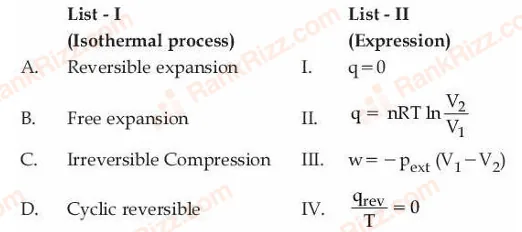
Choose the correct answer from the options given below :
- (A)
A-II, B-III, C-I, D-IV
- (B)
A-II, B-I, C-IV, D-III
- (C)
A-II, B-I, C-III, D-IV
- (D)
A-I, B-II, C-III, D-IV
rr2.rankrizz.com/jee-main/chemistry/chemical-thermodynamics/q/6-apr-2026-s2-q54
- (A)
Given below are two statements:
Statement I: For an ideal gas, heat capacity at constant volume is always greater than the heat capacity at constant pressure.
Statement II: In a constant volume process, no work is produced and all the heat withdrawn goes into the chaotic motion and is reflected by a temperature increase of the ideal gas.
In the light of the above statement, choose the correct answer from the options given below.- (A)
Both Statement I and Statement II are true
- (B)
Both Statement I and Statement II are false
- (C)
Statement I is true but Statement II is false
- (D)
Statement I is false but Statement II is true
rr2.rankrizz.com/jee-main/chemistry/chemical-thermodynamics/q/4-apr-2026-s1-q54
- (A)
Gas 'A' undergoes change from state 'X' to state 'Y'. In this process, the heat absorbed and work done by the gas is 10 J and 18 J respectively. Now gas is brought back to state 'X' by another process during which 6 J of heat is evolved. In the reverse process of 'Y' to 'X' :
- (A)
18 J of the work is done by the gas 'A'
- (B)
2 J of the work is done by the gas 'A'
- (C)
12 J of the work is done on the gas 'A' by the surrounding
- (D)
14 J of the work is done on the gas 'A' by the surrounding
rr2.rankrizz.com/jee-main/chemistry/chemical-thermodynamics/q/2-apr-2026-s2-q54
- (A)
20.0 of an ideal gas 'X' at 600 K and 0.5 MPa undergoes isothermal reversible expansion until pressure of the gas is 0.2 MPa. Which of the following option is correct?
(Given: )- (A)
w = +4.1kJ, U = 0, H = 0; q = -4.1kJ
- (B)
w = 9.1kJ, U = 9.1J, H = 0; q = 0
- (C)
w = -3.9kJ, U = 0, H = 0; q = 3.9kJ
- (D)
w = -9.1kJ, U = 0, H = 0; q = 9.1kJ
rr2.rankrizz.com/jee-main/chemistry/chemical-thermodynamics/q/28-jan-2026-s1-q60
- (A)
Match the LIST-I with LIST-II
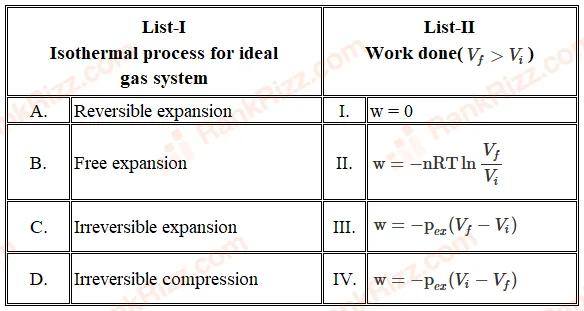
Choose the correct answer from the options given befow:- (A)
A-IV, B-II, C-III, D-I
- (B)
A-II, B-I, C-III, D-IV
- (C)
A-IV, B-I, C-III, D-II
- (D)
A-I, B-III, C-II, D-IV
rr2.rankrizz.com/jee-main/chemistry/chemical-thermodynamics/q/24-jan-2026-s1-q66
- (A)
A cup of water at 5°C (system) is placed in a microwave oven and the oven is turned on for one minute during which the water begins to boil. Which of the following option is true ?
- (A)
q = + ve, w = 0, = - ve
- (B)
q = + ve, w = - ve, = - ve
- (C)
q = + ve, w = - ve, = + ve
- (D)
q = - ve, w = - ve, = - ve
rr2.rankrizz.com/jee-main/chemistry/chemical-thermodynamics/q/23-jan-2026-s1-q64
- (A)
Match the LIST-I with LIST-II
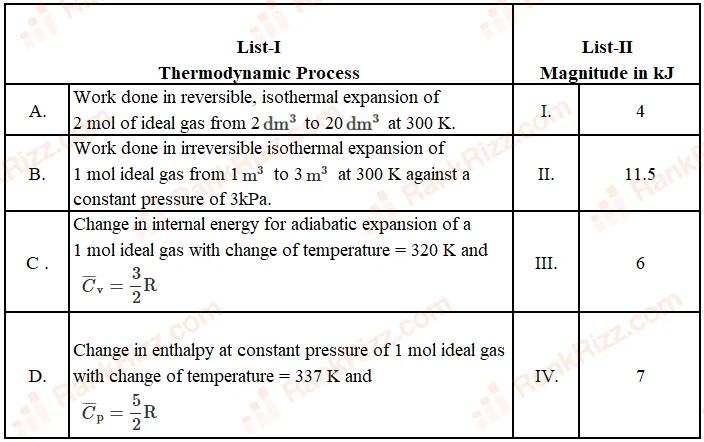
Choose the correct answer from the options given below:
- (A)
A-I, B-II, C-III, D-IV
- (B)
A-II, B-III, C-I, D-IV
- (C)
A-II, B-I, C-III, D-IV
- (D)
A-III, B-II, C-IV, D-1
rr2.rankrizz.com/jee-main/chemistry/chemical-thermodynamics/q/22-jan-2026-s1-q55
- (A)
Which of the following graphs between pressure 'p' versus volume 'V' represents the maximum work done?
- (A)
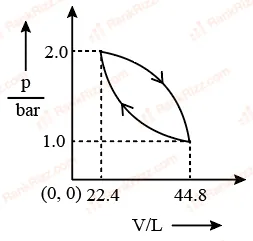
- (B)
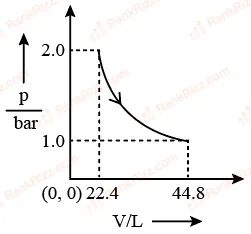
- (C)
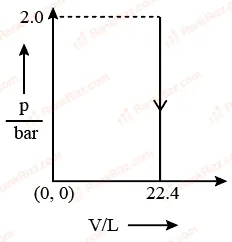
- (D)
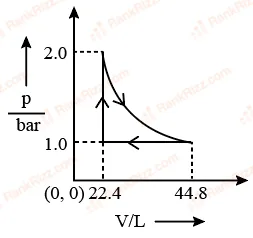
rr2.rankrizz.com/jee-main/chemistry/chemical-thermodynamics/q/21-jan-2026-s1-chemistry-q12
- (A)
For an isothermal free expansion of an ideal gas into vacuum, which one of the following set of values is correct?
- (A)
- (B)
- (C)
- (D)
rr2.rankrizz.com/jee-main/chemistry/chemical-thermodynamics/q/2026-chemistry-516809
- (A)
One mole of an ideal gas expands isothermally and reversibly from 10 to 20 at 300 K. , q and work done in the process respectively are: (Given: , , , )
- (A)
0, 21.84 kJ, -1.26 kJ
- (B)
0, -17.18 kJ, 1.718 J
- (C)
0, 21.84 kJ, 21,84 kJ
- (D)
0, 1718 kJ, -1.718 kJ
rr2.rankrizz.com/jee-main/chemistry/chemical-thermodynamics/q/2025-apr-4-s1-q55
- (A)
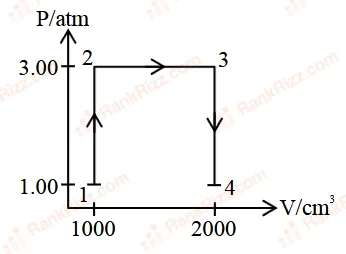
A perfect gas (0.1 mol) having (independent of temperature) undergoes the transformation from point 1 to point 4 as shown in the P-V diagram. If each step is reversible, the total work done (w) while going from point 1 to point 4 is (-) \text{____} J (nearest integer).
[Given: L atm ]Answer: ____________
rr2.rankrizz.com/jee-main/chemistry/chemical-thermodynamics/q/2025-apr-3-s2-q72
A sample of n-octane (1.14 g) was completely burnt in excess of oxygen in a bomb calorimeter, whose heat capacity is 5 kJ . As a result of combustion reaction, the temperature of the calorimeter is increased by 5 K. The magnitude of the heat of combustion of octane at constant volume is ________ kJ mol (nearest integer).
Answer: ____________
rr2.rankrizz.com/jee-main/chemistry/chemical-thermodynamics/q/2025-apr-3-s2-q73
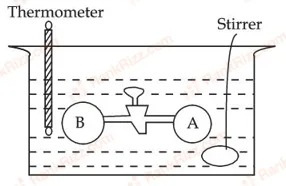
Two vessels A and B are connected via stopcock. The vessel A is filled with a gas at a certain pressure. The entire assembly is immersed in water and is allowed to come to thermal equilibrium with water. After opening the stopcock the gas from vessel A expands into vessel B and no change in temperature is observed in the thermometer. Which of the following statement is true?
- (A)
- (B)
- (C)
- (D)
The pressure in the vessel B before opening the stopcock is zero.
rr2.rankrizz.com/jee-main/chemistry/chemical-thermodynamics/q/2025-apr-02-s1-q56
- (A)
500J of energy is transferred as heat to 0.5 mol of Argon gas at 298 K and 1.00 atm. The final temperature and the change in internal energy respectively are: Given :
- (A)
378 K and 500 J
- (B)
368 K and 500 J
- (C)
348 K and 300 J
- (D)
378 K and 300 J
rr2.rankrizz.com/jee-main/chemistry/chemical-thermodynamics/q/29-jan-2025-s1-q52
- (A)
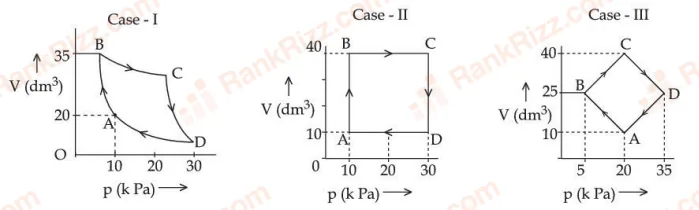
An ideal gas undergoes a cyclic transformation starting from the point A and coming back to the same point by tracing the path as shown in the three cases above. Choose the correct option regarding :
- (A)
- (B)
- (C)
- (D)
rr2.rankrizz.com/jee-main/chemistry/chemical-thermodynamics/q/28-jan-2025-s2-q67
- (A)
A liquid when kept inside a thermally insulated closed vessel at was mechanically stirred from outside. What will be the correct option for the following thermodynamic parameters ?
- (A)
- (B)
- (C)
- (D)
rr2.rankrizz.com/jee-main/chemistry/chemical-thermodynamics/q/22-jan-2025-s1-q53
- (A)
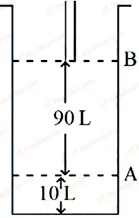
Consider the figure provided. 1 mol of an ideal gas is kept in a cylinder, fitted with a piston, at the position A, at . If the piston is moved to position B, keeping the temperature unchanged, then '' L atm work is done in this reversible process. ______ L atm. (nearest integer) [Given: Absolute temperature , ]
Answer: ____________
rr2.rankrizz.com/jee-main/chemistry/chemical-thermodynamics/q/8-apr-2024-s1-q53
for water is at 1 bar and . Change in internal energy for this vapourisation under same condition is _____ . (Given )
Answer: ____________
rr2.rankrizz.com/jee-main/chemistry/chemical-thermodynamics/q/8-apr-2024-s2-q53
An ideal gas, , is expanded adiabatically against a constant pressure of 1 atm until it doubles in volume. If the initial temperature and pressure is and , respectively then the final temperature is _______ K (nearest integer). [ is the molar heat capacity at constant volume]
Answer: ____________
rr2.rankrizz.com/jee-main/chemistry/chemical-thermodynamics/q/6-apr-2024-s1-q53
Three moles of an ideal gas are compressed isothermally from L to L using constant pressure of atm. Heat exchange for the compression is ______ Lit. atm.
Answer: ____________
rr2.rankrizz.com/jee-main/chemistry/chemical-thermodynamics/q/04-apr-2024-s2-q53
Choose the correct option for free expansion of an ideal gas under adiabatic condition from the following :
- (A)
- (B)
- (C)
- (D)
rr2.rankrizz.com/jee-main/chemistry/chemical-thermodynamics/q/01-feb-2024-s1-q35
- (A)
If 5 moles of an ideal gas expands from 10 L to a volume of 100 L at 300 K under isothermal and reversible condition then work, , is J. The value of is (Given J K mol)
Answer: ____________
rr2.rankrizz.com/jee-main/chemistry/chemical-thermodynamics/q/31-jan-2024-s2-q53
An ideal gas undergoes a cyclic transformation starting from the point and coming back to the same point by tracing the path as shown in the diagram. The total work done in the process is _____ J.
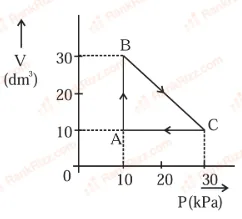
Answer: ____________
rr2.rankrizz.com/jee-main/chemistry/chemical-thermodynamics/q/30-jan-2024-s1-q54
If three moles of an ideal gas at K expand isothermally from to against a constant opposing pressure of kPa, then the amount of heat transferred is _________ J.
Answer: ____________
rr2.rankrizz.com/jee-main/chemistry/chemical-thermodynamics/q/27-jan-2024-s1-q54
When a 60 W electric heater is immersed in a gas for 100 s in a constant volume container with adiabatic walls, the temperature of the gas rises by 5°C. The heat capacity of the given gas is JK (Nearest integer)
Answer: ____________
rr2.rankrizz.com/jee-main/chemistry/chemical-thermodynamics/q/8-apr-2023-s1-q55
When 2 litre of ideal gas expands isothermally into vacuum to a total volume of 6 litre, the change in internal energy is ______ J. (Nearest integer)
Answer: ____________
rr2.rankrizz.com/jee-main/chemistry/chemical-thermodynamics/q/30-jan-2023-s1-q52
1 mole of ideal gas is allowed to expand reversibly and adiabatically from a temperature of C. The work done is kJ mol. The final temperature of the gas is ______ K (Nearest integer). Given J mol K
Answer: ____________
rr2.rankrizz.com/jee-main/chemistry/chemical-thermodynamics/q/30-jan-2023-s2-q51
One mole of an ideal monoatomic gas is subjected to changes as shown in the graph. The magnitude of the work done (by the system or on the system) is _____ J (nearest integer)
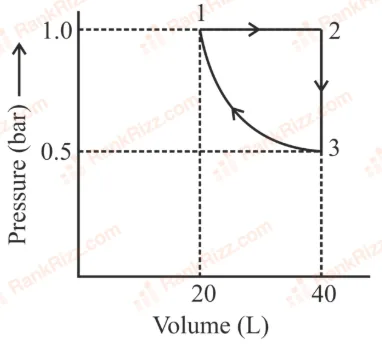
Given: log 2 = 0.3, ln 10 = 2.3
Answer: ____________
rr2.rankrizz.com/jee-main/chemistry/chemical-thermodynamics/q/24-jan-2023-s2-q53
The molar heat capacity for an ideal gas at constant pressure is . The change in internal energy is upon heating it from to . The number of moles of the gas at constant volume is ______ (Given: )
Answer: ____________
rr2.rankrizz.com/jee-main/chemistry/chemical-thermodynamics/q/27-jul-2022-s1-q53
A gas (Molar mass = 280 g mol) was burnt in excess in a constant volume calorimeter and during combustion the temperature of calorimeter increased from 298.0 K to 298.45 K. If the heat capacity of calorimeter is 2.5 kJ K and enthalpy of combustion of gas is 9 kJ mol then amount of gas burnt is _____ g.
Answer: ____________
rr2.rankrizz.com/jee-main/chemistry/chemical-thermodynamics/q/27-jul-2022-s2-q54
2.2 g of nitrous oxide (NO) gas is cooled at a constant pressure of 1 atm from 310 K to 270 K causing the compression of the gas from 217.1 mL to 167.75 mL. The change in internal energy of the process, U is '-x'J. The value of 'x' is ______.
[nearest integer]
(Given: atomic mass of N = 14 g mol and of O = 16 g mol. Molar heat capacity of NO is 100 JK mol)Answer: ____________
rr2.rankrizz.com/jee-main/chemistry/chemical-thermodynamics/q/29-jun-2022-s2-q52
L of an ideal gas is allowed to expand isothermally into vacuum until the total volume is L. The amount of heat absorbed in this expansion is ______ L atm.
Answer: ____________
rr2.rankrizz.com/jee-main/chemistry/chemical-thermodynamics/q/28-jun-2022-s1-q53
A fish swimming in water body when taken out from the water body is covered with a film of water of weight g. When it is subjected to cooking at C, then the internal energy for vaporization in kJ mol is ______ [integer]
[Assume steam to be an ideal gas. Given for water at K and bar is kJ mol : J K mol]Answer: ____________
rr2.rankrizz.com/jee-main/chemistry/chemical-thermodynamics/q/26-jun-2022-s2-q54
A system does 200 J of work and at the same time absorbs 150 J of heat. The magnitude of the change in internal energy is _________J. (Nearest integer)
Answer: ____________
rr2.rankrizz.com/jee-main/chemistry/chemical-thermodynamics/q/25-jul-2021-s2-q54
At 25°C, 50 g of iron reacts with HCl to form . The evolved hydrogen gas expands against a constant pressure of 1 bar. The work done by the gas during this expansion is ________ J. (Round off to the Nearest Integer)
[Given: J mol K. Assume, hydrogen is an ideal gas]
[Atomic mass of Fe is 55.85 u]Answer: ____________
rr2.rankrizz.com/jee-main/chemistry/chemical-thermodynamics/q/16-mar-2021-s2-q53
The reaction of cyanamide, with oxygen was run in a bomb calorimeter and was found to be kJ mol. The magnitude of for the reaction
is ______ kJ. (Rounded off to the nearest integer) [Assume ideal gases and R = 8.314 J mol K]Answer: ____________
rr2.rankrizz.com/jee-main/chemistry/chemical-thermodynamics/q/25-feb-2021-s1-q52
Five moles of an ideal gas at 293 K is expanded isothermally from an initial pressure of 2.1 MPa to 1.3 MPa against at constant external pressure 4.3 MPa. The heat transferred in this process is ______ kJ mol.
(Rounded-off to the nearest integer)
[Use J mol K]Answer: ____________
rr2.rankrizz.com/jee-main/chemistry/chemical-thermodynamics/q/25-feb-2021-s2-q52
Five moles of an ideal gas at 1 bar and 298 K is expanded into vacuum to double the volume. The work done is:
- (A)
- (B)
- (C)
- (D)
Zero
rr2.rankrizz.com/jee-main/chemistry/chemical-thermodynamics/q/4-sep-2020-s2-q30
- (A)
The magnitude of work done by a gas that undergoes a reversible expansion along the path ABC shown in the figure is __________.
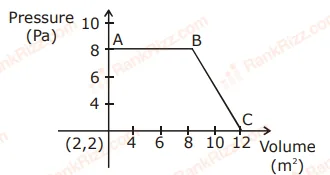
Answer: ____________
rr2.rankrizz.com/jee-main/chemistry/chemical-thermodynamics/q/8-jan-2020-s1-q47
At constant volume, 4 mol of an ideal gas when heated from 300K to 500K changes its internal energy by 5000J. The molar heat capacity at constant volume is
Answer: ____________
rr2.rankrizz.com/jee-main/chemistry/chemical-thermodynamics/q/8-jan-2020-s2-q47
An ideal gas is allowed to expand from 1 L to 10 L against a constant external pressure of 1 bar. The work done in kJ is:
- (A)
+10.0
- (B)
-2.0
- (C)
-0.9
- (D)
-9.0
rr2.rankrizz.com/jee-main/chemistry/chemical-thermodynamics/q/12-apr-2019-s1-q35
- (A)
During compression of a spring the work done is 10 kJ and 2 kJ escaped to the surroundings as heat. The change in internal energy, (in kJ) is:
- (A)
-8
- (B)
8
- (C)
12
- (D)
-12
rr2.rankrizz.com/jee-main/chemistry/chemical-thermodynamics/q/9-apr-2019-s2-q35
- (A)
Which one of the following equations does not correctly represent the first law of thermodynamics for the given processes involving an ideal gas? (Assume non-expansion work is zero)
- (A)
Isochoric process:
- (B)
Isochoric process:
- (C)
Cyclic process:
- (D)
Adiabatic process:
rr2.rankrizz.com/jee-main/chemistry/chemical-thermodynamics/q/8-apr-2019-s1-q33
- (A)
5 moles of an ideal gas at 100 K are allowed to undergo reversible compression till its temperature becomes 200 K. If J K, calculate and for the process. (R = 8.0 J K mol)
- (A)
J; J
- (B)
kJ; kJ
- (C)
kJ; kJ
- (D)
kJ; kJ
rr2.rankrizz.com/jee-main/chemistry/chemical-thermodynamics/q/8-apr-2019-s2-q36
- (A)
An ideal gas undergoes isothermal compression from 5 m to 1 m against a constant external pressure of 4 N m. The heat released in this process is 24 J mol K and is used to increase the pressure of 1 mole of Al. The temperature of Al increases by:
- (A)
K
- (B)
1 K
- (C)
K
- (D)
2 K
rr2.rankrizz.com/jee-main/chemistry/chemical-thermodynamics/q/10-jan-2019-s2-q34
- (A)
An ideal gas undergoes a cyclic process as shown in Figure.
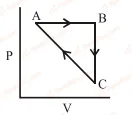
kJ mol, kJ mol
kJ mol, kJ mol
Heat absorbed by the system during process CA is:- (A)
-5 kJ mol
- (B)
+5 kJ mol
- (C)
18 kJ mol
- (D)
-18 kJ mol
rr2.rankrizz.com/jee-main/chemistry/chemical-thermodynamics/q/15-apr-2018-s1-q40
- (A)
The combustion of benzene (l) gives CO(g) and HO(l). Given that heat of combustion of benzene at constant volume is kJ mol at 25C; the heat of combustion (in kJ mol) of benzene at constant pressure will be:
(R = 8.314 JK mol)- (A)
-3267.6
- (B)
4152.6
- (C)
-452.46
- (D)
3260
rr2.rankrizz.com/jee-main/chemistry/chemical-thermodynamics/q/8-apr-2018-offline-q35
- (A)
A gas undergoes change from state A to state B. In this process, the heat absorbed and work done by the gas is 5 J and 8 J, respectively. Now gas is brought back to A by another process during which 3 J of heat is evolved. In this reverse process of B to A.
- (A)
6 J of the work will be done by the gas
- (B)
6 J of the work will be done by the surroundings on gas
- (C)
10 J of the work will be done by the surroundings on gas
- (D)
10 J of the work will be done by the gas on gas
rr2.rankrizz.com/jee-main/chemistry/chemical-thermodynamics/q/9-apr-2017-online-q39
- (A)
is equal to:
- (A)
Isobaric work
- (B)
Adiabatic work
- (C)
Isothermal work
- (D)
Isochoric work
rr2.rankrizz.com/jee-main/chemistry/chemical-thermodynamics/q/2-apr-2017-offline-q37
- (A)
If 100 mole of decompose at 1 bar and 300 K, the work is done (kJ) by one mole of as it expands against 1 bar pressure is:
J K mol- (A)
124.50
- (B)
249.00
- (C)
498.00
- (D)
62.25
rr2.rankrizz.com/jee-main/chemistry/chemical-thermodynamics/q/10-apr-2016-online-q35
- (A)
Which of the following statements/relationships is not correct in thermodynamic changes?
- (A)
(isothermal reversible expansion of a gas)
- (B)
(isothermal reversible expansion of an ideal gas)
- (C)
(isothermal reversible expansion of an ideal gas)
- (D)
For a system of constant volume heat involved directly changes to internal energy.
rr2.rankrizz.com/jee-main/chemistry/chemical-thermodynamics/q/23-apr-2013-online-q37
- (A)
A piston filled with 0.04 mol of an ideal gas expands reversibly from 50.0 mL to 375 mL at a constant temperature of 37.0°C. The values of q and w for the process will be
(R = 8.314 J/mol K) (ln7.5 = 2.01)- (A)
q = -208 J, w = +208 J
- (B)
q = +208 J, w = +208 J
- (C)
q = +208 J, w = -208 J
- (D)
q = -208 J, w = -208 J
rr2.rankrizz.com/jee-main/chemistry/chemical-thermodynamics/q/7-apr-2013-offline-q42
- (A)
An ideal gas is allowed to expand both reversibly and irreversibly in an isolated system. If is the initial temperature and is the final temperature, which of the following statements is correct?
- (A)
- (B)
for reversible process but for irreversible process
- (C)
- (D)
for both reversible and irreversible processes
rr2.rankrizz.com/jee-main/chemistry/chemical-thermodynamics/q/2006-chemistry-500040
- (A)
An ideal gas expands in volume from m to m at K against a constant pressure of N m. The work done is
- (A)
J
- (B)
kJ
- (C)
kJ
- (D)
kJ
rr2.rankrizz.com/jee-main/chemistry/chemical-thermodynamics/q/2004-chemistry-500327
- (A)
Gibbs energy and spontaneity 54
Consider the reaction X Y at 300 K. If and K are 28.40 kJ mol and at the same temperature, then the magnitude of for the reaction in J K mol is _______. (Nearest integer)
(Given: R = 8.3 J K mol, ln 10 = 2.3, log 3 = 0.48, log 2 = 0.30)Answer: ____________
rr2.rankrizz.com/jee-main/chemistry/chemical-thermodynamics/q/6-apr-2026-s1-q75
Consider the following data for the reaction
at 600 K. The (in ) for the reaction is :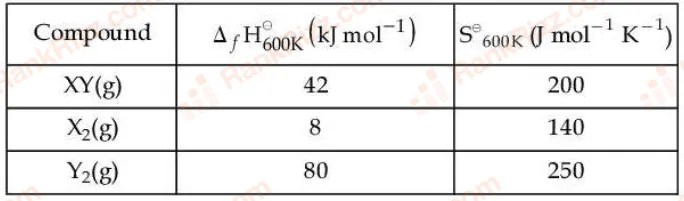
- (A)
- (B)
- (C)
- (D)
rr2.rankrizz.com/jee-main/chemistry/chemical-thermodynamics/q/5-apr-2026-s2-q54
- (A)
At the transition temperature T, A B and ΔG = 105 − 35 log T where A and B are two states of substance X. The transition temperature in °C when pressure is 1 atm is __________. (Nearest integer)
Answer: ____________
rr2.rankrizz.com/jee-main/chemistry/chemical-thermodynamics/q/2-apr-2026-s1-q75
For the reaction , graph is plotted as shown below. Identify correct statements.
A. Standard free energy change for the reaction is .
B. As in graph is positive, will not dissociate into at all.
C. Reverse reaction will go to completion.
D. When 1 mole of changes into equilibrium mixture, value of = -0.84kJ .
E. When 2 mole of changes into equilibrium mixture, for equilibrium mixture is -6.24kJ .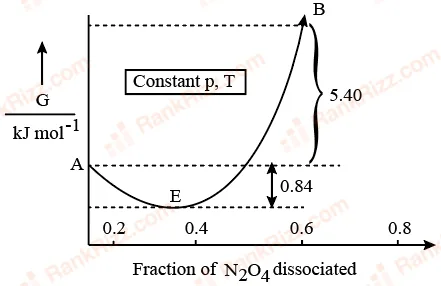
Choose the correct answer from the options given below:- (A)
D andE only
- (B)
B andC only
- (C)
A and D only
- (D)
C and E only
rr2.rankrizz.com/jee-main/chemistry/chemical-thermodynamics/q/21-jan-2026-s1-chemistry-q20
- (A)
Use the following data :
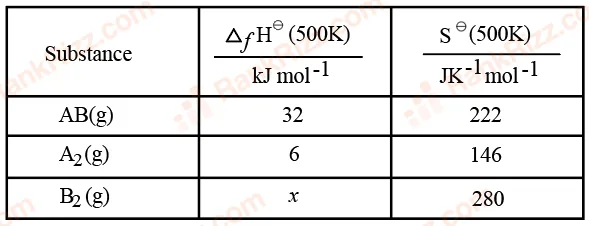
One mole each of and are taken in a 1 L closed flask and allowed to establish the equilibrium at 500K
The value of x in is ____ . (Nearest integer)
(Given: log K=2.2 R= 8.3 kJ )Answer: ____________
rr2.rankrizz.com/jee-main/chemistry/chemical-thermodynamics/q/21-jan-2026-s1-q73
Let us consider a reversible reaction at temperature, T. In this reaction, both and were observed to have positive values. If the equilibrium temperature is , then the reaction becomes spontaneous at:
- (A)
- (B)
- (C)
- (D)
rr2.rankrizz.com/jee-main/chemistry/chemical-thermodynamics/q/2025-apr-4-s1-q52
- (A)
Which of the following graphs correctly represents the variation of thermodynamic properties of Haber's process ?
- (A)
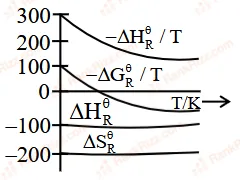
- (B)
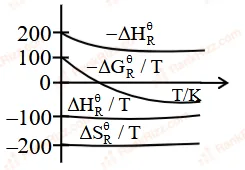
- (C)
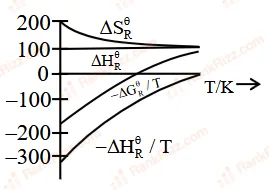
- (D)
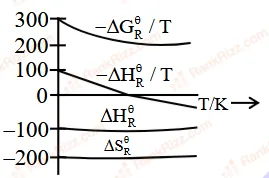
rr2.rankrizz.com/jee-main/chemistry/chemical-thermodynamics/q/2025-apr-02-s2-q68
- (A)
Let us consider an endothermic reaction which is non-spontaneous at the freezing point of water. However, the reaction is spontaneous at boiling point of water. Choose the correct option.
- (A)
- (B)
- (C)
- (D)
rr2.rankrizz.com/jee-main/chemistry/chemical-thermodynamics/q/24-jan-2025-s1-q56
- (A)
Standard entropies of and are and respectively. The temperature in Kelvin at which the reaction will be at equilibrium is (Nearest integer).}
Answer: ____________
rr2.rankrizz.com/jee-main/chemistry/chemical-thermodynamics/q/24-jan-2025-s1-q75
Ice at is heated to become vapor with temperature of at atmospheric pressure. The entropy change associated with this process can be obtained from
- (A)
- (B)
- (C)
- (D)
rr2.rankrizz.com/jee-main/chemistry/chemical-thermodynamics/q/23-jan-2025-s1-q64
- (A)
The standard enthalpy and standard entropy of decomposition of to are 55.0 kJ and 175.0 J/K/mol respectively. The standard free energy change for this reaction at in J is ______ (Nearest integer)
Answer: ____________
rr2.rankrizz.com/jee-main/chemistry/chemical-thermodynamics/q/23-jan-2025-s1-q71
The effect of temperature on spontaneity of reactions are represented as :
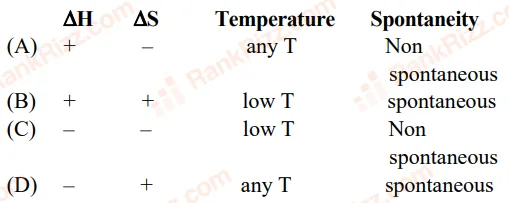
- (A)
(B) and (C) only
- (B)
(B) and (D) only
- (C)
(A) and (D) only
- (D)
(A) and (C) only
rr2.rankrizz.com/jee-main/chemistry/chemical-thermodynamics/q/23-jan-2025-s2-q53
- (A)
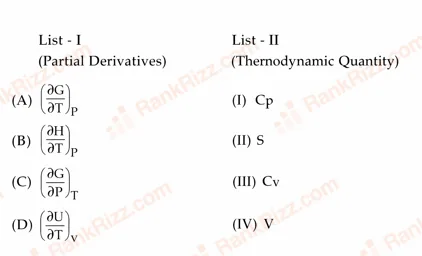
Match List - I with List - II.
Choose the correct answer from the options given below :- (A)
(A)-(II), (B)-(I), (C)-(III), (D)-(IV)
- (B)
(A)-(I), (B)-(II), (C)-(IV), (D)-(III)
- (C)
(A)-(II), (B)-(I), (C)-(IV), (D)-(III)
- (D)
(A)-(II), (B)-(III), (C)-(I), (D)-(IV)
rr2.rankrizz.com/jee-main/chemistry/chemical-thermodynamics/q/22-jan-2025-s2-q60
- (A)
When and , then the temperature of vapour, at one atmosphere is ______ K.
Answer: ____________
rr2.rankrizz.com/jee-main/chemistry/chemical-thermodynamics/q/9-apr-2024-s2-q53
For the reaction at , . and . The reaction will become spontaneous above ___________ K.
Answer: ____________
rr2.rankrizz.com/jee-main/chemistry/chemical-thermodynamics/q/6-apr-2024-s2-q54
For a certain reaction at 300 K, K = 10, then for the same reaction is - ______ . (Given )
Answer: ____________
rr2.rankrizz.com/jee-main/chemistry/chemical-thermodynamics/q/01-feb-2024-s2-q52
Consider the following reaction at 298 K. , . for the reaction is _________ kJ. (Given ) Round off your answer to the nearest integer.
Answer: ____________
rr2.rankrizz.com/jee-main/chemistry/chemical-thermodynamics/q/31-jan-2024-s1-q54
Which of the following is not correct?
- (A)
is negative for a spontaneous reaction
- (B)
is positive for a spontaneous reaction
- (C)
is zero for a reversible reaction
- (D)
is positive for a non-spontaneous reaction
rr2.rankrizz.com/jee-main/chemistry/chemical-thermodynamics/q/29-jan-2024-s1-q33
- (A)
For a certain thermochemical reaction at K, kJ mol, J K, log equilibrium constant () is _____ .
Answer: ____________
rr2.rankrizz.com/jee-main/chemistry/chemical-thermodynamics/q/27-jan-2024-s2-q56
kJ of heat is required to melt one mole of sodium chloride and the entropy change at the melting point is J K mol at 1 atm. The melting point of sodium chloride is _____ K (Nearest Integer)
Answer: ____________
rr2.rankrizz.com/jee-main/chemistry/chemical-thermodynamics/q/15-apr-2023-s1-q52
For complete combustion of ethene,
the amount of heat produced as measured in bomb calorimeter is 1406 kJ mol at 300 K. The minimum value of TS needed to reach equilibrium is () kJ. (Nearest integer)
Given: R = 8.3 J K molAnswer: ____________
rr2.rankrizz.com/jee-main/chemistry/chemical-thermodynamics/q/08-apr-2023-s2-q51
The value of log K for the reaction A B at 298 K is ______. (Nearest integer)
Given: kJ mol, J K mol
(Taken )Answer: ____________
rr2.rankrizz.com/jee-main/chemistry/chemical-thermodynamics/q/6-apr-2023-s1-q54
Consider the graph of Gibbs free energy G vs extent of reaction. The number of statement/s from the following which are true with respect to points (a), (b) and (c) is ______
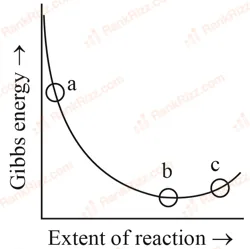
A. Reaction is spontaneous at (a) and (b)
B. Reaction is at equilibrium at point (b) and non-spontaneous at point (c)
C. Reaction is spontaneous at (a) and non-spontaneous at (c)
D. Reaction is non-spontaneous at (a) and (b)Answer: ____________
rr2.rankrizz.com/jee-main/chemistry/chemical-thermodynamics/q/6-apr-2023-s1-q55
For independent process at 300 K.
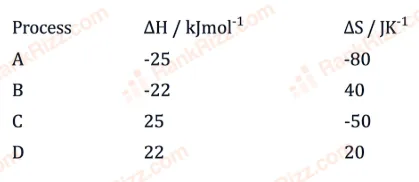
The number of non-spontaneous process from the following is _____.Answer: ____________
rr2.rankrizz.com/jee-main/chemistry/chemical-thermodynamics/q/24-jan-2023-s1-q52
For independent process at 300 K.
Process / kJmol / JK A -25 -80 B -22 40 C 25 -50 D 22 20
The number of non-spontaneous process from the following is _____.Answer: ____________
rr2.rankrizz.com/jee-main/chemistry/chemical-thermodynamics/q/24-jan-2023-s1-q52-494067
Given below are two statements: One is labelled as Assertion A and the other is labelled as Reason R
Assertion A: The reduction of a metal oxide is easier if the metal formed is in liquid state than solid state.
Reason R: The value of becomes more on negative side as entropy is higher in liquid state than solid state.
In the light of the above statements, choose the most appropriate answer from the options given below- (A)
Both A and R are correct and R is the correct explanation of A
- (B)
Both A and R are correct but R is NOT the correct explanation of A
- (C)
A is correct but R is not correct
- (D)
A is not correct but R is correct
rr2.rankrizz.com/jee-main/chemistry/chemical-thermodynamics/q/28-jul-2022-s2-q34
- (A)
The standard entropy change for the reaction
is J K at K
[Given : The standard enthalpy change for the reaction is kJ mol]. The temperature in K at which the reaction attains equilibrium is (Nearest Integer) ______Answer: ____________
rr2.rankrizz.com/jee-main/chemistry/chemical-thermodynamics/q/25-jun-2022-s1-q55
For the reaction 2NO(g) NO(g), when J K and kJ mol the magnitude of at 298 K for the reaction is _________ kJ mol. (Nearest integer)
Answer: ____________
rr2.rankrizz.com/jee-main/chemistry/chemical-thermodynamics/q/1-sep-2021-s2-q55
The incorrect expression among the following is:
- (A)
For isothermal process
- (B)
- (C)
(at constant P)
- (D)
rr2.rankrizz.com/jee-main/chemistry/chemical-thermodynamics/q/31-aug-2021-s2-q31
- (A)
Data given for the following reaction is as follows:
FeO + C Fe + CO
Substance (kJ mol) (J mol K)
FeO -266.3 57.49
C 0 5.74
Fe 0 27.28
CO -110.5 197.6
The minimum temperature in K at which the reaction becomes spontaneous is _________. (Integer answer)Answer: ____________
rr2.rankrizz.com/jee-main/chemistry/chemical-thermodynamics/q/27-aug-2021-s2-q55
For a given chemical reaction A B at 300 K the free energy change is -49.4 kJ mol and the enthalpy of reaction is 51.4 kJ mol. The entropy change of the reaction is ___ JK mol.
Answer: ____________
rr2.rankrizz.com/jee-main/chemistry/chemical-thermodynamics/q/20-jul-2021-s2-q52
During which of the following processes, does entropy decrease?
(A) Freezing of water to ice at 0°C
(B) Freezing of water to ice at -10°C
(C) N(g) + 3H(g) 2NH(g)
(D) Adsorption of CO(g) and lead surface
(E) Dissolution of NaCl in water- (A)
(A), (B), (C) and (D) only
- (B)
(B) and (C) only
- (C)
(A) and (E) only
- (D)
(A), (C) and (E) only
rr2.rankrizz.com/jee-main/chemistry/chemical-thermodynamics/q/17-mar-2021-s2-q32
- (A)
Assuming ideal behaviour, the magnitude of log K for the following reaction at 25°C is . The value of x is ______. (Integer answer)
[Given: J mol; J mol; R = 8.314 J K mol]Answer: ____________
rr2.rankrizz.com/jee-main/chemistry/chemical-thermodynamics/q/24-feb-2021-s2-q54
For a dimerization reaction,
at 298K, , , then the will be .....J.Answer: ____________
rr2.rankrizz.com/jee-main/chemistry/chemical-thermodynamics/q/5-sep-2020-s2-q46
For the reaction:
A(l) 2B(g)
kcal, cal K at 300K.
Hence in kcal isAnswer: ____________
rr2.rankrizz.com/jee-main/chemistry/chemical-thermodynamics/q/7-jan-2020-s1-q46
A process will be spontaneous at all temperatures if:
- (A)
and
- (B)
and
- (C)
and
- (D)
and
rr2.rankrizz.com/jee-main/chemistry/chemical-thermodynamics/q/10-apr-2019-s1-q36
- (A)
For the chemical reaction , the standard reaction Gibbs energy depends on temperature T (in K) as (in kJ mol) . The major component of the reaction mixture at T is:
- (A)
Y if T = 300 K
- (B)
Y if T = 280 K
- (C)
X if T = 350 K
- (D)
X if T = 315 K
rr2.rankrizz.com/jee-main/chemistry/chemical-thermodynamics/q/11-jan-2019-s1-q35
- (A)
The reaction , for which kJ mol and JK mol is not feasible at 298 K. Temperature above which reaction will be feasible is
- (A)
2040.5 K
- (B)
1890.0 K
- (C)
2480.3 K
- (D)
2380.5 K
rr2.rankrizz.com/jee-main/chemistry/chemical-thermodynamics/q/11-jan-2019-s2-q34
- (A)
The standard reaction Gibbs energy for a chemical reaction at an absolute temperature T is given by where A and B are non-zero constants. Which of the following is true about this reaction?
- (A)
Exothermic if
- (B)
Endothermic if
- (C)
Endothermic if and
- (D)
Exothermic if and
rr2.rankrizz.com/jee-main/chemistry/chemical-thermodynamics/q/11-jan-2019-s2-q35
- (A)
For the equilibrium ; the value of at 298 K is approximately:
- (A)
100 kJ mol
- (B)
kJ mol
- (C)
80 kJ mol
- (D)
kJ mol
rr2.rankrizz.com/jee-main/chemistry/chemical-thermodynamics/q/11-jan-2019-s2-q36
- (A)
A process has J mol and J K mol. Out of the values given below choose the minimum temperature above which the process will be spontaneous:
- (A)
20 K
- (B)
5 K
- (C)
12 K
- (D)
4 K
rr2.rankrizz.com/jee-main/chemistry/chemical-thermodynamics/q/10-jan-2019-s1-q34
- (A)
For which of the following processes, is negative?
- (A)
C (diamond) C (graphite)
- (B)
N(g, 1 atm) N(g, 5 atm)
- (C)
N(g, 273K) N(g, 300K)
- (D)
H(g) 2H(g)
rr2.rankrizz.com/jee-main/chemistry/chemical-thermodynamics/q/16-apr-2018-online-q38
- (A)
at 500 K for substance 'S' in liquid state and gaseous state are +100.7 kcal mol and +103 kcal mol, respectively. Vapour pressure of liquid 'S' at 500 K is approximately equal to: (R = 2 cal K mol)
- (A)
100 atm
- (B)
1 atm
- (C)
10 atm
- (D)
0.1 atm
rr2.rankrizz.com/jee-main/chemistry/chemical-thermodynamics/q/15-apr-2018-s2-q35
- (A)
Given (i) 2FeO(s) 4Fe(s) + 3O(g); = +1487.0 kJ mol
(ii) 2CO(g) + O(g) 2CO(g); = -514.4 kJ mol
Free energy change, for the reaction 2FeO(s) + 6CO(g) 4Fe(s) + 6CO(g) will be:- (A)
-112.4 kJ mol
- (B)
-56.2 kJ mol
- (C)
-208.0 kJ mol
- (D)
-168.2 kJ mol
rr2.rankrizz.com/jee-main/chemistry/chemical-thermodynamics/q/15-apr-2018-s2-q36
- (A)
For the reaction,
, and are, respectively, kJ mol and kJ K mol at 298 K. The equilibrium constant for the reaction at 298 K is:- (A)
- (B)
10
- (C)
1
- (D)
rr2.rankrizz.com/jee-main/chemistry/chemical-thermodynamics/q/9-apr-2016-online-q37
- (A)
A reaction at 1 bar is non-spontaneous at low temperature but becomes spontaneous at high temperature. Identify the correct statement about the reaction among the following:
- (A)
is negative while is positive
- (B)
Both and are negative
- (C)
is positive while is negative
- (D)
Both and are positive
rr2.rankrizz.com/jee-main/chemistry/chemical-thermodynamics/q/9-apr-2016-online-q38
- (A)
The plot shows the variation of versus temperature for the two reactions.
and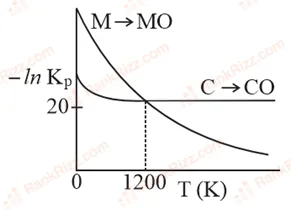
Identify the correct statement:- (A)
At T < 1200 K, oxidation of carbon is unfavourable
- (B)
Oxidation of carbon is favourable at all temperatures
- (C)
At T < 1200 K, the reaction is spontaneous
- (D)
At T > 1200 K, carbon will reduce to .
rr2.rankrizz.com/jee-main/chemistry/chemical-thermodynamics/q/9-apr-2016-online-q50
- (A)
The following reaction is performed at 298 K.
The standard free energy of the formation of is 86.6 kJ mol at 298 K. What is the standard free energy of the formation of at 298 K?- (A)
- (B)
- (C)
- (D)
rr2.rankrizz.com/jee-main/chemistry/chemical-thermodynamics/q/4-apr-2015-offline-q35
- (A)
The (S°) of the following substances are: CH(g) 186.2 JK mol, O(g) 205.2 JK mol, CO(g) 213.6 JK mol, HO(g) 69.9 JK mol. The entropy change () for the reaction CH(g) + 2O(g) CO(g) + 2HO(l) is:
- (A)
J K mol
- (B)
JK mol
- (C)
JK mol
- (D)
J K mol
rr2.rankrizz.com/jee-main/chemistry/chemical-thermodynamics/q/12-apr-2014-online-q38
- (A)
The molar heat capacity (C) of CDO is 10 cals at 1000 K. The change of entropy associated with cooling of 32 g of CDO vapour from 1000 K to 100 K at constant pressure will be: (D = deuterium, atomic mass = 2u)
- (A)
23.03 cal deg
- (B)
cal deg
- (C)
2.303 cal deg
- (D)
cal deg
rr2.rankrizz.com/jee-main/chemistry/chemical-thermodynamics/q/11-apr-2014-online-q39
- (A)
The incorrect expression among the following is :
- (A)
- (B)
In isothermal process
- (C)
- (D)
rr2.rankrizz.com/jee-main/chemistry/chemical-thermodynamics/q/2012-chemistry-499055
- (A)
For a particular reversible reaction at temperature , and were found to be both . If is the temperature at equilibrium, the reaction would be spontaneous when
- (A)
- (B)
- (C)
is 5 times
- (D)
rr2.rankrizz.com/jee-main/chemistry/chemical-thermodynamics/q/2010-chemistry-499671
- (A)
Standard entropy of and are 60, 40 and 50 , respectively. For the reaction, , to be at equilibrium, the temperature will be
- (A)
1250 K
- (B)
500 K
- (C)
750 K
- (D)
1000 K
rr2.rankrizz.com/jee-main/chemistry/chemical-thermodynamics/q/2008-chemistry-499902
- (A)
In conversion of lime-stone to lime, the values of and are kJ and 160.2 J/K respectively at 298 K and 1 bar. Assuming that do not change with temperature, temperature above which conversion of limestone to lime will be spontaneous is
- (A)
1008 K
- (B)
1200
- (C)
845 K
- (D)
1118 K
rr2.rankrizz.com/jee-main/chemistry/chemical-thermodynamics/q/2007-chemistry-499797
- (A)
Heat capacity and calorimetry 21
The correct order of molar heat capacities measured at 298 K and 1 bar is :
- (A)
- (B)
- (C)
- (D)
rr2.rankrizz.com/jee-main/chemistry/chemical-thermodynamics/q/5-apr-2026-s2-q55
- (A)
5 moles of unknown gas is heated at constant volume from 10 °C to 20 °C. The molar specific heat of this gas at constant pressure cal/mol.°C and J/mol.°C. The change in internal energy of the gas is _________ calorie.
Answer: ____________
rr2.rankrizz.com/jee-main/chemistry/chemical-thermodynamics/q/2-apr-2026-s2-q48
Which of the following properties will change when system containing solution 1 will become solution 2 ?
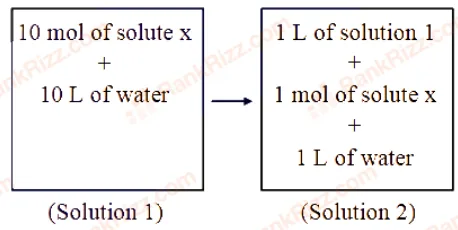
- (A)
Molar heat capacity
- (B)
Density
- (C)
Concentration
- (D)
Gibbs free energy
rr2.rankrizz.com/jee-main/chemistry/chemical-thermodynamics/q/2025-apr-03-s1-q60
- (A)
Given below are two statements:
Statement I: When a system containing ice in equilibrium with water (liquid) is heated, heat is absorbed by the system and there is no change in the temperature until whole ice gets melted.
Statement II: At melting point of ice, there is absorption of heat in order to overcome intermolecular forces of attraction within the molecules of water in ice and kinetic energy of molecules is not increased at melting point.
In the light of above statements, Choose the correct answer from the options given below :- (A)
Statement I is true but Statement II is false
- (B)
Both Statement I and Statement II are false
- (C)
Both Statement I and Statement II are true
- (D)
Statement I is false but Statement II is true
rr2.rankrizz.com/jee-main/chemistry/chemical-thermodynamics/q/2025-apr-3-s2-q66
- (A)
Arrange the following in order of magnitude of work done by the system / on the system at constant temperature :
(a) for expansion in infinite stage.
(b) for expansion in single stage.
(c) for compression in infinite stage.
(d) for compression in single stage.
Choose the correct answer from the options given below :- (A)
- (B)
- (C)
- (D)
rr2.rankrizz.com/jee-main/chemistry/chemical-thermodynamics/q/2025-apr-02-s2-q63
- (A)
The heat of combustion of solid benzoic acid at constant volume is at . The heat of combustion at constant pressure is , the value of is ______.
Answer: ____________
rr2.rankrizz.com/jee-main/chemistry/chemical-thermodynamics/q/5-apr-2024-s1-q54
What happens when methane undergoes combustion in systems A and B respectively?
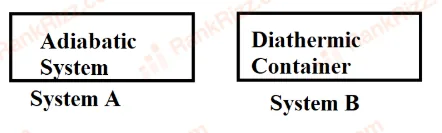
- (A)
System A: Temperature rises; System B: Temperature remains same
- (B)
System A: Temperature remains same; System B: Temperature rises
- (C)
System A: Temperature falls; System B: Temperature remains same
- (D)
System A: Temperature falls; System B: Temperature rises
rr2.rankrizz.com/jee-main/chemistry/chemical-thermodynamics/q/13-apr-2023-s2-q34
- (A)
Which of the following relations are correct?
(A)
(B)
(C)
(D)
Choose the most appropriate answer from the options given below:- (A)
C and D only
- (B)
B and C only
- (C)
A and B only
- (D)
B and D only
rr2.rankrizz.com/jee-main/chemistry/chemical-thermodynamics/q/29-jan-2023-s2-q33
- (A)
Which of the following relation is not correct?
- (A)
- (B)
- (C)
- (D)
rr2.rankrizz.com/jee-main/chemistry/chemical-thermodynamics/q/28-jul-2022-s1-q33
- (A)
Match List - I with List - II.
List-I List-II (A) Spontaneous process (I) (B) Process with (II) (C) (III) Isothermal and isobaric process (D) Exothermic Process (IV) [Bond energies in reactants] - [Bond energies in products] Choose the correct answer from the options given below
- (A)
A-(III), B-(II), C-(IV), D-(I)
- (B)
A-(II), B-(III), C-(IV), D-(I)
- (C)
A-(II), B-(III), C-(I), D-(IV)
- (D)
A-(II), B-(I), C-(III), D-(IV)
rr2.rankrizz.com/jee-main/chemistry/chemical-thermodynamics/q/27-jun-2022-s1-q33
- (A)
When 5 moles of He gas expand isothermally and reversibly at K from litre to litre, the magnitude of the maximum work obtained is ______ J. [nearest integer] (Given : J K mol and )
Answer: ____________
rr2.rankrizz.com/jee-main/chemistry/chemical-thermodynamics/q/27-jun-2022-s2-q53
Two flasks I and II shown below are connected by a valve of negligible volume.
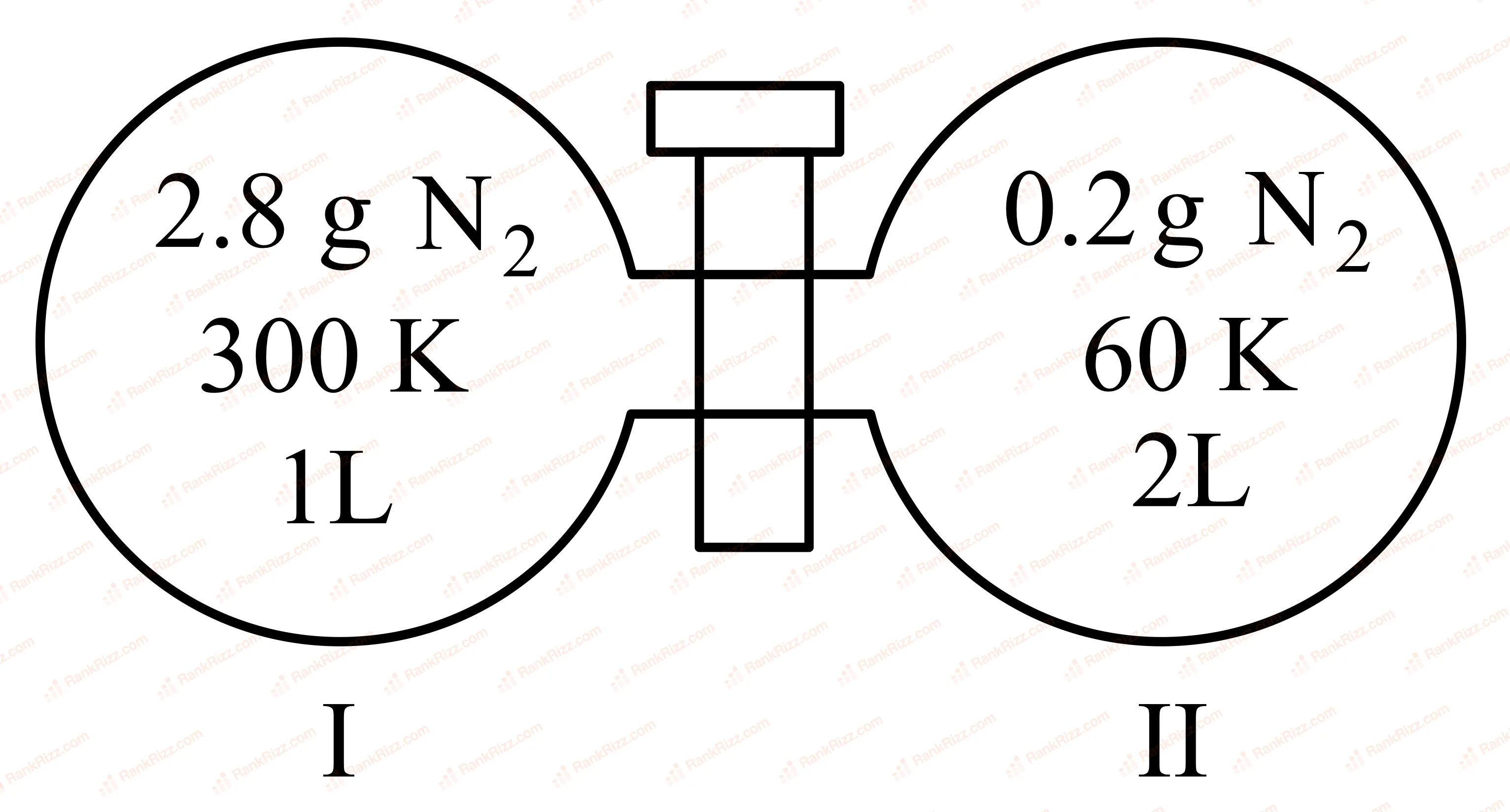
When the valve is opened, the final pressure of the system in bar is . The value of x is _________. (Integer answer)
[Assume : Ideal gas; 1 bar = Pa; Molar mass of N = 28.0 mol; R = 8.31 J mol K]Answer: ____________
rr2.rankrizz.com/jee-main/chemistry/chemical-thermodynamics/q/27-aug-2021-s2-q54
For one mole of an ideal gas, which of these statements must be true?
(a) Internal energy (U) and enthalpy (H) each depends on temperature.
(b) Compressibility factor Z is not equal to 1
(c)
(d) for any process- (A)
(a) and (c)
- (B)
(b), (c) and (d)
- (C)
(c) and (d)
- (D)
(a), (c) and (d)
rr2.rankrizz.com/jee-main/chemistry/chemical-thermodynamics/q/4-sep-2020-s1-q30
- (A)
For a diatomic ideal gas in a closed system, which of the following plots does not correctly describe the relation between various thermodynamic quantities?
- (A)
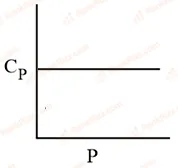
- (B)
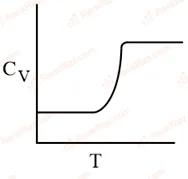
- (C)
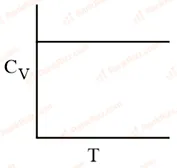
- (D)
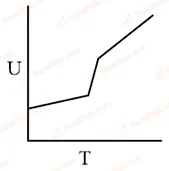
rr2.rankrizz.com/jee-main/chemistry/chemical-thermodynamics/q/12-jan-2019-s1-q35
- (A)
The combination of plots which does not represent isothermal expansion of an ideal gas is
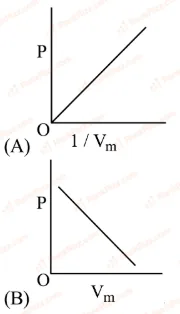
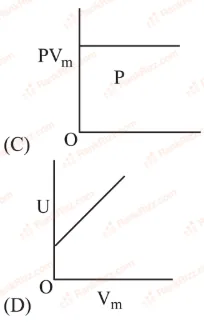
- (A)
(A) and (D)
- (B)
(B) and (C)
- (C)
(B) and (D)
- (D)
(A) and (C)
rr2.rankrizz.com/jee-main/chemistry/chemical-thermodynamics/q/12-jan-2019-s2-q38
- (A)
Consider the reversible isothermal expansion of an ideal gas in a closed system at two different temperatures and (). The correct graphical depiction of the dependence of work done vs the final volume is:
- (A)
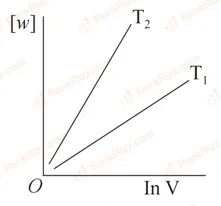
- (B)
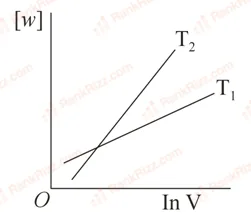
- (C)
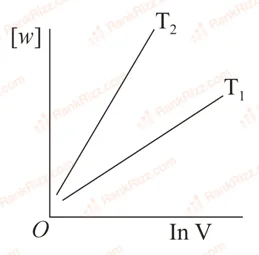
- (D)
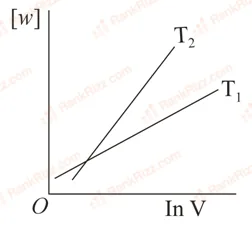
rr2.rankrizz.com/jee-main/chemistry/chemical-thermodynamics/q/9-jan-2019-s1-q36
- (A)
An ideal gas undergoes isothermal expansion at constant pressure. During the process:
- (A)
Enthalpy remains constant but entropy increases
- (B)
Enthalpy decreases but entropy increases
- (C)
Enthalpy increases but entropy decreases
- (D)
Both enthalpy and entropy remain constant
rr2.rankrizz.com/jee-main/chemistry/chemical-thermodynamics/q/9-apr-2017-online-q38
- (A)
The difference between the reaction enthalpy change () and reaction internal energy change () for the reaction: $ at K is ( J mol K)
- (A)
J mol
- (B)
J mol
- (C)
J mol
- (D)
J mol
rr2.rankrizz.com/jee-main/chemistry/chemical-thermodynamics/q/2012-chemistry-499417
- (A)
Assuming that water vapour is an ideal gas, the internal energy () when 1 mol of water is vapourised at 1 bar pressure and , (Given: Molar enthalpy of vapourization of water at 1 bar and 373 K = 41 kJ and R = 8.3 J ) will be
- (A)
4.100 kJ
- (B)
3.7904 kJ
- (C)
37.904 kJ
- (D)
41.00 kJ
rr2.rankrizz.com/jee-main/chemistry/chemical-thermodynamics/q/2007-chemistry-499795
- (A)
for the formation of carbon monoxide (CO) from its elements at is
- (A)
- (B)
- (C)
- (D)
rr2.rankrizz.com/jee-main/chemistry/chemical-thermodynamics/q/2006-chemistry-500042
- (A)
Consider the reaction: carried out at constant temperature and pressure. If and are the enthalpy and internal energy changes for the reaction, which of the following expressions is true?
- (A)
- (B)
- (C)
- (D)
rr2.rankrizz.com/jee-main/chemistry/chemical-thermodynamics/q/2005-chemistry-500284
- (A)
Bond enthalpy, atomisation, phase-change and solution enthalpies 12
If the enthalpy of sublimation of Li is 155 kJ , enthalpy of dissociation of is 150 kJ , ionization enthalpy of Li is 520 kJ , electron gain enthalpy of F is - 313 kJ , standard enthalpy of formation of LiF is - 594 kJ . The magnitude of lattice enthalpy of LiF is _________ kJ . (Nearest Integer)
Answer: ____________
rr2.rankrizz.com/jee-main/chemistry/chemical-thermodynamics/q/22-jan-2026-s2-q74
Resonance in can be represented as
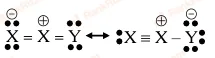
The enthalpy of formation of X_2Y\left( X\equiv X(g)+\frac{1}{2}Y=Y(g)\rightarrow X_2 Y(g)\right) is 80 kJ mol. The magnitude of resonance energy of is _____ kJ mol (nearest integer value). Given: Bond energies of , , and are 940, 410, 500 and 602 kJ mol respectively.
valence X : 3, Y : 2Answer: ____________
rr2.rankrizz.com/jee-main/chemistry/chemical-thermodynamics/q/2025-apr-8-s2-q71
The hydration energies of and are and kJ/mol respectively. If lattice energy of KCl is kJ/mol, then the heat of solution of KCl is :
- (A)
- (B)
- (C)
- (D)
rr2.rankrizz.com/jee-main/chemistry/chemical-thermodynamics/q/2025-apr-7-s2-q53
- (A)
The average S - F bond energy in kJ mol of is ______. (Rounded off to the nearest integer)
[Given: The values of standard enthalpy of formation of , and are , 275 and 80 kJ mol respectively.]Answer: ____________
rr2.rankrizz.com/jee-main/chemistry/chemical-thermodynamics/q/26-feb-2021-s2-q53
The ionization enthalpy of Na formation from is 495.8 kJ mol, while the electron gain enthalpy of Br is kJ mol. Given the lattice enthalpy of NaBr is kJ mol. The energy for the formation of NaBr ionic solid is kJ mol
Answer: ____________
rr2.rankrizz.com/jee-main/chemistry/chemical-thermodynamics/q/25-feb-2021-s1-q53
The heat of atomization of methane and ethane are 360 kJ mol and 620 kJ mol, respectively. The longest wavelength of light capable of breaking the C - C bond is (Avogadro's number = , h = J s)
- (A)
nm
- (B)
nm
- (C)
nm
- (D)
nm
rr2.rankrizz.com/jee-main/chemistry/chemical-thermodynamics/q/10-apr-2015-online-q37
- (A)
Given that: (i) of is 82 kJ mol (ii) Bond energies of , , and are 946, 418, 498 and 607 kJ mol respectively. The resonance energy of is :
- (A)
-88 kJ
- (B)
-66 kJ
- (C)
-62 kJ
- (D)
-44 kJ
rr2.rankrizz.com/jee-main/chemistry/chemical-thermodynamics/q/25-apr-2013-online-q42
- (A)
The standard enthalpy of formation of is kJ mol. If the enthalpy of formation of from its atoms is kJ mol and that of is kJ mol, the average bond enthalpy of NH bond in is
- (A)
kJ mol
- (B)
kJ mol
- (C)
kJ mol
- (D)
kJ mol
rr2.rankrizz.com/jee-main/chemistry/chemical-thermodynamics/q/2010-chemistry-499667
- (A)
Oxidising power of chlorine in aqueous solution can be determined by the parameters indicated below: $) will be
- (A)
- (B)
- (C)
- (D)
rr2.rankrizz.com/jee-main/chemistry/chemical-thermodynamics/q/2008-chemistry-499901
- (A)
The standard enthalpy of formation at for methane, , is . The additional information required to determine the average energy for bond formation would be
- (A)
the dissociation energy of and enthalpy of sublimation of carbon
- (B)
latent heat of vapourization of methane
- (C)
the first four ionization energies of carbon and electron gain enthalpy of hydrogen
- (D)
the dissociation energy of hydrogen molecule,
rr2.rankrizz.com/jee-main/chemistry/chemical-thermodynamics/q/2006-chemistry-500039
- (A)
The enthalpy changes for the following processes are listed below: ; ; ; . Given that the standard states for iodine and chlorine are and , the standard enthalpy of formation for is
- (A)
- (B)
- (C)
- (D)
rr2.rankrizz.com/jee-main/chemistry/chemical-thermodynamics/q/2006-chemistry-500041
- (A)
If the bond dissociation energies of , and (all diatomic molecules) are in the ratio of and for the formation of is kJ mole. The bond dissociation energy of will be
- (A)
kJ mol
- (B)
kJ mol
- (C)
kJ mol
- (D)
None of these
rr2.rankrizz.com/jee-main/chemistry/chemical-thermodynamics/q/2005-chemistry-500288
- (A)
Entropy and the second law 9
One mole of an ideal gas at K is in a L vessel of thermally conducting walls, which are in contact with the surroundings. It undergoes isothermal reversible expansion from L to L against a constant pressure of atm. The change in entropy of the surroundings () is _____ J K (Nearest integer)
Given: J K mol.Answer: ____________
rr2.rankrizz.com/jee-main/chemistry/chemical-thermodynamics/q/12-apr-2023-s1-q53
The true statement amongst the following is:
- (A)
Both and are functions of temperature.
- (B)
Both and are not functions of temperature
- (C)
is not a function of temperature but is a function of temperature
- (D)
is a function of temperature but is not a function of temperature
rr2.rankrizz.com/jee-main/chemistry/chemical-thermodynamics/q/9-jan-2020-s2-q28
- (A)
Two blocks of the same metal having same mass and at temperature , and , respectively, are brought in contact with each other and allowed to attain thermal equilibrium at constant pressure. The change in entropy, , for this process is:
- (A)
- (B)
- (C)
- (D)
rr2.rankrizz.com/jee-main/chemistry/chemical-thermodynamics/q/11-jan-2019-s1-q34
- (A)
The process with negative entropy change is:
- (A)
Synthesis of ammonia from N and H.
- (B)
Dissolution of iodine in water.
- (C)
Dissociation of CaSO (s) to CaO (s) and SO (g).
- (D)
Sublimation of dry ice.
rr2.rankrizz.com/jee-main/chemistry/chemical-thermodynamics/q/10-jan-2019-s2-q33
- (A)
The entropy change associated with the conversion of 1 kg of ice at 273 K to water vapours at 383 K is: (Specific heat of water liquid and water vapour are 4.2 kJ K and 2.0 kJ K kg; heat of liquid fusion and vaporization of water are 334 kJ kg and 2491 kJ kg, respectively). (log 273 = 2.436, log 373 = 2.572, log 383 = 2.583)
- (A)
9.26 kJ kgK
- (B)
2.64 kJ kgK
- (C)
8.49 kJ kgK
- (D)
7.90 kJ kgK
rr2.rankrizz.com/jee-main/chemistry/chemical-thermodynamics/q/9-jan-2019-s2-q35
- (A)
The entropy of a sample of a certain substance increases by on adding reversibly of heat at constant temperature. The temperature of the sample is:
- (A)
2.5 K
- (B)
0.3 K
- (C)
0.016 K
- (D)
0.4 K
rr2.rankrizz.com/jee-main/chemistry/chemical-thermodynamics/q/2012-chemistry-499146
- (A)
One mole of an ideal gas is expanded isothermally and reversibly to half of its initial pressure. for the process in is [ and J/(mol K)]
- (A)
6.76
- (B)
5.76
- (C)
10.76
- (D)
8.03
rr2.rankrizz.com/jee-main/chemistry/chemical-thermodynamics/q/2012-chemistry-499223
- (A)
The entropy change involved in the isothermal reversible expansion of moles of an ideal gas from a volume of to a volume of at is:
- (A)
- (B)
- (C)
- (D)
rr2.rankrizz.com/jee-main/chemistry/chemical-thermodynamics/q/2011-chemistry-499507
- (A)
Identify the correct statement regarding a spontaneous process
- (A)
For a spontaneous process in an isolated system, the change in entropy is positive
- (B)
Endothermic processes are never spontaneous
- (C)
Exothermic processes are always spontaneous
- (D)
Lowering of energy in the reaction process is the only criterion for spontaneity
rr2.rankrizz.com/jee-main/chemistry/chemical-thermodynamics/q/2007-chemistry-499796
- (A)
System, surroundings and state functions 3
The total number of intensive properties from the following is _______
Volume, Molar heat capacity, molarity, , Gibbs free energy change, Molar mass, MoleAnswer: ____________
rr2.rankrizz.com/jee-main/chemistry/chemical-thermodynamics/q/11-apr-2023-s2-q54
Among the following the number of state variable is
Internal energy (U), Volume (V), Heat (q), Enthalpy (H)Answer: ____________
rr2.rankrizz.com/jee-main/chemistry/chemical-thermodynamics/q/28-jul-2022-s2-q53
Among the following, the set of parameters that represents path functions, is:
i) q + w
ii) q
iii) w
iv) H - TS- (A)
(ii) and (iii)
- (B)
(i), (ii), and (iii)
- (C)
(ii), (iii) and (iv)
- (D)
(i) and (iv)
rr2.rankrizz.com/jee-main/chemistry/chemical-thermodynamics/q/9-apr-2019-s1-q36
- (A)
Answer key
- 01 1126
- 02 3
- 03 D
- 04 C
- 05 A
- 06 B
- 07 D
- 08 B
- 09 25
- 10 D
- 11 466
- 12 48
- 13 C
- 14 B
- 15 200
- 16 95
- 17 2
- 18 82
- 19 C
- 20 6535
- 21 125
- 22 492
- 23 56
- 24 800
- 25 4
- 26 C
- 27 4
- 28 278
- 29 499
- 30 1006
- 31 610
- 32 173
- 33 360
- 34 —
- 35 54
- 36 200
- 37 57
- 38 104
- 39 2
- 40 117
- 41 600
- 42 727
- 43 C
- 44 C
- 45 82
- 46 718
- 47 38
- 48 31
- 49 82
- 50 101
- 51 21
- 52 667
- 53 230
- 54 C
- 55 —
- 56 326400
- 57 C
- 58 —
- 59 C
- 60 A
- 61 B
- 62 A
- 63 B
- 64 D
- 65 C
- 66 B
- 67 B
- 68 C
- 69 D
- 70 A
- 71 C
- 72 A
- 73 D
- 74 B
- 75 B
- 76 C
- 77 C
- 78 D
- 79 D
- 80 D
- 81 B
- 82 C
- 83 B
- 84 D
- 85 D
- 86 D
- 87 304
- 88 2500
- 89 D
- 90 C
- 91 A
- 92 C
- 93 55
- 94 38
- 95 274
- 96 200
- 97 D
- 98 28721
- 99 200
- 100 1200
- 101 1200
- 102 0
- 103 150
- 104 —
- 105 2
- 106 35
- 107 195
- 108 0
- 109 38
- 110 50
- 111 2218
- 112 741
- 113 —
- 114 D
- 115 —
- 116 6.25
- 117 C
- 118 B
- 119 D
- 120 C
- 121 A
- 122 B
- 123 A
- 124 B
- 125 B
- 126 A
- 127 C
- 128 C
- 129 A
- 130 A
- 131 34
- 132 B
- 133 727
- 134 A
- 135 70
- 136 C
- 137 A
- 138 D
- 139 700
- 140 B
- 141 2850
- 142 A
- 143 C
- 144 400
- 145 2000
- 146 57
- 147 163
- 148 B
- 149 37
- 150 1070
- 151 1411
- 152 10
- 153 2
- 154 2
- 155 2
- 156 A
- 157 300
- 158 5
- 159 B
- 160 964
- 161 336
- 162 A
- 163 855
- 164 —
- 165 -2.7
- 166 B
- 167 D
- 168 C
- 169 B
- 170 C
- 171 B
- 172 B
- 173 D
- 174 B
- 175 C
- 176 D
- 177 C
- 178 A
- 179 B
- 180 B
- 181 C
- 182 B
- 183 C
- 184 D
- 185 B
- 186 300
- 187 D
- 188 C
- 189 B
- 190 150
- 191 A
- 192 B
- 193 A
- 194 B
- 195 8630
- 196 84
- 197 D
- 198 C
- 199 C
- 200 D
- 201 A
- 202 D
- 203 C
- 204 B
- 205 C
- 206 1031
- 207 98
- 208 C
- 209 309
- 210 5576
- 211 D
- 212 A
- 213 B
- 214 B
- 215 A
- 216 C
- 217 D
- 218 —
- 219 A
- 220 A
- 221 A
- 222 A
- 223 D
- 224 B
- 225 D
- 226 A
- 227 4
- 228 3
- 229 A
“—” marks a question whose key we have not checked yet; its page shows the latest on it.
Past questions are reproduced with their sitting. Not affiliated with NTA or the IITs. Every question, online and free: rr2.rankrizz.com/jee-main/chemistry/chemical-thermodynamics