JEE MAIN 2026 · 05 APR S2Reactions of carboxylic acids
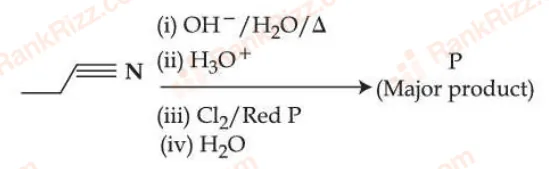
Complete the following reaction sequence and give the name of major product 'P'.
- A
2-Chloropropanoic acid
- B
3-Chloropropanoic acid
- C
1-Chloropropane
- D
2-Chloropropane
Carboxylic Acids and Derivatives has been asked in 16 of the 23 JEE Main years from 2004 to 2026: 76 questions in all. In 2026 it averaged 0.4 questions per paper (7 across 19 papers), 1.5% of Chemistry questions, up from 0.8% in 2025. Across the last 20 papers it carried 1.4% of Chemistry marks. By type: 69 MCQs and 7 numerical-answer questions. Of the 64 with a difficulty tag, 17% are easy, 78% medium and 5% hard. Most asked: Reactions of carboxylic acids (49, 64%), Acid derivatives: esters, amides, anhydrides and acid chlorides (11, 14%) and Acidity of carboxylic acids (9, 12%).
DATA UPDATED
Questions
76
Distinct ideas
4
Share of marks
1.4%
Difficulty
HARD
The share of each year’s Chemistry questions that came from Carboxylic Acids and Derivatives, counted from the 168 papers we hold for the last 10 years, and session by session inside a year.
Steady: 1.1% of Chemistry questions in 2024–2026 against 1.4% in 2017–2023, and between 0.0% and 2.5% in every year shown. Not asked at all in 2017.
| YEAR | QS | PER PAPER | SHARE OF CHEMISTRY | CHANGE | |
|---|---|---|---|---|---|
| 2026 | 7 / 480 | 0.4 | 1.5% | +0.7 pts | JAN 2.0%APR 0.9% |
| 2025 | 4 / 475 | 0.2 | 0.8% | −0.2 pts | JAN 0.8%APR 0.9% |
| 2024 | 6 / 600 | 0.3 | 1.0% | −0.6 pts | JAN 0.7%APR 1.3% |
| 2023 | 12 / 750 | 0.5 | 1.6% | +0.8 pts | JAN 1.0%APR 2.2% |
| 2022 | 5 / 660 | 0.2 | 0.8% | −0.7 pts | JUN 1.1%JUL 0.3% |
| 2021 | 11 / 720 | 0.5 | 1.5% | −0.5 pts | FEB 1.3%MAR 1.3%JUL 1.4%AUG 1.9% |
| 2020 | 8 / 400 | 0.5 | 2.0% | +0.7 pts | JAN 2.0%SEP 2.0% |
| 2019 | 6 / 480 | 0.4 | 1.3% | −1.2 pts | JAN 1.3%APR 1.3% |
| 2018 | 3 / 120 | 0.8 | 2.5% | +2.5 pts | 4 PAPERS, ONE SESSION |
| 2017 | 0 / 90 | 0.0 | 0.0% | — | 3 PAPERS, ONE SESSION |
“QS” is Carboxylic Acids and Derivatives questions out of all Chemistry questions that year; “per paper” is that count over the year’s papers, and “change” is the share against the year before. A year with more sittings asks more questions, which is why the share, not the count, is the number to compare.
How Carboxylic Acids and Derivatives compares: every Chemistry chapter by weightage · most repeated JEE Main topics
A chapter is not one subject — it is a handful of procedures the examiner reuses. These are the ones Carboxylic Acids and Derivatives questions actually test.
Every JEE Main Carboxylic Acids and Derivatives question we hold, newest first inside each topic. Open one for its options, answer key and solution.
FREE PDF
All 76 questions on A4, by topic, with the answer key at the end. No sign-up, no email: your browser saves it as a PDF.
Download free PDFUNIQUE CONCEPTS
4 ideas, each with the latest past question that tested it, drawn from 103 JEE Main and Advanced questions.
Carboxylic Acids and Derivatives Unique Concepts sheet →JEE ADVANCED
JEE Advanced has set 27 Carboxylic Acids and Derivatives questions, 2007–2026.
Carboxylic Acids and Derivatives JEE Advanced PYQs →Not every year. It has been asked in 16 of the 23 JEE Main years from 2004 to 2026; the years without a Carboxylic Acids and Derivatives question were 2007, 2008, 2010, 2012, 2013, 2016 and 2017.
Reactions of carboxylic acids: 49 of the 76 questions (64%). Next come Acid derivatives: esters, amides, anhydrides and acid chlorides (11) and Acidity of carboxylic acids (9).
About 1.4% across the last 20 papers. Every JEE Main question carries the same marks, so that is also its share of Chemistry questions. In 2026 it was 1.5% (7 of 480 Chemistry questions).
In JEE Main 05 Apr 2026, Shift 2, the latest sitting with a Carboxylic Acids and Derivatives question.
76 from 2004 to 2026, across 4 topics. Every one is listed on this page by topic and links to its own page, with the answer key and solution wherever we have them. Free, no sign-up.
1–20 OF 76 · NEWEST FIRST
Complete the following reaction sequence and give the name of major product 'P'.
2-Chloropropanoic acid
3-Chloropropanoic acid
1-Chloropropane
2-Chloropropane
Consider the following sequence of reactions to give the major product :
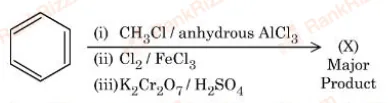
g of the major product formed is reacted with solution to liberate a gas which occupied 11.2 dm³ at STP. = _____ g.
( Given molar mass in g )
The correct order of acidic strength of the major products formed in the given reactions, is:
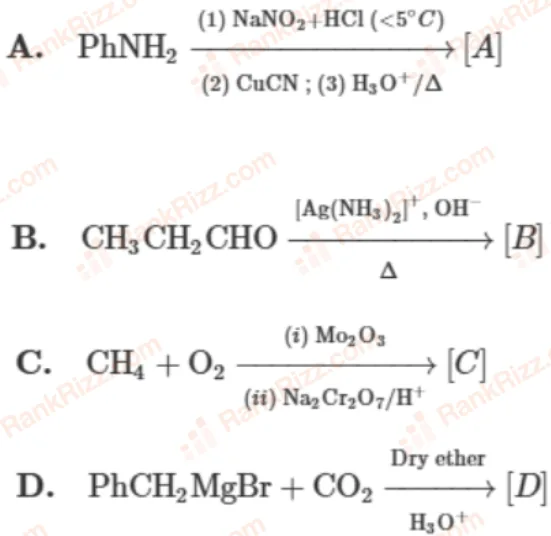
Choose the correct answer from the options given below :
A > D > C > B
C > B > A > D
A > D > B > C
C > A > D > B
Grignard reagent RMgBr (P) reacts with water and forms a gas (Q). One gram of Q occupies at STP.(P) on reaction with dry ice in dry ether followed by fonns a compound (Z). 0.1 mole of(Z) will weigh ____ g. (Nearest integer)
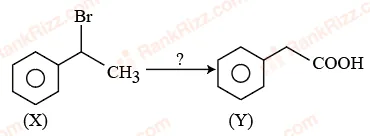
The correct sequence of reagents for the above conversion of X to Y is:
(i) (ii)NaOEt (iii)Jones reagent
(i)NaOEt (i) (iii)Jones reagent
(i)NaOH (aq) (ii)Jones reagent (iii)
(i)Jones reagent (ii)NaOEt (iii)Hot /KOH
Compound 'P' undergoes the following sequence of reactions:

'P' is:
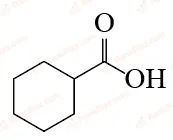
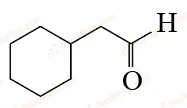
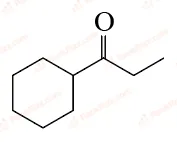
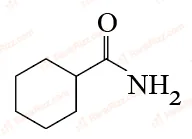
Given below are two statements:
Statement I: Compound (X), shown below, dissolves in solution and has two chiral carbon atoms
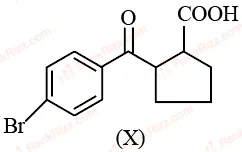
Statement II: Compound (Y), shown below, has two carbons with hybridization, one carbon with and one carbon with sp hybridization
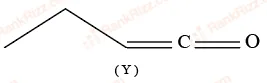
In the light of the above statements, choose the correct answer from the options given below:
Both Statement I and Statement II are true
Both Statement I and Statement II are false
Statement I is true but Statement II is false
Statement I is false but statement II is true
Consider the following molecules:
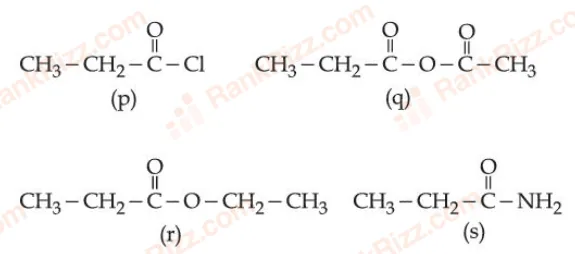
The correct order of rate of hydrolysis is:
Consider the following reactions. From these reactions which reaction will give carboxylic acid as a major product ?
(A)
(B)
(C)
(D)
(E)
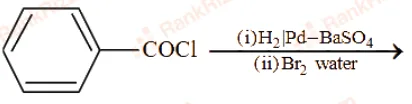
Choose the correct answer from the options given below :
A and D only
A, B and E only
B, C and E only
B and E only
The compounds that produce with aqueous solution are:
A.
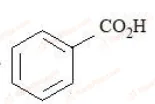
B.
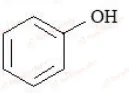
C.
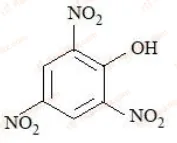
D.
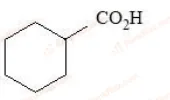
E.
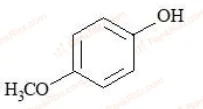
Choose the correct answer from the options given below:
A, C and D Only
A, B and E Only
A and C Only
A and B Only
The total number of compounds from below when treated with hot giving benzoic acid is :
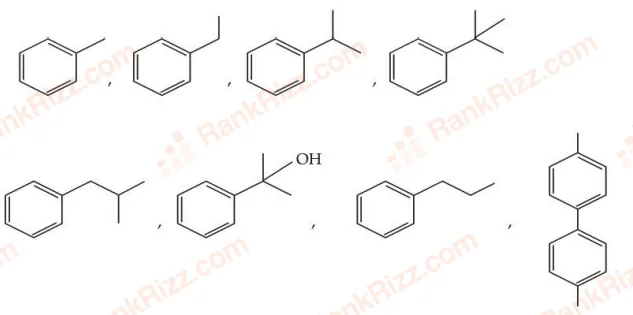
6
3
5
4
Identify the product (P) in the following reaction:
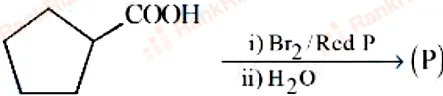
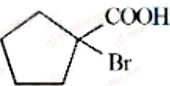
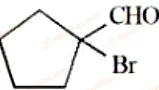
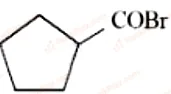
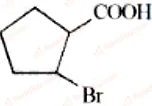
Identify and in the given chemical reaction sequence
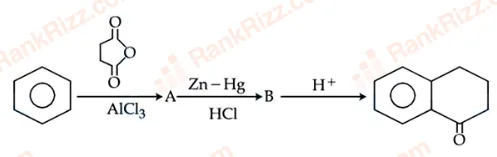
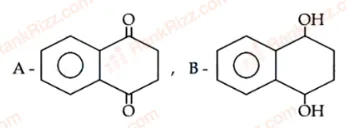
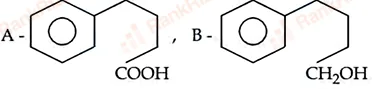
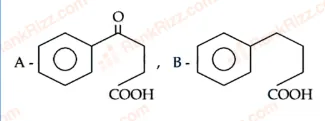
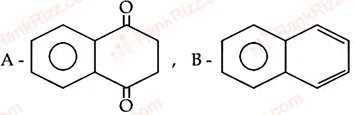
Consider the given chemical reaction :
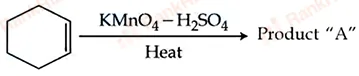
picric acid
acetic acid
adipic acid
oxalic acid
The product (C) in the following sequence of reactions has ______ bonds.

The total number of 'Sigma' and Pi bonds in 2-formylhex-4-enoic acid is ______.
The molecular formula of second homologue in the homologous series of mono carboxylic acids is :
A cyclic anhydride reacts with HO to give 'A' (major product).
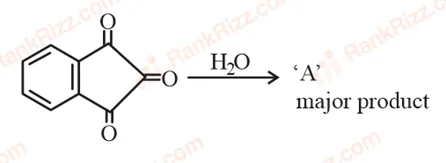
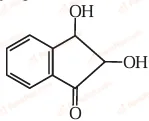
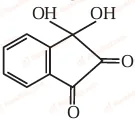
'A' formed in the above reaction is
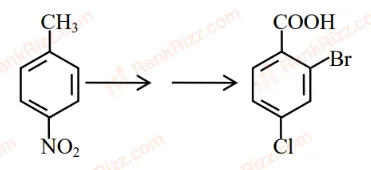
In the above conversion the correct sequence of reagents to be added is
(i) KMnO, (ii) Br/Fe, (iii) Fe/H, (iv) Cl
(i) Br/Fe, (ii) Fe/H, (iii) KMnO, (iv) Cl
(i) Fe/H, (ii) HONO, (iii) CuCl, (iv) KMnO
(i) Br/Fe, (ii) Fe/H, (iii) HONO, (iv) CuCl (v) KMnO
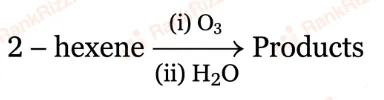
The two products formed in above reaction are
Butanal and acetaldehyde
Butanoic acid and acetaldehyde
Butanal and acetic acid
Butanoic acid and acetic acid
OTHER CHEMISTRY CHAPTERS