RankRizz

Qualitative Salt Analysis — JEE Main Previous Year Questions

Qualitative Salt Analysis has been asked in 10 of the 23 JEE Main years from 2004 to 2026: 69 questions in all. In 2026 it averaged 0.5 questions per paper (9 across 19 papers), 1.9% of Chemistry questions, up from 1.7% in 2025. Across the last 20 papers it carried 1.8% of Chemistry marks. By type: 62 MCQs and 7 numerical-answer questions. Of the 69 with a difficulty tag, 58% are easy, 41% medium and 1% hard. Most asked: Group analysis and confirmatory tests of cations (34, 49%), Analysis of anions (17, 25%) and Preliminary and dry tests (14, 20%).

DATA UPDATED

Questions

69

Distinct ideas

4

Share of marks

1.8%

Difficulty

EASY

Qualitative Salt Analysis weightage, year by year

The share of each year’s Chemistry questions that came from Qualitative Salt Analysis, counted from the 168 papers we hold for the last 10 years, and session by session inside a year.

Rising: 2.2% of Chemistry questions in 2024–2026, up from 0.9% in 2017–2023. Its heaviest year was 2024, at 2.8%. Not asked at all in 2019, 2020.

Qualitative Salt Analysis questions per year, per paper, and as a share of Chemistry questions
YEARQSPER PAPERSHARE OF CHEMISTRYCHANGE
20269 / 4800.51.9%+0.2 pts
20258 / 4750.41.7%−1.1 pts
202417 / 6000.82.8%+0.9 pts
202314 / 7500.61.9%+1.1 pts
20225 / 6600.20.8%−0.2 pts
20217 / 7200.31.0%+1.0 pts
20200 / 4000.00.0%level
20190 / 4800.00.0%−1.7 pts
20182 / 1200.51.7%−0.5 pts
20172 / 900.72.2%—

“QS” is Qualitative Salt Analysis questions out of all Chemistry questions that year; “per paper” is that count over the year’s papers, and “change” is the share against the year before. A year with more sittings asks more questions, which is why the share, not the count, is the number to compare.

How Qualitative Salt Analysis compares: every Chemistry chapter by weightage · most repeated JEE Main topics

The ideas inside Qualitative Salt Analysis

A chapter is not one subject — it is a handful of procedures the examiner reuses. These are the ones Qualitative Salt Analysis questions actually test.

All 69 Qualitative Salt Analysis questions, by topic

Every JEE Main Qualitative Salt Analysis question we hold, newest first inside each topic. Open one for its options, answer key and solution.

Group analysis and confirmatory tests of cations34 QUESTIONSTopic page →

  1. Among Fe³⁺, Pb²⁺, Cu²⁺ and Mn²⁺, identify the one that gets precipitated out while passing H₂S in presence of NH₄OH as group reagent. The…2026 · 04 APR S2
  2. A salt with few drops of conc. HCl gives apple green colour in flame test. The group precipitate of the salt is dissolved in acetic acid…2026 · 02 APR S1
  3. In the Group analysis of cations, Ba²⁺ Ca²⁺ are precipitated respectively as2026 · 24 JAN S2
  4. Consider the following reactions. PbCl₂+K₂CrO₄→ A+2KCI (Hot solution) A+NaOH⇌ B+Na₂CrO₄ PbSO₄+4CH₃COONH₄→ (NH₄)₂SO₄+X In the above…2026 · 21 JAN S1
  5. When a salt is treated with sodium hydroxide solution it gives gas X. On passing gas X through reagent Y a brown coloured precipitate is…2025 · 07 APR S1
  6. Choose the correct tests with respective observations. (A) CuSO₄ (acidified with acetic acid) + K₄[Fe(CN)₆] → Chocolate brown precipitate…2025 · 02 APR S1
  7. Among the following cations, the number of cations which will give characteristic precipitate in their identification tests with…2025 · 24 JAN S1
  8. Find the compound ' A ' from the following reaction sequences. yellow ppt2025 · 24 JAN S2
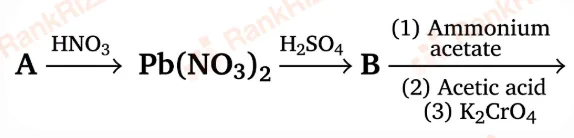
  9. Identify A,B and C in the given below reaction sequence2025 · 23 JAN S2
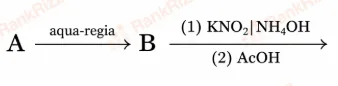
  10. M²⁺ + H₂S → A (Black precipitate) + by product A + aqua regia → B + NOCl + S + H₂O B + KNO₂ + CH₃COOH → C + by product Consider the…2024 · 09 APR S2
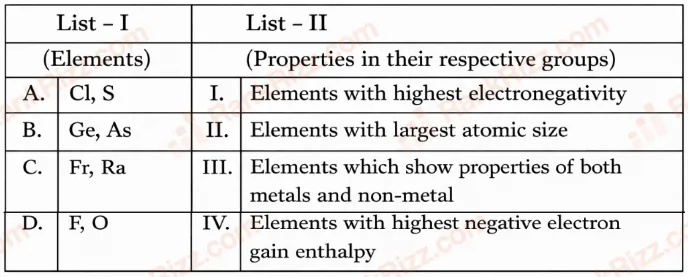
  11. Match List I with List II Choose the correct answer from the options given below:2024 · 08 APR S1
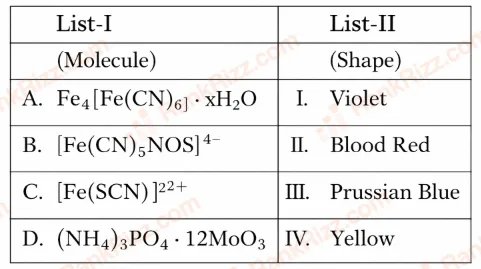
  12. Match List I with List II Choose the correct answer from the options given below:2024 · 06 APR S1
  13. In the precipitation of the iron group (III) in qualitative analysis, ammonium chloride is added before adding ammonium hydroxide to:2024 · 04 APR S1
  14. A reagent which gives brilliant red precipitate with Nickel ions in basic medium is2024 · 29 JAN S2
  15. In the wet tests for detection of various cations by precipitation, Ba²⁺ cations are detected by obtaining precipitate of2023 · 13 APR S2
  16. Element not present in Nessler's reagent is2023 · 06 APR S2
  17. Formation of which complex, among the following, is not a confirmatory test of Pb²⁺ ions2023 · 06 APR S2
  18. In the wet tests for identification of various cations by precipitation, which transition element cation doesn't belong to group IV in…2023 · 30 JAN S1
  19. Formulae for Nessler's reagent is:2023 · 30 JAN S2
  20. Match the List-I with List-II: Cations Group reaction P → Pb²⁺, Cu²⁺ (i) H₂S gas in presence of dilute HCl Q → Al³⁺, Fe³⁺ (ii) (NH₄)₂CO₃ in…2023 · 25 JAN S1
  21. An ammoniacal metal salt solution gives a brilliant red precipitate on addition of dimethylglyoxime. The metal ion is:2023 · 24 JAN S1
  22. An ammoniacal metal salt solution gives a brilliant red precipitate on addition of dimethylglyoxime. The metal ion is:2023 · 24 JAN S1
  23. During the qualitative analysis of salt with cation y²⁺, addition of a reagent (X) to alkaline solution of the salt gives a bright red…2022 · 24 JUN S1
  24. Match List - I with List - II: List - I (Metal ion) List - II (Group in Qualitative analysis) (a) Mn²⁺ (i) Group - III (b) As³⁺ (ii) Group…2021 · 31 AUG S2
  25. Acidic ferric chloride solution on treatment with excess of potassium ferrocyanide gives a Prussian blue coloured colloidal species. It is:2021 · 27 AUG S1
  26. To an aqueous solution containing ions such as Al³⁺, Zn²⁺, Ca²⁺, Fe³⁺, Ni²⁺, Ba²⁺ and Cu²⁺ was added conc. HCl, followed by H₂S. The total…2021 · 27 JUL S2
  27. Cu²⁺ salt reacts with potassium iodide to give:2021 · 20 JUL S2
  28. Given below are two statements: Statement I: The identification of Ni²⁺ is carried out by dimethyl glyoxime in the presence of NH₄OH…2021 · 25 FEB S2
  29. The incorrect statement is:2018 · 16 APR ONLINE
  30. A solution containing a period-IV cation gives a precipitate on passing H₂S. A solution of this precipitate in dil. HCl produces a white…2017 · 08 APR ONLINE
  31. The cation that will not be precipitated by H₂S in the presence of dil HCl is:2015 · 10 APR ONLINE
  32. An aqueous solution of a salt X turns blood red on treatment with SCN⁻ and blue on treatment with K₄[Fe(CN)₆], X also gives a positive…2015 · 10 APR ONLINE
  33. Which of the following statements is incorrect?2013 · 22 APR ONLINE
  34. Sodium Carbonate cannot be used in place of (NH₄)₂CO₃ for the identification of Ca²⁺, Ba²⁺ and Sr²⁺ ions (in group V) during mixture…2013 · 09 APR ONLINE

Analysis of anions17 QUESTIONSTopic page →

  1. Given below are two statements: Statement I: Griss-Ilosvay test is used for the detection of nitrite ion, which involves the use of…2026 · 28 JAN S1
  2. Consider the following reactions: NaCl+K₂Cr₂O₇+H₂SO₄→ A+KHSO₄+NaHSO₄+H₂O A+NaOH→ B+NaCl+H₂O B+H₂SO₄+H₂O₂→ C+Na₂SO₄+H₂O In the product 'C…2026 · 21 JAN S1
  3. On heating a mixture of common salt and K₂Cr₂O₇ in equal amount along with concentrated H₂SO₄ in a test tube, a gas is evolved. Formula of…2026 · 21 JAN S2
  4. Formation of Na₄[Fe(CN)₅NOS], a purple coloured complex formed by addition of sodium nitroprusside in sodium carbonate extract of salt…2025 · 02 APR S2
  5. During the detection of acidic radical present in a salt, a student gets a pale yellow precipitate soluble with difficulty in NH₄OH…2024 · 06 APR S2
  6. When MnO₂ and H₂SO₄ is added to a salt (A), the greenish yellow gas liberated as salt (A) is:2024 · 04 APR S2
  7. Given below are two statements: Statement-I: The gas liberated on warming a salt with dil H₂SO₄, turns a piece of paper dipped in lead…2024 · 30 JAN S1
  8. In chromyl chloride test for confirmation of Cl⁻ ion, a yellow solution is obtained. Acidification of the solution and addition of amyl…2024 · 29 JAN S1
  9. NaCl reacts with conc. H₂SO₄ and K₂Cr₂O₇ to give reddish fumes (B), which react with NaOH to give yellow solution (C). (B) and (C)…2024 · 27 JAN S1
  10. When a solution of mixture of two inorganic salts was treated with freshly prepared ferrous sulphate in acidic medium, a dark brown ring…2023 · 11 APR S1
  11. During the qualitative analysis of SO₃²⁻ using dilute H₂SO₄, SO₂ gas is evolved which turns K₂Cr₂O₇ solution (acidified with dilute H₂SO₄):2023 · 30 JAN S1
  12. A chloride salt solution acidified with dil. HNO₃ gives a curdy white precipitate, [A], on addition of AgNO₃. [A] on treatment with NH₄OH…2023 · 25 JAN S2
  13. A white precipitate was formed when BaCl₂ was added to water extract of an inorganic salt. Further, a gas 'X' with characteristic odour was…2022 · 29 JUN S2
  14. Match List - I with List - II. List-I (Anion) List-II (gas evolved on reaction with dil. H₂SO₄) (A) CO₃²⁻ (I) Colourless gas which turns…2022 · 27 JUN S2
  15. Which statement is not true with respect to nitrate ion test?2022 · 26 JUN S1
  16. A white sodium salt dissolves readily in water to give a solution which is neutral to litmus. When silver nitrate solution is added to the…2018 · 15 APR S1
  17. Potassium dichromate when heated with concentrated sulphuric acid and a soluble chloride, gives brown-red vapours of:2013 · 09 APR ONLINE

Preliminary and dry tests14 QUESTIONSTopic page →

  1. Consider the following reactions Na₂B₄O₇ →(Δ) 2X + Y [6pt]CuSO₄ + Y Non-luminous flame Z + SO₃ [6pt]2Z + 2X + C Luminous flame 2Q +Na₂B₄O₇…2026 · 28 JAN S2
  2. The metal ion whose electronic configuration is not affected by the nature of the ligand and which gives a violet colour in non-luminous…2025 · 28 JAN S1
  3. Match List I with List II Choose the correct answer from the options given below:2024 · 08 APR S1
  4. In a borax bead test under hot condition, a metal salt (one from the given) is heated at point B of the flame, resulted in green colour…2024 · 05 APR S1
  5. The number of white coloured salts among the following is: (A) SrSO₄ (B) MgNH₄PO₄ (C) BaCrO₄ (D) Mn(OH)₂ (E) PbSO₄ (F) PbCrO₄ (G) AgBr (H)…2024 · 01 FEB S1
  6. The compound that is white in color is2024 · 31 JAN S1
  7. Molar mass of the salt from NaBr, NaNO₃, KI and CaF₂ which does not evolve coloured vapours on heating with concentrated H₂SO₄ is ____ g…2024 · 31 JAN S1
  8. Number of metal ions characterized by flame test among the following is _________. Sr²⁺, Ba²⁺, Ca²⁺, Cu²⁺, Zn²⁺, Co²⁺, Fe²⁺2024 · 30 JAN S2
  9. On passing a gas, 'X', through Nessler's reagent, a brown precipitate is obtained. The gas 'X' is2024 · 29 JAN S2
  10. Given below are two statements: Statement I: Upon heating a borax bead dipped in cupric sulphate in a luminous flame, the colour of the…2023 · 31 JAN S2
  11. During the borax bead test with CuSO₄, a blue green colour of the bead was observed in oxidising flame due to the formation of2023 · 29 JAN S1
  12. Match List I with List II List I (Elements) List II (Colour imparted to the flame) A. K I. Brick Red B. Ca II. Violet C. Sr III. Apple…2023 · 25 JAN S1
  13. In the flame test of a mixture of salts, a green flame with blue centre was observed. Which one of the following cations may be present?2022 · 24 JUN S2
  14. Given below are two statements: Statement I: Colourless cupric metaborate is reduced to cuprous metaborate in a luminous flame. Statement…2021 · 24 FEB S1

FREE PDF

Qualitative Salt Analysis JEE Main PYQs with answer key

All 69 questions on A4, by topic, with the answer key at the end. No sign-up, no email: your browser saves it as a PDF.

Download free PDF

UNIQUE CONCEPTS

Qualitative Salt Analysis: one question per idea

4 ideas, each with the latest past question that tested it, drawn from 95 JEE Main and Advanced questions.

Qualitative Salt Analysis Unique Concepts sheet →

JEE ADVANCED

Qualitative Salt Analysis in JEE Advanced

JEE Advanced has set 27 Qualitative Salt Analysis questions, 2007–2025.

Qualitative Salt Analysis JEE Advanced PYQs →

Qualitative Salt Analysis: quick answers

Is Qualitative Salt Analysis asked every year in JEE Main?

Not every year. It has been asked in 10 of the 23 JEE Main years from 2004 to 2026; it was missing in 13 of them, most recently 2020.

Which Qualitative Salt Analysis topic is asked most in JEE Main?

Group analysis and confirmatory tests of cations: 34 of the 69 questions (49%). Next come Analysis of anions (17) and Preliminary and dry tests (14).

What share of Chemistry marks does Qualitative Salt Analysis carry in JEE Main?

About 1.8% across the last 20 papers. Every JEE Main question carries the same marks, so that is also its share of Chemistry questions. In 2026 it was 1.9% (9 of 480 Chemistry questions).

When was Qualitative Salt Analysis last asked in JEE Main?

In JEE Main 04 Apr 2026, Shift 2, the latest sitting with a Qualitative Salt Analysis question.

How many Qualitative Salt Analysis questions has JEE Main asked?

69 from 2013 to 2026, across 4 topics. Every one is listed on this page by topic and links to its own page, with the answer key and solution wherever we have them. Free, no sign-up.

Every Qualitative Salt Analysis question

1–20 OF 69 · NEWEST FIRST

JEE MAIN 2026 · 04 APR S2Group analysis and confirmatory tests of cations

Among Fe3+^{3+}, Pb2+^{2+}, Cu2+^{2+} and Mn2+^{2+}, identify the one that gets precipitated out while passing H2_2S in presence of NH4_4OH as group reagent. The highest possible oxidation state of the corresponding metal is

  1. A

    +3+3

  2. B

    +4+4

  3. C

    +2+2

  4. D

    +7+7

JEE MAIN 2026 · 02 APR S1Group analysis and confirmatory tests of cations

A salt with few drops of conc. HCl gives apple green colour in flame test. The group precipitate of the salt is dissolved in acetic acid and treated with K2_2CrO4_4 to give yellow precipitate. When the sodium carbonate extract of the salt solution is heated with conc. HNO3_3 and ammonium molybdate, it resulted a canary yellow precipitate. The cation and anion present in the salt are respectively,

  1. A

    Ca2+^{2+} and SO42−_4^{2-}

  2. B

    Ba2+^{2+} and PO43−_4^{3-}

  3. C

    Mn2+^{2+} and PO43−_4^{3-}

  4. D

    Ba2+^{2+} and SO42−_4^{2-}

JEE MAIN 2026 · 28 JAN S1Analysis of anions

Given below are two statements:
Statement I: Griss-Ilosvay test is used for the detection of nitrite ion, which involves the use of sulphanilic acid and α−naphthylamine\alpha-naphthylamine reagent.
Statement II: In the above test, sulphanilic acid is diazotized by the acidified nitrite ion, which on further coupling with α−naphthylamine\alpha-naphthylamine forms an azo-dye.
In the light of the above statements, choose the correct answer from the options given below

  1. A

    Statement I is true but Statement II is false

  2. B

    Statement I is false but Statement II is true

  3. C

    Both Statement I and Statement II are false

  4. D

    Both Statement I and Statement II are true

JEE MAIN 2026 · 28 JAN S2Preliminary and dry tests

Consider the following reactions
Na2B4O7→Δ2X+YCuSO4+Y→Non-luminous flameZ+SO32Z+2X+C→Luminous flame2Q+Na2B4O7+CO\begin{aligned}\mathrm{Na_2B_4O_7} & \xrightarrow{\Delta} 2X + Y \\[6pt]\mathrm{CuSO_4} + Y &\xrightarrow{\text{Non-luminous flame}} Z + \mathrm{SO_3}\\[6pt]2Z + 2X + \mathrm{C}&\xrightarrow{\text{Luminous flame}} 2Q +\mathrm{Na_2B_4O_7} + \mathrm{CO}\end{aligned}
The oxidation states of Cu in Z and Q, respectively are:

  1. A

    + 2 and + 2

  2. B

    + 2 and + 1

  3. C

    + 1 and + 1

  4. D

    + 1 and + 2

JEE MAIN 2026 · 24 JAN S1Chemical principles of qualitative analysis

Consider three metal chlorides x, y and z, where x is water soluble at room temperature, y is sparingly soluble in water at room temperature and z is soluble in hot water. x, y and z are respectively

  1. A

    MgCl2,AgClMgCl_{2},AgCl and AlCl3AlCl_{3}

  2. B

    CuCl2,AgClCuCl_{2},AgCl and PbCl2PbCl_{2}

  3. C

    AlCl3,PbCl2AlCl_{3},PbCl_{2} and BaCl2BaCl_{2}

  4. D

    AlCl,Hg2Cl2AlCl,Hg_{2}Cl_{2} and PbCl2PbCl_{2}

JEE MAIN 2026 · 24 JAN S2Group analysis and confirmatory tests of cations

In the Group analysis of cations, Ba2+Ba^{2+} & Ca2+Ca^{2+} are precipitated respectively as

  1. A

    chromate & sulphide

  2. B

    hydroxide & carbonate

  3. C

    sulphide & sulphide

  4. D

    carbonate & carbonate

JEE MAIN 2026 · 21 JAN S1Group analysis and confirmatory tests of cations

Consider the following reactions.
PbCl2+K2CrO4→A+2KCIPbCl_{2}+K_{2}CrO_{4}\rightarrow A+2KCI
(Hot solution)
A+NaOH⇌B+Na2CrO4A+NaOH\rightleftharpoons B+Na_{2}CrO_{4}
PbSO4+4CH3COONH4→(NH4)2SO4+XPbSO_{4}+4CH_{3}COONH_{4}\rightarrow (NH_{4})_{2}SO_{4}+X
In the above reactions, A, Band X are respectively.

  1. A

    PbCrO4,Na2[Pb(OH)4] and [Pb(NH3)4]SO4PbCrO_{4},Na_{2}[Pb(OH)_{4}]\text{ and }[Pb(NH_{3})_{4}]SO_{4}

  2. B

    PbCrO4,Na2[Pb(OH)4]PbCrO_{4},Na_{2}[Pb(OH)_{4}] and (NH4)2[Pb(CH3COO)4](NH_{4})_{2}[Pb(CH_{3}COO)_{4}]

  3. C

    Na2[Pb(OH)4],PbCrO4Na_{2}[Pb(OH)_{4}],PbCrO_{4} and (NH4)2[Pb(CH3COO)4](NH_{4})_{2}[Pb(CH_{3}COO)_{4}]

  4. D

    Na2[Pb(OH)4],PbCrO4 and [Pb(NH3)4]SO4Na_{2}[Pb(OH)_{4}],PbCrO_{4}\text{ and }[Pb(NH_{3})_{4}]SO_{4}

JEE MAIN 2026 · 21 JAN S1Analysis of anions

Consider the following reactions:
NaCl+K2Cr2O7+H2SO4→A+KHSO4+NaHSO4+H2ONaCl+K_{2}Cr_{2}O_{7}+H_{2}SO_{4}\rightarrow A+KHSO_{4}+NaHSO_{4}+H_{2}O
A+NaOH→B+NaCl+H2OA+NaOH\rightarrow B+NaCl+H_{2}O
B+H2SO4+H2O2→C+Na2SO4+H2OB+H_{2}SO_{4}+H_{2}O_{2}\rightarrow C+Na_{2}SO_{4}+H_{2}O
In the product 'C, 'X' is the number of O22−O_{2}^{2-} units, 'Y' is the total number oxygen atoms present and 'Z' is the oxidation state of Cr·. The value of X + Y + Z is ______

JEE MAIN 2026 · 21 JAN S2Analysis of anions

On heating a mixture of common salt and K2Cr2O7K_{2}Cr_{2}O_{7} in equal amount along with concentrated H2SO4H_{2}SO_{4} in a test tube, a gas is evolved. Formula of the gas evolved and oxidation State of the central metal atom in the gas respectively are:

  1. A

    CrO2Cl2CrO_{2}Cl_{2} and +5

  2. B

    Cr2O2Cl2Cr_{2}O_{2}Cl_{2} and +6

  3. C

    Cr2O2Cl2Cr_{2}O_{2}Cl_{2} and +3

  4. D

    CrO2Cl2CrO_{2}Cl_{2} and +6

JEE MAIN 2025 · 07 APR S1Group analysis and confirmatory tests of cations

When a salt is treated with sodium hydroxide solution it gives gas X. On passing gas X through reagent Y a brown coloured precipitate is formed. X and Y respectively, are

  1. A

    X=NH3X = NH_3 and Y=HgOY = HgO

  2. B

    X=NH3X = NH_3 and Y=K2HgI4+KOHY = K_2HgI_4 + KOH

  3. C

    X=NH4ClX = NH_4Cl and Y=KOHY = KOH

  4. D

    X=HClX = HCl and Y=NH4ClY = NH_4Cl

JEE MAIN 2025 · 02 APR S1Group analysis and confirmatory tests of cations

Choose the correct tests with respective observations.

(A) CuSO4CuSO_4 (acidified with acetic acid) + K4[Fe(CN)6]K_4[Fe(CN)_6] →\rightarrow Chocolate brown precipitate.

(B) FeCl3+K4[Fe(CN)6]FeCl_3 + K_4[Fe(CN)_6] →\rightarrow Prussian blue precipitate.

(C) ZnCl2+K4[Fe(CN)6]ZnCl_2 + K_4[Fe(CN)_6], neutralised with NH4OHNH_4OH →\rightarrow White or bluish white precipitate.

(D) MgCl2+K4[Fe(CN)6]MgCl_2 + K_4[Fe(CN)_6] →\rightarrow Blue precipitate.

(E) BaCl2+K4[Fe(CN)6]BaCl_2 + K_4[Fe(CN)_6], neutralised with NaOH →\rightarrow White precipitate.

Choose the correct answer from the options given below:

  1. A

    A, D and E only

  2. B

    B, D and E only

  3. C

    A, B and C only

  4. D

    C, D and E only

JEE MAIN 2025 · 02 APR S2Analysis of anions

Formation of Na4[Fe(CN)5NOS]Na_4[Fe(CN)_5NOS], a purple coloured complex formed by addition of sodium nitroprusside in sodium carbonate extract of salt indicates the presence of :

  1. A

    Sodium ion

  2. B

    Sulphate ion

  3. C

    Sulphide ion

  4. D

    Sulphite ion

JEE MAIN 2025 · 28 JAN S1Preliminary and dry tests

The metal ion whose electronic configuration is not affected by the nature of the ligand and which gives a violet colour in non-luminous flame under hot condition in borax bead test is

  1. A

    Mn2+Mn^{2+}

  2. B

    Cr3+Cr^{3+}

  3. C

    Ni2+Ni^{2+}

  4. D

    Ti3+Ti^{3+}

JEE MAIN 2025 · 28 JAN S2Chemical principles of qualitative analysis

Identify the inorganic sulphides that are yellow in colour : (A) (NH4)2S\mathrm{(NH_4)_2S} (B) PbS\mathrm{PbS} (C) CuS\mathrm{CuS} (D) As2S3\mathrm{As_2S_3} (E) As2S5\mathrm{As_2S_5} Choose the correct answer from the options given below :

  1. A

    (A), (D) and (E) only

  2. B

    (D) and (E) only

  3. C

    (A) and (B) only

  4. D

    (A) and (C) only

JEE MAIN 2025 · 24 JAN S1Group analysis and confirmatory tests of cations

Among the following cations, the number of cations which will give  characteristic precipitate in their identification tests with K4[Fe(CN)6]K_4[Fe(CN)_6]  is  ‾\underline{\hspace{2cm}}. Cu2+,  Fe3+,  Ba2+,  Ca2+,  NH4+,  Mg2+,  Zn2+Cu^{2+},\; Fe^{3+},\; Ba^{2+},\; Ca^{2+},\; NH_4^{+},\; Mg^{2+},\; Zn^{2+}

JEE MAIN 2025 · 24 JAN S2Group analysis and confirmatory tests of cations

Find the compound ' A ' from the following reaction sequences. 

Figure for JEE Main 2025 Chemistry question on Group analysis and confirmatory tests of cations

yellow ppt

  1. A

    CoS

  2. B

    ZnS

  3. C

    NiS

  4. D

    MnS

JEE MAIN 2025 · 23 JAN S2Group analysis and confirmatory tests of cations

Identify A,B and C in the given below reaction sequence 

Figure for JEE Main 2025 Chemistry question on Group analysis and confirmatory tests of cations
  1. A

    PbCl2,PbSO4,PbCrO4PbCl_{2},PbSO_{4},PbCrO_{4}

  2. B

    Pbs,PbSO4,Pb(CH3COO)2Pbs,PbSO_{4},Pb(CH_{3}COO)_{2}

  3. C

    PbCl2,Pb(SO4)2,PbCrO4PbCl_{2},Pb(SO_{4})_{2},PbCrO_{4}

  4. D

    Pbs,PbSO4,PbCrO4Pbs,PbSO_{4},PbCrO_{4}

JEE MAIN 2024 · 09 APR S2Group analysis and confirmatory tests of cations

M2++H2S→A (Black precipitate)+by productM^{2+} + H_2S \to A \text{ (Black precipitate)} + \text{by product}
A+aqua regia→B+NOCl+S+H2OA + \text{aqua regia} \to B + NOCl + S + H_2O
B+KNO2+CH3COOH→C+by productB + KNO_2 + CH_3COOH \to C + \text{by product}
Consider the following test for a group-IV cation. The spin-only magnetic moment value of the metal complex C is ______ BM (Nearest integer)

JEE MAIN 2024 · 08 APR S1Preliminary and dry tests

Match List I with List II

Figure for JEE Main 2024 Chemistry question on Preliminary and dry tests


Choose the correct answer from the options given below:

  1. A

    A-II, B-I, C-IV, D-III

  2. B

    A-III, B-II, C-I, D-IV

  3. C

    A-IV, B-III, C-II, D-I

  4. D

    A-II, B-III, C-IV, D-I

JEE MAIN 2024 · 08 APR S1Group analysis and confirmatory tests of cations

Match List I with List II

Figure for JEE Main 2024 Chemistry question on Group analysis and confirmatory tests of cations

Choose the correct answer from the options given below:

  1. A

    A-III, B-I, C-II, D-IV

  2. B

    A-I, B-II, C-III, D-IV

  3. C

    A-IV, B-I, C-II, D-III

  4. D

    A-II, B-III, C-IV, D-I