The reaction of cyanamide, with oxygen was run in a bomb calorimeter and was found to be kJ mol. The magnitude of for the reaction
is ______ kJ. (Rounded off to the nearest integer) [Assume ideal gases and R = 8.314 J mol K]
Every Chemical Thermodynamics question JEE Main has set from 2004–2026, grouped by the idea it tests rather than the order of the syllabus. 229 questions across 7 distinct ideas. Free to read, answer key on every one.
DATA UPDATED
Questions
229
Distinct ideas
7
Share of marks
4.6%
Difficulty
MEDIUM
A chapter is not one subject — it is a handful of procedures the examiner reuses. These are the ones Chemical Thermodynamics questions actually test.
141–160 OF 229 · NEWEST FIRST
The reaction of cyanamide, with oxygen was run in a bomb calorimeter and was found to be kJ mol. The magnitude of for the reaction
is ______ kJ. (Rounded off to the nearest integer) [Assume ideal gases and R = 8.314 J mol K]
The ionization enthalpy of Na formation from is 495.8 kJ mol, while the electron gain enthalpy of Br is kJ mol. Given the lattice enthalpy of NaBr is kJ mol. The energy for the formation of NaBr ionic solid is kJ mol
Five moles of an ideal gas at 293 K is expanded isothermally from an initial pressure of 2.1 MPa to 1.3 MPa against at constant external pressure 4.3 MPa. The heat transferred in this process is ______ kJ mol.
(Rounded-off to the nearest integer)
[Use J mol K]
Assuming ideal behaviour, the magnitude of log K for the following reaction at 25°C is . The value of x is ______. (Integer answer)
[Given: J mol; J mol; R = 8.314 J K mol]
Lattice enthalpy and enthalpy of solution of NaCl are and , respectively. The hydration enthalpy of is:
For a dimerization reaction,
at 298K, , , then the will be .....J.
For one mole of an ideal gas, which of these statements must be true?
(a) Internal energy (U) and enthalpy (H) each depends on temperature.
(b) Compressibility factor Z is not equal to 1
(c)
(d) for any process
(a) and (c)
(b), (c) and (d)
(c) and (d)
(a), (c) and (d)
Five moles of an ideal gas at 1 bar and 298 K is expanded into vacuum to double the volume. The work done is:
Zero
The internal energy change (in J) when 90 g of water undergoes complete evaporation at 100C is ___________.
(Given: for water at 373 K kJ/mol, R J K mol)
The heat of combustion of ethanol into carbon dioxides and water is Kcal at constant pressure. The heat evolved (in cal) at constant volume at 27C (if all gases behave ideally) is cal mol K ___________.
If enthalpy of atomization for is kJ/mol and bond enthalpy for is kJ/mol, the relation between them:
is
does not exist
is
is
The true statement amongst the following is:
Both and are functions of temperature.
Both and are not functions of temperature
is not a function of temperature but is a function of temperature
is a function of temperature but is not a function of temperature
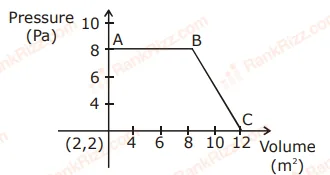
The magnitude of work done by a gas that undergoes a reversible expansion along the path ABC shown in the figure is __________.

At constant volume, 4 mol of an ideal gas when heated from 300K to 500K changes its internal energy by 5000J. The molar heat capacity at constant volume is
For the reaction:
A(l) 2B(g)
kcal, cal K at 300K.
Hence in kcal is
The standard heat of formation of ethane (in kJ/mol), if the heat of combustion of ethane, hydrogen and graphite are , and kJ/mol, respectively is
An ideal gas is allowed to expand from 1 L to 10 L against a constant external pressure of 1 bar. The work done in kJ is:
+10.0
-2.0
-0.9
-9.0
Enthalpy of sublimation of iodine is 24 cal g at 200°C. If specific heat of I(s) and I(vap) are 0.055 and 0.031 cal g K respectively, then enthalpy of sublimation of iodine at 250°C in cal g is:
11.4
2.85
22.8
5.7
A process will be spontaneous at all temperatures if:
and
and
and
and
The difference between ΔH and ΔU is ΔH - ΔU, when the combustion of one mole of heptane l is carried out at a temperature T, is equal to:
-4RT
3RT
4RT
-3RT
JEE Advanced has set 40 Chemical Thermodynamics questions too. Chemical Thermodynamics JEE Advanced PYQs →
OTHER CHEMISTRY CHAPTERS