JEE MAIN 2024 · 06 APR S1Electrical and magnetic properties of solids
Which of the following material is not a semiconductor.
- A
Silicon
- B
Copper oxide
- C
Germanium
- D
Graphite
Solid State has been asked in 19 of the 23 JEE Main years from 2004 to 2026: 78 questions in all. It was not set in any of the 19 2026 papers. Across the last 20 papers it carried 0% of Chemistry marks. By type: 56 MCQs and 22 numerical-answer questions. Of the 64 with a difficulty tag, 50% are easy, 50% medium and 0% hard. Most asked: Crystal lattices, unit cells and density (41, 53%), Voids, radius ratio and structures of ionic solids (18, 23%) and Defects in solids (9, 12%).
DATA UPDATED
Questions
78
Distinct ideas
6
Share of marks
0%
Difficulty
EASY
The share of each year’s Chemistry questions that came from Solid State, counted from the 168 papers we hold for the last 10 years, and session by session inside a year.
Falling: 0.1% of Chemistry questions in 2024–2026, down from 1.6% in 2017–2023. Its heaviest year was 2019, at 2.1%. Not asked at all in 2025, 2026.
| YEAR | QS | PER PAPER | SHARE OF CHEMISTRY | CHANGE | |
|---|---|---|---|---|---|
| 2026 | 0 / 480 | 0.0 | 0.0% | level | JAN 0.0%APR 0.0% |
| 2025 | 0 / 475 | 0.0 | 0.0% | −0.2 pts | JAN 0.0%APR 0.0% |
| 2024 | 1 / 600 | 0.1 | 0.2% | −1.4 pts | JAN 0.0%APR 0.3% |
| 2023 | 12 / 750 | 0.5 | 1.6% | +0.4 pts | JAN 1.3%APR 1.9% |
| 2022 | 8 / 660 | 0.4 | 1.2% | −0.7 pts | JUN 1.4%JUL 1.0% |
| 2021 | 14 / 720 | 0.6 | 1.9% | +0.6 pts | FEB 2.0%MAR 2.7%JUL 2.4%AUG 1.0% |
| 2020 | 5 / 400 | 0.3 | 1.3% | −0.8 pts | JAN 0.7%SEP 1.6% |
| 2019 | 10 / 480 | 0.6 | 2.1% | +0.4 pts | JAN 2.1%APR 2.1% |
| 2018 | 2 / 120 | 0.5 | 1.7% | +0.6 pts | 4 PAPERS, ONE SESSION |
| 2017 | 1 / 90 | 0.3 | 1.1% | — | 3 PAPERS, ONE SESSION |
“QS” is Solid State questions out of all Chemistry questions that year; “per paper” is that count over the year’s papers, and “change” is the share against the year before. A year with more sittings asks more questions, which is why the share, not the count, is the number to compare.
How Solid State compares: every Chemistry chapter by weightage · most repeated JEE Main topics
A chapter is not one subject — it is a handful of procedures the examiner reuses. These are the ones Solid State questions actually test.
Every JEE Main Solid State question we hold, newest first inside each topic. Open one for its options, answer key and solution.
FREE PDF
All 78 questions on A4, by topic, with the answer key at the end. No sign-up, no email: your browser saves it as a PDF.
Download free PDFUNIQUE CONCEPTS
6 ideas, each with the latest past question that tested it, drawn from 98 JEE Main and Advanced questions.
Solid State Unique Concepts sheet →JEE ADVANCED
JEE Advanced has set 20 Solid State questions, 2007–2025.
Solid State JEE Advanced PYQs →Not every year. It has been asked in 19 of the 23 JEE Main years from 2004 to 2026; the years without a Solid State question were 2007, 2016, 2025 and 2026.
Crystal lattices, unit cells and density: 41 of the 78 questions (53%). Next come Voids, radius ratio and structures of ionic solids (18) and Defects in solids (9).
About 0% across the last 20 papers. Every JEE Main question carries the same marks, so that is also its share of Chemistry questions. In 2026 it was 0.0% (0 of 480 Chemistry questions).
In JEE Main 06 Apr 2024, Shift 1, the latest sitting with a Solid State question. It has not been set since 2024, though the bank holds JEE Main papers up to 2026.
78 from 2004 to 2024, across 6 topics. Every one is listed on this page by topic and links to its own page, with the answer key and solution wherever we have them. Free, no sign-up.
1–20 OF 78 · NEWEST FIRST
Which of the following material is not a semiconductor.
Silicon
Copper oxide
Germanium
Graphite
Which of the following expressions is correct in case of a CsCl unit cell (edge length 'a')?
Sodium metal crystallises in a body centred cubic lattice with unit cell edge length of A. The radius of sodium atom is _____ A. (Nearest integer)
An atomic substance A of molar mass 12 g mol has a cubic crystal structure with edge length of 300 pm. The no. of atoms present in one unit cell of A is _______ (Nearest integer)
Given the density of A is 3.0 g m m and NA = mol
Which one of the following pairs is an example of polar molecular solids?
SO(s), CO(s)
SO(s), NH(s)
MgO(s), SO(s)
HCl(s), AlN(s)
The correct relationships between unit cell edge length 'a' and radius of sphere 'r' for face-centred and body-centred cubic structures respectively are:
and
and
and
and
A compound is formed by two elements X and Y. The element Y forms cubic close packed arrangement and those of element X occupy one third of the tetrahedral voids. What is the formula of the compound?
XY
XY
XY
XY
Number of crystal systems from the following where body centred unit cell can be found, is ______.
Cubic, tetragonal, orthorhombic, hexagonal, rhombohedral, monoclinic, triclinic
Which of the following represents the lattice structure of AO containing A, A and O ions?

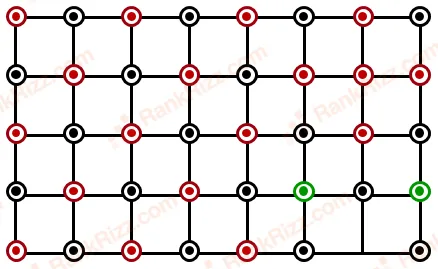
B and C only
B only
A and B only
A only
A metal M crystallizes into two lattices: face centred cubic (fcc) and body centred cubic (bcc) with unit cell edge length of and respectively. The ratio of densities of lattices fcc to bcc for the metal M is ______ (Nearest integer)
1
2
3
4
Iron oxide FeO, crystallises in a cubic lattice with a unit cell edge length of . If density of the FeO in the crystal is g cm, then the number of FeO units present per unit cell is ______ (Nearest integer)
Given: Molar mass of Fe and O is 56 and 16 g mol respectively.
N mol
A metal M forms hexagonal close-packed structure. The total number of voids in mol of it is ______ (Nearest integer)
(Given N)
A cubic solid is made up of two elements X and Y. Atoms of X are present on every alternate corner and one at the center of cube. Y is at rd of the total faces. The empirical formula of the compound is
XY
XY
XY
XY
Ionic radii of cation and anion are 102 and 181 pm respectively. These ions are allowed to crystallize into an ionic solid. This crystal has cubic close packing for . is present in all octahedral voids. The edge length of the unit cell of the crystal AB is _____ pm.
An element M crystallises in a body centred cubic unit cell with a cell edge of 300 pm. The density of the element is 6.0 g cm. The number of atoms present in 180 g of the element is _____ . (Nearest integer)
Metal M crystallizes into a FCC lattice with the edge length of cm. The atomic mass of the metal is _____ g/mol. (Use: mol, density of metal, g cm)
The incorrect statement about the imperfections in solids is
Schottky defect decreases the density of the substance.
Frenkel defect does not alter the density of the substance.
Interstitial defect increases the density of the substance.
Vacancy defect increases the density of the substance.
Metal deficiency defect is shown by . In the crystal, some cations are missing and loss of positive charge is compensated by the presence of ions. The percentage of ions in the crystals is ______ (Nearest integer)
In a solid AB, A atoms are in ccp arrangement and B atoms occupy all the octahedral sites. If two atoms from the opposite faces are removed, then the resultant stoichiometry of the compound is . The value of is ______ [nearest integer]
The distance between and ions in solid NaCl of density g cm is ______ m. (Nearest Integer)
(Given : mol)
OTHER CHEMISTRY CHAPTERS