RankRizz

p-Block Elements: Groups 13 and 14 — JEE Main Previous Year Questions

p-Block Elements: Groups 13 and 14 has been asked in 17 of the 23 JEE Main years from 2004 to 2026: 92 questions in all. In 2026 it averaged 0.4 questions per paper (7 across 19 papers), 1.5% of Chemistry questions, the same as in 2025. Across the last 20 papers it carried 1.4% of Chemistry marks. By type: 90 MCQs and 2 numerical-answer questions. Of the 83 with a difficulty tag, 58% are easy, 42% medium and 0% hard. Most asked: Group 13: general trends and inert pair effect (41, 45%), Group 14: trends and carbon allotropes (36, 39%) and Aluminium and its compounds (9, 10%).

DATA UPDATED

Questions

92

Distinct ideas

5

Share of marks

1.4%

Difficulty

EASY

p-Block Elements: Groups 13 and 14 weightage, year by year

The share of each year’s Chemistry questions that came from p-Block Elements: Groups 13 and 14, counted from the 168 papers we hold for the last 10 years, and session by session inside a year.

Steady: 1.6% of Chemistry questions in 2024–2026 against 1.6% in 2017–2023, and between 0.0% and 3.3% in every year shown. Not asked at all in 2017.

p-Block Elements: Groups 13 and 14 questions per year, per paper, and as a share of Chemistry questions
YEARQSPER PAPERSHARE OF CHEMISTRYCHANGE
20267 / 4800.41.5%level
20257 / 4750.41.5%−0.3 pts
202411 / 6000.61.8%+0.6 pts
20239 / 7500.41.2%−0.8 pts
202213 / 6600.62.0%+1.0 pts
20217 / 7200.31.0%+0.5 pts
20202 / 4000.10.5%−2.8 pts
201916 / 4801.03.3%+0.8 pts
20183 / 1200.82.5%+2.5 pts
20170 / 900.00.0%—

“QS” is p-Block Elements: Groups 13 and 14 questions out of all Chemistry questions that year; “per paper” is that count over the year’s papers, and “change” is the share against the year before. A year with more sittings asks more questions, which is why the share, not the count, is the number to compare.

How p-Block Elements: Groups 13 and 14 compares: every Chemistry chapter by weightage · most repeated JEE Main topics

The ideas inside p-Block Elements: Groups 13 and 14

A chapter is not one subject — it is a handful of procedures the examiner reuses. These are the ones p-Block Elements: Groups 13 and 14 questions actually test.

All 92 p-Block Elements: Groups 13 and 14 questions, by topic

Every JEE Main p-Block Elements: Groups 13 and 14 question we hold, newest first inside each topic. Open one for its options, answer key and solution.

FREE PDF

p-Block Elements: Groups 13 and 14 JEE Main PYQs with answer key

All 92 questions on A4, by topic, with the answer key at the end. No sign-up, no email: your browser saves it as a PDF.

Download free PDF

UNIQUE CONCEPTS

p-Block Elements: Groups 13 and 14: one question per idea

5 ideas, each with the latest past question that tested it, drawn from 106 JEE Main and Advanced questions.

p-Block Elements: Groups 13 and 14 Unique Concepts sheet →

JEE ADVANCED

p-Block Elements: Groups 13 and 14 in JEE Advanced

JEE Advanced has set 14 p-Block Elements: Groups 13 and 14 questions, 2007–2022.

p-Block Elements: Groups 13 and 14 JEE Advanced PYQs →

p-Block Elements: Groups 13 and 14: quick answers

Is p-Block Elements: Groups 13 and 14 asked every year in JEE Main?

Not every year. It has been asked in 17 of the 23 JEE Main years from 2004 to 2026; the years without a p-Block Elements: Groups 13 and 14 question were 2006, 2009, 2010, 2012, 2015 and 2017.

Which p-Block Elements: Groups 13 and 14 topic is asked most in JEE Main?

Group 13: general trends and inert pair effect: 41 of the 92 questions (45%). Next come Group 14: trends and carbon allotropes (36) and Aluminium and its compounds (9).

What share of Chemistry marks does p-Block Elements: Groups 13 and 14 carry in JEE Main?

About 1.4% across the last 20 papers. Every JEE Main question carries the same marks, so that is also its share of Chemistry questions. In 2026 it was 1.5% (7 of 480 Chemistry questions).

When was p-Block Elements: Groups 13 and 14 last asked in JEE Main?

In JEE Main 06 Apr 2026, Shift 1, the latest sitting with a p-Block Elements: Groups 13 and 14 question.

How many p-Block Elements: Groups 13 and 14 questions has JEE Main asked?

92 from 2004 to 2026, across 5 topics. Every one is listed on this page by topic and links to its own page, with the answer key and solution wherever we have them. Free, no sign-up.

Every p-Block Elements: Groups 13 and 14 question

1–20 OF 92 · NEWEST FIRST

JEE MAIN 2026 · 06 APR S1Group 13: general trends and inert pair effect

Given below are two statements:

Statement I: Aluminium is more electropositive than thallium as the standard electrode potential value of EAl3+/Al∘^\circ_{Al^{3+}/Al} is negative and ETl3+/Tl∘^\circ_{Tl^{3+}/Tl} is positive.

Statement II: The sum of first three ionization enthalpies of boron is very high when compared to that of aluminium. Due to this reason boron forms covalent compounds only and aluminium forms Al3+^{3+} ion.

In the light of the above statements, choose the correct answer from the options given below:

  1. A

    Both Statement I and Statement II are true

  2. B

    Both Statement I and Statement II are false

  3. C

    Statement I is true but Statement II is false

  4. D

    Statement I is false but Statement II is true
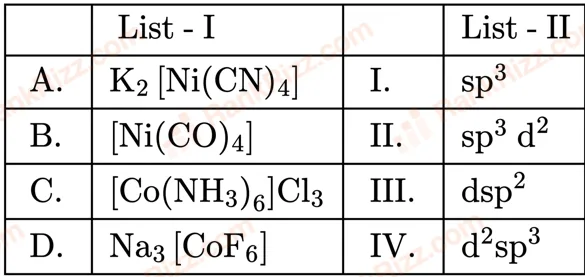
JEE MAIN 2026 · 04 APR S2Group 13: general trends and inert pair effect

The electronegativity of a group 13 element 'E' is same as that of Ge (on Pauling scale and upto one decimal point). The CORRECT statements about E3+^{3+} are

A. It can act as a reducing agent.

B. It can act as an oxidizing agent.

C. E3+^{3+} is more stable than E+^+.

D. The standard electrode potential value for E3+^{3+}/E is positive.
choose the correct answer from the options given below 

  1. A

    A, C Only

  2. B

    B, C Only

  3. C

    B, D Only

  4. D

    A, D Only

JEE MAIN 2026 · 02 APR S2Group 13: general trends and inert pair effect

Given below are two statements :
Statement I : The second ionization enthalpy of B, Al and Ga is in the order of B>Al>GaB > Al > Ga.
Statement II : The correct order in terms of first ionization enthalpy is Si<Ge<Pb<SnSi < Ge < Pb < Sn.
In the light of the above statements, choose the correct answer from the options given below:

  1. A

    Both Statement I and Statement II are true

  2. B

    Both Statement I and Statement II are false

  3. C

    Statement I is true but Statement II is false

  4. D

    Statement I is false but Statement II is true

JEE MAIN 2026 · 24 JAN S2Group 14: trends and carbon allotropes

Choose the INCORRECT statement

  1. A

    Carbon cannot exceed its covalency more than four.

  2. B

    Carbon exhibits negative oxidation states along with +4 and +2.

  3. C

    Among the isotopes of carbon, 13C^{13}C is a radioactive isotope.

  4. D

    CO2CO_{2} is the most acidic oxide among the dioxides of group of 14 elements.

JEE MAIN 2026 · 23 JAN S1Group 13: general trends and inert pair effect

The correct statements from the following are:
A. Ionic radii of trivalent cations of group 13 elements decreases down the group.
B. Electronegativity of group 13 elements decreases down the group.
C. Among the group 13 elements, Boron has highest first ionisation enthalpy.
D. The trichloride and triiodide of group 13 elements are covalent in nature.
Choose the correct answer from the options given below :

  1. A

    A and D Only

  2. B

    A and C Only

  3. C

    B and D Only

  4. D

    C and D Only

JEE MAIN 2026 · 23 JAN S2Group 14: trends and carbon allotropes

It is noticed that Pb2+Pb^{2+} is more stable than Pb4+Pb^{4+} but Sn2+Sn^{2+} is less stable than Sn4+Sn^{4+}
Observe the following reactions.

PbO2+Pb→2PbO;△rGo(1)PbO_2+Pb\rightarrow 2PbO;\triangle_rG^{o}(1)
SnO2+Sn→2SnO;△rGo(2)SnO_2+Sn\rightarrow 2SnO;\triangle_rG^{o}(2)

Identify the correct set from the following

  1. A

    △rGo(1)>0;△rGo(2)<0\triangle_r G^{o}(1) \gt 0; \triangle_r G^{o}(2) \lt 0

  2. B

    △rGo(1)<0;△rGo(2)>0\triangle_r G^{o}(1) \lt 0; \triangle_r G^{o}(2) \gt 0

  3. C

    △rGo(1)>0;△rGo(2)>0\triangle_r G^{o}(1) \gt 0; \triangle_r G^{o}(2) \gt 0

  4. D

    △rGo(1)<0;△rGo(2)<0\triangle_r G^{o}(1) \lt 0; \triangle_r G^{o}(2) \lt 0

JEE MAIN 2026 · 21 JAN S1Oxides of carbon, silica, silicones and silicates

Given below are two statements:
Statement I: The number of pairs among [SiO2,CO2],[SnO,SnO2],[PbO,PbO2][SiO_{2},CO_{2}],[SnO,SnO_{2}],[PbO,PbO_{2]} and [GeO,GeO2][GeO,GeO_{2}], which contain oxides that are both amphoteric is 2.
Statement ll: BF3BF_{3} is an electron deficient molecule, can act as a Lewis add, forms adduct with NH3NH_{3} and has a trigonal planar geometry.
In the light of the above statements, choose the correct answer from the options given below:

  1. A

    Statement I is true but Statement II is false

  2. B

    Statement I is false but Statement II is true

  3. C

    Both Statement I and Statement Il are false

  4. D

    Both Statement I and Statement Il are true

JEE MAIN 2025 · 07 APR S1Group 14: trends and carbon allotropes

The group 14 elements A and B have the first ionisation enthalpy values of 708 and 715 kJ mol−1^{-1} respectively. The above values are lowest among their group members. The nature of their ions A2+A^{2+} B4+B^{4+} respectively is

  1. A

    both reducing

  2. B

    both oxidising

  3. C

    reducing and oxidising

  4. D

    oxidising and reducing

JEE MAIN 2025 · 07 APR S2Group 13: general trends and inert pair effect

The correct statements from the following are :
(A) Tl3+Tl^{3+} is a powerful oxidising agent
(B) Al3+Al^{3+} does not get reduced easily
(C) Both Al3+Al^{3+} and Tl3+Tl^{3+} are very stable in solution
(D) Tl+Tl^+ is more stable than Tl3+Tl^{3+}
(E) Al3+Al^{3+} and Tl+Tl^+ are highly stable

  1. A

    (A), (B), (C), (D) and (E)

  2. B

    (A), (B), (D) and (E) only

  3. C

    (B), (D) and (E) only

  4. D

    (A), (C) and (D) only

JEE MAIN 2025 · 04 APR S1Group 13: general trends and inert pair effect

Given below are the pairs of group 13 elements showing their relation in terms of atomic radius. (B<Al),(Al<Ga),(Ga<In)(B \lt Al), (Al \lt Ga), (Ga \lt In) and (In<Tl)(In \lt Tl). Identify the elements present in the incorrect pair and in that pair find out the element (X) that has higher ionic radius (M3+M^{3+}) than the other one. The atomic number of the element (X) is

  1. A

    31

  2. B

    49

  3. C

    13

  4. D

    81

JEE MAIN 2025 · 04 APR S2Group 14: trends and carbon allotropes

Given below are two statements :
Statement (I) : The first ionisation enthalpy of group 14 elements is higher than the corresponding elements of group 13.
Statement (II) : Melting points and boiling points of group 13 elements are in general much higher than those the corresponding elements of group 14.
In the light of the above statements, choose the most appropriate answer from the options given below :

  1. A

    Statement I is correct but Statement II is incorrect

  2. B

    Statement I is incorrect but Statement II is correct

  3. C

    Both Statement I and Statement II are incorrect

  4. D

    Both Statement I and Statement II are correct

JEE MAIN 2025 · 04 APR S2Group 13: general trends and inert pair effect

The elements of Group 13 with highest and lowest first ionisation enthalpies are respectively:

  1. A

    B & Ga

  2. B

    B & Tl

  3. C

    Tl & B

  4. D

    B & In

JEE MAIN 2025 · 03 APR S2Group 13: general trends and inert pair effect

The correct orders among the following are:
Atomic radius: B<Al<Ga<In<TlB \lt Al \lt Ga \lt In \lt Tl
Electronegativity: Al<Ga<In<Tl<BAl \lt Ga \lt In \lt Tl \lt B
Density: Tl<In<Ga<Al<BTl \lt In \lt Ga \lt Al \lt B
1st Ionisation Energy: In<Al<Ga<Tl<BIn \lt Al \lt Ga \lt Tl \lt B
Choose the correct answer from the options given below :

  1. A

    B and D Only

  2. B

    A and C Only

  3. C

    C and D Only

  4. D

    A and B Only

JEE MAIN 2025 · 23 JAN S2Group 14: trends and carbon allotropes

Given below are the atomic numbers of some group 14 elements. The atomic number of the element with lowest melting point is :

  1. A

    6

  2. B

    82

  3. C

    14

  4. D

    50

JEE MAIN 2024 · 09 APR S2Group 13: general trends and inert pair effect

Match List I with List II:

Figure for JEE Main 2024 Chemistry question on Group 13: general trends and inert pair effect


Choose the correct answer from the options given below:

  1. A

    A-III, B-I, C-IV, D-II

  2. B

    A-III, B-I, C-II, D-IV

  3. C

    A-I, B-III, C-II, D-IV

  4. D

    A-III, B-II, C-IV, D-I

JEE MAIN 2024 · 08 APR S1Group 13: general trends and inert pair effect

Given below are two statements: One is labelled as Assertion A and the other is labelled as Reason R: Assertion A: The stability order of +1 oxidation state of Ga, In and Tl is Ga<In<TlGa < In < Tl. Reason R: The inert pair effect stabilizes the lower oxidation state down the group. In the light of the above statements, choose the correct answer from the options given below:

  1. A

    A is true but R is false.

  2. B

    A is false but R is true.

  3. C

    Both A and R are true and R is the correct explanation of A.

  4. D

    Both A and R are true but R is NOT the correct explanation of A.

JEE MAIN 2024 · 06 APR S1Group 13: general trends and inert pair effect

Given below are two statements: Statement I : Gallium is used in the manufacturing of thermometers. Statement II : A thermometer containing gallium is useful for measuring the freezing point of brine solution (256 K). In the light of the above statements, choose the correct answer from the options given below :

  1. A

    Both Statement I and Statement II are true

  2. B

    Statement I is false but Statement II is true

  3. C

    Both Statement I and Statement II are false

  4. D

    Statement I is true but Statement II is false

JEE MAIN 2024 · 06 APR S2Group 14: trends and carbon allotropes

Evaluate the following statements related to group 14 elements for their correctness. (A) Covalent radius decreases down the group from C to Pb in a regular manner. (B) Electronegativity decreases from C to Pb down the group gradually. (C) Maximum covalance of C is 4 whereas other elements can expand their covalance due to presence of d orbitals. (D) Heavier elements do not form pπ−pπp\pi - p\pi bonds. (E) Carbon can exhibit negative oxidation states. Choose the correct answer from the options given below :

  1. A

    (A), (B) and (C) Only

  2. B

    (C), (D) and (E) Only

  3. C

    (C) and (D) Only

  4. D

    (A) and (B) Only

JEE MAIN 2024 · 05 APR S1Group 13: general trends and inert pair effect

Given below are two statements :

Statement I : In group 13, the stability of +1 oxidation state increases down the group. 

Statement II : The atomic size of gallium is greater than that of aluminium. 

In the light of the above statements, choose the most appropriate answer from the options given below :

  1. A

    Both Statement I and Statement II are correct

  2. B

    Statement I is incorrect but Statement II is correct

  3. C

    Both Statement I and Statement II are incorrect

  4. D

    Statement I is correct but Statement II is incorrect

JEE MAIN 2024 · 05 APR S1Group 13: general trends and inert pair effect

The number of neutrons present in the more abundant isotope of boron is 'xx'. Amorphous boron upon heating with air forms a product, in which the oxidation state of boron is 'yy'. The value of x+yx + y is ______

  1. A

    3

  2. B

    9

  3. C

    4

  4. D

    6