JEE MAIN 2024 · 06 APR S2Gibbs energy and spontaneity
For the reaction at , . and . The reaction will become spontaneous above ___________ K.
Every Chemical Thermodynamics question JEE Main has set from 2004–2026, grouped by the idea it tests rather than the order of the syllabus. 229 questions across 7 distinct ideas. Free to read, answer key on every one.
DATA UPDATED
Questions
229
Distinct ideas
7
Share of marks
4.6%
Difficulty
MEDIUM
A chapter is not one subject — it is a handful of procedures the examiner reuses. These are the ones Chemical Thermodynamics questions actually test.
61–80 OF 229 · NEWEST FIRST
For the reaction at , . and . The reaction will become spontaneous above ___________ K.
Given below are two statements : One is labelled as Assertion (A) and the other is labelled as Reason (R).
Assertion (A) : Enthalpy of neutralisation of strong monobasic acid with strong monoacidic base is always .
Reason (R) : Enthalpy of neutralisation is the amount of heat liberated when one mole of ions furnished by acid combine with one mole of ions furnished by base to form one mole of water.
In the light of the above statements, choose the correct answer from the options given below.
(A) is true but (R) is false
Both (A) and (R) are true but (R) is not the correct explanation of (A)
Both (A) and (R) are true and (R) is the correct explanation of (A)
(A) is false but (R) is true
The heat of combustion of solid benzoic acid at constant volume is at . The heat of combustion at constant pressure is , the value of is ______.
Combustion of 1 mole of benzene is expressed at . The standard enthalpy of combustion of 2 mol of benzene is kJ. ______ Given: 1. Standard enthalpy of formation of 1 mol of , for the reaction is . 2. Standard enthalpy of formation of 1 mol of , for the reaction is . 3. Standard enthalpy of formation of 1 mol of , for the reaction is .
The enthalpy of formation of ethane (C₂H₆) from ethylene by addition of hydrogen where the bond-energies of C−H, C−C, C=C, H−H are 414 kJ, 347 kJ, 615 kJ and 435 kJ respectively is ______ kJ.
Three moles of an ideal gas are compressed isothermally from L to L using constant pressure of atm. Heat exchange for the compression is ______ Lit. atm.
Choose the correct option for free expansion of an ideal gas under adiabatic condition from the following :
For a certain reaction at 300 K, K = 10, then for the same reaction is - ______ . (Given )
Consider the following reaction at 298 K. , . for the reaction is _________ kJ. (Given ) Round off your answer to the nearest integer.
If 5 moles of an ideal gas expands from 10 L to a volume of 100 L at 300 K under isothermal and reversible condition then work, , is J. The value of is (Given J K mol)
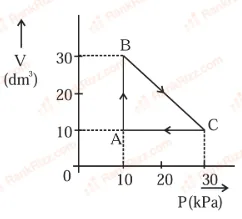
An ideal gas undergoes a cyclic transformation starting from the point and coming back to the same point by tracing the path as shown in the diagram. The total work done in the process is _____ J.
Two reactions are given below:
, kJ/mol
, kJ/mol
Then enthalpy change for following reaction:
Which of the following is not correct?
is negative for a spontaneous reaction
is positive for a spontaneous reaction
is zero for a reversible reaction
is positive for a non-spontaneous reaction
Standard enthalpy of vapourisation for is kJ mol. Heat required for vapourisation of g of at constant temperature is ______ kJ. (Given molar mass in g mol; C = 12, Cl = 35.5)
If three moles of an ideal gas at K expand isothermally from to against a constant opposing pressure of kPa, then the amount of heat transferred is _________ J.
For a certain thermochemical reaction at K, kJ mol, J K, log equilibrium constant () is _____ .
kJ of heat is required to melt one mole of sodium chloride and the entropy change at the melting point is J K mol at 1 atm. The melting point of sodium chloride is _____ K (Nearest Integer)
A + B 2AB. kJ mol
AB, A and B are diatomic molecules. If the bond enthalpies of A, B and AB are in the ratio 1 : 0.5 : 1, then the bond enthalpy of A is _____ kJ mol (Nearest integer)
What happens when methane undergoes combustion in systems A and B respectively?
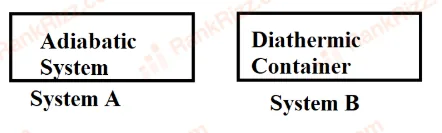
System A: Temperature rises; System B: Temperature remains same
System A: Temperature remains same; System B: Temperature rises
System A: Temperature falls; System B: Temperature remains same
System A: Temperature falls; System B: Temperature rises
One mole of an ideal gas at K is in a L vessel of thermally conducting walls, which are in contact with the surroundings. It undergoes isothermal reversible expansion from L to L against a constant pressure of atm. The change in entropy of the surroundings () is _____ J K (Nearest integer)
Given: J K mol.
JEE Advanced has set 40 Chemical Thermodynamics questions too. Chemical Thermodynamics JEE Advanced PYQs →
OTHER CHEMISTRY CHAPTERS