JEE MAIN 2026 · 08 APR S2Law of mass action and equilibrium constants Kc and Kp
Consider the following reactions in which all the reactants and products are present in gaseous state
The value of for the equilibrium is :
- A
- B
- C
- D
Chemical and Ionic Equilibrium has been asked in every one of the 23 JEE Main years from 2004 to 2026: 274 questions in all. In 2026 it averaged 1.5 questions per paper (28 across 19 papers), 5.8% of Chemistry questions, up from 5.1% in 2025. Across the last 20 papers it carried 5.7% of Chemistry marks. By type: 186 MCQs and 88 numerical-answer questions. Of the 229 with a difficulty tag, 44% are easy, 56% medium and 0% hard. Most asked: Law of mass action and equilibrium constants Kc and Kp (93, 34%), pH of acids, bases and their mixtures (60, 22%) and Solubility product and common ion effect (51, 19%).
DATA UPDATED
Questions
274
Distinct ideas
10
Share of marks
5.7%
Difficulty
MEDIUM
The share of each year’s Chemistry questions that came from Chemical and Ionic Equilibrium, counted from the 168 papers we hold for the last 10 years, and session by session inside a year.
Steady: 4.5% of Chemistry questions in 2024–2026 against 4.3% in 2017–2023, and between 3.0% and 10.8% in every year shown.
| YEAR | QS | PER PAPER | SHARE OF CHEMISTRY | CHANGE | |
|---|---|---|---|---|---|
| 2026 | 28 / 480 | 1.5 | 5.8% | +0.7 pts | JAN 4.8%APR 7.0% |
| 2025 | 24 / 475 | 1.3 | 5.1% | +2.1 pts | JAN 5.6%APR 4.4% |
| 2024 | 18 / 600 | 0.9 | 3.0% | −0.9 pts | JAN 3.0%APR 3.0% |
| 2023 | 29 / 750 | 1.2 | 3.9% | +0.1 pts | JAN 4.1%APR 3.6% |
| 2022 | 25 / 660 | 1.1 | 3.8% | −0.1 pts | JUN 3.9%JUL 3.7% |
| 2021 | 28 / 720 | 1.2 | 3.9% | −1.4 pts | FEB 4.0%MAR 5.3%JUL 3.3%AUG 3.3% |
| 2020 | 21 / 400 | 1.3 | 5.3% | +1.1 pts | JAN 5.3%SEP 5.2% |
| 2019 | 20 / 480 | 1.3 | 4.2% | −6.6 pts | JAN 4.2%APR 4.2% |
| 2018 | 13 / 120 | 3.3 | 10.8% | +6.4 pts | 4 PAPERS, ONE SESSION |
| 2017 | 4 / 90 | 1.3 | 4.4% | — | 3 PAPERS, ONE SESSION |
“QS” is Chemical and Ionic Equilibrium questions out of all Chemistry questions that year; “per paper” is that count over the year’s papers, and “change” is the share against the year before. A year with more sittings asks more questions, which is why the share, not the count, is the number to compare.
How Chemical and Ionic Equilibrium compares: every Chemistry chapter by weightage · most repeated JEE Main topics
A chapter is not one subject — it is a handful of procedures the examiner reuses. These are the ones Chemical and Ionic Equilibrium questions actually test.
Every JEE Main Chemical and Ionic Equilibrium question we hold, newest first inside each topic. Open one for its options, answer key and solution.
FREE PDF
All 274 questions on A4, by topic, with the answer key at the end. No sign-up, no email: your browser saves it as a PDF.
Download free PDFUNIQUE CONCEPTS
10 ideas, each with the latest past question that tested it, drawn from 297 JEE Main and Advanced questions.
Chemical and Ionic Equilibrium Unique Concepts sheet →JEE ADVANCED
JEE Advanced has set 24 Chemical and Ionic Equilibrium questions, 2008–2025.
Chemical and Ionic Equilibrium JEE Advanced PYQs →Yes. It has been asked in every one of the 23 JEE Main years from 2004 to 2026, 274 questions in all.
Law of mass action and equilibrium constants Kc and Kp: 93 of the 274 questions (34%). Next come pH of acids, bases and their mixtures (60) and Solubility product and common ion effect (51).
About 5.7% across the last 20 papers. Every JEE Main question carries the same marks, so that is also its share of Chemistry questions. In 2026 it was 5.8% (28 of 480 Chemistry questions).
In JEE Main 08 Apr 2026, Shift 2, the latest sitting with a Chemical and Ionic Equilibrium question.
274 from 2004 to 2026, across 10 topics. Every one is listed on this page by topic and links to its own page, with the answer key and solution wherever we have them. Free, no sign-up.
1–20 OF 274 · NEWEST FIRST
Consider the following reactions in which all the reactants and products are present in gaseous state
The value of for the equilibrium is :
Solid carbon, CaO and CaCO are mixed and allowed to attain equilibrium at T K.
atm
atm
The partial pressure of CO is __________ atm
One mole each of He and A(g) are taken in a 10 L closed flask and heated to 400 K to establish the following equilibrium.
A(g) B(g)
K for this reaction at 400 K is 4.0. The partial pressures (in atm) of He and B(g) are respectively (at equilibrium)
(Assume He, A(g) and B(g) behave as ideal gases)
(Given: R = 0.082 L atm K mol)
3.28, 2.624
2.624, 3.28
3.28, 0.656
0.656, 6.56
Given is a concentrated solution of a weak electrolyte of concentration 'c' and dissociation constant 'K'. The degree of dissociation is given by :
In a closed flask at 600 K, one mole of attains equilibrium as given below : $ At equilibrium, 75% was dissociated and the total pressure is 1 atm. The magnitude of (in kJ mol) at this temperature is __________. (Nearest Integer) (Given : R = 8.3 J mol K; ln 10 = 2.3, log 2 = 0.3, log 3 = 0.48, log 5 = 0.69, log 7 = 0.84)
is a sparingly soluble salt of molar mass g mol and solubility g L. The ratio of the molar concentration of the anion () to the solubility product of the salt is
Arrange the following resultant mixtures in increasing order of their pH values
A. 10 mL 0.2 M Ca(OH) + 25 mL 0.1 M HCl
B. 10 mL 0.01 M HSO + 10 mL 0.01 M Ca(OH)
C. 10 mL 0.1 M HSO + 10 mL 0.1 M KOH
Choose the correct answer from the options given below:
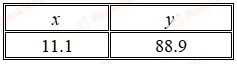
The values of pressure equilibrium constant recorded at different temperatures for the following equilibrium reaction have been given below
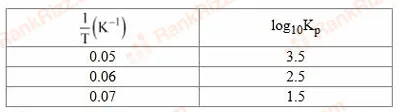
The magnitude of calculated from the above data is _______. (Nearest integer)
The reaction was initiated with the amount `` of . At equilibrium it is found that the amount of remaining is at a total pressure of .
The equilibrium constant of the reaction can be calculated from the expression:
At (K), the equilibrium constant of is . What is the equilibrium constant for at the same temperature?
The pH of a solution obtained by mixing 5 mL of 0.1 M solution with 250 mL of 0.1 M solution is _____ . (Nearest integer)
Given: , , ,
20 mL of a solution of acetic acid required 28.4 mL of 0.1 M NaOH for its neutralization. A solution (X) was prepared by mixing 20 mL of the above acetic acid and 14.2 mL of 0.1 M NaOH solution. What is the pH of the solution (X)? (pK value of acetic acid is 4.75).
For the following reaction at 50 °C and at 2 atm pressure,
NO is 50% dissociated.
The magnitude of standard free energy change at this temperature is .
= _________ J mol [Nearest integer].
Given: J mol K, , , , °C + 273 = K
The solubility product constants of AgCrO and AgBr are 32x and 4y respectively at 298 K. The value of can be expressed as :
The first and second ionization constants of a weak dibasic acid are and respectively. 0.1 mol of was dissolved in 1 L of 0.1 M HCl solution. The concentration of in the resultant solution is :
M
M
M
M
At 25°C, 20.0 mL of 0.2 M weak monoprotic acid HX is titrated against 0.2 M NaOH. The pH of the solution (a) at the start of the titration (when NaOH has not been added) and (b) when 10 mL of NaOH is added respectively, are :
Given: ,
,
(a) 0.7, (b) 2.0
(a) 2.0, (b) 3.3
(a) 1.1, (b) 2.2
(a) 3.0, (b) 2.2
Consider a weak base 'B' of . 'x' mL of 0.02 M HCI and 'y' mL of 0.02 M weak base 'B' are mixed to make 100 mL of a buffer of pH 9 at 25 °C. The values of 'x' and 'y' respectively are:
[Given: log 2 = 0.3010, log 3 = 0.4771, log 5 = 0.699]
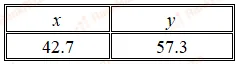
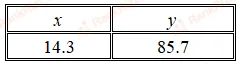
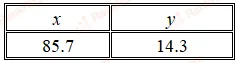
Consider the dissociation equilibrium of the following weak acid If the pKa of the acid is 4, then the pH of 10 mM HA solution is __ .(Nearest integer)
[Given: The degree of dissociation can be neglected with respect to unity]
Observe the following equilibrium in a 1 L flask.
At T(K), the equilibrium concentrations of A and B are 0.5 Mand 0.375 M respectively. 0.1 moles of A is added into the flask and heated to T(K) to establish the equilibrium again. The new equilibrium concentrations (in M) of A and B are respectively
0.557, 0.418.
0.53, 0.4.
0.742, 0.557.
0.367, 0.275.
The plot of gives a straight Line. The intercept and slope respectively are
(where K is equilibrium constant).
OTHER CHEMISTRY CHAPTERS