JEE Main 2025 Chemistry question — First law: work, heat and internal energy
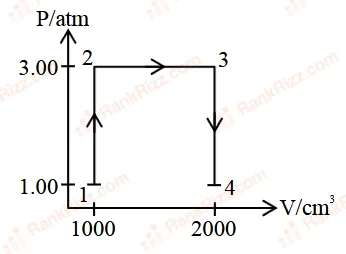
A perfect gas (0.1 mol) having (independent of temperature) undergoes the transformation from point 1 to point 4 as shown in the P-V diagram. If each step is reversible, the total work done (w) while going from point 1 to point 4 is (-) \text{____} J (nearest integer).
[Given: L atm ]
SOLUTION
The total work done during the process can be obtained by calculating the work done in each step of the given path on the P-V diagram.
The expression for pressure-volume work is
Since the process occurs in three stages,
the total work is
The given values of the number of moles ( mol) and molar heat capacity
are not required for calculating pressure-volume work, since work depends only on the pressure and volume changes.
For the process from 1 to 2:
- The process is isochoric.
- The volume remains constant at
Since
the work done is
For the process from 2 to 3:
- The process is isobaric.
- The pressure remains constant at
The volume changes from
to
Therefore,
Hence,
For the process from 3 to 4:
- The process is again isochoric.
- The volume remains constant at
Therefore,
and
Adding the contributions from all three steps,
Using the conversion
the total work is
Rounding to the nearest integer,
Since the question is of the form
the value to be filled in the blank is
304.