JEE MAIN 2023 · 15 APR S1Properties of colloids and coagulation
mL of M NaCl is required to coagulate mL of AsS solution in 2 hours. The coagulating value of NaCl is _____.
Surface Chemistry has been asked in 15 of the 23 JEE Main years from 2004 to 2026: 123 questions in all. It was not set in any of the 19 2026 papers. Across the last 20 papers it carried 0% of Chemistry marks. By type: 106 MCQs and 17 numerical-answer questions. Of the 112 with a difficulty tag, 71% are easy, 29% medium and 1% hard. Most asked: Properties of colloids and coagulation (71, 58%), Adsorption and adsorption isotherms (34, 28%) and Catalysis: homogeneous, heterogeneous and enzyme (11, 9%).
DATA UPDATED
Questions
123
Distinct ideas
4
Share of marks
0%
Difficulty
EASY
The share of each year’s Chemistry questions that came from Surface Chemistry, counted from the 168 papers we hold for the last 10 years, and session by session inside a year.
Falling: 0.0% of Chemistry questions in 2024–2026, down from 3.1% in 2017–2023. Its heaviest year was 2020, at 3.8%. Not asked at all in 2024, 2025, 2026.
| YEAR | QS | PER PAPER | SHARE OF CHEMISTRY | CHANGE | |
|---|---|---|---|---|---|
| 2026 | 0 / 480 | 0.0 | 0.0% | level | JAN 0.0%APR 0.0% |
| 2025 | 0 / 475 | 0.0 | 0.0% | level | JAN 0.0%APR 0.0% |
| 2024 | 0 / 600 | 0.0 | 0.0% | −3.2 pts | JAN 0.0%APR 0.0% |
| 2023 | 24 / 750 | 1.0 | 3.2% | +0.5 pts | JAN 3.6%APR 2.8% |
| 2022 | 18 / 660 | 0.8 | 2.7% | −0.5 pts | JUN 2.8%JUL 2.7% |
| 2021 | 23 / 720 | 1.0 | 3.2% | −0.6 pts | FEB 3.3%MAR 2.7%JUL 3.3%AUG 3.3% |
| 2020 | 15 / 400 | 0.9 | 3.8% | +0.7 pts | JAN 2.7%SEP 4.4% |
| 2019 | 15 / 480 | 0.9 | 3.1% | +0.6 pts | JAN 3.3%APR 2.9% |
| 2018 | 3 / 120 | 0.8 | 2.5% | −0.8 pts | 4 PAPERS, ONE SESSION |
| 2017 | 3 / 90 | 1.0 | 3.3% | — | 3 PAPERS, ONE SESSION |
“QS” is Surface Chemistry questions out of all Chemistry questions that year; “per paper” is that count over the year’s papers, and “change” is the share against the year before. A year with more sittings asks more questions, which is why the share, not the count, is the number to compare.
How Surface Chemistry compares: every Chemistry chapter by weightage · most repeated JEE Main topics
A chapter is not one subject — it is a handful of procedures the examiner reuses. These are the ones Surface Chemistry questions actually test.
Every JEE Main Surface Chemistry question we hold, newest first inside each topic. Open one for its options, answer key and solution.
FREE PDF
All 123 questions on A4, by topic, with the answer key at the end. No sign-up, no email: your browser saves it as a PDF.
Download free PDFUNIQUE CONCEPTS
4 ideas, each with the latest past question that tested it, drawn from 138 JEE Main and Advanced questions.
Surface Chemistry Unique Concepts sheet →JEE ADVANCED
JEE Advanced has set 16 Surface Chemistry questions, 2007–2026.
Surface Chemistry JEE Advanced PYQs →Not every year. It has been asked in 15 of the 23 JEE Main years from 2004 to 2026; the years without a Surface Chemistry question were 2004, 2007, 2010, 2011, 2014, 2024, 2025 and 2026.
Properties of colloids and coagulation: 71 of the 123 questions (58%). Next come Adsorption and adsorption isotherms (34) and Catalysis: homogeneous, heterogeneous and enzyme (11).
About 0% across the last 20 papers. Every JEE Main question carries the same marks, so that is also its share of Chemistry questions. In 2026 it was 0.0% (0 of 480 Chemistry questions).
In JEE Main 15 Apr 2023, Shift 1, the latest sitting with a Surface Chemistry question. It has not been set since 2023, though the bank holds JEE Main papers up to 2026.
123 from 2005 to 2023, across 4 topics. Every one is listed on this page by topic and links to its own page, with the answer key and solution wherever we have them. Free, no sign-up.
1–20 OF 123 · NEWEST FIRST
mL of M NaCl is required to coagulate mL of AsS solution in 2 hours. The coagulating value of NaCl is _____.
What happens when a lyophilic sol is added to a lyophobic sol?
Film of lyophilic sol is formed over lyophobic sol
Lyophilic sol is dispersed in lyophobic sol
Film of lyophobic sol is formed over lyophilic sol
Lyophobic sol is coagulated
Given below are two statements, one is labelled as Assertion A and the other is labelled as Reason R.
Assertion A : The diameter of colloidal particles in solution should not be much smaller than wavelength of light to show Tyndall effect.
Reason R : The light scatters in all directions when the size of particles is large enough.
In the light of the above statements, choose the correct answer from the options given below :
Both A and R are correct but R is NOT the correct explanation of A
A is true but R is false
A is false but R is true
Both A and R are correct and R is the correct explanation of A
Four gases, A, B, C and D have critical temperatures 5.3, 33.2, 126.0 and 154.3K respectively. For their adsorption on a fixed amount of charcoal, the correct order is :
C D B A
C B D A
D C B A
D C A B
The number of correct statements about modern adsorption theory of heterogeneous catalysis from the following is _______
A. The catalyst is diffused over the surface of reactants.
B. Reactants are adsorbed on the surface of the catalyst.
C. Occurrence of chemical reaction on the catalyst's surface through formation of an intermediate.
D. It is a combination of intermediate compound formation theory and the old adsorption theory.
E. It explains the action of the catalyst as well as those of catalytic promoters and poisons.
The enthalpy change for the adsorption process and micelle formation respectively are
and
and
and
and
Ferric chloride is applied to stop bleeding because
Blood absorbs FeCl and forms a complex.
Cl ions cause coagulation of blood.
Fe ions coagulate blood which is a negatively charged sol.
FeCl reacts with the constituents of blood which is a positively charged sol.
Which of the following represents the Freundlich adsorption isotherms?
(A)
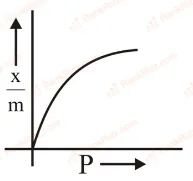
(B)
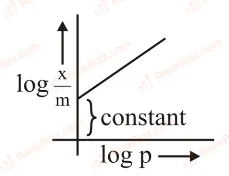
(C)
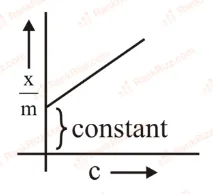
(D)
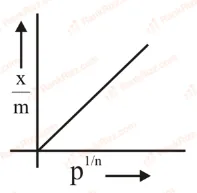
Choose the correct answer from the options given below:
A, C, D only
A, B only
B, C, D only
A, B, D only
Coagulating value of the electrolytes AlCl and NaCl for AsS are 0.09 and 50.04 respectively. The coagulating power of AlCl is x times the coagulating power of NaCl. The value of x is _____.
The number of colloidal systems from the following, which will have 'liquid' as the dispersion medium, is ______.
Gem stones, paints, smoke, cheese, milk, hair cream, insecticide sprays, froth, soap lather
Given below are two statements:
Assertion A: Amongst He, Ne, Ar and Kr; 1 g of activated charcoal adsorbs more of Kr.
Reason R: The critical volume V (cm mol) and critical pressure P (atm) is highest for Krypton but the compressibility factor at critical point Z is lowest for Krypton.
A is true but R is false
A is false but R is true
Both A and R are true but R is NOT the correct explanation of A
Both A and R are true and R is the correct explanation A
In figure, a straight line is given for Freundrich Adsorption (). The value of and log K are respectively.
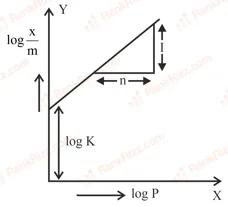
and log
and
and
and
Adding surfactants in non polar solvent, the micelles structure will look like
(a)
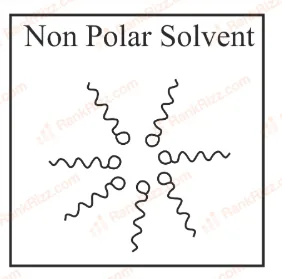
(b)
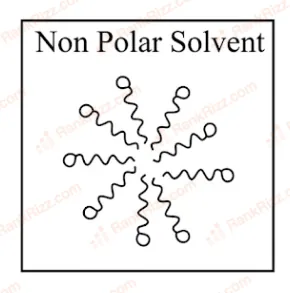
(c)
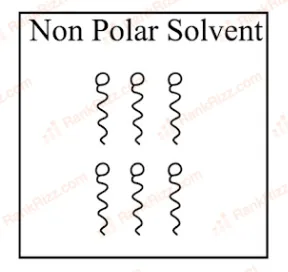
(d)
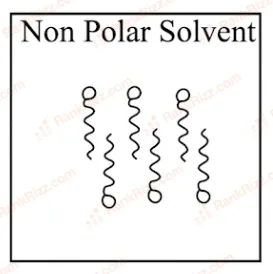
(b)
(c)
(a)
(d)
Match List I with List II
List I List II
A. Physisorption I. Single Layer Adsorption
B. Chemisorption II. 20-40 kJ mol
C. N(g) + 3H(g) 2NH(g) III. Chromatography
D. Analytical Application or Adsorption IV. Heterogeneous catalysis
Choose the correct answer from the options given below:
A-III, B-IV, C-I, D-II
A-II, B-III, C-I, D-IV
A-II, B-I, C-IV, D-III
A-IV, B-II, C-III, D-I
Given below are two statements: one is labelled as Assertion (A) and the other is labelled as Reason (R).
Assertion (A): In expensive scientific instruments, silica gel is kept in watch-glasses or in semipermeable membrane bags.
Reason (R): Silica gel adsorbs moisture from air via adsorption, thus protects the instrument from water corrosion (rusting) and / or prevents malfunctioning.
In the light of the above statements, choose the correct answer from the options given below:
(A) is false but (R) is true
(A) is true but (R) is false
Both (A) and (R) are true and (R) is the correct explanation of (A)
Both (A) and (R) are true but (R) is not the correct explanation of (A)
The graph of vs for an adsorption process is a straight line inclined at an angle of with intercept equal to . The mass of gas adsorbed per unit mass of adsorbent at the pressure of atm is ______ (Nearest integer)
Given:
Which of the following salt solutions would coagulate the colloid solution formed when FeCl is added to NaOH solution, at the fastest rate?
10 mL of 0.2 mol dm AlCl
10 mL of 0.1 mol dm NaSO
10 mL of 0.1 mol dm Ca(PO)
10 mL of 0.15 mol dm CaCl
Match List-I and List-II
| List-I | List-II |
|---|---|
| A. Osmosis | I. Solvent molecules pass through semi permeable membrane towards solvent side. |
| B. Reverse osmosis | II. Movement of charged colloidal particles under the influence of applied electric potential towards oppositely charged electrodes |
| C. Electro osmosis | III. Solvent molecules pass through semi permeable membrane towards solution side |
| D. Electrophoresis | IV. Dispersion medium moves in an electric field. |
A-I, B-III, C-IV, D-II
A-III, B-I, C-IV, D-II
A-III, B-I, C-II, D-IV
A-I, B-III, C-II, D-IV
The variation of the rate of an enzyme catalyzed reaction with substrate concentration is correctly represented by graph
(a)
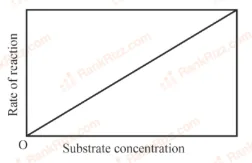
(b)
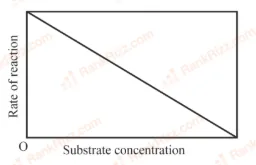
(c)
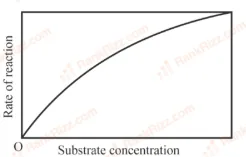
(d)
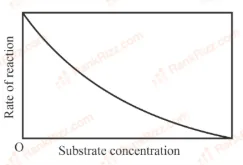
b
c
d
a
Based on the given figure, the number of correct statement/s is/are
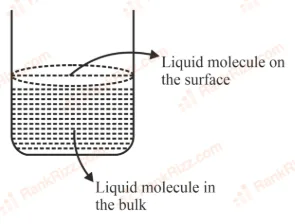
A. Surface tension is the outcome of equal attractive and repulsion forces acting on the liquid molecule in bulk.
B. Surface tension is due to uneven forces acting on the molecules present on the surface.
C. The molecule in the bulk can never come to the liquid surface.
D. The molecules on the surface are responsible for vapour pressure if the system is a closed system.
OTHER CHEMISTRY CHAPTERS