RankRizz

Chemical Thermodynamics — JEE Main Previous Year Questions

Every Chemical Thermodynamics question JEE Main has set from 2004–2026, grouped by the idea it tests rather than the order of the syllabus. 229 questions across 7 distinct ideas. Free to read, answer key on every one.

DATA UPDATED

Questions

229

Distinct ideas

7

Share of marks

4.6%

Difficulty

MEDIUM

The ideas inside Chemical Thermodynamics

A chapter is not one subject — it is a handful of procedures the examiner reuses. These are the ones Chemical Thermodynamics questions actually test.

Every Chemical Thermodynamics question

161–180 OF 229 · NEWEST FIRST

JEE MAIN 2019 · 09 APR S1System, surroundings and state functions

Among the following, the set of parameters that represents path functions, is:
i) q + w
ii) q
iii) w
iv) H - TS

  1. A

    (ii) and (iii)

  2. B

    (i), (ii), and (iii)

  3. C

    (ii), (iii) and (iv)

  4. D

    (i) and (iv)

JEE MAIN 2019 · 09 APR S2First law: work, heat and internal energy

During compression of a spring the work done is 10 kJ and 2 kJ escaped to the surroundings as heat. The change in internal energy, ΔU\Delta U (in kJ) is:

  1. A

    -8

  2. B

    8

  3. C

    12

  4. D

    -12

JEE MAIN 2019 · 08 APR S1First law: work, heat and internal energy

Which one of the following equations does not correctly represent the first law of thermodynamics for the given processes involving an ideal gas? (Assume non-expansion work is zero)

  1. A

    Isochoric process: ΔU=q\Delta U = q

  2. B

    Isochoric process: q=−wq = -w

  3. C

    Cyclic process: q=−wq = -w

  4. D

    Adiabatic process: ΔU=−w\Delta U = -w

JEE MAIN 2019 · 08 APR S1Enthalpies of reaction and Hess's law

For silver, CpC_p (J K−1^{-1} mol−1^{-1}) = 23 + 0.01T. If the temperature T of 3 moles of silver is raised from 300 K to 1000 K at 1 atm pressure, the value of ΔH\Delta H will be close to:

  1. A

    16 kJ

  2. B

    62 kJ

  3. C

    13 kJ

  4. D

    21 kJ

JEE MAIN 2019 · 08 APR S2First law: work, heat and internal energy

5 moles of an ideal gas at 100 K are allowed to undergo reversible compression till its temperature becomes 200 K. If CV=28C_V = 28 J K−1^{-1}, calculate ΔU\Delta U and ΔpV\Delta pV for the process. (R = 8.0 J K−1^{-1} mol−1^{-1})

  1. A

    ΔU=14\Delta U = 14 J; ΔpV=0.8\Delta pV = 0.8 J

  2. B

    ΔU=14\Delta U = 14 kJ; ΔpV=18\Delta pV = 18 kJ

  3. C

    ΔU=14\Delta U = 14 kJ; ΔpV=4\Delta pV = 4 kJ

  4. D

    ΔU=2.8\Delta U = 2.8 kJ; ΔpV=0.8\Delta pV = 0.8 kJ

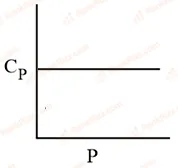
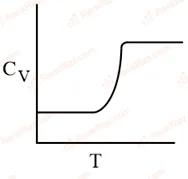
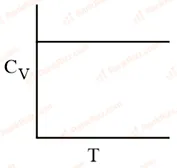
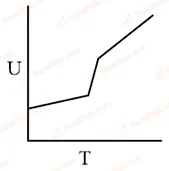
JEE MAIN 2019 · 12 JAN S1Heat capacity and calorimetry

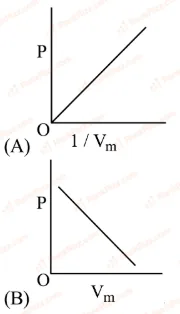
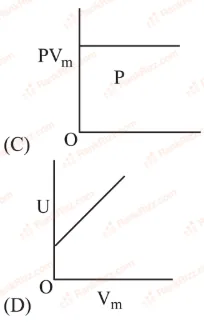
For a diatomic ideal gas in a closed system, which of the following plots does not correctly describe the relation between various thermodynamic quantities?

  1. A
    Figure for JEE Main 2019 Chemistry question on Heat capacity and calorimetry
  2. B
    Figure for JEE Main 2019 Chemistry question on Heat capacity and calorimetry
  3. C
    Figure for JEE Main 2019 Chemistry question on Heat capacity and calorimetry
  4. D
    Figure for JEE Main 2019 Chemistry question on Heat capacity and calorimetry
JEE MAIN 2019 · 12 JAN S2Enthalpies of reaction and Hess's law

Given:
(i) C(graphite) + O2_2(g) →\to CO2_2(g); ΔrH⊖=x\Delta_r H^{\ominus} = x kJ mol−1^{-1},
(ii) C(graphite) + 12\frac{1}{2}O2_2(g) →\to CO(g); ΔrH⊖=y\Delta_r H^{\ominus} = y kJ mol−1^{-1},
(iii) CO(g) + 12\frac{1}{2}O2_2(g) →\to CO2_2(g); ΔrH⊖=z\Delta_r H^{\ominus} = z kJ mol−1^{-1}.
Based on the above thermochemical equations, find out which one of the following algebraic relationships is correct?

  1. A

    x = y + z

  2. B

    z = x + y

  3. C

    y = 2z - x

  4. D

    x = y - z

JEE MAIN 2019 · 12 JAN S2Heat capacity and calorimetry

The combination of plots which does not represent isothermal expansion of an ideal gas is

Figure for JEE Main 2019 Chemistry question on Heat capacity and calorimetry Figure for JEE Main 2019 Chemistry question on Heat capacity and calorimetry
  1. A

    (A) and (D)

  2. B

    (B) and (C)

  3. C

    (B) and (D)

  4. D

    (A) and (C)

JEE MAIN 2019 · 11 JAN S1Entropy and the second law

Two blocks of the same metal having same mass and at temperature T1T_1, and T2T_2, respectively, are brought in contact with each other and allowed to attain thermal equilibrium at constant pressure. The change in entropy, ΔS\Delta S, for this process is:

  1. A

    Cpln⁡[(T1+T2)24T1T2]C_p \ln\left[\frac{(T_1+T_2)^2}{4T_1 T_2}\right]

  2. B

    2Cpln⁡[(T1+T2)12T1T2]2C_p \ln\left[\frac{(T_1+T_2)^{\frac{1}{2}}}{T_1 T_2}\right]

  3. C

    2CPln⁡(T1+T24T1T2)2C_P \ln\left(\frac{T_1+T_2}{4T_1 T_2}\right)

  4. D

    2CPln⁡[T1+T22T1T2]2C_P \ln\left[\frac{T_1+T_2}{2\sqrt{T_1 T_2}}\right]

JEE MAIN 2019 · 11 JAN S1Gibbs energy and spontaneity

For the chemical reaction X⇌YX \rightleftharpoons Y, the standard reaction Gibbs energy depends on temperature T (in K) as ΔrG°\Delta_r G° (in kJ mol−1^{-1}) =120−38T= 120 - \frac{3}{8}T. The major component of the reaction mixture at T is:

  1. A

    Y if T = 300 K

  2. B

    Y if T = 280 K

  3. C

    X if T = 350 K

  4. D

    X if T = 315 K

JEE MAIN 2019 · 11 JAN S2Gibbs energy and spontaneity

The reaction MgO(s)+C(s)→Mg(s)+CO(g)MgO(s) + C(s) \to Mg(s) + CO(g), for which ΔH°=+491.1\Delta H° = +491.1 kJ mol−1^{-1} and ΔS°=198.0\Delta S° = 198.0 JK−1^{-1} mol−1^{-1} is not feasible at 298 K. Temperature above which reaction will be feasible is

  1. A

    2040.5 K

  2. B

    1890.0 K

  3. C

    2480.3 K

  4. D

    2380.5 K

JEE MAIN 2019 · 11 JAN S2Gibbs energy and spontaneity

The standard reaction Gibbs energy for a chemical reaction at an absolute temperature T is given by ΔG°=A−BT\Delta G° = A - BT where A and B are non-zero constants. Which of the following is true about this reaction?

  1. A

    Exothermic if B<0B < 0

  2. B

    Endothermic if A>0A > 0

  3. C

    Endothermic if A<0A < 0 and B>0B > 0

  4. D

    Exothermic if A>0A > 0 and B<0B < 0

JEE MAIN 2019 · 11 JAN S2Gibbs energy and spontaneity

For the equilibrium 2H2O⇌H3O++OH−2H_2O \rightleftharpoons H_3O^+ + OH^-; the value of ΔG°\Delta G° at 298 K is approximately:

  1. A

    100 kJ mol−1^{-1}

  2. B

    −80-80 kJ mol−1^{-1}

  3. C

    80 kJ mol−1^{-1}

  4. D

    −100-100 kJ mol−1^{-1}

JEE MAIN 2019 · 10 JAN S1Gibbs energy and spontaneity

A process has ΔH=200\Delta H = 200 J mol−1^{-1} and ΔS=40\Delta S = 40 J K−1^{-1} mol−1^{-1}. Out of the values given below choose the minimum temperature above which the process will be spontaneous:

  1. A

    20 K

  2. B

    5 K

  3. C

    12 K

  4. D

    4 K

JEE MAIN 2019 · 10 JAN S2Entropy and the second law

The process with negative entropy change is:

  1. A

    Synthesis of ammonia from N2_2 and H2_2.

  2. B

    Dissolution of iodine in water.

  3. C

    Dissociation of CaSO4_4 (s) to CaO (s) and SO3_3 (g).

  4. D

    Sublimation of dry ice.

JEE MAIN 2019 · 10 JAN S2First law: work, heat and internal energy

An ideal gas undergoes isothermal compression from 5 m3^3 to 1 m3^3 against a constant external pressure of 4 N m−2^{-2}. The heat released in this process is 24 J mol−1^{-1} K−1^{-1} and is used to increase the pressure of 1 mole of Al. The temperature of Al increases by:

  1. A

    23\frac{2}{3} K

  2. B

    1 K

  3. C

    32\frac{3}{2} K

  4. D

    2 K

JEE MAIN 2019 · 09 JAN S1Heat capacity and calorimetry

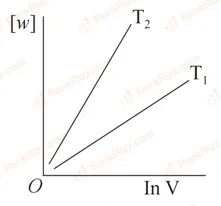
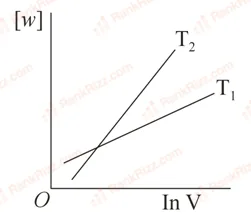
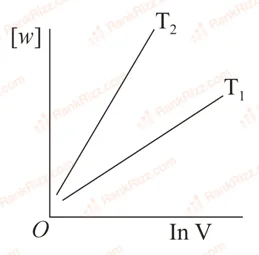
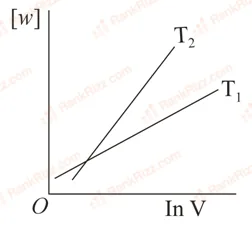
Consider the reversible isothermal expansion of an ideal gas in a closed system at two different temperatures T1T_1 and T2T_2 (T1<T2T_1 < T_2). The correct graphical depiction of the dependence of work done ww vs the final volume VV is:

  1. A
    Figure for JEE Main 2019 Chemistry question on Heat capacity and calorimetry
  2. B
    Figure for JEE Main 2019 Chemistry question on Heat capacity and calorimetry
  3. C
    Figure for JEE Main 2019 Chemistry question on Heat capacity and calorimetry
  4. D
    Figure for JEE Main 2019 Chemistry question on Heat capacity and calorimetry
JEE MAIN 2019 · 09 JAN S2Entropy and the second law

The entropy change associated with the conversion of 1 kg of ice at 273 K to water vapours at 383 K is: (Specific heat of water liquid and water vapour are 4.2 kJ K−1^{-1} and 2.0 kJ K−1^{-1} kg−1^{-1}; heat of liquid fusion and vaporization of water are 334 kJ kg−1^{-1} and 2491 kJ kg−1^{-1}, respectively). (log 273 = 2.436, log 373 = 2.572, log 383 = 2.583)

  1. A

    9.26 kJ kg−1^{-1}K−1^{-1}

  2. B

    2.64 kJ kg−1^{-1}K−1^{-1}

  3. C

    8.49 kJ kg−1^{-1}K−1^{-1}

  4. D

    7.90 kJ kg−1^{-1}K−1^{-1}

JEE MAIN 2018 · 16 APR ONLINEGibbs energy and spontaneity

For which of the following processes, ΔS\Delta S is negative?

  1. A

    C (diamond) →\rightarrow C (graphite)

  2. B

    N2_2(g, 1 atm) →\rightarrow N2_2(g, 5 atm)

  3. C

    N2_2(g, 273K) →\rightarrow N2_2(g, 300K)

  4. D

    H2_2(g) →\rightarrow 2H(g)

JEE MAIN 2018 · 15 APR S1Enthalpies of reaction and Hess's law

For which of the following reactions, ΔH\Delta H is equal to ΔU\Delta U?

  1. A

    N2_2(g) + 3H2_2(g) →\rightarrow 2NH3_3(g)

  2. B

    2HI(g) →\rightarrow H2_2(g) + I2_2(g)

  3. C

    2SO2_2(g) + O2_2(g) →\rightarrow 2SO3_3(g)

  4. D

    2NO2_2(g) →\rightarrow N2_2O4_4(g)