JEE MAIN 2026 · 08 APR S2Colour and magnetic behaviour of complexes from CFT
Number of paramagnetic complexes among the following is __________.
, , , , , , , , ,
Coordination Compounds has been asked in every one of the 23 JEE Main years from 2004 to 2026: 373 questions in all. In 2026 it averaged 1.9 questions per paper (36 across 19 papers), 7.5% of Chemistry questions, down from 8.2% in 2025. Across the last 20 papers it carried 7.7% of Chemistry marks. By type: 291 MCQs and 82 numerical-answer questions. Of the 336 with a difficulty tag, 23% are easy, 73% medium and 4% hard. Most asked: Colour and magnetic behaviour of complexes from CFT (145, 39%), Valence bond theory of complexes (79, 21%) and Structural isomerism in complexes (52, 14%).
DATA UPDATED
Questions
373
Distinct ideas
10
Share of marks
7.7%
Difficulty
MEDIUM
The share of each year’s Chemistry questions that came from Coordination Compounds, counted from the 168 papers we hold for the last 10 years, and session by session inside a year.
Rising: 7.7% of Chemistry questions in 2024–2026, up from 6.0% in 2017–2023. Its heaviest year was 2025, at 8.2%.
| YEAR | QS | PER PAPER | SHARE OF CHEMISTRY | CHANGE | |
|---|---|---|---|---|---|
| 2026 | 36 / 480 | 1.9 | 7.5% | −0.7 pts | JAN 8.0%APR 7.0% |
| 2025 | 39 / 475 | 2.1 | 8.2% | +0.7 pts | JAN 6.8%APR 9.8% |
| 2024 | 45 / 600 | 2.3 | 7.5% | +0.6 pts | JAN 6.7%APR 8.3% |
| 2023 | 52 / 750 | 2.1 | 6.9% | +2.2 pts | JAN 6.4%APR 7.5% |
| 2022 | 31 / 660 | 1.4 | 4.7% | −0.6 pts | JUN 5.0%JUL 4.3% |
| 2021 | 38 / 720 | 1.6 | 5.3% | −2.7 pts | FEB 4.0%MAR 3.3%JUL 7.1%AUG 5.7% |
| 2020 | 32 / 400 | 2.0 | 8.0% | +1.5 pts | JAN 8.0%SEP 8.0% |
| 2019 | 31 / 480 | 1.9 | 6.5% | +0.7 pts | JAN 6.3%APR 6.7% |
| 2018 | 7 / 120 | 1.8 | 5.8% | +3.6 pts | 4 PAPERS, ONE SESSION |
| 2017 | 2 / 90 | 0.7 | 2.2% | — | 3 PAPERS, ONE SESSION |
“QS” is Coordination Compounds questions out of all Chemistry questions that year; “per paper” is that count over the year’s papers, and “change” is the share against the year before. A year with more sittings asks more questions, which is why the share, not the count, is the number to compare.
How Coordination Compounds compares: every Chemistry chapter by weightage · most repeated JEE Main topics
A chapter is not one subject — it is a handful of procedures the examiner reuses. These are the ones Coordination Compounds questions actually test.
Every JEE Main Coordination Compounds question we hold, newest first inside each topic. Open one for its options, answer key and solution.
FREE PDF
All 373 questions on A4, by topic, with the answer key at the end. No sign-up, no email: your browser saves it as a PDF.
Download free PDFUNIQUE CONCEPTS
10 ideas, each with the latest past question that tested it, drawn from 417 JEE Main and Advanced questions.
Coordination Compounds Unique Concepts sheet →JEE ADVANCED
JEE Advanced has set 46 Coordination Compounds questions, 2007–2026.
Coordination Compounds JEE Advanced PYQs →Yes. It has been asked in every one of the 23 JEE Main years from 2004 to 2026, 373 questions in all.
Colour and magnetic behaviour of complexes from CFT: 145 of the 373 questions (39%). Next come Valence bond theory of complexes (79) and Structural isomerism in complexes (52).
About 7.7% across the last 20 papers. Every JEE Main question carries the same marks, so that is also its share of Chemistry questions. In 2026 it was 7.5% (36 of 480 Chemistry questions).
In JEE Main 08 Apr 2026, Shift 2, the latest sitting with a Coordination Compounds question.
373 from 2004 to 2026, across 10 topics. Every one is listed on this page by topic and links to its own page, with the answer key and solution wherever we have them. Free, no sign-up.
1–20 OF 373 · NEWEST FIRST
Number of paramagnetic complexes among the following is __________.
, , , , , , , , ,
Match the LIST-I with LIST-II
| List-I Electronic configuration of tetrahedral metal ion | List-II Crystal Field Stabilization Energy () | ||
|---|---|---|---|
| A. | d | I. | -0.6 |
| B. | d | II. | -0.8 |
| C. | d | III. | -1.2 |
| D. | d | IV. | -0.4 |
Choose the correct answer from the options given below:
A-III, B-IV, C-II, D-I
A-III, B-I, C-IV, D-II
A-III, B-IV, C-I, D-II
A-II, B-I, C-IV, D-III
Which of the following are true about the energy of the given d-orbitals of a tetrahedral complex?
A.
B.
C.
D.
Choose the correct answer from the given below:
A, B and D only
A and B only
B and D only
B, C and D only
Which of the following sequences of hybridisation, geometry and magnetic nature are correct for the given coordination compounds?
A. -- sp, tetrahedral, paramagnetic
B. -- spd, octahedral, paramagnetic
C. -- sp, tetrahedral, paramagnetic
D. -- dsp, square planar, diamagnetic
Choose the correct answer from the options given below :
A, B, C and D
B, C and D only
A, C and D only
A, B and D only
An excess of AgNO is added to 100 mL of a 0.05 M solution of tetraaquadichloridochromium (III) chloride. The number of moles of AgCl precipitated will be __________ . (Nearest integer)
The correct statements about metal carbonyls are
A. The metal-carbon bonds in metal carbonyls possess both and -character.
B. Due to synergic bonding interactions between metal and CO ligand, the metal-carbon bond becomes weak.
C. The metal-carbon bond is formed by the donation of lone pair of electrons on the carbonyl carbon into a vacant orbital of metal.
D. The metal-carbon bond is formed by the donation of electrons from filled d-orbital of metal into vacant orbital of CO.
Choose the correct answer from the options given below:
A and B Only
A, C and D Only
B and C Only
A and D Only
Given below are two statements:
Statement I: Each electron in orbitals destabilizes the orbitals by and each electron in the orbitals stabilizes the orbitals by in an octahedral field on the basis of crystal field theory.
Statement II: All the d-orbitals of the transition metals have the same energy in their free atomic state but when a complex is formed the ligands destroy the degeneracy of these orbitals on the basis of crystal field theory.
In the light of the above statements, choose the correct answer from the options given below
Both Statement I and Statement II are correct
Both Statement I and Statement II are incorrect
Statement I is correct but Statement II is incorrect
Statement I is incorrect but Statement II is correct
Given below are two statements:
Presence of large number of unpaired electrons in transition metal atoms results in higher enthalpies of their atomisation.
and are the d-orbital splittings in and complex ions respectively.
In the light of the above statements, choose the correct answer from the options given below:
Both statements are correct
Both statements are incorrect
Statement I is correct but Statement II is incorrect
Statement I is incorrect but Statement II is correct
Identify the correct statements from the following
is the most stable complex among , and
The stability of is greater than that of
The hybridization of Fe in is
exhibits linkage isomerism
and ligands are NOT ambidentate ligands
Choose the correct answer from the options given below:
A, B, C, D, E
B, C, D
A, C, D
A, C, E
The total number of unpaired electrons present in the , (low spin), (high spin), (high spin), and (low spin) octahedral complexes systems is :
Match List-I with List-II.
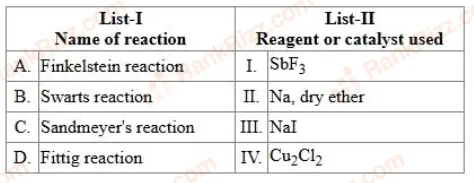
Choose the correct answer from the options given below :
A-I, B-IV, C-III, D-II
A-III, B-I, C-IV, D-II
A-IV, B-II, C-I, D-III
A-I, B-III, C-II, D-IV
Consider the metal complexes (A), (B) and (C). Choose the CORRECT option by considering the number of unpaired electrons present in (A), (B) and (C) respectively and the order of frequency of absorption
2, 2, 2 and (A) > (C) > (B)
0, 2, 0 and (A) > (C) > (B)
2, 2, 0 and (B) > (C) > (A)
2, 2, 2 and (C) > (A) > (B)
Match List - I with List - II.
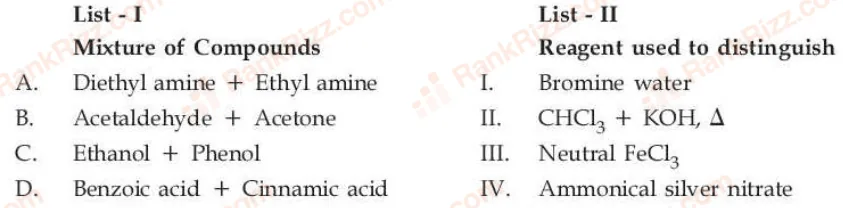
Choose the correct answer from the options given below :
A-IV, B-II, C-I, D-III
A-IV, B-II, C-III, D-I
A-II, B-IV, C-I, D-III
A-II, B-IV, C-III, D-I
5.33 g of CrCl·6HO, which is a 1 : 3 electrolyte, is dissolved in water and is passed through a cation exchanger. The chloride ions in the eluted solution, on treatment with AgNO results in 8.61 g of AgCl. The ratio of moles of complex reacted and moles of AgCl formed is __________ × 10. (Nearest integer) [Molar mass in g mol Cr : 52, Ag : 108, Cl : 35.5, H : 1, O : 16]
Given below are two statements :
Statement I : Among Zn, Mn, Sc and Cu, the energy required to remove the third valence electron is highest for Zn and lowest for Sc.
Statement II : The correct order of the following complexes in terms of CFSE is .
In the light of the above statements, choose the correct answer from the options given below:
Both Statement I and Statement II are true
Both Statement I and Statement II are false
Statement I is true but Statement II is false
Statement I is false but Statement II is true
Which of the following complexes will show coordination isomerism?
A.
B.
C.
D.
E.
Choose the correct answer from the options given below :
B, C and D Only
B, D and E Only
A, C and D Only
C, D and E Only
The correct statement among the followring is:
is diamagnetic and are paramagnetic.
are diamagnetic and is paramagnetic.
are diamagnetic and is paramagnetic.
are diamagnetic and is paramagnetic.
X is the number of geometrical isomers exhibited by .
Y is the number of optically inactive isomer(s) exhibited by
z is the number of geometrical isomers exhibited by .
The value of X + Y + Z is________.
The correct increasing o rd e r of spin-only magnetic moment values of the complex ions and is:
A = B < C < D
A = B < D < C
C = D < B < A
C < B < D < A
The numbei of isoelectronic species among is 'n'. If 'n' moles of AgCl is formed during the reaction of complex with formula with excess of solution, then the number of electrons present in the orbital of the complex is ________.
OTHER CHEMISTRY CHAPTERS