RankRizz
UNIQUE CONCEPTSFREE IN EARLY ACCESS

You don’t need 339 questions. You need 10 ideas.

Rotational Motion: JEE has set 339 questions there. They sit under 10 ideas. Revise every idea JEE has asked in a chapter, one past question per idea — and keep the other 329 one tap away.

Free while it’s in early access. It’ll be a paid feature later, so get in now. Or get new sheets by email ↓

Questions in the chapter

339

Rotational Motion · JEE Main + Advanced

Distinct ideas inside

10

one question each

Fewer questions to read

97%

every idea still on the sheet

HOW IT WORKS

From 339 questions to 10 ideas, in four steps.

JEE keeps asking the same ideas with new numbers. We do the sorting once, so you don’t have to solve your way through every repeat to find out.

1

Every PYQ in the chapter

All 339 Rotational Motion questions JEE ever set, in one pile.

2

Sorted by the idea it tests

Each question goes under the one idea it’s really asking about.

3

Repeats folded

Same idea, new numbers? Counted, not repeated. Nothing is thrown away.

4

One question per idea

10 ideas, most-asked first. Learn each once and you’ve covered the chapter.

One chapter, before and after.

Every question keeps its place. We just stop showing you the same idea again and again.

THE USUAL WAY

339 questions

78 of them test one idea — moment of inertia of standard bodies and composite systems. You find that out by solving them all.

UNIQUE CONCEPTS

10 questions

  1. 01Moment of inertia of standard bodies and composite systemsset 78×
  2. 02Rolling with friction, slipping and impulsive forcesset 77×
  3. 03Angular momentum of particles and rigid bodiesset 64×
  4. 04Torque and the rotational form of Newton's second lawset 46×
  5. 05Fixed-axis rotation: kinematics, rotational energy and pulleysset 26×
  6. 06Conservation of angular momentumset 15×
  7. 07Equilibrium of rigid bodies and topplingset 13×
  8. 08Parallel and perpendicular axis theoremsset 10×
  9. 09Rolling without slipping: kinematics and energyset 8×
  10. 10Collisions involving rigid bodiesset 2×

A LIVE SHEET · ROTATIONAL MOTION

This is what you get.

The first 2 of 10 ideas, straight from the sheet — the idea, how often it has been asked, and the last time the examiner set it. No answers printed.

01

Moment of inertia of standard bodies and composite systems

ASKED 78× · 2004–2026, 16 DIFFERENT YEARS · 72 MAIN, 6 ADVANCED

set 78×
JEE ADVANCED 2026 · PAPER 1MOST RECENTLY SET

List-I shows four planar structures made of uniform solid rods each of mass mm and length ll. In the List-II the possible moment of inertia of these structures about an axis OCO′OCO', which lies in the plane of the structures, are given. Choose the option that describes the correct match between the entries in List-I to those in List-II.
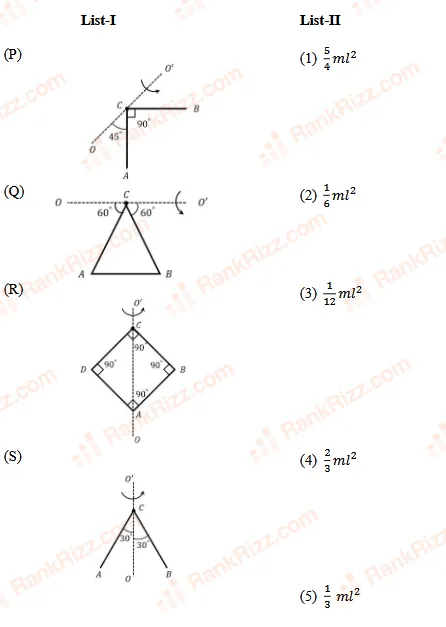
Figure for JEE Advanced 2026 Physics question on Moment of inertia of standard bodies and composite systems
  1. A

    (P)→\to(5), (Q)→\to(1), (R)→\to(4), (S)→\to(2)

  2. B

    (P)→\to(1), (Q)→\to(3), (R)→\to(4), (S)→\to(2)

  3. C

    (P)→\to(5), (Q)→\to(3), (R)→\to(2), (S)→\to(1)

  4. D

    (P)→\to(5), (Q)→\to(4), (R)→\to(2), (S)→\to(1)

02

Rolling with friction, slipping and impulsive forces

ASKED 77× · 2007–2026, 18 DIFFERENT YEARS · 45 MAIN, 32 ADVANCED

set 77×
JEE ADVANCED 2026 · PAPER 1MOST RECENTLY SET

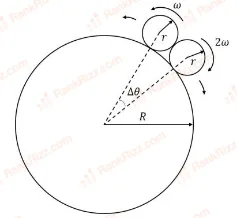
Consider a large disk of radius RR and two smaller disks, each of radius r=R/50r=R/50, lying on its circumference, as shown in the figure. The smaller disks are initially in contact with each other, with an angular separation Δθ\Delta\theta between their centers. They are made to roll without slipping in opposite directions, with constant angular velocities ω\omega and 2ω2\omega while the large disk is held stationary. The time τ\tau at which the smaller disks are again in contact is:

[Use sin⁡(Δθ)=Δθ\sin(\Delta\theta)=\Delta\theta and ignore gravity.]

Figure for JEE Advanced 2026 Physics question on Rolling with friction, slipping and impulsive forces
  1. A

    τ=51×(2π−451)/ω\tau=51\times\left(2\pi-\dfrac{4}{51}\right)/\omega

  2. B

    τ=51×(2π−251)/3ω\tau=51\times\left(2\pi-\dfrac{2}{51}\right)/3\omega

  3. C

    τ=51×(2π−451)/3ω\tau=51\times\left(2\pi-\dfrac{4}{51}\right)/3\omega

  4. D

    τ=51×(2π−251)/ω\tau=51\times\left(2\pi-\dfrac{2}{51}\right)/\omega

Open all 10 ideas →See the printable PDF

Every chapter, already done.

19,523 past questions from JEE Main and Advanced, sorted into 619 ideas across 97 chapters.

The fine print: how we decide what’s different.

01

Index

Every past question is filed under the topic it tests — the finest tag our bank holds today.

02

Fold

Copies of the same question are folded together — only where the match is unmistakable, and never across ideas.

03

Pick

The most recently set question represents each idea, because exam style drifts.

04

Rank

Ideas ordered by how often the examiner returns to them. Most asked first.

What this page will not claim

An idea here is one syllabus topic — the finest tag our past questions carry. A topic can hold more than one technique, so treat each question as the door into an idea, not the whole of it. We do not yet tag past questions concept by concept, so two different techniques inside one topic share one card for now. Folding is deliberately strict: of 19,606 past questions, we folded 83 duplicate copies of one twice-loaded sitting and marked 14 as the same question set again; when we built the rule we read every pair it folds. Everything else stays its own question, one tap away.

Who it’s for.

01

Revising in the last months

You have done the chapter once. You need to see every idea again, fast, without the thirty-question slog.

02

Finishing a chapter

Before you call a chapter done, check you have met every idea the examiner has asked in it — once each.

03

Teachers

A one-page revision handout per chapter, printed on A4 with the sitting on every question.

Questions, answered

Is Unique Concepts free?

Yes, right now. Unique Concepts is in early access, so every sheet and the printable PDF are free. It will become part of a paid plan later; sign up during early access and you get in first. An account also adds graded practice on every idea and your mistakes filed by idea.

How do you decide what counts as one idea?

An idea here is one syllabus topic — the finest tag our past questions carry. A topic can hold more than one technique, so treat each question as the door into an idea, not the whole of it. Inside a topic we fold only what is plainly the same question: 83 rows of one sitting that was loaded into our bank twice, and 14 questions the examiner set again at a later sitting. When we built the rule, we read every pair it folds.

Which question stands for an idea?

The most recently set one that we can show cleanly — a past question with its answer key confirmed. Exam style drifts, so the last time the examiner asked an idea is the best guide to how they will ask it next.

Are the answers on the sheet?

No. Each question links to its own page where you pick an answer and we check it. Where we hold a solution we are allowed to publish, it opens behind a “Show solution” button, never printed beside the question.

Is a sheet enough to finish a chapter?

It is a revision map, not a replacement. Do one question per idea; where you get one wrong, practise every past question on that idea — the link is on each card.

JEE Main or JEE Advanced?

Both. Every question carries its sitting, and the count on each idea says how many came from each exam.

Can I print a sheet?

Yes. Every sheet has a Download PDF button that opens an A4 version without the site around it — choose “Save as PDF” in the print dialog.

Free in early access. Get in now.

Every sheet and PDF is free while we’re in early access. Make an account to practise each idea and keep your mistakes, or just leave an address and we’ll send new sheets.

MAKE AN ACCOUNT

Practise every idea, graded

One tap from any idea to all its past questions, checked as you go. Wrong answers file themselves under the idea.

Get it free — sign up

NOT READY?

Get new sheets by email

A note when a chapter’s sheet changes or a new one is added. No account, no spam, one click to leave.