RankRizz

Electrostatics — JEE Main Previous Year Questions

Every Electrostatics question JEE Main has set from 2004–2026, grouped by the idea it tests rather than the order of the syllabus. 294 questions across 9 distinct ideas. Free to read, answer key on every one.

DATA UPDATED

Questions

294

Distinct ideas

9

Share of marks

6%

Difficulty

MEDIUM

The ideas inside Electrostatics

A chapter is not one subject — it is a handful of procedures the examiner reuses. These are the ones Electrostatics questions actually test.

Every Electrostatics question

281–294 OF 294 · NEWEST FIRST

JEE MAIN 2007Electric potential and potential energy

An electric charge 10−3μC10^{-3} \mu C is placed at the origin (0,0)(0, 0) of X−YX-Y co-ordinate system. Two points AA and BB are situated at (2,2)(\sqrt{2}, \sqrt{2}) and (2,0)(2, 0) respectively. The potential difference between the points AA and BB will be

  1. A

    9 volt

  2. B

    zero

  3. C

    2 volt

  4. D

    4.5 volt

JEE MAIN 2007Electric field due to point charges and superposition

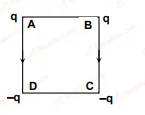
Charges are placed on the vertices of a square as shown. Let E⃗\vec{E} be the electric field and VV the potential at the centre. If the charges on AA and BB are interchanged with those on DD and CC respectively, thenFigure for JEE Main 2007 Physics question on Electric field due to point charges and superposition

  1. A

    E⃗\vec{E} remains unchanged, VV changes

  2. B

    Both E⃗\vec{E} and VV change

  3. C

    E⃗\vec{E} and VV remains unchanged

  4. D

    E⃗\vec{E} changes, VV remains unchanged

JEE MAIN 2007Relation between field and potential, equipotential surfaces

The potential at a point xx (measured in μm\mu m) due to some charges situated on the x-axis is given by V(x)=20/(x2−4)V(x) = 20/(x^2 - 4) Volts. The electric field EE at x=4μmx = 4 \mu m is given by

  1. A

    5/35/3 Volt/μm\mu m and in the −ve-ve xx direction

  2. B

    5/35/3 Volt/μm\mu m and in the +ve+ve xx direction.

  3. C

    10/910/9 Volt/μm\mu m and in the −ve-ve xx direction

  4. D

    10/910/9 Volt/μm\mu m and in the +ve+ve xx direction.

JEE MAIN 2007Electric charge and Coulomb's law

If gEg_E and gmg_m are the accelerations due to gravity on the surfaces of the earth and the moon respectively and if Millikan's oil drop experiment could be performed on the two surfaces, one will find the ratio electronic charge on the moonelectronic charge on the earth\frac{\text{electronic charge on the moon}}{\text{electronic charge on the earth}} to be

  1. A

    1

  2. B

    0

  3. C

    gE/gmg_E / g_m

  4. D

    gm/gEg_m / g_E

JEE MAIN 2006Electric dipole and dipole in external field

A electric dipole is placed at an angle of 30∘30^\circ to a non-uniform electric field. The dipole will experience

  1. A

    a torque only

  2. B

    a translational force only in the direction of the field

  3. C

    a translational force only in a direction normal to the direction of the field

  4. D

    a torque as well as a translational force

JEE MAIN 2006Motion and equilibrium of charged bodies in electric fields

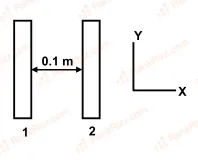
Two insulating plates are both uniformly charged in such a way that the potential difference between them is V2−V1=20 VV_2 - V_1 = 20\,V. (i.e. plate 2 is at a higher potential). The plates are separated by d=0.1 md = 0.1\,m and can be treated as infinitely large. An electron is released from rest on the inner surface of plate 1. What is its speed when it hits plate 2? (e=1.6×10⁻¹⁹ C,me=9.11×10⁻³¹ kg)(e = 1.6\times 10^{-19}\,C, m_e = 9.11\times 10^{-31}\,kg)Figure for JEE Main 2006 Physics question on Motion and equilibrium of charged bodies in electric fields

  1. A

    32×10−19 m/s32\times 10^{-19}\,m/s

  2. B

    2.65×10⁶ m/s2.65\times 10^{6}\,m/s

  3. C

    7.02×10¹² m/s7.02\times 10^{12}\,m/s

  4. D

    1.87×10⁶ m/s1.87\times 10^{6}\,m/s

JEE MAIN 2006Conductors, concentric shells and earthing

Two spherical conductors AA and BB of radii 1 mm1\,mm and 2 mm2\,mm are separated by a distance of 5 cm5\,cm and are uniformly charged. If the spheres are connected by a conducting wire then in equilibrium condition, the ratio of the magnitude of the electric fields at the surface of spheres AA and BB is

  1. A

    1 : 4

  2. B

    4 : 1

  3. C

    1 : 2

  4. D

    2 : 1

JEE MAIN 2005Motion and equilibrium of charged bodies in electric fields

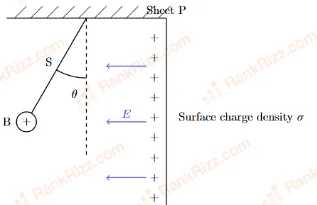
A charged ball BB hangs from a silk thread SS which makes an angle θ\theta with a large charged conducting sheet PP, as show in the figure. The surface charge density σ\sigma of the sheet is proportional to

Figure for JEE Main 2005 Physics question on Motion and equilibrium of charged bodies in electric fields
  1. A

    cos⁡θ\cos \theta

  2. B

    cot⁡θ\cot \theta

  3. C

    sin⁡θ\sin \theta

  4. D

    tan⁡θ\tan \theta

JEE MAIN 2005Electric field due to point charges and superposition

Two point charges +8q+8q and −2q-2q are located at x=0x = 0 and x=Lx = L respectively. The location of a point on the xx axis at which the net electric field due to these two point charges is zero is

  1. A

    2L2L

  2. B

    L/4L/4

  3. C

    8L8L

  4. D

    4L4L

JEE MAIN 2005Electric potential and potential energy

Two thin wires rings each having a radius RR are placed at a distance dd apart with their axes coinciding. The charges on the two rings are +q+q and −q-q. The potential difference between the centres of the two rings is

  1. A

    QR/4πε0d2QR/4\pi \varepsilon_0 d^2

  2. B

    Q2πε0[1R−1R2+d2]\frac{Q}{2\pi \varepsilon_0}\left[\frac{1}{R} - \frac{1}{\sqrt{R^2 + d^2}}\right]

  3. C

    zero

  4. D

    Q4πε0[1R−1R2+d2]\frac{Q}{4\pi \varepsilon_0}\left[\frac{1}{R} - \frac{1}{\sqrt{R^2 + d^2}}\right]

JEE MAIN 2004Electric charge and Coulomb's law

Two spherical conductor BB and CC having equal radii and carrying equal charges in them repel each other with a force FF when kept apart at some distance. A third spherical conductor having same radius as that of BB but uncharged brought in contact with BB, then brought in contact with CC and finally removed away from both. The new force of repulsion, between BB and CC is

  1. A

    F/4F/4

  2. B

    3F/43F/4

  3. C

    F/8F/8

  4. D

    3F/83F/8

JEE MAIN 2004Electric potential and potential energy

A charged particle qq is shot towards another charged particle QQ which is fixed, with a speed vv it approaches QQ upto a closest distance rr and then returns. If qq were given a speed 2v2v, the closest distances of approach would be

  1. A

    rr

  2. B

    2r2r

  3. C

    r/2r/2

  4. D

    r/4r/4

JEE MAIN 2004Electric charge and Coulomb's law

Four charges equal to −Q-Q are placed at the four corners of a square and a charge qq is at its centre. If the system is in equilibrium the value of qq is

  1. A

    −Q4(1+22)-\frac{Q}{4}(1 + 2\sqrt{2})

  2. B

    −Q2(1+22)-\frac{Q}{2}(1 + 2\sqrt{2})

  3. C

    Q4(1+22)\frac{Q}{4}(1 + 2\sqrt{2})

  4. D

    Q2(1+22)\frac{Q}{2}(1 + 2\sqrt{2})

JEE MAIN 2004Motion and equilibrium of charged bodies in electric fields

A charged oil drop is suspended in a uniform field of 3×1043 \times 10^4 V/m so that it neither falls nor rises. The charge on the drop will be (take the mass of the charge =9.9×10−15= 9.9 \times 10^{-15} kg and g=10 m/s2g = 10 \text{ m/s}^2)

  1. A

    3.3×10−183.3 \times 10^{-18} C

  2. B

    3.2×10−183.2 \times 10^{-18} C

  3. C

    1.6×10−181.6 \times 10^{-18} C

  4. D

    4.8×10−184.8 \times 10^{-18} C