JEE MAIN 2024 · 09 APR S1Electric potential and potential energy
At the centre of a half ring of radius cm and linear charge density nCm, the potential is V. The value of is _______
Every Electrostatics question JEE Main has set from 2004–2026, grouped by the idea it tests rather than the order of the syllabus. 294 questions across 9 distinct ideas. Free to read, answer key on every one.
DATA UPDATED
Questions
294
Distinct ideas
9
Share of marks
6%
Difficulty
MEDIUM
A chapter is not one subject — it is a handful of procedures the examiner reuses. These are the ones Electrostatics questions actually test.
61–80 OF 294 · NEWEST FIRST
At the centre of a half ring of radius cm and linear charge density nCm, the potential is V. The value of is _______
Five charges and are situated as shown in the figure.
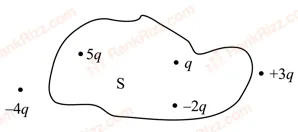
The electric flux due to this configuration through the surface is :
An electric field exists in space. A cube of side is placed in the space as per figure given below.
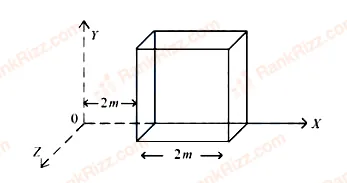
The electric flux through the cube is ______ .
Two charged conducting spheres of radii and are connected to each other by a conducting wire. The ratio of charges of the two spheres respectively is:
An electric field, passes through the surface of area having unit vector . The electric flux for that surface is ______ Vm.
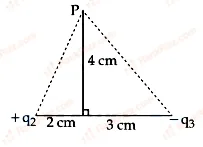
If the net electric field at point P along Y axis is zero, then the ratio of is , where _____
is the uniform surface charge density of a thin spherical shell of radius . The electric field at any point on the surface of the spherical shell is :
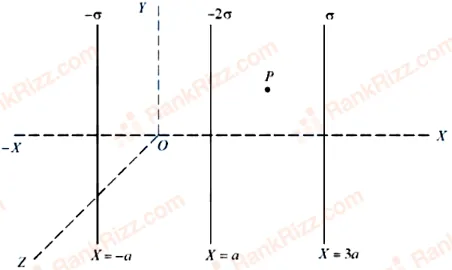
Three infinitely long charged thin sheets are placed as shown in the figure. The magnitude of electric field at point is . The value of is _______ (all quantities are measured in SI units).
Two identical conducting spheres and with charge on each, repel each other with a force . A third identical uncharged conducting sphere is successively brought in contact with the two spheres. The new force of repulsion between and is :
In hydrogen like system the ratio of coulombian force and gravitational force between an electron and a proton is in the order of :
The vehicles carrying inflammable fluids usually have metallic chains touching the ground :
To protect tyres from catching dirt from ground
To alert other vehicles
It is a custom
To conduct excess charge due to air friction to ground and prevent sparking
The electric field at point due to an electric dipole is . The electric field at point on equitorial line will be . The value of
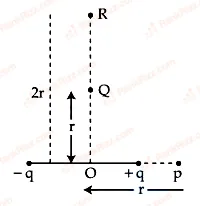
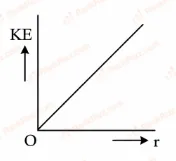
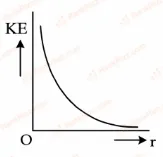
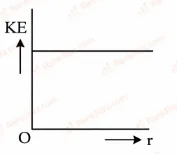
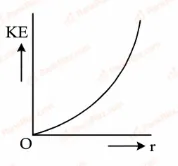
An infinitely long positively charged straight thread has a linear charge density . An electron revolves along a circular path having axis along the length of the wire. The graph that correctly represents the variation of the kinetic energy of electron as a function of radius of circular path from the wire is:
An infinite plane sheet of charge having uniform surface charge density is placed on x−y plane. Another infinitely long line charge having uniform linear charge density is placed at z = 4 m plane and parallel to y-axis. If the magnitude values , then at point (0, 0, 2), the ratio of magnitudes of electric field values due to sheet charge to that of line charge is . The value of n is _____.
A charge is placed at the center of one of the surface of a cube. The flux linked with the cube is:
Zero
Two identical charged spheres are suspended by strings of equal lengths. The strings make an angle with each other. When suspended in water the angle remains the same. If density of the material of the sphere is g/cc, the dielectric constant of water will be ______. (Take density of water g/cc)
and are two hollow concentric cubes enclosing charges and respectively as shown in figure. The ratio of electric flux passing through and is
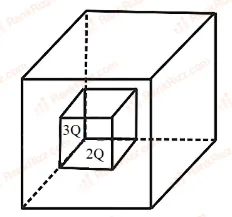
2 : 5
5 : 2
2 : 3
3 : 2
Suppose a uniformly charged wall provides a uniform electric field of normally. A charged particle of mass 2 g being suspended through a silk thread of length 20 cm and remain stayed at a distance of 10 cm from the wall. Then the charge on the particle will be where = ______ [use ]
Two charges and are separated by a distance '' in air. At a distance from charge , the resultant electric field is zero. The value of is :
Force between two point charges and placed in vacuum at cm apart is . Force between them when placed in a medium having dielectric at cm apart will be:
JEE Advanced has set 61 Electrostatics questions too. Electrostatics JEE Advanced PYQs →
OTHER PHYSICS CHAPTERS