RankRizz

Electrostatics — JEE Main Previous Year Questions

Every Electrostatics question JEE Main has set from 2004–2026, grouped by the idea it tests rather than the order of the syllabus. 294 questions across 9 distinct ideas. Free to read, answer key on every one.

DATA UPDATED

Questions

294

Distinct ideas

9

Share of marks

6%

Difficulty

MEDIUM

The ideas inside Electrostatics

A chapter is not one subject — it is a handful of procedures the examiner reuses. These are the ones Electrostatics questions actually test.

Every Electrostatics question

221–240 OF 294 · NEWEST FIRST

JEE MAIN 2019 · 11 JAN S1Electric potential and potential energy

The given graph shows variation (with distance r from centre) of:
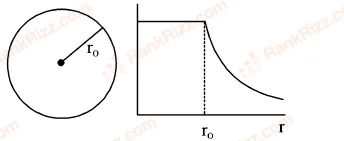
Figure for JEE Main 2019 Physics question on Electric potential and potential energy
  1. A

    Electric field of a uniformly charged sphere

  2. B

    Potential of a uniformly charged spherical shell
  3. C

    Potential of a uniformly charged sphere

  4. D

    Electric field of a uniformly charged spherical shell
JEE MAIN 2019 · 11 JAN S1Electric potential and potential energy

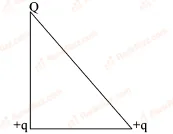
Three charges QQ, +q+q and +q+q are placed at the vertices of a right-angle isosceles triangle as shown below. The net electrostatic energy of the configuration is zero, if the value of Q is:

Figure for JEE Main 2019 Physics question on Electric potential and potential energy
  1. A

    +q+q

  2. B

    −2q2+1\frac{-\sqrt{2}q}{\sqrt{2}+1}

  3. C

    −q1+2\frac{-q}{1+\sqrt{2}}

  4. D

    −2q-2q

JEE MAIN 2019 · 11 JAN S2Electric dipole and dipole in external field

An electric field of 1000 V/m is applied to an electric dipole at angle of 45°45°. The value of electric dipole moment is 10−2910^{-29} C.m. What is the potential energy of the electric dipole?

  1. A

    −20×10−18-20 \times 10^{-18} J

  2. B

    −7×10⁻²⁷-7 \times 10^{-27} J

  3. C

    −10×10−29-10 \times 10^{-29} J

  4. D

    −9×10⁻²⁰-9 \times 10^{-20} J

JEE MAIN 2019 · 10 JAN S1Electric dipole and dipole in external field

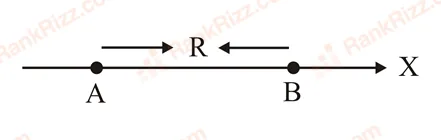
Two electric dipoles, A, B with respective dipole moments dA⃗=−4qai^\vec{d_A} = -4qa\hat{i} and dB⃗=−2qai^\vec{d_B} = -2qa\hat{i} are placed on the xx-axis with a separation RR, as shown in the figure.

Figure for JEE Main 2019 Physics question on Electric dipole and dipole in external field


The distance from A at which both of them produce the same potential is:

  1. A

    R2−1\frac{R}{\sqrt{2}-1}

  2. B

    2R2−1\frac{\sqrt{2}R}{\sqrt{2}-1}

  3. C

    2R2+1\frac{\sqrt{2}R}{\sqrt{2}+1}

  4. D

    R2+1\frac{R}{\sqrt{2}+1}

JEE MAIN 2019 · 10 JAN S1Electric potential and potential energy

A charge QQ is distributed over three concentric spherical shells of radii aa, bb, cc (a<b<ca < b < c) such that their surface charge densities are equal to one another. The total potential at a point at distance rr from their common centre, where r<ar < a, would be:

  1. A

    Q4πε0(a+b+c)\frac{Q}{4\pi\varepsilon_0(a+b+c)}

  2. B

    Q(a2+b2+c2)4πε0(a3+b3+c3)\frac{Q(a^2+b^2+c^2)}{4\pi\varepsilon_0(a^3+b^3+c^3)}

  3. C

    Q12πε0⋅ab+bc+caabc\frac{Q}{12\pi\varepsilon_0} \cdot \frac{ab+bc+ca}{abc}

  4. D

    Q(a+b+c)4πε0(a2+b2+c2)\frac{Q(a+b+c)}{4\pi\varepsilon_0(a^2+b^2+c^2)}

JEE MAIN 2019 · 10 JAN S2Electric dipole and dipole in external field

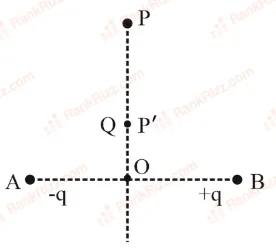
Charges −q-q and +q+q, located at A and B, respectively, constitute an electric dipole. Distance AB=2aAB = 2a, OO is the mid point of the dipole and OPOP is perpendicular to ABAB. A charge QQ is placed at P where OP=yOP = y and y≫2ay \gg 2a. The charge QQ experiences an electrostatic force FF. If QQ is now moved along the equatorial line to P' such that OP′=y3OP' = \frac{y}{3}, the force on QQ will be close to (y3≪2a\frac{y}{3} \ll 2a):

Figure for JEE Main 2019 Physics question on Electric dipole and dipole in external field
  1. A

    27F

  2. B

    F3\frac{F}{3}

  3. C

    3F

  4. D

    9F

JEE MAIN 2019 · 10 JAN S2Electric potential and potential energy

Four equal point charges QQ each are placed in the xyxy plane at (0,2)(0, 2), (4,2)(4, 2), (4,−2)(4, -2) and (0,−2)(0, -2). The work required to put a fifth charge QQ at the origin of the coordinate system will be:

  1. A

    Q24πε0\frac{Q^2}{4\pi\varepsilon_0}

  2. B

    Q222πε0\frac{Q^2}{2\sqrt{2}\pi\varepsilon_0}

  3. C

    Q24πε0(1+15)\frac{Q^2}{4\pi\varepsilon_0}\left(1 + \frac{1}{\sqrt{5}}\right)

  4. D

    Q24πε0(1+13)\frac{Q^2}{4\pi\varepsilon_0}\left(1 + \frac{1}{\sqrt{3}}\right)

JEE MAIN 2019 · 09 JAN S1Electric charge and Coulomb's law

Three charges +Q+Q, qq, +Q+Q are placed respectively, at distance, 00, d/2d/2 and dd from the origin, on the xx-axis. If the net force experienced by +Q+Q, placed at x=0x = 0, is zero, then value of qq is:

  1. A

    +Q/2+Q/2

  2. B

    +Q/4+Q/4

  3. C

    −Q/4-Q/4

  4. D

    −Q/2-Q/2

JEE MAIN 2019 · 09 JAN S1Electric field of continuous charge distributions

For a uniformly charged ring of radius RR, the electric field on its axis has the largest magnitude at a distance hh from its centre. Then value of hh is:

  1. A

    R2\frac{R}{\sqrt{2}}

  2. B

    R5\frac{R}{\sqrt{5}}

  3. C

    R2R\sqrt{2}

  4. D

    RR

JEE MAIN 2019 · 09 JAN S2Electric charge and Coulomb's law

Charge is distributed within a sphere of radius RR with a volume charge density ρ(r)=Ar2e−2ra\rho(r) = \frac{A}{r^2}e^{-\frac{2r}{a}}, where AA and aa are constants. If QQ is the total charge of this charge distribution, the radius RR is:

  1. A

    a2log⁡(11−Q2πaA)\frac{a}{2}\log\left(\frac{1}{1 - \frac{Q}{2\pi aA}}\right)

  2. B

    alog⁡(11−Q2πaA)a \log\left(\frac{1}{1 - \frac{Q}{2\pi aA}}\right)

  3. C

    alog⁡(1−Q2πaA)a \log\left(1 - \frac{Q}{2\pi aA}\right)

  4. D

    a2log⁡(1−Q2πaA)\frac{a}{2}\log\left(1 - \frac{Q}{2\pi aA}\right)

JEE MAIN 2019 · 09 JAN S2Electric field of continuous charge distributions

Two point charges q1(10q_1(\sqrt{10} μ\muC) and q2(−25q_2(-25 μ\muC) are placed on the xx-axis at x=1x = 1 m and x=4x = 4 m respectively. The electric field (in V/m) at a point y=3y = 3 m on yy-axis is, [Take 14πε0=9×10⁹\frac{1}{4\pi\varepsilon_0} = 9 \times 10^9 N m2^2C−2^{-2}]

  1. A

    (−81i^+81j^)×102(-81\hat{i} + 81\hat{j}) \times 10^2

  2. B

    (81i^−81j^)×102(81\hat{i} - 81\hat{j}) \times 10^2

  3. C

    (−63i^+27j^)×102(-63\hat{i} + 27\hat{j}) \times 10^2

  4. D

    (63i^−27j^)×102(63\hat{i} - 27\hat{j}) \times 10^2

JEE MAIN 2018 · 16 APR ONLINEElectric charge and Coulomb's law

Two identical conducting spheres A and B carry an equal charge. They are separated by a distance much larger than their diameters, and the force between them is F. A third identical conducting sphere, C, is uncharged. Sphere C is first touched to A, then to B, and then removed. As a result, force between A and B would be equal to:

  1. A

    3F4\frac{3F}{4}

  2. B

    F2\frac{F}{2}

  3. C

    3F8\frac{3F}{8}

  4. D

    F

JEE MAIN 2018 · 15 APR S1Motion and equilibrium of charged bodies in electric fields

A body of mass M and charge q is connected to a spring of spring constant k. It is oscillating along x-direction about its equilibrium position, taken to be at x = 0, with an amplitude A. An electric field E is applied along the x-direction. Which of the following statements is correct?

  1. A

    The total energy of the system is 12mω2A2+12q2E2k\frac{1}{2}m\omega^2A^2 + \frac{1}{2}\frac{q^2E^2}{k}

  2. B

    The new equilibrium position is at a distance 2qEk\frac{2qE}{k} from x = 0

  3. C

    The new equilibrium position is at a distance qE2k\frac{qE}{2k} from x = 0

  4. D

    The total energy of the system is 12mω2A2−12q2E2k\frac{1}{2}m\omega^2A^2 - \frac{1}{2}\frac{q^2E^2}{k}

JEE MAIN 2018 · 15 APR S1Electric flux and Gauss's law

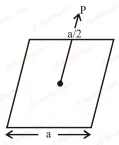
A charge Q is placed at a distance a/2 above the centre of the square surface of edge a as shown in the figure. The electric flux through the square surface is:
Figure for JEE Main 2018 Physics question on Electric flux and Gauss's law

  1. A

    Q3ε0\frac{Q}{3\varepsilon_0}

  2. B

    Q6ε0\frac{Q}{6\varepsilon_0}

  3. C

    Q2ε0\frac{Q}{2\varepsilon_0}

  4. D

    Qε0\frac{Q}{\varepsilon_0}

JEE MAIN 2018 · 15 APR S2Electric field of continuous charge distributions

A solid ball of radius R has a charge density ρ\rho given by ρ=ρ0(1−rR)\rho = \rho_0\left(1 - \frac{r}{R}\right) for 0≤r≤R0 \leq r \leq R. The electric field outside the ball is:

  1. A

    ρ0R3ε0r2\frac{\rho_0 R^3}{\varepsilon_0 r^2}

  2. B

    4ρ0R33ε0r2\frac{4\rho_0 R^3}{3\varepsilon_0 r^2}

  3. C

    3ρ0R34ε0r2\frac{3\rho_0 R^3}{4\varepsilon_0 r^2}

  4. D

    ρ0R312ε0r2\frac{\rho_0 R^3}{12\varepsilon_0 r^2}

JEE MAIN 2018 · 08 APR OFFLINEConductors, concentric shells and earthing

Three concentric metal shells A, B and C of respective radii a, b and c (a < b < c) have surface charge densities +σ+\sigma, −σ-\sigma and +σ+\sigma respectively. The potential of shell B is:

  1. A

    σε0[b2−c2c+a]\frac{\sigma}{\varepsilon_0}\left[\frac{b^2 - c^2}{c} + a\right]

  2. B

    σε0[a2−b2a+c]\frac{\sigma}{\varepsilon_0}\left[\frac{a^2 - b^2}{a} + c\right]

  3. C

    σε0[a2−b2b+c]\frac{\sigma}{\varepsilon_0}\left[\frac{a^2 - b^2}{b} + c\right]

  4. D

    σε0[b2−c2b+a]\frac{\sigma}{\varepsilon_0}\left[\frac{b^2 - c^2}{b} + a\right]

JEE MAIN 2017 · 09 APR ONLINEElectric flux and Gauss's law

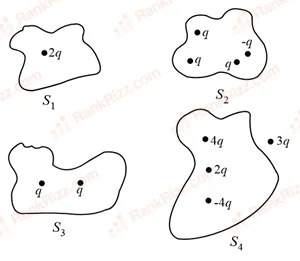
Four closed surfaces and corresponding charge distributions are shown below.

Figure for JEE Main 2017 Physics question on Electric flux and Gauss's law

Let the respective electric fluxes through the surfaces be ϕ1\phi_1, ϕ2\phi_2, ϕ3\phi_3 and ϕ4\phi_4. Then:

  1. A

    ϕ1>ϕ2>ϕ3>ϕ4\phi_1 > \phi_2 > \phi_3 > \phi_4

  2. B

    ϕ1<ϕ2=ϕ3>ϕ4\phi_1 < \phi_2 = \phi_3 > \phi_4

  3. C

    ϕ1>ϕ3\phi_1 > \phi_3; ϕ2<ϕ4\phi_2 < \phi_4

  4. D

    ϕ1=ϕ2=ϕ3=ϕ4\phi_1 = \phi_2 = \phi_3 = \phi_4

JEE MAIN 2017 · 08 APR ONLINEElectric potential and potential energy

There is a uniform electrostatic field in a region. The potential at various points on a small sphere centred at PP, in the region, is found to vary between the limits 589.0 V to 589.8 V. What is the potential at a point on the sphere whose radius vector makes an angle of 60° with the direction of the field?

  1. A

    589.4 V

  2. B

    589.5 V

  3. C

    589.2 V

  4. D

    589.6 V

JEE MAIN 2017 · 02 APR OFFLINEElectric dipole and dipole in external field

An electric dipole has fixed dipole moment p⃗\vec{p}, which makes angle θ\theta with respect to xx-axis. When subjected to an electric field E⃗1=Ei^\vec{E}_{1} = E\hat{i}, it experiences a torque T⃗1=τk^\vec{T}_{1} = \tau\hat{k}. When subjected to another electric field E⃗2=3E1j^\vec{E}_{2} = \sqrt{3}E_{1}\hat{j}, it experiences a torque T⃗2=−T⃗1\vec{T}_{2} = -\vec{T}_{1}. The angle θ\theta is:

  1. A

    90°

  2. B

    30°

  3. C

    45°

  4. D

    60°

JEE MAIN 2016 · 10 APR ONLINERelation between field and potential, equipotential surfaces

Within a spherical charge distribution of charge density ρ(r)\rho(r), N equipotential surfaces of potential V0V_0, V0+ΔVV_0 + \Delta V, V0+2ΔVV_0 + 2\Delta V, ... V0+NΔVV_0 + N\Delta V (ΔV>0)(\Delta V > 0), are drawn and have increasing radii r0r_0, r1r_1, r2r_2, ... rNr_N, respectively. If the difference in the radii of the surfaces is constant for all values of V0V_0 and ΔV\Delta V then:

  1. A

    ρ(r)=\rho(r) = constant

  2. B

    ρ(r)∝1r2\rho(r) \propto \frac{1}{r^2}

  3. C

    ρ(r)∝1r\rho(r) \propto \frac{1}{r}

  4. D

    ρ(r)∝r\rho(r) \propto r