A new unit () of length is chosen such that it is equal to the speed of light in vacuum. What is the distance between Venus and Earth in terms of units if light takes 6 min. 40 s to cover this distance?
- A
- B
- C
- D
Units, Dimensions & Errors has been asked in 20 of the 23 JEE Main years from 2004 to 2026: 223 questions in all. In 2026 it averaged 1.4 questions per paper (26 across 19 papers), 5.5% of Physics questions, down from 6.1% in 2025. Across the last 20 papers it carried 5.4% of Physics marks. By type: 207 MCQs and 16 numerical-answer questions. Of the 206 with a difficulty tag, 57% are easy, 42% medium and 0% hard. Most asked: Dimensional analysis: deriving and checking relations (108, 48%), Errors in measurement and significant figures (75, 34%) and Units: SI system, unit conversion and new systems of units (20, 9%).
DATA UPDATED
Questions
223
Distinct ideas
4
Share of marks
5.4%
Difficulty
EASY
The share of each year’s Physics questions that came from Units, Dimensions & Errors, counted from the 168 papers we hold for the last 10 years, and session by session inside a year.
Rising: 5.3% of Physics questions in 2024–2026, up from 3.5% in 2017–2023. Its heaviest year was 2025, at 6.1%.
| YEAR | QS | PER PAPER | SHARE OF PHYSICS | CHANGE | |
|---|---|---|---|---|---|
| 2026 | 26 / 475 | 1.4 | 5.5% | −0.6 pts | JAN 5.2%APR 5.8% |
| 2025 | 29 / 475 | 1.5 | 6.1% | +1.6 pts | JAN 6.4%APR 5.8% |
| 2024 | 27 / 600 | 1.4 | 4.5% | +1.2 pts | JAN 4.3%APR 4.7% |
| 2023 | 25 / 750 | 1.0 | 3.3% | −0.3 pts | JAN 3.3%APR 3.3% |
| 2022 | 24 / 660 | 1.1 | 3.6% | −0.3 pts | JUN 3.6%JUL 3.7% |
| 2021 | 28 / 720 | 1.2 | 3.9% | +0.4 pts | FEB 3.3%MAR 2.7%JUL 2.9%AUG 6.2% |
| 2020 | 14 / 400 | 0.9 | 3.5% | +0.8 pts | JAN 3.3%SEP 3.6% |
| 2019 | 13 / 480 | 0.8 | 2.7% | −1.5 pts | JAN 2.5%APR 2.9% |
| 2018 | 5 / 120 | 1.3 | 4.2% | +0.9 pts | 4 PAPERS, ONE SESSION |
| 2017 | 3 / 90 | 1.0 | 3.3% | — | 3 PAPERS, ONE SESSION |
“QS” is Units, Dimensions & Errors questions out of all Physics questions that year; “per paper” is that count over the year’s papers, and “change” is the share against the year before. A year with more sittings asks more questions, which is why the share, not the count, is the number to compare.
How Units, Dimensions & Errors compares: every Physics chapter by weightage · most repeated JEE Main topics
A chapter is not one subject — it is a handful of procedures the examiner reuses. These are the ones Units, Dimensions & Errors questions actually test.
Every JEE Main Units, Dimensions & Errors question we hold, newest first inside each topic. Open one for its options, answer key and solution.
FREE PDF
All 223 questions on A4, by topic, with the answer key at the end. No sign-up, no email: your browser saves it as a PDF.
Download free PDFUNIQUE CONCEPTS
4 ideas, each with the latest past question that tested it, drawn from 252 JEE Main and Advanced questions.
Units, Dimensions & Errors Unique Concepts sheet →JEE ADVANCED
JEE Advanced has set 29 Units, Dimensions & Errors questions, 2007–2026.
Units, Dimensions & Errors JEE Advanced PYQs →Not every year. It has been asked in 20 of the 23 JEE Main years from 2004 to 2026; the years without a Units, Dimensions & Errors question were 2007, 2009 and 2011.
Dimensional analysis: deriving and checking relations: 108 of the 223 questions (48%). Next come Errors in measurement and significant figures (75) and Units: SI system, unit conversion and new systems of units (20).
About 5.4% across the last 20 papers. Every JEE Main question carries the same marks, so that is also its share of Physics questions. In 2026 it was 5.5% (26 of 475 Physics questions).
In JEE Main 08 Apr 2026, Shift 2, the latest sitting with a Units, Dimensions & Errors question.
223 from 2004 to 2026, across 4 topics. Every one is listed on this page by topic and links to its own page, with the answer key and solution wherever we have them. Free, no sign-up.
1–20 OF 223 · NEWEST FIRST
A new unit () of length is chosen such that it is equal to the speed of light in vacuum. What is the distance between Venus and Earth in terms of units if light takes 6 min. 40 s to cover this distance?
Consider the equation
Where = magnetic field Intensity ; = electric field, = permittivity, = distance, = time. The values of and respectively are :
1, 1, 1, 1
The density of a uniform cylinder is determined by measuring its mass , length and diameter . The measured values of , and are 97.42 0.02 g, 8.35 0.05 mm and 20.20 0.02 mm, respectively. Calculated percentage fractional error in is _______.
0.63%
0.82%
0.72%
0.25%
The potential energy of a particle changes with distance from a fixed origin as , where and are constants with appropriate dimensions. The dimensions of are _______.
The percentage error in the calculated volume of a sphere, if there is 2% error in its diameter measurement, is __________.
1
2
6
8
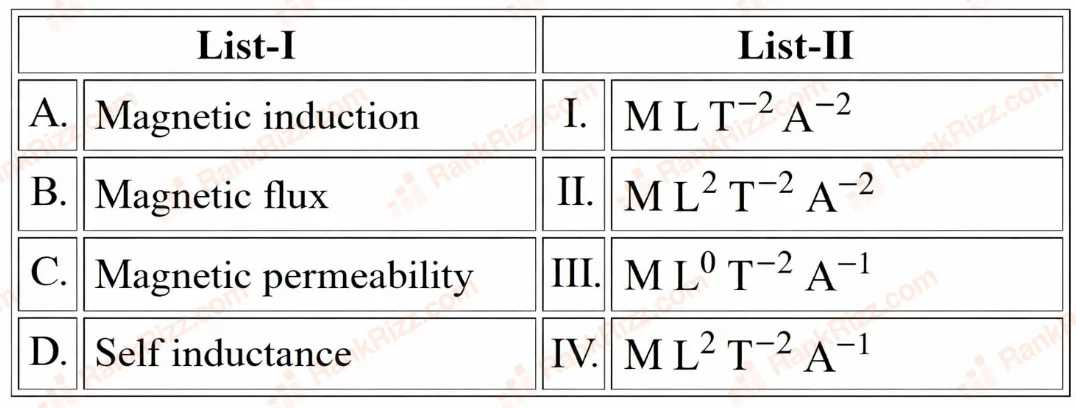
Match List - I with List - II.
Choose the correct answer from the options given below :
A-I, B-II, C-III, D-IV
A-IV, B-III, C-II, D-I
A-III, B-IV, C-II, D-I
A-II, B-I, C-IV, D-III
, and represents physical quantities inductance, capacitance and resistance respectively. The dimensional formula corresponds to _______.
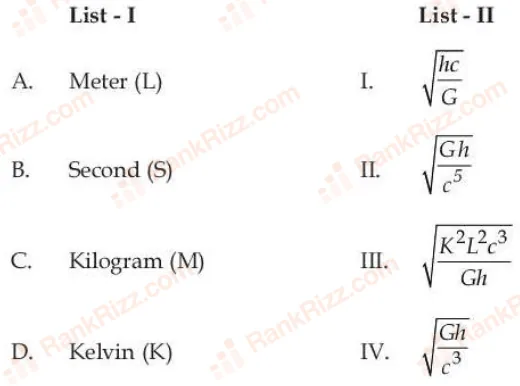
Match the List I With List II:
Where (Plank's constant), G(gravitational constant) and c (speed of light in vacuum) as fundamental units.
Choose the correct answer from the options given below:
A-II, B-IV, C-I, D-III
A-IV, B-II, C-I, D-III
A-IV, B-I, C-II, D-III
A-III, B-I, C-II, D-IV
In an experiment to determine the resistance of a given wire using Ohm’s law, the voltmeter and ammeter readings are noted as and , respectively. The least counts of voltmeter and ammeter are and , respectively. The estimated error in the resistance measurement is_______Ω.
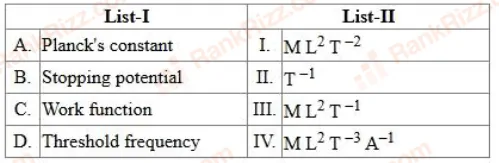
Match the List-I with List II
Choose the correct answer from the options given below:
A-III, B-IV, C-I, D-II
A-I, B-II, C-III, D-IV
A-IV, B-III, C-I, D-II
A-I, B-IV, C-III, D-II
The dimensional formula of ( = permittivity of vacuum and E = electric field) is . The value of = __________.
The diameter of a wire measured by a screw gauge of least count 0.001 cm is 0.08 cm. The length measured by a scale of least count 0.1 cm is 150 cm. When a weight of 100 N is applied to the wire, the extension in length is 0.5 cm, measured by a micrometer of least count 0.001 cm. The error in the measured Young's modulus is N/m. The value of is __________ . (Ignore the contribution of the load to Young's modulus error calculation)
Dimensions of universal gravitational constant in terms of Planck's constant , distance , mass and time are :
The speed of a longitudinal wave in a metallic bar is 400 m/s. If the density and Young's modulus of the bar material are increased by 0.5% and 1 %, respectively then the speed of the wave is changed approximately to m/ s.
402
399
401
398
The time period of a simple harmonic oscillator is . Measured value of mass (m) of the object is 10 g with an accuracy of 10 mg and time for 50 oscillations of the spring is found to be 60 s using a watch of 2 s resolution. Percentage error in determination of spring constant (k) is________%.
3.35
3.43
7.60
6.76
Matd1 List - I with List - II.
List - I List - II
A. Coefficient of viscosity I.
B. Surface tension II.
C. Pressure III.
D. Surface energy IV.
Choose the correct answer from the options given below:
A-I, B-III, C-II, D-IV
A-IV, B-I, C-II, D-III
A-IV, B-III, C-I, D-II
A-I, B-II, C-IV, D-III
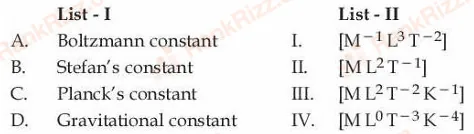
Match the LIST-I with LIST-II
Choose the correct answer from the options given below:
A-IV, B-III, C-I, D-II
A-III, B-IV, C-I, D-II
A-III, B-IV, C-II, D-I
A-I, B-III, C-IV, D-II
Four persons measure the length of a rod as 20.00 cm, 19.75 cm, 17.01 cm and 18.25cm. The relative error in the measurement of average length of the rod is :
0.24
0.18
0.08
0.06
To compare EMF of two cells using potentiometer the balancing lengths obtained are 200 cm and 150 cm. The least count of scale is 1 cm. The percentage error in the ratio of EMFs is______
1.55
1.75
1.65
1.17
A ball of radius r and density dropped through a viscous liquid of density and viscosity attains its terminal velocity at time t, given by , where A is a constant and a, b, c and d are integers. The value of is _________.
OTHER PHYSICS CHAPTERS