JEE MAIN 2023 · 11 APR S2Electric flux and Gauss's law
A capacitor of capacitance is charged to a potential . The flux of the electric field through a closed surface enclosing the positive plate of the capacitor is:
- A
- B
Zero
- C
- D
Every Electrostatics question JEE Main has set from 2004–2026, grouped by the idea it tests rather than the order of the syllabus. 294 questions across 9 distinct ideas. Free to read, answer key on every one.
DATA UPDATED
Questions
294
Distinct ideas
9
Share of marks
6%
Difficulty
MEDIUM
A chapter is not one subject — it is a handful of procedures the examiner reuses. These are the ones Electrostatics questions actually test.
101–120 OF 294 · NEWEST FIRST
A capacitor of capacitance is charged to a potential . The flux of the electric field through a closed surface enclosing the positive plate of the capacitor is:
Zero
Three concentric spherical metallic shells , and of radius , and respectively have surface charge densities , and , respectively. The shells and are at same potential. If the radii of & are 2 cm and 3 cm, respectively. The radius of shell Z is _______ cm.
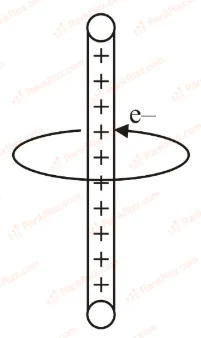
An electron revolves around an infinite cylindrical wire having uniform linear charge density C m in circular path under the influence of attractive electrostatic field as shown in the figure. The velocity of electron with which it is revolving is _______ m s. Given mass of electron kg
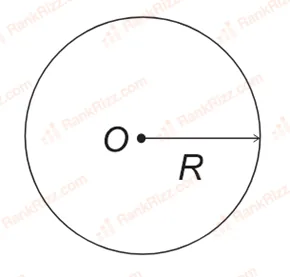
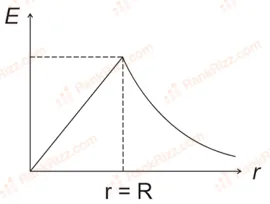
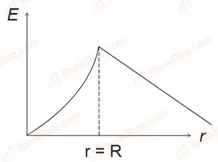
Graphical variation of electric field due to a uniformly charged insulating solid sphere of radius R, with distance r from the centre O is represented by:
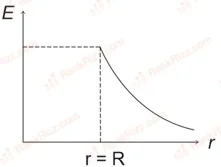
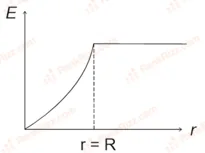
An electric dipole of dipole moment is C m placed in a uniform electric field of N C in such a way that dipole moment is along electric field. The work done in rotating dipole by 180° in this field will be ______ mJ.
Electric potential at a point due to a point charge of C is 50 V. The distance of from the point charge is:
(Assume, N m C)
9 cm
3 cm
0.9 cm
90 cm
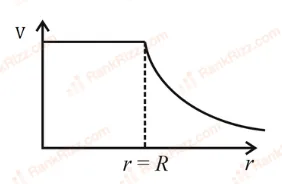
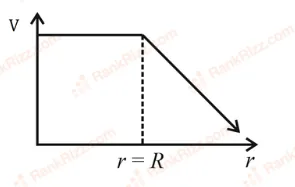
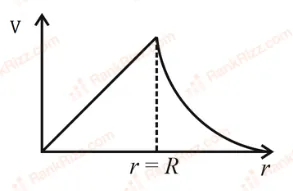
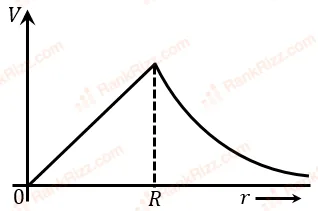
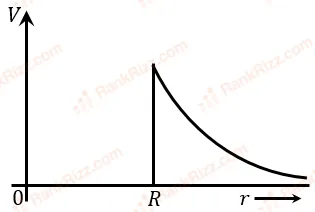
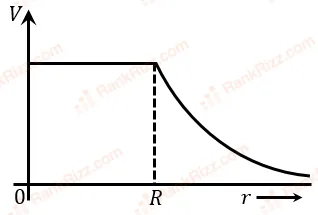
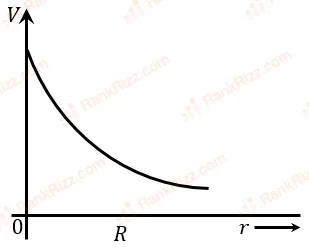
For a uniformly charged thin spherical shell, the electric potential radially away from the centre of shell can be graphically represented as
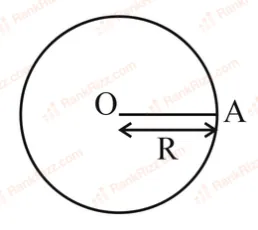
(1)
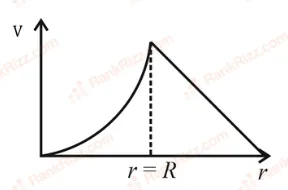
(2)
(3)
(4)
Graph (1)
Graph (2)
Graph (3)
Graph (4)
A dipole comprises of two charged particles of identical magnitude and opposite in nature. The mass of the positive charged particle is half of the mass of the negative charged particle. The two charges are separated by a distance . If the dipole is placed in a uniform electric field , in such a way that dipole axis makes a very small angle with the electric field, . The angular frequency of the oscillations of the dipole when released is given by:
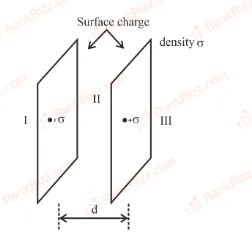
Let be the uniform surface charge density of two infinite thin plane sheets as shown in the figure. Then the electric fields in three different regions, , and are:
Two equal positive point charges are separated by a distance . The distance of a point from the centre of the line joining two charges on the equatorial line (perpendicular bisector) at which force experienced by a test charge becomes maximum is . The value of is _____.
A cubical volume is bounded by the surfaces , , , , , . The electric field in the region is given by . Where NC m. If cm, the charge contained in the cubical volume is C. The value of is ______. (Take C Nm)
Which of the following correctly represents the variation of electric potential of a charged spherical conductor of radius with radial distance from the centre?
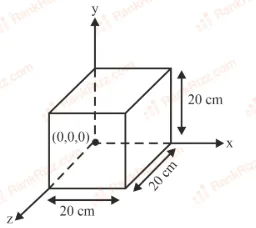
Expression for an electric field is given by V m. The electric flux through the cube of side 20 cm when placed in electric field (as shown in the figure) is ______ V cm.
Considering a group of positive charges, which of the following statements is correct?
Net potential of the system cannot be zero at a point but net electric field can be zero at that point
Net potential of the system at a point can be zero but net electric field can't be zero at that point
Both the net potential and the net field can be zero at a point
Both the net potential and the net electric field cannot be zero at a point
Two isolated metallic solid spheres of radii and are charged such that both have same charge density . The spheres are then connected by a thin conducting wire. If the new charge density of the bigger sphere is . The ratio is:
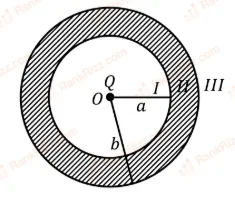
As shown in the figure, a point charge is placed at the centre of conducting spherical shell of inner radius and outer radius . The electric field in three different regions I, II and III is given by:
(I: , II: , III: )
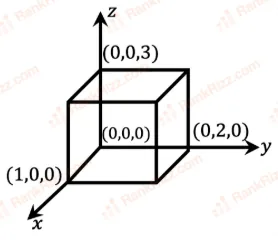
As shown in figure, a cuboid lies in a region with electric field N C. The magnitude of charge within the cuboid is C. The value of is ______ (if dimension of cuboid is m)
In a cuboid of dimension , a charge is placed at the centre of the surface having area of . The flux through the opposite surface to is given by
A point charge is placed at origin. Another point charge is placed at cm. Charge of proton is . The proton is placed on -axis so that the electrostatic force on the proton in zero. In this situation, the position of the proton from the origin is ______ cm.
A point charge C is moved from to in a uniform electric field of N C directed along positive -axis. If coordinates of and are m and m respectively, the work done by electric field will be
mJ
mJ
mJ
mJ
JEE Advanced has set 61 Electrostatics questions too. Electrostatics JEE Advanced PYQs →
OTHER PHYSICS CHAPTERS