Ray Optics & Optical Instruments — JEE Main Previous Year Questions
Ray Optics & Optical Instruments has been asked in 22 of the 23 JEE Main years from 2004 to 2026: 272 questions in all. In 2026 it averaged 1.7 questions per paper (33 across 19 papers), 6.9% of Physics questions, down from 8.8% in 2025. Across the last 20 papers it carried 7% of Physics marks. By type: 207 MCQs and 65 numerical-answer questions. Of the 254 with a difficulty tag, 31% are easy, 65% medium and 3% hard. Most asked: Thin lenses: lens formula, lens maker's formula and power (98, 36%), Refraction at plane surfaces, Snell's law and apparent depth (96, 35%) and Spherical mirrors: mirror formula and magnification (38, 14%).
Ray Optics & Optical Instruments weightage, year by year
The share of each year’s Physics questions that came from Ray Optics & Optical Instruments, counted from the 168 papers we hold for the last 10 years, and session by session inside a year.
Rising: 6.1% of Physics questions in 2024–2026, up from 4.1% in 2017–2023. Its heaviest year was 2025, at 8.8%.
Ray Optics & Optical Instruments questions per year, per paper, and as a share of Physics questions
YEAR
QS
PER PAPER
SHARE OF PHYSICS
CHANGE
BY SESSION
2026
33 / 475
1.7
6.9%
−1.9 pts
JAN 7.6%APR 6.2%
2025
42 / 475
2.2
8.8%
+5.5 pts
JAN 9.2%APR 8.4%
2024
20 / 600
1.0
3.3%
−0.7 pts
JAN 3.7%APR 3.0%
2023
30 / 750
1.2
4.0%
+0.2 pts
JAN 3.3%APR 4.7%
2022
25 / 660
1.1
3.8%
−0.4 pts
JUN 3.1%JUL 4.7%
2021
30 / 720
1.3
4.2%
−0.6 pts
FEB 3.3%MAR 4.7%JUL 4.3%AUG 4.3%
2020
19 / 400
1.2
4.8%
+0.2 pts
JAN 5.3%SEP 4.4%
2019
22 / 480
1.4
4.6%
+1.3 pts
JAN 4.6%APR 4.6%
2018
4 / 120
1.0
3.3%
level
4 PAPERS, ONE SESSION
2017
3 / 90
1.0
3.3%
—
3 PAPERS, ONE SESSION
“QS” is Ray Optics & Optical Instruments questions out of all Physics questions that year; “per paper” is that count over the year’s papers, and “change” is the share against the year before. A year with more sittings asks more questions, which is why the share, not the count, is the number to compare.
A chapter is not one subject — it is a handful of procedures the examiner reuses. These are the ones Ray Optics & Optical Instruments questions actually test.
Is Ray Optics & Optical Instruments asked every year in JEE Main?+
Not every year. It has been asked in 22 of the 23 JEE Main years from 2004 to 2026; the year without a Ray Optics & Optical Instruments question was 2008.
Which Ray Optics & Optical Instruments topic is asked most in JEE Main?+
Thin lenses: lens formula, lens maker's formula and power: 98 of the 272 questions (36%). Next come Refraction at plane surfaces, Snell's law and apparent depth (96) and Spherical mirrors: mirror formula and magnification (38).
What share of Physics marks does Ray Optics & Optical Instruments carry in JEE Main?+
About 7% across the last 20 papers. Every JEE Main question carries the same marks, so that is also its share of Physics questions. In 2026 it was 6.9% (33 of 475 Physics questions).
When was Ray Optics & Optical Instruments last asked in JEE Main?+
In JEE Main 08 Apr 2026, Shift 2, the latest sitting with a Ray Optics & Optical Instruments question.
How many Ray Optics & Optical Instruments questions has JEE Main asked?+
272 from 2004 to 2026, across 9 topics. Every one is listed on this page by topic and links to its own page, with the answer key and solution wherever we have them. Free, no sign-up.
Every Ray Optics & Optical Instruments question
1–20 OF 272 · NEWEST FIRST
JEE MAIN 2026 · 08 APR S2Thin lenses: lens formula, lens maker's formula and power
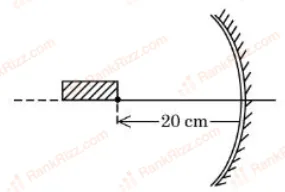
A thin biconvex lens is prepared from the glass (μ=1.5) both curved surfaces of which have equal radii of 20 cm each. Left side surface of the lens is silvered from outside to make it reflecting. To have the position of image and object at the same place, the object should be placed, from the lens at a distance of __________ cm.
JEE MAIN 2026 · 08 APR S2Refraction at plane surfaces, Snell's law and apparent depth
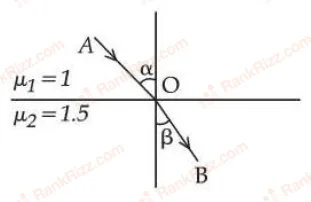
Light ray incident along a vector AO (AO=2i^−3j^) emerges out along vector OB (OB=Ci^−4j^) as shown in the figure below. The value of C is __________.
JEE MAIN 2026 · 06 APR S1Refraction at plane surfaces, Snell's law and apparent depth
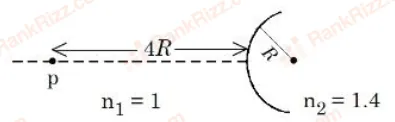
A spherical interface lens of radius R separates two media of refractive indices 1 and 1.4 respectively as shown in the figure below. A point source is placed at a distance of 4R in front of spherical interface. The magnitude of the magnification of point source image is _______.
JEE MAIN 2026 · 06 APR S2Spherical mirrors: mirror formula and magnification
A concave mirror of focal length 10 cm forms an image which is double the size of object when the object is placed at two different positions. The distance between the two positions of the object is __________ cm.
JEE MAIN 2026 · 05 APR S1Refraction at plane surfaces, Snell's law and apparent depth
A ray of light passing through an equilateral prism is having velocity 2.12×10⁸ m/s in the prism material, then the minimum angle of deviation is _______ degrees.
JEE MAIN 2026 · 05 APR S1Optical instruments: microscopes and telescopes
A compound microscope is designed with two symmetric biconvex lenses. The objective lens is cut vertically, creating two identical plano-convex lenses. One of them is used in place of original objective lens. To retain same magnification keeping the object distance unchanged, the tube length has to be
JEE MAIN 2026 · 05 APR S2Thin lenses: lens formula, lens maker's formula and power
A thin convex lens and a thin concave lens are kept in contact and are co-axial. Which of the following statements is correct for this combination of two lenses ?
A
behaves as concave lens if ∣fconvex∣>∣fconcave∣
B
behaves as concave if ∣fconvex∣<∣fconcave∣
C
behaves as convex if ∣fconvex∣>∣fconcave∣
D
The focal length of the lens system will changes if the positions of two lenses are interchanged
JEE MAIN 2026 · 05 APR S2Thin lenses: lens formula, lens maker's formula and power
An object AB is placed 15 cm to the left of a convex lens P of focal length 10cm. Another convex lens Q is now placed 15cm right of lens P . If the focal length of lens Q is 15 cm, final image is______.
A
virtual, formed at 7.5 cm right of lens Q, with a size bigger than that of AB
B
real, formed at 7.5 cm right of lens Q, with a size same as that of AB
C
formed at infinity
D
real, formed at 7 cm right of lens Q, with a size smaller than that of AB
JEE MAIN 2026 · 04 APR S2Thin lenses: lens formula, lens maker's formula and power
A convex lens is made from glass material having refractive index of 1.4 with same radius of curvature on both sides. The ratio of its focal length and radius of curvature is ______.
JEE MAIN 2026 · 02 APR S2Refraction at plane surfaces, Snell's law and apparent depth
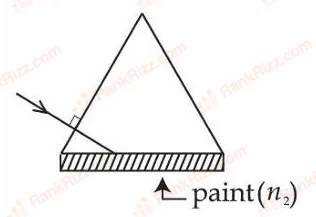
One side of an equilateral prism is painted by a transparent material of refractive index n2. The refractive index of prism is 1.6. The minimum value of n2 required for total internal reflection from painted face is ________ .
JEE MAIN 2026 · 28 JAN S1Thin lenses: lens formula, lens maker's formula and power
The magnitudes of power of a biconvex lens (refractive index 1.5) and that of a piano-concave lens (refractive index = l.7) are same. If the curvature of plano-concave lens exactly matches with the curvature of back surface of the biconvex lens, then ratio of radius of curvature of front and back smface of the biconvex lens is________.
JEE MAIN 2026 · 28 JAN S1Thin lenses: lens formula, lens maker's formula and power
A convex lens of refractive index 1.5 and focal length f = 18 cm is immersed in water. The difference in focal lengths of the given lens when it is in water and in air is α×f. The value ofα is______. (refractive index of water = 4/3)
JEE MAIN 2026 · 28 JAN S2Thin lenses: lens formula, lens maker's formula and power
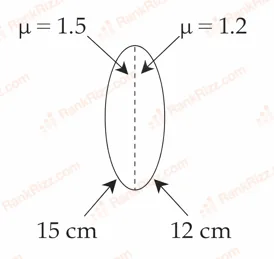
A biconvex lens is formed by using two thin planoconvex lenses, as shown in the figure. The refractive index and radius of curved surfaces are also mentioned in figure. When an object is placed on the left side of lens at a distance of 30 cm from the biconvex lens, the magnification of the image will be:
JEE MAIN 2026 · 24 JAN S1Refraction at plane surfaces, Snell's law and apparent depth
The exit surface of a prism with refractive index n is coated with a material having refractive index 2n. When this prism is set for minimum angle of deviation, it exactly meets the condition of critical angle. The prism angle is ___ .
JEE MAIN 2026 · 24 JAN S1Optical instruments: microscopes and telescopes
In a microscope of tube length 1O cm two convex lenses are arranged with focal length of 2 cm and 5 cm. Total magnification obtained with this system for normal adjustment is (5)k The value of k is ___.