JEE MAIN 2026 · 08 APR S2Spring-block oscillations
The frequency of oscillation of a mass suspended by a spring is . If the length of the spring is cut to half, the same mass oscillates with frequency . The value of is __________.
- A
1
- B
2
- C
- D
Oscillations has been asked in 21 of the 23 JEE Main years from 2004 to 2026: 182 questions in all. In 2026 it averaged 0.7 questions per paper (14 across 19 papers), 2.9% of Physics questions, up from 2.1% in 2025. Across the last 20 papers it carried 2.8% of Physics marks. By type: 144 MCQs and 38 numerical-answer questions. Of the 158 with a difficulty tag, 44% are easy, 53% medium and 3% hard. Most asked: SHM: equation, phase, velocity and acceleration (78, 43%), Spring-block oscillations (51, 28%) and Energy in simple harmonic motion (17, 9%).
DATA UPDATED
Questions
182
Distinct ideas
7
Share of marks
2.8%
Difficulty
MEDIUM
The share of each year’s Physics questions that came from Oscillations, counted from the 168 papers we hold for the last 10 years, and session by session inside a year.
Falling: 2.4% of Physics questions in 2024–2026, down from 3.1% in 2017–2023. Its heaviest year was 2017, at 5.6%.
| YEAR | QS | PER PAPER | SHARE OF PHYSICS | CHANGE | |
|---|---|---|---|---|---|
| 2026 | 14 / 475 | 0.7 | 2.9% | +0.8 pts | JAN 2.8%APR 3.1% |
| 2025 | 10 / 475 | 0.5 | 2.1% | −0.1 pts | JAN 2.8%APR 1.3% |
| 2024 | 13 / 600 | 0.7 | 2.2% | −1.1 pts | JAN 2.0%APR 2.3% |
| 2023 | 25 / 750 | 1.0 | 3.3% | +0.9 pts | JAN 3.3%APR 3.3% |
| 2022 | 16 / 660 | 0.7 | 2.4% | −2.2 pts | JUN 2.2%JUL 2.7% |
| 2021 | 33 / 720 | 1.4 | 4.6% | +3.6 pts | FEB 7.3%MAR 4.7%JUL 3.8%AUG 3.3% |
| 2020 | 4 / 400 | 0.3 | 1.0% | −1.7 pts | JAN 0.0%SEP 1.6% |
| 2019 | 13 / 480 | 0.8 | 2.7% | −0.6 pts | JAN 4.2%APR 1.3% |
| 2018 | 4 / 120 | 1.0 | 3.3% | −2.3 pts | 4 PAPERS, ONE SESSION |
| 2017 | 5 / 90 | 1.7 | 5.6% | — | 3 PAPERS, ONE SESSION |
“QS” is Oscillations questions out of all Physics questions that year; “per paper” is that count over the year’s papers, and “change” is the share against the year before. A year with more sittings asks more questions, which is why the share, not the count, is the number to compare.
How Oscillations compares: every Physics chapter by weightage · most repeated JEE Main topics
A chapter is not one subject — it is a handful of procedures the examiner reuses. These are the ones Oscillations questions actually test.
Every JEE Main Oscillations question we hold, newest first inside each topic. Open one for its options, answer key and solution.
FREE PDF
All 182 questions on A4, by topic, with the answer key at the end. No sign-up, no email: your browser saves it as a PDF.
Download free PDFUNIQUE CONCEPTS
7 ideas, each with the latest past question that tested it, drawn from 208 JEE Main and Advanced questions.
Oscillations Unique Concepts sheet →JEE ADVANCED
JEE Advanced has set 27 Oscillations questions, 2008–2026.
Oscillations JEE Advanced PYQs →Not every year. It has been asked in 21 of the 23 JEE Main years from 2004 to 2026; the years without a Oscillations question were 2008 and 2010.
SHM: equation, phase, velocity and acceleration: 78 of the 182 questions (43%). Next come Spring-block oscillations (51) and Energy in simple harmonic motion (17).
About 2.8% across the last 20 papers. Every JEE Main question carries the same marks, so that is also its share of Physics questions. In 2026 it was 2.9% (14 of 475 Physics questions).
In JEE Main 08 Apr 2026, Shift 2, the latest sitting with a Oscillations question.
182 from 2004 to 2026, across 7 topics. Every one is listed on this page by topic and links to its own page, with the answer key and solution wherever we have them. Free, no sign-up.
1–20 OF 182 · NEWEST FIRST
The frequency of oscillation of a mass suspended by a spring is . If the length of the spring is cut to half, the same mass oscillates with frequency . The value of is __________.
1
2
A particle is executing simple harmonic motion. Its amplitude is and time period is 5 sec. The time required by it to move from to is _______ sec.
1/4
5/4
5/8
3/8
A spring stretches by 2 mm when it is loaded with a mass of 200 g. From equilibrium position the mass is further pulled down by 2 mm and released. The frequency associated with the system and maximum energy in the spring are __________ Hz and __________ J, respectively. (Take m/s)
and
and 8
and
and
Match the List I with List II:
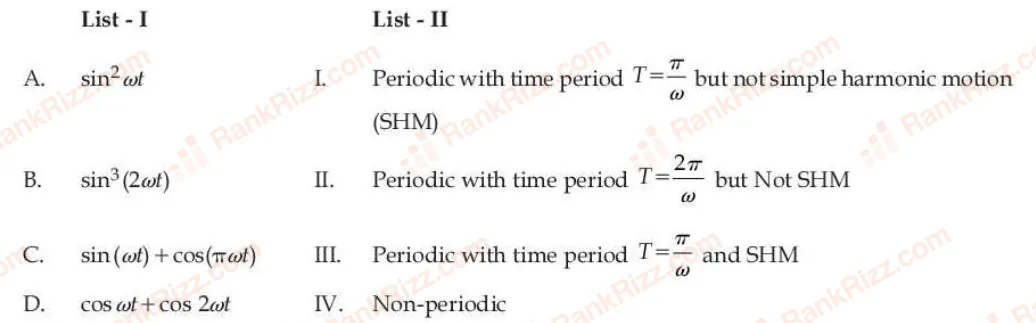
Choose the correct answer from the options given below:
A-III, B-I, C-IV, D-II
A-II, B-I, C-III, D-IV
A-III, B-II, C-IV, D-I
A-II, B-I, C-IV, D-III
The velocity of a particle executing simple harmonic motion along -axis is described as , where represents displacement. If the time period of motion is s, the value of is _____.
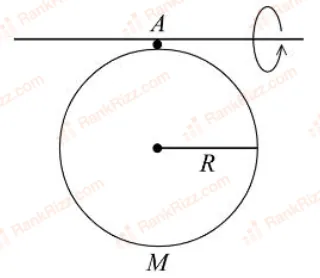
A uniform disc of radius R and mass M is free to oscillate about the axis A as shown in the figure. For small oscillations the time period is ______. ( g is acceleration due to gravity)
The equation of motion of a particle is given by cm. The particle will come to rest at time and it will have zero acceleration at time . The and respectively are _____.
s, s
s, s
s, s
s, s
The displacement of a particle, executing simple harmonic motion with time period T, is expressed as , where A is the amplitude. The maximum value of potential energy of this oscillator is found at . The value of is_____.
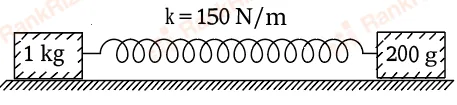
As shown in the figure, a spring is kept in a stretched position with some extension by holding the masses 1 kg and 0.2 kg with a separation more than spring natural length and are released. Assuming the horizontal serface to be frictionless, the angular frequency (in SI unit) of the system is:
5
20
27
30
A cylindrical block of mass M and area of cross section A is floating in a liquid of density and with its axis vertical. When depressed a little and released the block starts oscillating. The period of oscillation is ___
A spring of force constant 15 N/m is cut into two pieces. If the ratio of their length is 1:3, then the force constant of smaller piece is __ /m.
45
15
60
20
A simple pendulum of string length 30 cm performs 20 oscillations in 10 s. The length of the string required for the pendulum to perfo rm 40 oscillations in the same time duration is _________cm. [Assume that the mass of the pendulum remains same.]
120
15
0.75
7.5
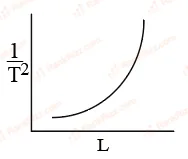
Using a simple pendulum experiment g is determind by measuring its time period T. Which of the following plots represent the correct relation between the pendulum length L and time period T?
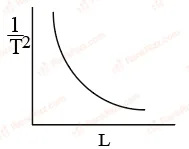
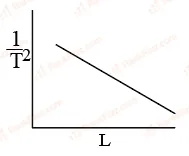
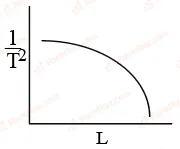
The kinetic energy of a simple harmonic oscillator is oscillating with angular frequency of 176 rad/ s. The frequency of this simple harmonic oscillator is _____Hz. [take ]
28
88
176
14
The amplitude of the vibrating particle due to superposition of two SHMs
and
.
Two simple pendulums having lengths and with negligible string mass undergo angular displacements and , from their mean positions, respectively. If the angular accelerations of both pendulums are same, then which expression is correct?
Two blocks of masses m and M, , are placed on a frictionless table as shown in figure. A massless spring with spring constant k is attached with the lower block. If the system is slightly displaced and released then ( = coefficient of friction between the two blocks)
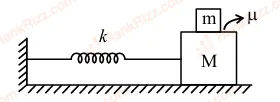
(A) The time period of small oscillation of the two blocks is
(B) The acceleration of the blocks is
(C) The magnitude of the frictional force on upper block is
(D) The maximum amplitude of the upper block, if it does not slip, is
(E) Maximum frictional force can be .
Choose the correct answer from the options given below :
A, B, D Only
B, C, D Only
C, D, E Only
A, B, C Only
A particle is subjected to two simple harmonic motions as:
cm
and cm
where x is displacement and is time in seconds. The maximum acceleration of the particle is ms. The value of x is:
175
125
Given below are two statements : one is labelled as Assertion (A) and the other is labelled as Reason (R). Assertion (A) : Time period of a simple pendulum is longer at the top of a mountain than that at the base of the mountain. Reason (R): Time period of a simple pendulum decreases with increasing value of acceleration due to gravity and vice-versa. In the light of the above statements, choose the most appropriate answer from the options given below :
Both (A) and (R) are true and (R) is the correct explanation of (A)
(A) is true but (R) is false
(A) is false but (R) is true
Both (A) and (R) are true but (R) is not the correct explanation of (A)
Two bodies A and B of equal mass are suspended from two massless springs of spring constant and , respectively. If the bodies oscillate vertically such that their amplitudes are equal, the ratio of the maximum velocity of A to the maximum velocity of B is
OTHER PHYSICS CHAPTERS