JEE MAIN 2006
JEE Main 2006 Physics question — Motion and equilibrium of charged bodies in electric fields
Two insulating plates are both uniformly charged in such a way that the potential difference between them is . (i.e. plate 2 is at a higher potential). The plates are separated by and can be treated as infinitely large. An electron is released from rest on the inner surface of plate 1. What is its speed when it hits plate 2? 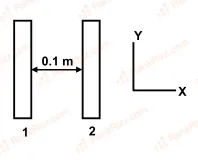
SOLUTION
Key idea: The work done by the field on the electron equals its gain in kinetic energy: .
- The electron moves towards the higher potential (plate 2), so it speeds up while crossing the 20 V difference.
- .
- m/s.
- The separation is not needed.
Answer: (B)
Topic: Motion and equilibrium of charged bodies in electric fields