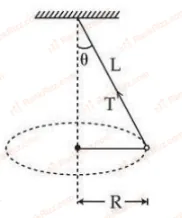
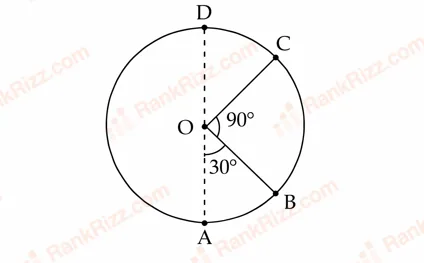
A car moving with a speed of 54 km/h takes a turn of radius 20 m. A simple pendulum is suspended from the ceiling of the car. Determine the angle made by the string of the pendulum with the vertical during the turning. (Take m/s)
- A
- B
- C
- D
Circular Motion has been asked in 17 of the 23 JEE Main years from 2004 to 2026: 75 questions in all. In 2026 it averaged 0.3 questions per paper (6 across 19 papers), 1.3% of Physics questions, the same as in 2025. Across the last 20 papers it carried 1.2% of Physics marks. By type: 66 MCQs and 9 numerical-answer questions. Of the 71 with a difficulty tag, 34% are easy, 61% medium and 6% hard. Most asked: Kinematics of uniform circular motion (35, 47%), Dynamics of horizontal circular motion: conical pendulum, rotating drums (15, 20%) and Vertical circular motion (14, 19%).
DATA UPDATED
Questions
75
Distinct ideas
5
Share of marks
1.2%
Difficulty
MEDIUM
The share of each year’s Physics questions that came from Circular Motion, counted from the 168 papers we hold for the last 10 years, and session by session inside a year.
Steady: 1.5% of Physics questions in 2024–2026 against 1.3% in 2017–2023, and between 0.6% and 2.0% in every year shown.
| YEAR | QS | PER PAPER | SHARE OF PHYSICS | CHANGE | |
|---|---|---|---|---|---|
| 2026 | 6 / 475 | 0.3 | 1.3% | level | JAN 0.8%APR 1.8% |
| 2025 | 6 / 475 | 0.3 | 1.3% | −0.7 pts | JAN 2.4%APR 0.0% |
| 2024 | 12 / 600 | 0.6 | 2.0% | +0.1 pts | JAN 2.7%APR 1.3% |
| 2023 | 14 / 750 | 0.6 | 1.9% | +0.2 pts | JAN 2.1%APR 1.7% |
| 2022 | 11 / 660 | 0.5 | 1.7% | +0.4 pts | JUN 2.5%JUL 0.7% |
| 2021 | 9 / 720 | 0.4 | 1.3% | +0.3 pts | FEB 0.7%MAR 2.7%JUL 1.0%AUG 1.0% |
| 2020 | 4 / 400 | 0.3 | 1.0% | +0.4 pts | JAN 1.3%SEP 0.8% |
| 2019 | 3 / 480 | 0.2 | 0.6% | −0.2 pts | JAN 0.8%APR 0.4% |
| 2018 | 1 / 120 | 0.3 | 0.8% | −0.3 pts | 4 PAPERS, ONE SESSION |
| 2017 | 1 / 90 | 0.3 | 1.1% | — | 3 PAPERS, ONE SESSION |
“QS” is Circular Motion questions out of all Physics questions that year; “per paper” is that count over the year’s papers, and “change” is the share against the year before. A year with more sittings asks more questions, which is why the share, not the count, is the number to compare.
How Circular Motion compares: every Physics chapter by weightage · most repeated JEE Main topics
A chapter is not one subject — it is a handful of procedures the examiner reuses. These are the ones Circular Motion questions actually test.
Every JEE Main Circular Motion question we hold, newest first inside each topic. Open one for its options, answer key and solution.
FREE PDF
All 75 questions on A4, by topic, with the answer key at the end. No sign-up, no email: your browser saves it as a PDF.
Download free PDFUNIQUE CONCEPTS
5 ideas, each with the latest past question that tested it, drawn from 75 JEE Main and Advanced questions.
Circular Motion Unique Concepts sheet →Not every year. It has been asked in 17 of the 23 JEE Main years from 2004 to 2026; the years without a Circular Motion question were 2005, 2006, 2007, 2008, 2009 and 2011.
Kinematics of uniform circular motion: 35 of the 75 questions (47%). Next come Dynamics of horizontal circular motion: conical pendulum, rotating drums (15) and Vertical circular motion (14).
About 1.2% across the last 20 papers. Every JEE Main question carries the same marks, so that is also its share of Physics questions. In 2026 it was 1.3% (6 of 475 Physics questions).
In JEE Main 08 Apr 2026, Shift 2, the latest sitting with a Circular Motion question.
75 from 2004 to 2026, across 5 topics. Every one is listed on this page by topic and links to its own page, with the answer key and solution wherever we have them. Free, no sign-up.
1–20 OF 75 · NEWEST FIRST
A car moving with a speed of 54 km/h takes a turn of radius 20 m. A simple pendulum is suspended from the ceiling of the car. Determine the angle made by the string of the pendulum with the vertical during the turning. (Take m/s)
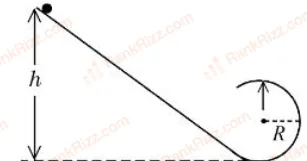
A smooth inclined plane ends in a vertical circular loop, as shown in the figure. A small body is released from height as shown. If the body exerts a force of three times its weight on the plane at the highest point of circle then the height . The value of is _______.

2
4
3
6
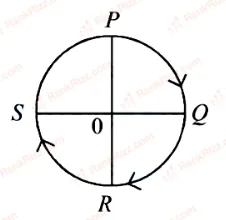
A particle is rotating in a circular path and at any instant its motion can be described as . The angular acceleration of the particle after 10 seconds is __________ rad/s.
A 0.5 kg mass is in contact against the inner wall of a cylindrical drum of radius 4 m rotating about its vertical axis. The minimum rotational speed of the drum to enable the mass to remain stuck to the wall (without falling) is 5 rad/s. The coefficient of friction between the drum's inner wall surface and mass is : (Take m/s)
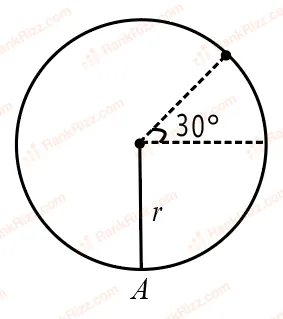
In case of vertical circular motion of a particle by a thread of length r if the tension in the thread is zero at an angle shown in figure, the velocity at the bottom point (A) of the circular path is
(g = gravitational acceleration)

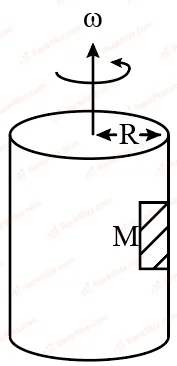
A large drum having radius R is spinning around its axis with angular velocity , as shown in figure. The minimum value of so that a body of mass M remains stuck to the inner wall of the drum, taking the coefficient of friction between the drum surface and mass M as , is :

A body of mass 'm' connected to a massless and unstretchable string goes in verticle circle of radius 'R' under gravity g. The other end of the string is fixed at the center of circle. If velocity at top of circular path is , where, , then ratio of kinetic energy of the body at bottom to that at top of the circle is
A car of mass moves on a banked road having radius and banking angle To avoid slipping from the banked road, the maximum permissible speed of the car is The coefficient of friction between the wheels of the car and the banked road is:
A string of length is fixed at one end and carries a mass of at the other end. The mass makes rotations per second about the vertical axis passing through end of the string as shown. The tension in the string is
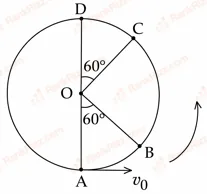
A bob of mass m is suspended at a point O by a light string of length l and left to perform vertical motion (circular) as shown in figure. Initially, by applying horizontal velocity at the point ' A ', the string becomes slack when, the bob reaches at the point ' D '. The ratio of the kinetic energy of the bob at the points B and C is
________.
1
2
4
3
A body of mass 100 g is moving in circular path of radius 2 m on vertical plane as shown in figure. The velocity of the body at point A is 10 m/s. The ratio of its kinetic energies at point B and C is :
(Take acceleration due to gravity as )
A tube of length 1 m is filled completely with an ideal liquid of mass 2 M , and closed at both ends. The tube is rotated uniformly in horizontal plane about one of its ends. If the force exerted by the liquid at the other end is F then angular velocity of the tube is in SI unit. The value of is __________.
A clock has long second hand and minute hand respectively. In 30 minutes duration the tip of second hand will travel distance more than the tip of minute hand. The value of in meter is nearly (Take ) :
140.5
118.9
139.4
220.0
A car of is taking turn on a banked road of radius and angle of banking . If coefficient of static friction is then the maximum speed with which car can negotiate the turn safely:
A man carrying a monkey on his shoulder does cycling smoothly on a circular track of radius m and completes 120 revolutions in 3 minutes. The magnitude of centripetal acceleration of monkey is (in ) :
Zero
A cyclist starts from the point of a circular ground of radius km and travels along its circumference to the point . The displacement of a cyclist is:

km
km
km
km
A ball of mass kg is attached to a string of length cm. The ball is rotated on a horizontal circular path about its vertical axis. The maximum tension that the string can bear is N. The maximum possible value of angular velocity of the ball in rad s is :
A coin is placed on a disc. The coefficient of friction between the coin and the disc is . If the distance of the coin from the center of the disc is , the maximum angular velocity which can be given to the disc, so that the coin does not slip away, is :
If the radius of curvature of the path of two particles of same mass are in the ratio , then in order to have constant centripetal force, their velocities will be in the ratio of:
A stone of mass g is tied to a string and moved in a vertical circle of radius m making rpm. The tension in the string, when the stone is at the lowest point is (if and )
N
N
N
N
OTHER PHYSICS CHAPTERS