RankRizz

Electrostatics — JEE Main Previous Year Questions

Every Electrostatics question JEE Main has set from 2004–2026, grouped by the idea it tests rather than the order of the syllabus. 294 questions across 9 distinct ideas. Free to read, answer key on every one.

DATA UPDATED

Questions

294

Distinct ideas

9

Share of marks

6%

Difficulty

MEDIUM

The ideas inside Electrostatics

A chapter is not one subject — it is a handful of procedures the examiner reuses. These are the ones Electrostatics questions actually test.

Every Electrostatics question

181–200 OF 294 · NEWEST FIRST

JEE MAIN 2021 · 25 FEB S2Electric charge and Coulomb's law

Two identical conducting spheres with negligible volume have 2.1 nC and −0.1-0.1 nC charges, respectively. They are brought into contact and then separated by a distance of 0.5 m. The electrostatic force acting between the spheres is ______ ×10−9\times 10^{-9} N.
[Given : 4πϵ∘4\pi \epsilon_{\circ} = 19×109\frac{1}{9\times 10^{9}} SI Units}]

JEE MAIN 2021 · 24 FEB S1Electric field due to point charges and superposition

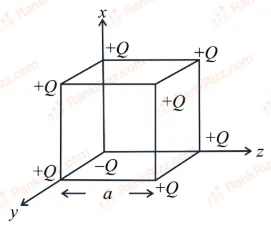
A cube of side aa has point charges +Q located at each of its vertices except at the origin where the charge is -Q. The electric field at the centre of cube is: 

Figure for JEE Main 2021 Physics question on Electric field due to point charges and superposition
  1. A

    −Q33πε0a2(x^+y^+z^)\frac{-Q}{3\sqrt{3}\pi\varepsilon_0 a^2}(\hat{x} + \hat{y} + \hat{z})

  2. B

    Q33πε0a2(x^+y^+z^)\frac{Q}{3\sqrt{3}\pi\varepsilon_0 a^2}(\hat{x} + \hat{y} + \hat{z})

  3. C

    2Q33πε0a2(x^+y^+z^)\frac{2Q}{3\sqrt{3}\pi\varepsilon_0 a^2}(\hat{x} + \hat{y} + \hat{z})

  4. D

    −2Q33πε0a2(x^+y^+z^)\frac{-2Q}{3\sqrt{3}\pi\varepsilon_0 a^2}(\hat{x} + \hat{y} + \hat{z})

JEE MAIN 2021 · 24 FEB S2Electric charge and Coulomb's law

Two electrons each are fixed at a distance 2d. A third charge proton placed at the midpoint is displaced slightly by a distance x(x≪d)x (x \ll d) perpendicular to the line joining the two fixed charges. Proton will execute simple harmonic motion having angular frequency:
(mm = mass of charged particle)

  1. A

    (πε0md32q2)12\left(\frac{\pi\varepsilon_0 md^3}{2q^2}\right)^{\frac{1}{2}}

  2. B

    (2πε0md3q2)12\left(\frac{2\pi\varepsilon_0 md^3}{q^2}\right)^{\frac{1}{2}}

  3. C

    (q22πε0md3)12\left(\frac{q^2}{2\pi\varepsilon_0 md^3}\right)^{\frac{1}{2}}

  4. D

    (2q2πε0md3)12\left(\frac{2q^2}{\pi\varepsilon_0 md^3}\right)^{\frac{1}{2}}

JEE MAIN 2021 · 24 FEB S2Electric flux and Gauss's law

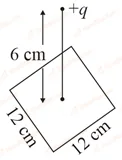
A point charge of +12+12 μC\mu C is at a distance 6 cm vertically above the centre of a square of side 12 cm as shown in figure. The magnitude of the electric flux through the square will be ______ ×103\times 10^3 N m2^2 C−1^{-1}.

page5_img1
JEE MAIN 2020 · 06 SEP S1Electric field due to point charges and superposition

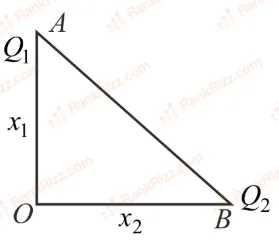
Charges Q1Q_1 and Q2Q_2 are at points A and B of a right-angled triangle OAB. The resultant electric field at point O is perpendicular to the hypotenuse, then Q1/Q2Q_1/Q_2 is proportional to:

Figure for JEE Main 2020 Physics question on Electric field due to point charges and superposition
  1. A

    x13x23\frac{x_1^3}{x_2^3}

  2. B

    x2x1\frac{x_2}{x_1}

  3. C

    x1x2\frac{x_1}{x_2}

  4. D

    x22x12\frac{x_2^2}{x_1^2}

JEE MAIN 2020 · 06 SEP S2Electric dipole and dipole in external field

Two identical electric point dipoles have dipole moments p⃗1=pi^\vec{p}_1 = p\hat{i} and p⃗2=−pi^\vec{p}_2 = -p\hat{i} and are held on the x-axis at distance 'a' from each other. When released, they move along the x-axis with the direction of their dipole moments remaining unchanged. If the mass of each dipole is 'm', their speed when they are infinitely far apart is:

  1. A

    pa1πε0ma\frac{p}{a}\sqrt{\frac{1}{\pi\varepsilon_0 ma}}

  2. B

    pa12πε0ma\frac{p}{a}\sqrt{\frac{1}{2\pi\varepsilon_0 ma}}

  3. C

    pa2πε0ma\frac{p}{a}\sqrt{\frac{2}{\pi\varepsilon_0 ma}}

  4. D

    pa32πε0ma\frac{p}{a}\sqrt{\frac{3}{2\pi\varepsilon_0 ma}}

JEE MAIN 2020 · 06 SEP S2Electric field due to point charges and superposition

Consider the force F on a charge 'q' due to a uniformly charged spherical shell of radius R carrying charge Q distributed uniformly over it. Which one of the following statements is true for F, if 'q' is placed at distance r from the centre of the shell?

  1. A

    F=14πε0QqR2F = \frac{1}{4\pi\varepsilon_0}\frac{Qq}{R^2} for r<Rr < R

  2. B

    14πε0qQR2>F>0\frac{1}{4\pi\varepsilon_0}\frac{qQ}{R^2} > F > 0 for r<Rr < R

  3. C

    F=14πε0Qqr2F = \frac{1}{4\pi\varepsilon_0}\frac{Qq}{r^2} for r>Rr > R

  4. D

    F=14πε0Qqr2F = \frac{1}{4\pi\varepsilon_0}\frac{Qq}{r^2} for all r

JEE MAIN 2020 · 05 SEP S1Electric potential and potential energy

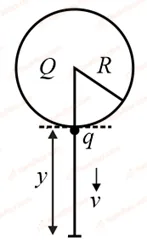
A solid sphere of radius RR carries a charge Q+qQ + q distributed uniformly over its volume. A very small point like piece of it of mass mm gets detached from the bottom of the sphere and falls down vertically under gravity. This piece carries charge qq. If it acquires a speed vv when it has fallen through a vertical height yy (see figure), then (assume the remaining portion to be spherical)

Figure for JEE Main 2020 Physics question on Electric potential and potential energy
  1. A

    v2=y[qQ4πε0R2ym+g]v^2 = y\left[\frac{qQ}{4\pi\varepsilon_0 R^2 ym} + g\right]

  2. B

    v2=y[qQ4πε0R(R+y)m+g]v^2 = y\left[\frac{qQ}{4\pi\varepsilon_0 R(R+y)m} + g\right]

  3. C

    v2=2y[QqR4πε0(R+y)3m+g]v^2 = 2y\left[\frac{QqR}{4\pi\varepsilon_0(R+y)^3 m} + g\right]

  4. D

    v2=2y[qQ4πε0R(R+y)m+g]v^2 = 2y\left[\frac{qQ}{4\pi\varepsilon_0 R(R+y)m} + g\right]

JEE MAIN 2020 · 05 SEP S2Electric potential and potential energy

Ten charges are placed on the circumference of a circle of radius R with constant angular separation between successive charges. Alternate charges 1, 3, 5, 7, 9 have charge (+q)(+q) each, while 2, 4, 6, 8, 10 have charge (−q)(-q) each. The potential V and the electric field E at the centre of the circle are respectively: (Take V=0V = 0 at infinity)

  1. A

    V=10q4πε0RV = \frac{10q}{4\pi\varepsilon_0 R}; E=0E = 0

  2. B

    V=0V = 0, E=10q4πε0R2E = \frac{10q}{4\pi\varepsilon_0 R^2}

  3. C

    V=0V = 0; E=0E = 0

  4. D

    V=10q4πε0RV = \frac{10q}{4\pi\varepsilon_0 R}; E=10q4πε0R2E = \frac{10q}{4\pi\varepsilon_0 R^2}

JEE MAIN 2020 · 04 SEP S1Electric field of continuous charge distributions

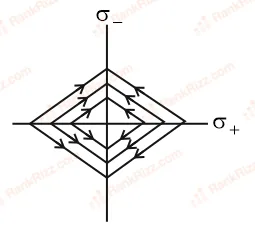
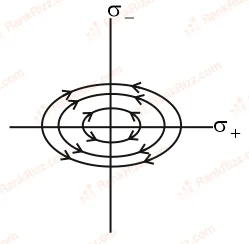
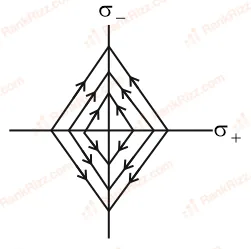
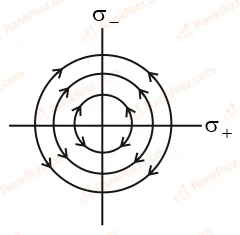
Two charged thin infinite plane sheets of uniform charge density σ+\sigma_+ and σ−\sigma_-, where ∣σ+∣>∣σ−∣|\sigma_+| > |\sigma_-|, intersect at the right angle. Which of the following best represents the electric field lines for the system:

  1. A
    Figure for JEE Main 2020 Physics question on Electric field of continuous charge distributions
  2. B
    Figure for JEE Main 2020 Physics question on Electric field of continuous charge distributions
  3. C
    Figure for JEE Main 2020 Physics question on Electric field of continuous charge distributions
  4. D
    Figure for JEE Main 2020 Physics question on Electric field of continuous charge distributions
JEE MAIN 2020 · 04 SEP S1Electric potential and potential energy

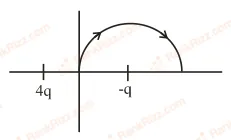
A two point charges 4q4q and −q-q are fixed on the xx-axis at x=−d2x = \frac{-d}{2} and x=d2x = \frac{d}{2}, respectively. If the third point charge 'q' is taken from the origin to x=dx = d along the semicircle as shown in the figure, the energy of the charge will:

Figure for JEE Main 2020 Physics question on Electric potential and potential energy
  1. A

    Increase by 3q24πε0d\frac{3q^2}{4\pi\varepsilon_0 d}

  2. B

    Increase by 2q23πε0d\frac{2q^2}{3\pi\varepsilon_0 d}

  3. C

    decrease by q24πε0d\frac{q^2}{4\pi\varepsilon_0 d}

  4. D

    decrease by 4q23πε0d\frac{4q^2}{3\pi\varepsilon_0 d}

JEE MAIN 2020 · 04 SEP S2Motion and equilibrium of charged bodies in electric fields

A particle of charge qq and mass mm is subjected to an electric field E=E0(1−ax2)E = E_0(1 - ax^2) in the xx-direction, where aa and E0E_0 are constants. Initially the particle was at rest at x=0x = 0. Other than the initial position the kinetic energy of the particle becomes zero when the distance of the particle from the origin is:

  1. A

    aa

  2. B

    2a\sqrt{\frac{2}{a}}

  3. C

    3a\sqrt{\frac{3}{a}}

  4. D

    1a\sqrt{\frac{1}{a}}

JEE MAIN 2020 · 03 SEP S1Electric potential and potential energy

Two isolated conducting spheres S1S_1 and S2S_2 of radius 23R\frac{2}{3}R and 13R\frac{1}{3}R have 12 μC\mu C and −3-3 μC\mu C charges, respectively, and are at a large distance from each other. They are now connected by a conducting wire. A long time after this is done the charges on S1S_1 and S2S_2 are respectively:

  1. A

    4.54.5 μC\mu C of both

  2. B

    +4.5+4.5 μC\mu C and −4.5-4.5 μC\mu C

  3. C

    33 μC\mu C and 66 μC\mu C

  4. D

    66 μC\mu C and 33 μC\mu C

JEE MAIN 2020 · 03 SEP S2Electric potential and potential energy

Hydrogen ion and singly ionized helium atom are accelerated, from rest, through the same potential difference. The ratio of final speeds of hydrogen and helium ions is close to:

  1. A

    1:21 : 2

  2. B

    10:710 : 7

  3. C

    2:12 : 1

  4. D

    5:75 : 7

JEE MAIN 2020 · 03 SEP S2Electric potential and potential energy

Concentric metallic hollow spheres of radii R and 4R hold charges Q1Q_1 and Q2Q_2 respectively. Given that surface charge densities of the concentric spheres are equal, the potential difference V(R) - V(4R) is:

  1. A

    Q24πε0R\frac{Q_2}{4\pi\varepsilon_0 R}

  2. B

    3Q24πε0R\frac{3Q_2}{4\pi\varepsilon_0 R}

  3. C

    3Q116πε0R\frac{3Q_1}{16\pi\varepsilon_0 R}

  4. D

    3Q14πε0R\frac{3Q_1}{4\pi\varepsilon_0 R}

JEE MAIN 2020 · 02 SEP S1Electric field due to point charges and superposition

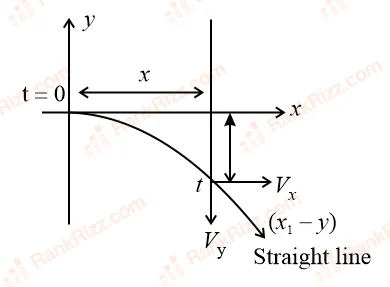
A charged particle (mass m and charge q) moves along X axis with velocity V0V_0. When it passes through the origin it enters a region having uniform electric field E⃗=−Ej^\vec{E} = -E\hat{j} which extends upto x=dx = d. Equation of path of electron in the region x>dx > d is:

Figure for JEE Main 2020 Physics question on Electric field due to point charges and superposition
  1. A

    y=qEdmv02(x−d)y = \frac{qEd}{mv_0^2}(x - d)

  2. B

    y=qEdmv02(d2−x)y = \frac{qEd}{mv_0^2}\left(\frac{d}{2} - x\right)

  3. C

    y=qEdmv0y = \frac{qEd}{mv_0}

  4. D

    y=qEd2mv02xy = \frac{qEd^2}{mv_0^2}x

JEE MAIN 2020 · 02 SEP S2Electric potential and potential energy

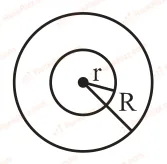
A charge Q is distributed over two concentric conducting thin spherical shells radii r and R (R > r). If the surface charge densities on the two shells are equal, the electric potential at the common centre is:

Figure for JEE Main 2020 Physics question on Electric potential and potential energy
  1. A

    14πϵ0(R+r)2(R2+r2)Q\frac{1}{4\pi\epsilon_0}\frac{(R+r)}{2(R^2+r^2)}Q

  2. B

    14πϵ0(2R+r)(R2+r2)Q\frac{1}{4\pi\epsilon_0}\frac{(2R+r)}{(R^2+r^2)}Q

  3. C

    14πϵ0(R+2r)Q2(R2+r2)\frac{1}{4\pi\epsilon_0}\frac{(R+2r)Q}{2(R^2+r^2)}

  4. D

    14πϵ0(R+r)(R2+r2)Q\frac{1}{4\pi\epsilon_0}\frac{(R+r)}{(R^2+r^2)}Q

JEE MAIN 2020 · 02 SEP S2Electric field of continuous charge distributions

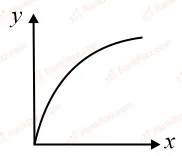
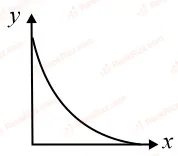
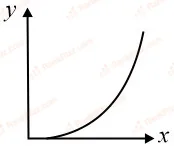
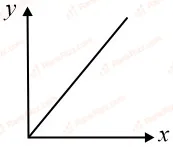
A small point mass carrying some positive charge on it, is released from the edge of a table. There is a uniform electric field in this region in the horizontal direction. Which of the following options then correctly describe the trajectory of the mass? (Curves are drawn schematically and are not to scale)

  1. A
    Figure for JEE Main 2020 Physics question on Electric field of continuous charge distributions
  2. B
    Figure for JEE Main 2020 Physics question on Electric field of continuous charge distributions
  3. C
    Figure for JEE Main 2020 Physics question on Electric field of continuous charge distributions
  4. D
    Figure for JEE Main 2020 Physics question on Electric field of continuous charge distributions
JEE MAIN 2020 · 09 JAN S1Electric field of continuous charge distributions

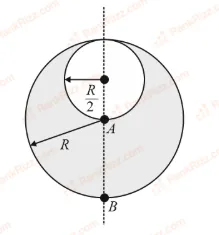
Consider a sphere of radius RR which carries a uniform charge density ρ\rho. If a sphere of radius R2\frac{R}{2} is carved out of it, as shown, the ratio ∣EA⃗∣∣EB⃗∣\frac{|\vec{E_A}|}{|\vec{E_B}|} of magnitude of electric field EA⃗\vec{E_A} and EB⃗\vec{E_B}, respectively, at points AA and BB due to the remaining portion is:

Figure for JEE Main 2020 Physics question on Electric field of continuous charge distributions
  1. A

    2134\frac{21}{34}

  2. B

    1834\frac{18}{34}

  3. C

    1754\frac{17}{54}

  4. D

    1854\frac{18}{54}

JEE MAIN 2020 · 09 JAN S1Electric dipole and dipole in external field

An electric dipole of moment p⃗=(−i^−3j^+2k^)×10−29\vec{p} = (-\hat{i} - 3\hat{j} + 2\hat{k}) \times 10^{-29} C m at the origin (0,0,0)(0,0,0). The electric field due to this dipole at r⃗=+i^+3j^+5k^\vec{r} = +\hat{i} + 3\hat{j} + 5\hat{k} (note that r⃗⋅p⃗=0\vec{r} \cdot \vec{p} = 0) is parallel to:

  1. A

    (+i^−3j^−2k^)(+\hat{i} - 3\hat{j} - 2\hat{k})

  2. B

    (−i^+3j^−2k^)(-\hat{i} + 3\hat{j} - 2\hat{k})

  3. C

    (+i^+3j^−2k^)(+\hat{i} + 3\hat{j} - 2\hat{k})

  4. D

    (−i^−3j^+2k^)(-\hat{i} - 3\hat{j} + 2\hat{k})