Electrostatics JEE Main PYQs with answer key
PHYSICS · 294 PAST QUESTIONS · 9 TOPICS · 2004–2026
HOW TO USE THIS SHEET
Every JEE Main Electrostatics question we hold, grouped by topic, most-asked topic first and newest first inside each. The answer key is at the end (292 of 294 questions have a checked key); the worked solution is on each question’s page, printed beside it.
Electric potential and potential energy 62
A three coulomb charge moves from the point (0, -2, -5) to the point (5, 1, 2) in an electric field expressed as N/C. The work done in moving the charge is _______ J.
Answer: ____________
rr2.rankrizz.com/jee-main/physics/electrostatics/q/6-apr-2026-s1-q49
Two metal plates (A, B) are kept horizontally with separation of cm, with plate A on the top. An atomizer jet sprays oil (density g/cm) droplets of radius 1 mm horizontally. All oil droplets carry a charge 5 nC. The potentials and are required on plates A and B respectively in order to ensure the droplets do not descend. The values of and are ______.
(Neglect the air resistance to the droplets and take m/s)- (A)
V and V
- (B)
V and V
- (C)
V and V
- (D)
V and V
rr2.rankrizz.com/jee-main/physics/electrostatics/q/2-apr-2026-s2-q39
- (A)
Two point charges of 1 nC and 2 nC are placed at the two corners of equilateral triangle of side 3 cm. The work done in bringing a charge of3 nC from infinity to the third corner of the triangle is __
- (A)
3.3
- (B)
2.7
- (C)
27
- (D)
5.4
rr2.rankrizz.com/jee-main/physics/electrostatics/q/28-jan-2026-s1-q42
- (A)
There are three co-centric conducting spherical shells A, B and C of radii a, b and c respectively (c > b > a) and they are charged with charge respectively. The potentials of the spheres A, Band C respectively, are :
- (A)
, ,
- (B)
,
- (C)
- (D)
, ,
rr2.rankrizz.com/jee-main/physics/electrostatics/q/24-jan-2026-s1-q34
- (A)
Two charges and are placed at (-9,0,0)cm and (9,0,0)cm respectively in an external field , where Considering the potential at infinity is 0, the electrostatic energy of the configuration is ______J.
- (A)
1.4
- (B)
-90.7
- (C)
49.3
- (D)
24.3
rr2.rankrizz.com/jee-main/physics/electrostatics/q/23-jan-2026-s2-q35
- (A)
Electric field in a region is given by , where , and . If the electric potential at a point (10, 20) is 500 , then the electric potential at origin is____ .
- (A)
2000
- (B)
0
- (C)
500
- (D)
1000
rr2.rankrizz.com/jee-main/physics/electrostatics/q/22-jan-2026-s1-q31
- (A)
Five positive charges each having charge q are placed at the vertices of a pentagon as shown in the figure. The electric potential (V) and the electric field at the center O of the pentagon due to these five positive charges are:
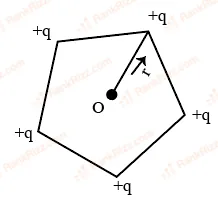
- (A)
and
- (B)
and
- (C)
and
- (D)
V = 0 and
rr2.rankrizz.com/jee-main/physics/electrostatics/q/22-jan-2026-s2-q34
- (A)
Three small identical drops of water having same charge on each coalesce to form a bigger drop. Then the ratio of the potentials on one initial drop and that on the resultant bigger drop is :
- (A)
- (B)
- (C)
- (D)
rr2.rankrizz.com/jee-main/physics/electrostatics/q/22-jan-2026-s2-q44
- (A)
Two smooth spherical non conducting shells each of radius having uniformly distributed charge & on their surfaces are released on a smooth non-conducting surface when the distance between their centers is . The mass of A is and that of B is . The speed of A just before A and B collide is: [Neglect gravitational interaction]
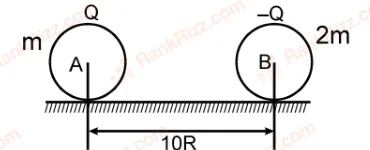
- (A)
- (B)
- (C)
- (D)
rr2.rankrizz.com/jee-main/physics/electrostatics/q/2026-physics-515797
- (A)
Two charges and are separated by a distance of 30 cm. A third charge initially at 'C' as shown in the figure, is moved along the circular path of radius 40 cm from C to D. If the difference in potential energy due to movement of from C to D is given by , the value of K is :
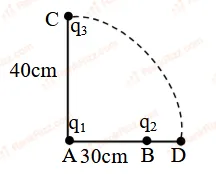
- (A)
- (B)
- (C)
- (D)
rr2.rankrizz.com/jee-main/physics/electrostatics/q/2025-apr-7-s1-q45
- (A)
The electrostatic potential on the surface of uniformly charged spherical shell of radius R = 10 cm is 120 V. The potential at the centre of shell, at a distance r = 5 cm from centre, and at a distance r = 15 cm from the centre of the shell, respectively, are :
- (A)
120V, 120V, 80V
- (B)
40V, 40V, 80V
- (C)
0V, 0V, 80V
- (D)
0V, 120V, 40V
rr2.rankrizz.com/jee-main/physics/electrostatics/q/2025-apr-03-s1-q39
- (A)
Two large plane parallel conducting plates are kept 10 cm apart as shown in figure. The potential difference between them is V. The potential difference between the points A and B (shown in the figure) is :
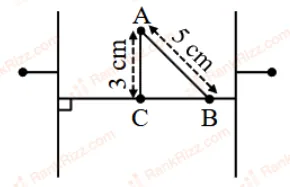
- (A)
- (B)
- (C)
- (D)
rr2.rankrizz.com/jee-main/physics/electrostatics/q/2025-apr-02-s2-q34
- (A)
Three infinitely long wires with linear charge density are placed along the x-axis, y-axis and z-axis respectively. Which of the following denotes an equipotential surface?
- (A)
- (B)
- (C)
- (D)
rr2.rankrizz.com/jee-main/physics/electrostatics/q/28-jan-2025-s1-q26
- (A)
Two charges and are placed at (−7 cm, 0, 0) and (7 cm, 0, 0) respectively. Given, , the electrostatic potential energy of the charge configuration is :
- (A)
-1.8 J
- (B)
-2.0 J
- (C)
-1.5 J
- (D)
-1.2 J
rr2.rankrizz.com/jee-main/physics/electrostatics/q/23-jan-2025-s2-q28
- (A)
At the centre of a half ring of radius cm and linear charge density nCm, the potential is V. The value of is _______
Answer: ____________
rr2.rankrizz.com/jee-main/physics/electrostatics/q/9-apr-2024-s1-q25
An infinitely long positively charged straight thread has a linear charge density . An electron revolves along a circular path having axis along the length of the wire. The graph that correctly represents the variation of the kinetic energy of electron as a function of radius of circular path from the wire is:
- (A)
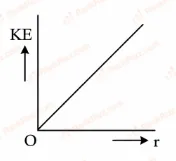
- (B)
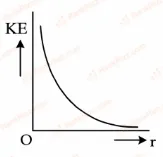
- (C)
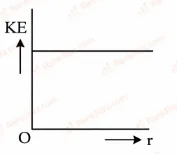
- (D)
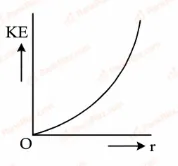
rr2.rankrizz.com/jee-main/physics/electrostatics/q/04-apr-2024-s1-q12
- (A)
An electric charge C is placed at origin m of co-ordinate system. Two points and are situated at m and m respectively. The potential difference between the points and will be :
- (A)
V
- (B)
V
- (C)
V
- (D)
V
rr2.rankrizz.com/jee-main/physics/electrostatics/q/27-jan-2024-s1-q10
- (A)
Given below are two statements : one is labelled as Assertion (A) and the other is labelled as Reason (R).
Assertion (A) : Work done by electric field on moving a positive charge on an equipotential surface is always zero.
Reason (R) : Electric lines of forces are always perpendicular to equipotential surfaces.
In the light of the above statements, choose the most appropriate answer from the options given below :- (A)
Both (A) and (R) are correct but (R) is not the correct explanation of (A)
- (B)
(A) is correct but (R) is not correct
- (C)
(A) is not correct but (R) is correct
- (D)
Both (A) and (R) are correct and (R) is the correct explanation of (A)
rr2.rankrizz.com/jee-main/physics/electrostatics/q/27-jan-2024-s2-q10
- (A)
The electric potential at the surface of an atomic nucleus () of radius cm is V. What is the value of ?
(Charge of proton C)Answer: ____________
rr2.rankrizz.com/jee-main/physics/electrostatics/q/27-jan-2024-s2-q25
64 identical drops each charged upto potential of mV are combined to form a bigger drop. The potential of the bigger drop will be _____ mV.
Answer: ____________
rr2.rankrizz.com/jee-main/physics/electrostatics/q/12-apr-2023-s1-q23
Electric potential at a point due to a point charge of C is 50 V. The distance of from the point charge is:
(Assume, N m C)- (A)
9 cm
- (B)
3 cm
- (C)
0.9 cm
- (D)
90 cm
rr2.rankrizz.com/jee-main/physics/electrostatics/q/08-apr-2023-s2-q11
- (A)
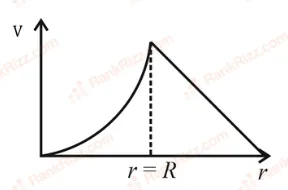
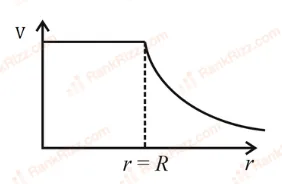
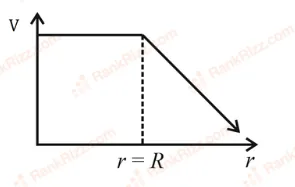
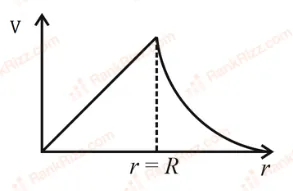
For a uniformly charged thin spherical shell, the electric potential radially away from the centre of shell can be graphically represented as
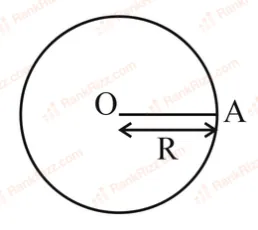
(1)
(2)
(3)
(4)
- (A)
Graph (1)
- (B)
Graph (2)
- (C)
Graph (3)
- (D)
Graph (4)
rr2.rankrizz.com/jee-main/physics/electrostatics/q/6-apr-2023-s1-q11
- (A)
Which of the following correctly represents the variation of electric potential of a charged spherical conductor of radius with radial distance from the centre?
- (A)
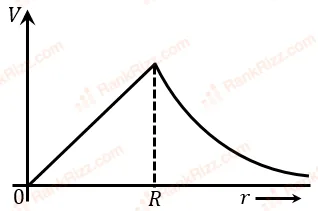
- (B)
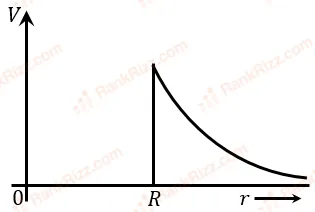
- (C)
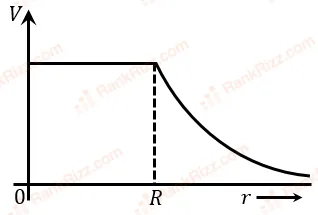
- (D)
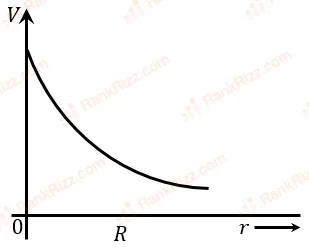
rr2.rankrizz.com/jee-main/physics/electrostatics/q/31-jan-2023-s1-q11
- (A)
For a charged spherical ball, electrostatic potential inside the ball varies with as . Here, and are constant and is the distance from the center. The volume charge density inside the ball is . The value of is ______.
= permittivity of medium.Answer: ____________
rr2.rankrizz.com/jee-main/physics/electrostatics/q/29-jan-2023-s2-q25
The electric potential at the centre of two concentric half rings of radii and , having same linear charge density is
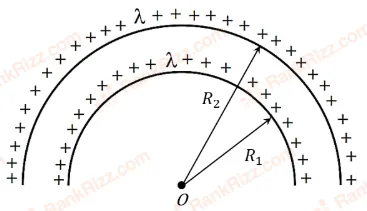
- (A)
- (B)
- (C)
- (D)
rr2.rankrizz.com/jee-main/physics/electrostatics/q/24-jan-2023-s2-q11
- (A)
Given below are two statements.
Statement I: Electric potential is constant within and at the surface of each conductor.
Statement II: Electric field just outside a charged conductor is perpendicular to the surface of the conductor at every point.
In the light of the above statements, choose the most appropriate answer from the options given below.- (A)
Both statement I and statement II are correct
- (B)
Both statement I and statement II are incorrect
- (C)
Statement I is correct but statement II is incorrect
- (D)
Statement I is incorrect but statement II is correct
rr2.rankrizz.com/jee-main/physics/electrostatics/q/29-jul-2022-s1-q12
- (A)
If the electric potential at any point m in space is given by volt. The electric field at the point m will be:
- (A)
3 Vm, directed along positive -axis.
- (B)
3 Vm, directed along negative -axis.
- (C)
6 Vm, directed along negative -axis.
- (D)
6 Vm, directed along positive -axis.
rr2.rankrizz.com/jee-main/physics/electrostatics/q/29-jun-2022-s2-q12
- (A)
identical drops are charged at V each. They combine to form a bigger drop. The potential of the bigger drop will be ______ V.
Answer: ____________
rr2.rankrizz.com/jee-main/physics/electrostatics/q/25-jun-2022-s2-q27
The two thin coaxial rings, each of radius and having charges and respectively are separated by a distance of . The potential difference between the centres of the two rings is:
- (A)
- (B)
- (C)
- (D)
rr2.rankrizz.com/jee-main/physics/electrostatics/q/26-aug-2021-s2-q11
- (A)
27 similar drops of mercury are maintained at 10 V each. All these spherical drops combine into a single big drop. The potential energy of the bigger drop is ______ times that of a smaller drop.
Answer: ____________
rr2.rankrizz.com/jee-main/physics/electrostatics/q/26-feb-2021-s2-q26
512 identical drops of mercury are charged to a potential of 2 V each. The drops are joined to form a single drop. The potential of this drop is ______ V in Volt.
Answer: ____________
rr2.rankrizz.com/jee-main/physics/electrostatics/q/25-feb-2021-s1-q26
A solid sphere of radius carries a charge distributed uniformly over its volume. A very small point like piece of it of mass gets detached from the bottom of the sphere and falls down vertically under gravity. This piece carries charge . If it acquires a speed when it has fallen through a vertical height (see figure), then (assume the remaining portion to be spherical)
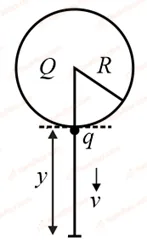
- (A)
- (B)
- (C)
- (D)
rr2.rankrizz.com/jee-main/physics/electrostatics/q/5-sep-2020-s1-q12
- (A)
Ten charges are placed on the circumference of a circle of radius R with constant angular separation between successive charges. Alternate charges 1, 3, 5, 7, 9 have charge each, while 2, 4, 6, 8, 10 have charge each. The potential V and the electric field E at the centre of the circle are respectively: (Take at infinity)
- (A)
;
- (B)
,
- (C)
;
- (D)
;
rr2.rankrizz.com/jee-main/physics/electrostatics/q/5-sep-2020-s2-q10
- (A)
A two point charges and are fixed on the -axis at and , respectively. If the third point charge 'q' is taken from the origin to along the semicircle as shown in the figure, the energy of the charge will:
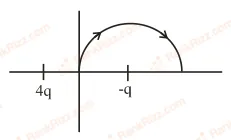
- (A)
Increase by
- (B)
Increase by
- (C)
decrease by
- (D)
decrease by
rr2.rankrizz.com/jee-main/physics/electrostatics/q/4-sep-2020-s1-q11
- (A)
Two isolated conducting spheres and of radius and have 12 and charges, respectively, and are at a large distance from each other. They are now connected by a conducting wire. A long time after this is done the charges on and are respectively:
- (A)
of both
- (B)
and
- (C)
and
- (D)
and
rr2.rankrizz.com/jee-main/physics/electrostatics/q/3-sep-2020-s1-q8
- (A)
Hydrogen ion and singly ionized helium atom are accelerated, from rest, through the same potential difference. The ratio of final speeds of hydrogen and helium ions is close to:
- (A)
- (B)
- (C)
- (D)
rr2.rankrizz.com/jee-main/physics/electrostatics/q/3-sep-2020-s2-q3
- (A)
Concentric metallic hollow spheres of radii R and 4R hold charges and respectively. Given that surface charge densities of the concentric spheres are equal, the potential difference V(R) - V(4R) is:
- (A)
- (B)
- (C)
- (D)
rr2.rankrizz.com/jee-main/physics/electrostatics/q/3-sep-2020-s2-q11
- (A)
A charge Q is distributed over two concentric conducting thin spherical shells radii r and R (R > r). If the surface charge densities on the two shells are equal, the electric potential at the common centre is:
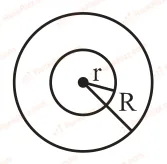
- (A)
- (B)
- (C)
- (D)
rr2.rankrizz.com/jee-main/physics/electrostatics/q/2-sep-2020-s2-q9
- (A)
Consider two charged metallic spheres and of radii and , respectively. The electric fields (on ) and (on ) on their surfaces are such that . Then the ratio (on )/ (on ) of the electrostatic potentials on each sphere is:
- (A)
- (B)
- (C)
- (D)
rr2.rankrizz.com/jee-main/physics/electrostatics/q/8-jan-2020-s2-q11
- (A)
A uniformly charged ring of radius 3a and total charge q is placed in x-y plane centred at origin. A point charge q is moving towards the ring along the z-axis and has speed v at z = 4a. The minimum value of v such that it crosses the origin is:
- (A)
- (B)
- (C)
- (D)
rr2.rankrizz.com/jee-main/physics/electrostatics/q/10-apr-2019-s1-q13
- (A)
In free space, a particle A of charge 1 μC is held fixed at point P. Another particle B of the same charge and mass 4 μg is kept at a distance of 1 mm from P. If B is released, then its velocity at a distance of 9 mm from P is:
[Take N m C]- (A)
1.0 m s
- (B)
m s
- (C)
m s
- (D)
m s
rr2.rankrizz.com/jee-main/physics/electrostatics/q/10-apr-2019-s2-q19
- (A)
A system of three charges are placed as shown in the figure:
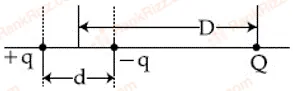
If , the potential energy of the system is best given by:- (A)
- (B)
- (C)
- (D)
rr2.rankrizz.com/jee-main/physics/electrostatics/q/9-apr-2019-s1-q16
- (A)
A solid conducting sphere, having a charge Q, is surrounded by an uncharged conducting hollow spherical shell. Let the potential difference between the surface of the solid sphere and that of the outer surface of the hollow shell be V. If the shell is now given a charge of -4Q, the new potential difference between the same two surfaces is:
- (A)
-2V
- (B)
2 V
- (C)
V
- (D)
4 V
rr2.rankrizz.com/jee-main/physics/electrostatics/q/8-apr-2019-s1-q15
- (A)
A positive point charge is released from rest at a distance from a positive line charge with uniform charge density. The speed (v) of the point charge, as a function of instantaneous distance r from line charge, is proportional to:
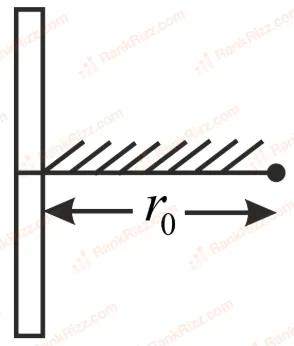
- (A)
- (B)
- (C)
- (D)
rr2.rankrizz.com/jee-main/physics/electrostatics/q/8-apr-2019-s2-q14
- (A)
The electric field in a region is given by , where E is in NC and is in metres. The values of constants are A = 20 SI unit and B = 10 SI unit. If the potential at is and that at is , then is:
- (A)
320 V
- (B)
-520 V
- (C)
180 V
- (D)
-48 V
rr2.rankrizz.com/jee-main/physics/electrostatics/q/8-apr-2019-s2-q16
- (A)
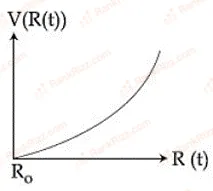
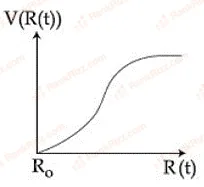
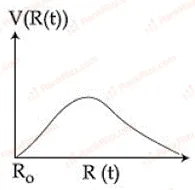
There is a uniform spherically symmetric surface charge density at a distance from the origin. The charge distribution is initially at rest and starts expanding because of mutual repulsion. The figure that represents best the speed of the distribution as a function of its instantaneous radius is:
- (A)
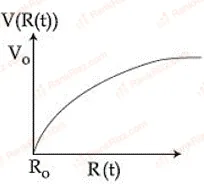
- (B)
- (C)
- (D)
rr2.rankrizz.com/jee-main/physics/electrostatics/q/12-jan-2019-s1-q14
- (A)
The given graph shows variation (with distance r from centre) of:
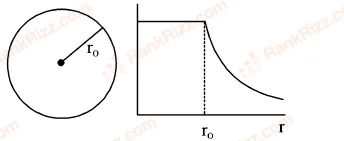
- (A)
Electric field of a uniformly charged sphere
- (B)
Potential of a uniformly charged spherical shell
- (C)
Potential of a uniformly charged sphere
- (D)
Electric field of a uniformly charged spherical shell
rr2.rankrizz.com/jee-main/physics/electrostatics/q/11-jan-2019-s1-q14
- (A)
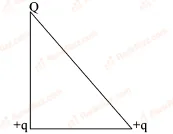
Three charges , and are placed at the vertices of a right-angle isosceles triangle as shown below. The net electrostatic energy of the configuration is zero, if the value of Q is:
- (A)
- (B)
- (C)
- (D)
rr2.rankrizz.com/jee-main/physics/electrostatics/q/11-jan-2019-s1-q15
- (A)
A charge is distributed over three concentric spherical shells of radii , , () such that their surface charge densities are equal to one another. The total potential at a point at distance from their common centre, where , would be:
- (A)
- (B)
- (C)
- (D)
rr2.rankrizz.com/jee-main/physics/electrostatics/q/10-jan-2019-s1-q15
- (A)
Four equal point charges each are placed in the plane at , , and . The work required to put a fifth charge at the origin of the coordinate system will be:
- (A)
- (B)
- (C)
- (D)
rr2.rankrizz.com/jee-main/physics/electrostatics/q/10-jan-2019-s2-q17
- (A)
There is a uniform electrostatic field in a region. The potential at various points on a small sphere centred at , in the region, is found to vary between the limits 589.0 V to 589.8 V. What is the potential at a point on the sphere whose radius vector makes an angle of 60° with the direction of the field?
- (A)
589.4 V
- (B)
589.5 V
- (C)
589.2 V
- (D)
589.6 V
rr2.rankrizz.com/jee-main/physics/electrostatics/q/8-apr-2017-online-q15
- (A)
An electric field N C exists in a region of space. If the potential at the origin is taken to be zero then the potential at m, m is:
- (A)
J C
- (B)
J C
- (C)
J C
- (D)
J C
rr2.rankrizz.com/jee-main/physics/electrostatics/q/11-apr-2015-online-q16
- (A)
A uniformly charged solid sphere of radius R has potential (measured with respect to ) on its surface. For this sphere the equipotential surfaces with potential , , and have radius , , and respectively. Then
Note: This question had two options correct at the time of examination. Proper corrections are made in the question to avoid it.- (A)
- (B)
and
- (C)
and
- (D)
and
rr2.rankrizz.com/jee-main/physics/electrostatics/q/4-apr-2015-offline-q15
- (A)
Assume that an electric field exists in space. Then the potential difference , where is the potential at the origin and the potential at x = 2 m is:
- (A)
120 J C
- (B)
J C
- (C)
J C
- (D)
80 J C
rr2.rankrizz.com/jee-main/physics/electrostatics/q/6-apr-2014-offline-q16
- (A)
This question has Statement-1 and Statement-2. Of the four choices given after the Statements, choose the one that best describes the two Statements.
Statement 1: No work is required to be done to move a test charge between any two points on an equipotential surface.
Statement 2: Electric lines of force at the equipotential surfaces are mutually perpendicular to each other.- (A)
Statement 1 is true, Statement 2 is true, Statement 2 is the correct explanation of Statement 1.
- (B)
Statement 1 is true, Statement 2 is true, Statement 2 is not the correct explanation of Statement 1.
- (C)
Statement 1 is true, Statement 2 is false.
- (D)
Statement 1 is false, Statement 2 is true.
rr2.rankrizz.com/jee-main/physics/electrostatics/q/25-apr-2013-online-q12
- (A)
A charge Q is uniformly distributed over a long rod AB of length L as shown in the figure. The electric potential at the point O lying at a distance L from the end A is :

- (A)
- (B)
- (C)
- (D)
rr2.rankrizz.com/jee-main/physics/electrostatics/q/7-apr-2013-offline-q13
- (A)
This question has statement 1 and statement 2. Of the four choices given after the statements, choose the one that best describes the two statements.
An insulating solid sphere of radius has a uniformly positive charge density . As a result of this uniform charge distribution there is a finite value of electric potential at the centre of the sphere, at the surface of the sphere and also at a point out side the sphere. The electric potential at infinity is zero.
Statement 1: When a charge is taken from the centre to the surface of the sphere, its potential energy changes by .
Statement 2: The electric field at a distance from the centre of the sphere is
- (A)
Statement 1 is true, Statement 2 is true, Statement 2 is not the correct explanation for statement 1.
- (B)
Statement 1 is true, Statement 2 is false
- (C)
Statement 1 is false, Statement 2 is true
- (D)
Statement 1 is true, Statement 2 is the correct explanation for statement 1
rr2.rankrizz.com/jee-main/physics/electrostatics/q/2012-physics-499033
- (A)
This question contains Statement-1 and Statement-2. Of the four choices given after the statements, choose the one that best describes the two statements. Statement - 1: For a charged particle moving from point to point , the net work done by an electrostatic field on the particle is independent of the path connecting point to point . Statement-2: The net work done by a conservative force on an object moving along a closed loop is zero
- (A)
Statement-1 is true, Statement-2 is false
- (B)
Statement-1 is true, Statement-2 is true; Statement-2 is the correct explanation of Statement-1.
- (C)
Statement-1 is true, Statement-2 is true; Statement-2 is not the correct explanation of Statement-1.
- (D)
Statement-1 is false, Statement-2 is true
rr2.rankrizz.com/jee-main/physics/electrostatics/q/2009-physics-499572
- (A)
Two points and are maintained at the potentials of V and V respectively. The work done in moving electrons from to is
- (A)
J
- (B)
J
- (C)
J
- (D)
J
rr2.rankrizz.com/jee-main/physics/electrostatics/q/2009-physics-499574
- (A)
An electric charge is placed at the origin of co-ordinate system. Two points and are situated at and respectively. The potential difference between the points and will be
- (A)
9 volt
- (B)
zero
- (C)
2 volt
- (D)
4.5 volt
rr2.rankrizz.com/jee-main/physics/electrostatics/q/2007-physics-499759
- (A)
Two thin wires rings each having a radius are placed at a distance apart with their axes coinciding. The charges on the two rings are and . The potential difference between the centres of the two rings is
- (A)
- (B)
- (C)
zero
- (D)
rr2.rankrizz.com/jee-main/physics/electrostatics/q/2005-physics-500180
- (A)
A charged particle is shot towards another charged particle which is fixed, with a speed it approaches upto a closest distance and then returns. If were given a speed , the closest distances of approach would be
- (A)
- (B)
- (C)
- (D)
rr2.rankrizz.com/jee-main/physics/electrostatics/q/2004-physics-500219
- (A)
Electric flux and Gauss's law 53
Two point charges C and C are located at cm and cm, respectively on the x-axis. The ratio of electric flux due to these charges through two spheres of radii 3 cm and 5 cm with their centers at the origin is _______.
- (A)
- (B)
- (C)
- (D)
rr2.rankrizz.com/jee-main/physics/electrostatics/q/2-apr-2026-s2-q40
- (A)
The electrostatic potential in a charged spherical region of radius r varies as , where a and b are constants. The total charge in the sphere of unit radius is . the value of is_____. (permittivity of vacuum is )
- (A)
-9
- (B)
-6
- (C)
-12
- (D)
-8
rr2.rankrizz.com/jee-main/physics/electrostatics/q/24-jan-2026-s1-q26
- (A)
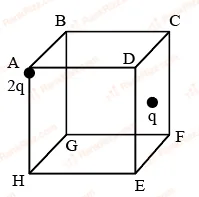
Two point charges 2q and q are placed at vertex A and centre of face CDEF of the cube as shown in figure. The electric flux passing through the cube is :
- (A)
- (B)
- (C)
- (D)
rr2.rankrizz.com/jee-main/physics/electrostatics/q/23-jan-2026-s1-q35
- (A)
An infinitely long wire has uniform linear charge density nC/m. The net flux through a Gaussian cube of side length cm, if the wire passes through two corners of the cube that are maximally displaced from each other, would be NmC, where x is :
[Neglect any edge effects and use SI units]- (A)
- (B)
- (C)
- (D)
rr2.rankrizz.com/jee-main/physics/electrostatics/q/2025-apr-8-s2-q32
- (A)
Given below are two statements : one is labelled as Assertion (A) and the other is labelled as Reason (R).
Assertion (A) : The outer body of an air craft is made of metal which protects persons sitting inside from lightning-strikes.
Reason (R) : The electric field inside the cavity enclosed by a conductor is zero.
In the light of the above statements, choose the most appropriate answer from the options given below :- (A)
Both (A) and (R) are correct and (R) is the correct explanation of (A)
- (B)
(A) is correct but (R) is not correct
- (C)
Both (A) and (R) are correct but (R) is not correct explanation of (A)
- (D)
(A) is not correct but (R) is correct
rr2.rankrizz.com/jee-main/physics/electrostatics/q/2025-apr-7-s2-q26
- (A)
The electric field in a region is given by N/C. The flux of the field through a rectangular surface parallel to x-z plane is 6.0 NmC. The area of the surface is _____ cm.
Answer: ____________
rr2.rankrizz.com/jee-main/physics/electrostatics/q/2025-apr-7-s2-q48
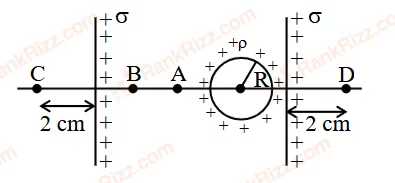
Two infinite identical charged sheets and a charged spherical body of charge density '' are arranged as shown in figure. Then the correct relation between the electrical fields at A, B, C and D points is:
- (A)
- (B)
- (C)
- (D)
rr2.rankrizz.com/jee-main/physics/electrostatics/q/2025-apr-4-s1-q43
- (A)
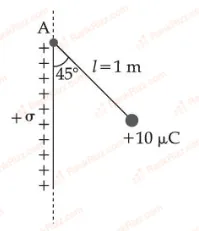
A small bob of mass 100 and charge C is connected to an insulating string of length 1 m. It is brought near to an infinitely long non-conducting sheet of charge density '' as shown in figure. If string subtends an angle of 45° with sheet at equilibrium the charge density of sheet will be:
(Given, F/m and acceleration due to gravity, m/s)
- (A)
0.885 nC/m
- (B)
17.7 nC/m
- (C)
885 nC/m
- (D)
1.77 nC/m
rr2.rankrizz.com/jee-main/physics/electrostatics/q/2025-apr-02-s1-q44
- (A)
A point charge causes an electric flux of to pass through a spherical Gaussian surface of 8.0 cm radius, centred on the charge. The value of the point charge is : (Given )
- (A)
- (B)
- (C)
- (D)
rr2.rankrizz.com/jee-main/physics/electrostatics/q/29-jan-2025-s2-q44
- (A)
A square loop of sides is held normally in front of a point charge The flux of the electric field through the shaded region is , where the value of is
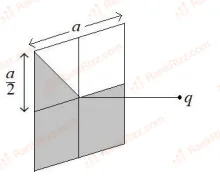
Answer: ____________
rr2.rankrizz.com/jee-main/physics/electrostatics/q/24-jan-2025-s1-q47
A line charge of length is kept at the center of an edge BC of a cube ABCDEFGH having edge length 'a' as shown in the figure. If the density of line charge is per unit length, then the total electric flux through
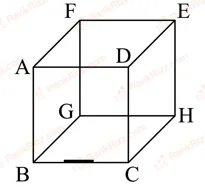
all the faces of the cube will be . (Take, as the free space permittivity)
- (A)
- (B)
- (C)
- (D)
rr2.rankrizz.com/jee-main/physics/electrostatics/q/22-jan-2025-s1-q38
- (A)
Five charges and are situated as shown in the figure.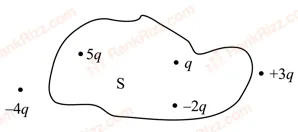
The electric flux due to this configuration through the surface is :
- (A)
- (B)
- (C)
- (D)
rr2.rankrizz.com/jee-main/physics/electrostatics/q/9-apr-2024-s2-q9
- (A)
An electric field exists in space. A cube of side is placed in the space as per figure given below.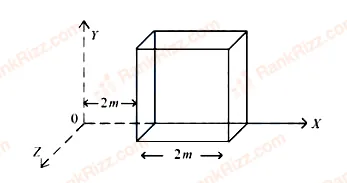
The electric flux through the cube is ______ .
Answer: ____________
rr2.rankrizz.com/jee-main/physics/electrostatics/q/9-apr-2024-s2-q26
An electric field, passes through the surface of area having unit vector . The electric flux for that surface is ______ Vm.
Answer: ____________
rr2.rankrizz.com/jee-main/physics/electrostatics/q/8-apr-2024-s1-q25
is the uniform surface charge density of a thin spherical shell of radius . The electric field at any point on the surface of the spherical shell is :
- (A)
- (B)
- (C)
- (D)
rr2.rankrizz.com/jee-main/physics/electrostatics/q/6-apr-2024-s1-q11
- (A)
A charge is placed at the center of one of the surface of a cube. The flux linked with the cube is:
- (A)
- (B)
- (C)
Zero
- (D)
rr2.rankrizz.com/jee-main/physics/electrostatics/q/04-apr-2024-s2-q11
- (A)
and are two hollow concentric cubes enclosing charges and respectively as shown in figure. The ratio of electric flux passing through and is
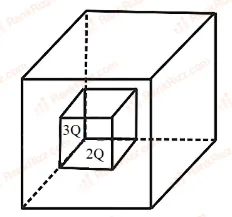
- (A)
2 : 5
- (B)
5 : 2
- (C)
2 : 3
- (D)
3 : 2
rr2.rankrizz.com/jee-main/physics/electrostatics/q/01-feb-2024-s2-q10
- (A)
A particle of charge and mass moves in a circle of radius around an infinitely long line charge of linear density . Then time period will be given as: (Consider as Coulomb's constant)
- (A)
- (B)
- (C)
- (D)
rr2.rankrizz.com/jee-main/physics/electrostatics/q/30-jan-2024-s2-q10
- (A)
Two charges of and are situated at the points and respectively. The electric flux through a sphere of radius having centre at origin is:
- (A)
- (B)
- (C)
- (D)
rr2.rankrizz.com/jee-main/physics/electrostatics/q/29-jan-2024-s1-q10
- (A)
An electric field is given by N C. The electric flux through a surface area m lying in YZ-plane (in SI unit) is:
- (A)
- (B)
- (C)
- (D)
rr2.rankrizz.com/jee-main/physics/electrostatics/q/29-jan-2024-s2-q11
- (A)
A capacitor of capacitance is charged to a potential . The flux of the electric field through a closed surface enclosing the positive plate of the capacitor is:
- (A)
- (B)
Zero
- (C)
- (D)
rr2.rankrizz.com/jee-main/physics/electrostatics/q/11-apr-2023-s2-q11
- (A)
A cubical volume is bounded by the surfaces , , , , , . The electric field in the region is given by . Where NC m. If cm, the charge contained in the cubical volume is C. The value of is ______. (Take C Nm)
Answer: ____________
rr2.rankrizz.com/jee-main/physics/electrostatics/q/01-feb-2023-s2-q26
Expression for an electric field is given by V m. The electric flux through the cube of side 20 cm when placed in electric field (as shown in the figure) is ______ V cm.
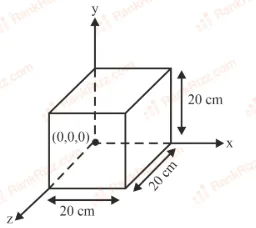
Answer: ____________
rr2.rankrizz.com/jee-main/physics/electrostatics/q/31-jan-2023-s1-q26
As shown in figure, a cuboid lies in a region with electric field N C. The magnitude of charge within the cuboid is C. The value of is ______ (if dimension of cuboid is m)
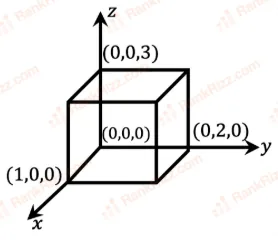
Answer: ____________
rr2.rankrizz.com/jee-main/physics/electrostatics/q/30-jan-2023-s2-q25
In a cuboid of dimension , a charge is placed at the centre of the surface having area of . The flux through the opposite surface to is given by
- (A)
- (B)
- (C)
- (D)
rr2.rankrizz.com/jee-main/physics/electrostatics/q/29-jan-2023-s1-q10
- (A)
A spherically symmetric charge distribution is considered with charge density varying as
Where, is the distance from the centre O (as shown in figure). The electric field at point P will be: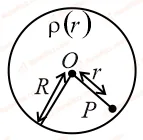
- (A)
- (B)
- (C)
- (D)
rr2.rankrizz.com/jee-main/physics/electrostatics/q/29-jul-2022-s1-q11
- (A)
A long cylindrical volume contains a uniformly distributed charge of density . The electric field inside the cylindrical volume at a distance from its axis is ______ .
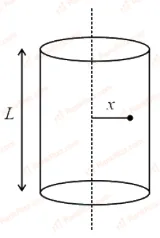
Answer: ____________
rr2.rankrizz.com/jee-main/physics/electrostatics/q/27-jul-2022-s1-q26
If a charge is placed at the centre of a closed hemispherical non-conducting surface, the total flux passing through the flat surface would be
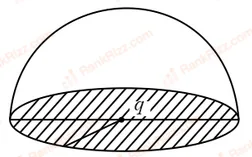
- (A)
- (B)
- (C)
- (D)
rr2.rankrizz.com/jee-main/physics/electrostatics/q/27-jun-2022-s2-q13
- (A)
A long cylindrical volume contains a uniformly distributed charge of density . The radius of cylindrical volume is . A charge particle () revolves around the cylinder in a circular path. The kinetic energy of the particle is :
- (A)
- (B)
- (C)
- (D)
rr2.rankrizz.com/jee-main/physics/electrostatics/q/24-jun-2022-s2-q12
- (A)
A cube is placed inside an electric field, . The side of the cube is 0.5 m and is placed in the field as shown in the given figure. The charge inside the cube is:
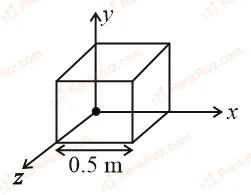
- (A)
C
- (B)
C
- (C)
C
- (D)
C
rr2.rankrizz.com/jee-main/physics/electrostatics/q/1-sep-2021-s2-q11
- (A)
Choose the incorrect statement:
(a) The electric lines of force entering into a Gaussian surface provide negative flux.
(b) A charge is placed at the centre of a cube. The flux through all the faces will be the same.
(c) In a uniform electric field net flux through a closed Gaussian surface containing no net charge, is zero.
(d) When an electric field is parallel to a Gaussian surface, it provides a finite non-zero flux.
Choose the most appropriate answer from the options given below:- (A)
(b) and (d) Only
- (B)
(c) and (d) Only
- (C)
(a) and (c) Only
- (D)
(d) Only
rr2.rankrizz.com/jee-main/physics/electrostatics/q/31-aug-2021-s2-q12
- (A)
The total charge enclosed in an incremental volume of m located at the origin is ___ nC, if electric flux density of its field is found as C m
Answer: ____________
rr2.rankrizz.com/jee-main/physics/electrostatics/q/22-jul-2021-s1-q27
The electric field in a region is given by with N C. The flux of this field through a rectangular surface, area 0.4 m parallel to the plane is ________ N m C.
Answer: ____________
rr2.rankrizz.com/jee-main/physics/electrostatics/q/17-mar-2021-s2-q26
The electric field in a region is given by N C. The ratio of flux of reported field through the rectangular surface of area 0.2 m (parallel to plane) to that of the surface of area 0.3 m (parallel to plane) is , where = ______?[Here and are unit vectors along and -axes respectively]
Answer: ____________
rr2.rankrizz.com/jee-main/physics/electrostatics/q/25-feb-2021-s1-q25
A charge is placed at one corner of a cube as shown in figure. The flux of electrostatic field through the shaded area is:
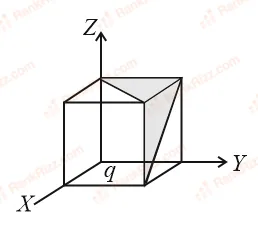
- (A)
- (B)
- (C)
- (D)
rr2.rankrizz.com/jee-main/physics/electrostatics/q/25-feb-2021-s2-q9
- (A)
A point charge of is at a distance 6 cm vertically above the centre of a square of side 12 cm as shown in figure. The magnitude of the electric flux through the square will be ______ N m C.
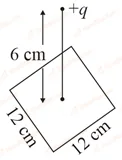
Answer: ____________
rr2.rankrizz.com/jee-main/physics/electrostatics/q/24-feb-2021-s2-q26
An electric field N/C passes through the box shown in figure. The flux of the electric field through surfaces ABCD and BCGF are marked as and respectively. The absolute difference between is (in Nm/C) ___________.
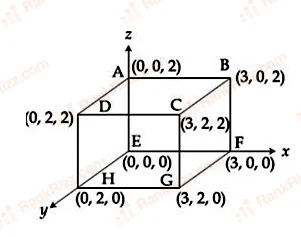
Answer: ____________
rr2.rankrizz.com/jee-main/physics/electrostatics/q/9-jan-2020-s2-q22
In finding the electric field using Gauss law the formula is applicable. In the formula is permittivity of free space, A is the area of the Gaussian surface and is charge enclosed by the Gaussian surface. This equation can be used in which of the following situation?
- (A)
Only when the Gaussian surface is an equipotential surface
- (B)
Only when the Gaussian surface is an equipotential surface and is constant on the surface.
- (C)
Only when = constant on the surface.
- (D)
For any choice of Gaussian surface.
rr2.rankrizz.com/jee-main/physics/electrostatics/q/8-jan-2020-s1-q11
- (A)
Let a total charge 2Q be distributed in a sphere of radius R, with the charge density given by , where r is the distance from the centre. Two charges A and B, of -Q each, are placed on diametrically opposite points, at equal distance, a, from the centre. If A and B do not experience any force, then:
- (A)
a =
- (B)
a =
- (C)
a =
- (D)
a =
rr2.rankrizz.com/jee-main/physics/electrostatics/q/12-apr-2019-s2-q16
- (A)
A charge Q is placed at a distance a/2 above the centre of the square surface of edge a as shown in the figure. The electric flux through the square surface is:
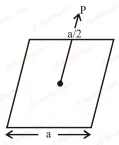
- (A)
- (B)
- (C)
- (D)
rr2.rankrizz.com/jee-main/physics/electrostatics/q/15-apr-2018-s1-q14
- (A)
Four closed surfaces and corresponding charge distributions are shown below.
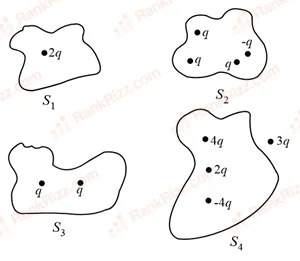
Let the respective electric fluxes through the surfaces be , , and . Then:
- (A)
- (B)
- (C)
;
- (D)
rr2.rankrizz.com/jee-main/physics/electrostatics/q/9-apr-2017-online-q15
- (A)
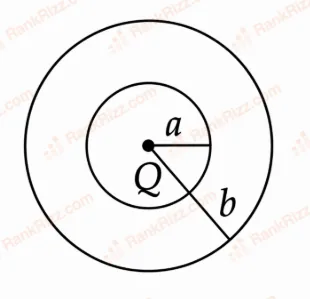
The region between two concentric spheres of radii 'a' and 'b', respectively (see figure), has volume charge density , where A is a constant and r is the distance from the centre. At the centre of the spheres is a point charge Q. The value of A such that the electric field in the region between the spheres will be constant, is:
- (A)
- (B)
- (C)
- (D)
rr2.rankrizz.com/jee-main/physics/electrostatics/q/3-apr-2016-offline-q13
- (A)
The electric field in a region of space is given by, where N C. The flux of this field through a circular surface of radius 0.02 m parallel to the Y-Z plane is nearly:
- (A)
0.02 N m C
- (B)
0.005 N m C
- (C)
0.125 N m C
- (D)
3.14 N m C
rr2.rankrizz.com/jee-main/physics/electrostatics/q/19-apr-2014-online-q16
- (A)
A spherically symmetric charge distribution is characterised by the following charge density variations: for , for . Where r is the distance from the centre of the charge distribution and is a constant. The electric field at an internal point () is:
- (A)
- (B)
- (C)
- (D)
rr2.rankrizz.com/jee-main/physics/electrostatics/q/12-apr-2014-online-q16
- (A)
A cone of base radius R and height h is located in a uniform electric field parallel to its base. The electric flux entering the cone is:
- (A)
- (B)
EhR
- (C)
2EhR
- (D)
4EhR
rr2.rankrizz.com/jee-main/physics/electrostatics/q/11-apr-2014-online-q16
- (A)
The magnitude of the average electric field normally present in the atmosphere just above the surface of the Earth is about 150 N/C, directed inward towards the center of the Earth. This gives the total net surface charge carried by the Earth to be: [Given: C/N-m, m]
- (A)
kC
- (B)
kC
- (C)
kC
- (D)
kC
rr2.rankrizz.com/jee-main/physics/electrostatics/q/9-apr-2014-online-q16
- (A)
In a uniformly charged sphere of total charge and radius , the electric field is plotted as a function of distance from the centre. The graph which would correspond to the above will be
- (A)
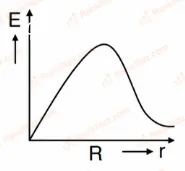
- (B)
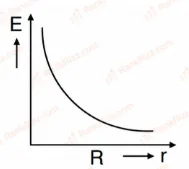
- (C)
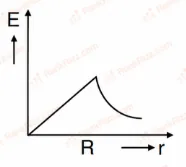
- (D)
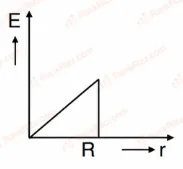
rr2.rankrizz.com/jee-main/physics/electrostatics/q/2012-physics-499032
- (A)
The electric potential in a region around the origin is given by volts. The electric charge enclosed in a cube of 1 m side with its centre at the origin is (in coulomb)
- (A)
- (B)
- (C)
0
- (D)
rr2.rankrizz.com/jee-main/physics/electrostatics/q/2012-physics-499125
- (A)
The flat base of a hemisphere of radius with no charge inside it lies in a horizontal plane. A uniform electric field is applied at an angle with the vertical direction. The electric flux through the curved surface of the hemisphere is
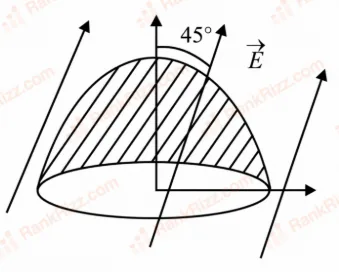
- (A)
- (B)
- (C)
- (D)
rr2.rankrizz.com/jee-main/physics/electrostatics/q/2012-physics-499284
- (A)
The electrostatic potential inside a charged spherical ball is given by where is the distance from the centre; are constants. Then the charge density inside ball is:
- (A)
- (B)
- (C)
- (D)
rr2.rankrizz.com/jee-main/physics/electrostatics/q/2011-physics-499486
- (A)
Let there be a spherically symmetric charge distribution with charge density varying as upto , and for , where is the distance from the origin. The electric field at a distance () from the origin is given by
- (A)
- (B)
- (C)
- (D)
rr2.rankrizz.com/jee-main/physics/electrostatics/q/2010-physics-499635
- (A)
Let be the charge density distribution for a solid sphere of radius and total charge . For a point '' inside the sphere at distance from the centre of the sphere, the magnitude of electric field is
- (A)
- (B)
- (C)
- (D)
rr2.rankrizz.com/jee-main/physics/electrostatics/q/2009-physics-499573
- (A)
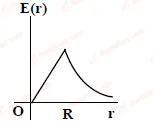
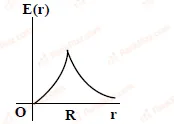
A thin spherical shell of radius has charge spread uniformly over its surface. Which of the following graphs most closely represents the electric field produced by the shell in the range , where is the distance from the centre of the shell?
- (A)
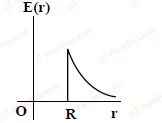
- (B)
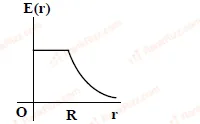
- (C)
- (D)
rr2.rankrizz.com/jee-main/physics/electrostatics/q/2008-physics-499879
- (A)
Electric charge and Coulomb's law 42
Two point charges and are placed at points and respectively. Force on charge is __________ N.
- (A)
- (B)
- (C)
- (D)
rr2.rankrizz.com/jee-main/physics/electrostatics/q/8-apr-2026-s2-q41
- (A)
A point charge q = l is located at a distance 2 cm from one end of a thin insulating wire of length 10 cm having a charge Q = 24 , distributed uniformly along its length, as shown in figure. Force between q and wire is __ N.
(Use: )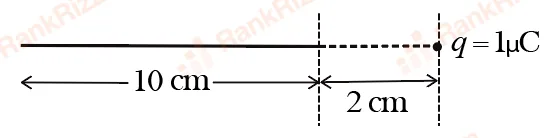
Answer: ____________
rr2.rankrizz.com/jee-main/physics/electrostatics/q/24-jan-2026-s2-q49
A small uncharged conducting sphere is placed in contact with an identical sphere but having charge and then removed to a distance such that the force of repulsion between them is . The distance between them is
- (A)
3 cm
- (B)
2 cm
- (C)
4 cm
- (D)
1 cm
rr2.rankrizz.com/jee-main/physics/electrostatics/q/24-jan-2025-s2-q34
- (A)
A positive ion A and a negative ion B has charges and , and masses and respectively. At an instant, the ions are separated by a certain distance r. At that instant the ratio of the magnitudes of electrostatic force to gravitational force is , where the value of 10P is (Take and universal gravitational constant as )
Assume that charge may not be an integral multiple of electrons.Answer: ____________
rr2.rankrizz.com/jee-main/physics/electrostatics/q/23-jan-2025-s1-q46
Two identical conducting spheres and with charge on each, repel each other with a force . A third identical uncharged conducting sphere is successively brought in contact with the two spheres. The new force of repulsion between and is :
- (A)
- (B)
- (C)
- (D)
rr2.rankrizz.com/jee-main/physics/electrostatics/q/6-apr-2024-s2-q10
- (A)
In hydrogen like system the ratio of coulombian force and gravitational force between an electron and a proton is in the order of :
- (A)
- (B)
- (C)
- (D)
rr2.rankrizz.com/jee-main/physics/electrostatics/q/5-apr-2024-s1-q8
- (A)
The vehicles carrying inflammable fluids usually have metallic chains touching the ground :
- (A)
To protect tyres from catching dirt from ground
- (B)
To alert other vehicles
- (C)
It is a custom
- (D)
To conduct excess charge due to air friction to ground and prevent sparking
rr2.rankrizz.com/jee-main/physics/electrostatics/q/05-apr-2024-s2-q10
- (A)
Two identical charged spheres are suspended by strings of equal lengths. The strings make an angle with each other. When suspended in water the angle remains the same. If density of the material of the sphere is g/cc, the dielectric constant of water will be ______. (Take density of water g/cc)
Answer: ____________
rr2.rankrizz.com/jee-main/physics/electrostatics/q/01-feb-2024-s1-q25
Force between two point charges and placed in vacuum at cm apart is . Force between them when placed in a medium having dielectric at cm apart will be:
- (A)
- (B)
- (C)
- (D)
rr2.rankrizz.com/jee-main/physics/electrostatics/q/31-jan-2024-s2-q10
- (A)
Two identical charged spheres are suspended by strings of equal lengths. The string make an angle of with each other. When suspended in a liquid of density g cm, the angle remains same. If density of material of the sphere is g cm, the dielectric constant of the liquid is _____ ()
Answer: ____________
rr2.rankrizz.com/jee-main/physics/electrostatics/q/30-jan-2024-s2-q26
A thin metallic wire having cross sectional area of is used to make a ring of radius cm. A positive charge of C is uniformly distributed over the ring, while another positive charge of pC is kept at the centre of the ring. The tension in the ring is _______ N; provided that the ring does not get deformed (neglect the influence of gravity). (Given, SI units)
Answer: ____________
rr2.rankrizz.com/jee-main/physics/electrostatics/q/27-jan-2024-s1-q25
A C charge is divided into two parts and placed at cm distance so that the repulsive force between them is maximum. The charges of the two parts are:
- (A)
C, C
- (B)
C, C
- (C)
C, C
- (D)
C, C
rr2.rankrizz.com/jee-main/physics/electrostatics/q/13-apr-2023-s2-q11
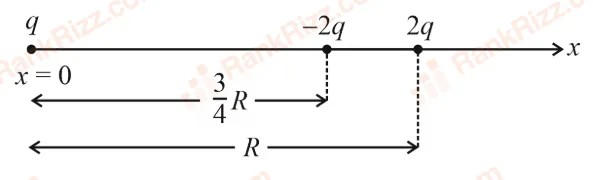
- (A)
Three point charges , and are placed on x axis at a distance , and respectively from origin as shown. If C and cm, the magnitude of net force experienced by the charge is _____ N.
Answer: ____________
rr2.rankrizz.com/jee-main/physics/electrostatics/q/13-apr-2023-s2-q25
As shown in the figure, a configuration of two equal point charges is placed on an inclined plane. Mass of each point charge is 20 g. Assume that there is no friction between charge and plane. For the system of two point charges to be in equilibrium (at rest) the height m. The value of x is _______
Take N m C, m s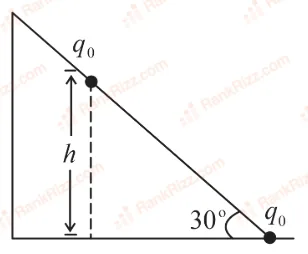
Answer: ____________
rr2.rankrizz.com/jee-main/physics/electrostatics/q/11-apr-2023-s1-q26
A point charge is placed at origin. Another point charge is placed at cm. Charge of proton is . The proton is placed on -axis so that the electrostatic force on the proton in zero. In this situation, the position of the proton from the origin is ______ cm.
Answer: ____________
rr2.rankrizz.com/jee-main/physics/electrostatics/q/29-jan-2023-s1-q25
If two charges and are separated with distance and placed in a medium of dielectric constant . What will be the equivalent distance between charges in air for the same electrostatic force?
- (A)
- (B)
- (C)
- (D)
rr2.rankrizz.com/jee-main/physics/electrostatics/q/24-jan-2023-s1-q10
- (A)
If two charges and are separated with distance and placed in a medium of dielectric constant . What will be the equivalent distance between charges in air for the same electrostatic force?
- (A)
- (B)
- (C)
- (D)
rr2.rankrizz.com/jee-main/physics/electrostatics/q/24-jan-2023-s1-q10-494025
- (A)
Two identical metallic spheres A and B when placed at certain distance in air repel each other with a force of F. Another identical uncharged sphere C is first placed in contact with A and then in contact with B and finally placed at midpoint between spheres A and B. The force experienced by sphere C will be:
- (A)
- (B)
- (C)
F
- (D)
2F
rr2.rankrizz.com/jee-main/physics/electrostatics/q/29-jul-2022-s2-q10
- (A)
Two identical positive charges each are fixed at a distance of apart from each other. Another point charge with mass is placed at midpoint between two fixed charges. For a small displacement along the line joining the fixed charges, the charge executes SHM. The time period of oscillation of charge will be
- (A)
- (B)
- (C)
- (D)
rr2.rankrizz.com/jee-main/physics/electrostatics/q/27-jul-2022-s1-q10
- (A)
A charge of is to be divided into two. The distance between the two divided charges is constant. The magnitude of the divided charges so that the force between them is maximum, will be:
- (A)
and
- (B)
and
- (C)
and
- (D)
and
rr2.rankrizz.com/jee-main/physics/electrostatics/q/27-jul-2022-s2-q10
- (A)
Three point charges of magnitude , and are located at the vertices , , of a right angled triangle whose sides are , and and point is the right angle corner. Charge at point experiences ______ N of electrostatic force due to the other two charges.
Answer: ____________
rr2.rankrizz.com/jee-main/physics/electrostatics/q/26-jul-2022-s2-q25
Two point charges each are placed at a distance apart. A third point charge is placed at a distance from mid-point on the perpendicular bisector. The value of at which charge will experience the maximum Coulomb's force is:
- (A)
- (B)
- (C)
- (D)
rr2.rankrizz.com/jee-main/physics/electrostatics/q/29-jun-2022-s2-q11
- (A)
Three identical charged balls each of charge are suspended from a common point by silk threads of m each (as shown in figure). They form an equilateral triangle of side m. The ratio of net force on a charged ball to the force between any two charged balls will be
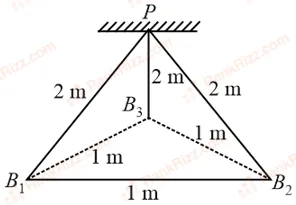
- (A)
- (B)
- (C)
- (D)
rr2.rankrizz.com/jee-main/physics/electrostatics/q/27-jun-2022-s2-q14
- (A)
Two identical charged particles each having a mass g and charge C are placed on a horizontal table with a separation of between them such that they stay in limited equilibrium. If the coefficient of friction between each particle and the table is , find the value of . [Use ms]
- (A)
12 cm
- (B)
10 cm
- (C)
8 cm
- (D)
5 cm
rr2.rankrizz.com/jee-main/physics/electrostatics/q/24-jun-2022-s2-q11
- (A)
Two identical tennis balls each having mass and charge are suspended from a fixed point by threads of length . What is the equilibrium separation when each thread makes a small angle with the vertical?
- (A)
- (B)
- (C)
- (D)
rr2.rankrizz.com/jee-main/physics/electrostatics/q/27-jul-2021-s1-q11
- (A)
A particle of mass 1 mg and charge is lying at the mid-point of two stationary particles kept at a distance 2 m when each is carrying same charge . If the free charged particle is displaced from its equilibrium position through distance ( m). The particle executes SHM. Its angular frequency of oscillation will be ___ rad s (if )
Answer: ____________
rr2.rankrizz.com/jee-main/physics/electrostatics/q/25-jul-2021-s1-q25
A certain charge is divided into two parts and . How should the charges and be divided so that and placed at a certain distance apart experience maximum electrostatic repulsion?
- (A)
- (B)
- (C)
- (D)
rr2.rankrizz.com/jee-main/physics/electrostatics/q/20-jul-2021-s1-q10
- (A)
An infinite number of point charges, each carrying charge, are placed along the y-axis at m, 2 m, 4 m, 8 m .....
The total force on a 1 C point charge, placed at the origin, is N. The value of , to the nearest integer, is ___.
[Take N m C]Answer: ____________
rr2.rankrizz.com/jee-main/physics/electrostatics/q/18-mar-2021-s2-q26
Two small spheres each of mass 10 mg are suspended from a point by threads 0.5 m long. They are equally charged and repel each other to a distance of 0.20 m. The charge on each of the sphere is C. The value of will be ______. [Given m s]
Answer: ____________
rr2.rankrizz.com/jee-main/physics/electrostatics/q/25-feb-2021-s2-q27
Two identical conducting spheres with negligible volume have 2.1 nC and nC charges, respectively. They are brought into contact and then separated by a distance of 0.5 m. The electrostatic force acting between the spheres is ______ N.
[Given : = SI Units}]Answer: ____________
rr2.rankrizz.com/jee-main/physics/electrostatics/q/25-feb-2021-s2-q28
Two electrons each are fixed at a distance 2d. A third charge proton placed at the midpoint is displaced slightly by a distance perpendicular to the line joining the two fixed charges. Proton will execute simple harmonic motion having angular frequency:
( = mass of charged particle)- (A)
- (B)
- (C)
- (D)
rr2.rankrizz.com/jee-main/physics/electrostatics/q/24-feb-2021-s2-q10
- (A)
Three charges , , are placed respectively, at distance, , and from the origin, on the -axis. If the net force experienced by , placed at , is zero, then value of is:
- (A)
- (B)
- (C)
- (D)
rr2.rankrizz.com/jee-main/physics/electrostatics/q/9-jan-2019-s1-q14
- (A)
Charge is distributed within a sphere of radius with a volume charge density , where and are constants. If is the total charge of this charge distribution, the radius is:
- (A)
- (B)
- (C)
- (D)
rr2.rankrizz.com/jee-main/physics/electrostatics/q/9-jan-2019-s2-q14
- (A)
Two identical conducting spheres A and B carry an equal charge. They are separated by a distance much larger than their diameters, and the force between them is F. A third identical conducting sphere, C, is uncharged. Sphere C is first touched to A, then to B, and then removed. As a result, force between A and B would be equal to:
- (A)
- (B)
- (C)
- (D)
F
rr2.rankrizz.com/jee-main/physics/electrostatics/q/16-apr-2018-online-q15
- (A)
Two balls of same mass and carrying equal charge are hung from a fixed support of length . At electrostatic equilibrium, assuming that angles made by each thread is small, the separation, x between the balls is proportional to :
- (A)
- (B)
- (C)
- (D)
rr2.rankrizz.com/jee-main/physics/electrostatics/q/9-apr-2013-online-q15
- (A)
Two charges, each equal to q, are kept at and on the x-axis. A particle of mass m and charge is placed at the origin. If charge is given a small displacement () along the y-axis, the net force acting on the particle is proportional to :
- (A)
- (B)
- (C)
- (D)
rr2.rankrizz.com/jee-main/physics/electrostatics/q/7-apr-2013-offline-q10
- (A)
Two identical charged spheres suspended from a common point by two massless strings of length are initially a distance apart because of their mutual repulsion. The charge begins to leak from both the spheres at a constant rate. As a result the charges approach each other with a velocity . Then as a function of distance between them,
- (A)
- (B)
- (C)
- (D)
rr2.rankrizz.com/jee-main/physics/electrostatics/q/2011-physics-499485
- (A)
Two identical charged spheres are suspended by strings of equal lengths. The strings make an angle of with each other. When suspended in a liquid of density g cm, the angle remains the same. If density of the material of the sphere is g cm, the dielectric constant of the liquid is
- (A)
4
- (B)
3
- (C)
2
- (D)
1
rr2.rankrizz.com/jee-main/physics/electrostatics/q/2010-physics-499636
- (A)
A charge is placed at each of the opposite corners of a square. A charge is placed at each of the other two corners. If the net electrical force on is zero, then the equals
- (A)
- (B)
- (C)
- (D)
rr2.rankrizz.com/jee-main/physics/electrostatics/q/2009-physics-499575
- (A)
If and are the accelerations due to gravity on the surfaces of the earth and the moon respectively and if Millikan's oil drop experiment could be performed on the two surfaces, one will find the ratio to be
- (A)
1
- (B)
0
- (C)
- (D)
rr2.rankrizz.com/jee-main/physics/electrostatics/q/2007-physics-499762
- (A)
Two spherical conductor and having equal radii and carrying equal charges in them repel each other with a force when kept apart at some distance. A third spherical conductor having same radius as that of but uncharged brought in contact with , then brought in contact with and finally removed away from both. The new force of repulsion, between and is
- (A)
- (B)
- (C)
- (D)
rr2.rankrizz.com/jee-main/physics/electrostatics/q/2004-physics-500217
- (A)
Four charges equal to are placed at the four corners of a square and a charge is at its centre. If the system is in equilibrium the value of is
- (A)
- (B)
- (C)
- (D)
rr2.rankrizz.com/jee-main/physics/electrostatics/q/2004-physics-500222
- (A)
Electric field of continuous charge distributions 42
A thin half ring of radius 35 cm is uniformly charged with a total charge of coulomb. If the magnitude of the electric field at centre of the half ring is 100 V/m, then the value of is _______ nC.
C/Nm and- (A)
2.14
- (B)
2.44
- (C)
3.25
- (D)
0.7
rr2.rankrizz.com/jee-main/physics/electrostatics/q/6-apr-2026-s1-q38
- (A)
Identify the correct statements :
A. Electrostatic field lines form closed loops .
B. The eleclric field lines point radially outward when charge is greater than zero.
C. The Gauss - Law is valid only for inverse - square force.
D. The workdone in moving a charged particle in a static eleclric field around a closed path is zero.
E. The motion of a particle under Coulomb's force must take place in a plane.
Choose the correct answer from the options given below:- (A)
A, C, E Only
- (B)
A, B, D, E Only
- (C)
B, C, D, E Only
- (D)
A, B, C, D Only
rr2.rankrizz.com/jee-main/physics/electrostatics/q/28-jan-2026-s2-q34
- (A)
A simple pendulum has a bob with mass and charge . The pendulum string has negligible mass. When a uniform and horizontal electric field it is applied, the tension in the string changes. The final tension in the string, when pendulum attains an equilibrium position is ______.
(: acceleration due to gravity)- (A)
- (B)
- (C)
- (D)
rr2.rankrizz.com/jee-main/physics/electrostatics/q/22-jan-2026-s1-q45
- (A)
A metallic ring is uniformly charged as shown in figure. AC and BD are two mutually perpendicular diameters. Electric field due to arc AB to 'O' is 'E' is magnitude. What would be the magnitude of electric field at 'O' due to arc ABC?
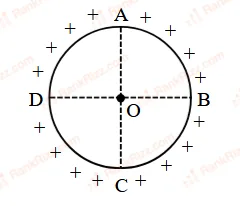
- (A)
- (B)
- (C)
- (D)
Zero
rr2.rankrizz.com/jee-main/physics/electrostatics/q/2025-apr-4-s2-q32
- (A)
Consider two infinitely large plane parallel conducting plates as shown below. The plates are uniformly charged with a surface charge density and . The force experienced by a point charge placed at the mid point between two plates will be:
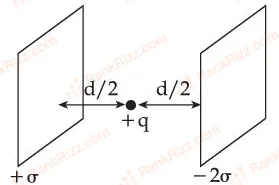
- (A)
- (B)
- (C)
- (D)
rr2.rankrizz.com/jee-main/physics/electrostatics/q/2025-apr-02-s1-q30
- (A)
A point charge is placed at the origin. A second point charge is placed at in Cartesian coordinate system. The point in between them where the electric field vanishes is:
- (A)
- (B)
- (C)
- (D)
rr2.rankrizz.com/jee-main/physics/electrostatics/q/2025-apr-02-s1-q32
- (A)
Consider a circular loop that is uniformly charged and has a radius . Find the position along the positive z-axis of the cartesian coordinate system where the electric field is maximum if the ring was assumed to be placed in xy-plane at the origin :
- (A)
- (B)
- (C)
- (D)
rr2.rankrizz.com/jee-main/physics/electrostatics/q/2025-apr-02-s2-q45
- (A)
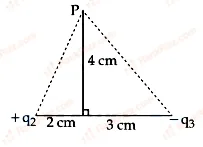
If the net electric field at point P along Y axis is zero, then the ratio of is , where _____
Answer: ____________
rr2.rankrizz.com/jee-main/physics/electrostatics/q/8-apr-2024-s2-q25
An infinite plane sheet of charge having uniform surface charge density is placed on x−y plane. Another infinitely long line charge having uniform linear charge density is placed at z = 4 m plane and parallel to y-axis. If the magnitude values , then at point (0, 0, 2), the ratio of magnitudes of electric field values due to sheet charge to that of line charge is . The value of n is _____.
Answer: ____________
rr2.rankrizz.com/jee-main/physics/electrostatics/q/04-apr-2024-s1-q25
A thin infinite charged sheet and an infinite line charge of respective charge densities and are placed parallel at m distance from each other. Points P and Q are at m and m perpendicular distances from line charge towards sheet charge, respectively. and are the magnitudes of resultant electric field intensities at point P and Q respectively. If for , then the value of is _____.
Answer: ____________
rr2.rankrizz.com/jee-main/physics/electrostatics/q/13-apr-2023-s1-q24
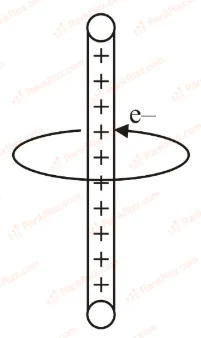
An electron revolves around an infinite cylindrical wire having uniform linear charge density C m in circular path under the influence of attractive electrostatic field as shown in the figure. The velocity of electron with which it is revolving is _______ m s. Given mass of electron kg
Answer: ____________
rr2.rankrizz.com/jee-main/physics/electrostatics/q/10-apr-2023-s2-q25
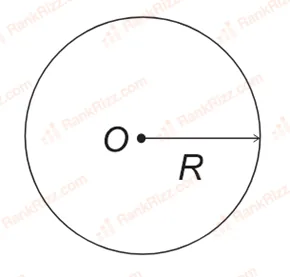
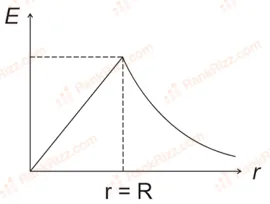
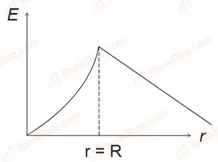
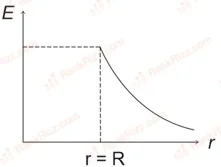
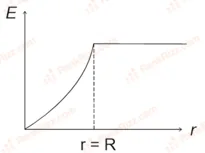
Graphical variation of electric field due to a uniformly charged insulating solid sphere of radius R, with distance r from the centre O is represented by:
- (A)
- (B)
- (C)
- (D)
rr2.rankrizz.com/jee-main/physics/electrostatics/q/8-apr-2023-s1-q12
- (A)
Let be the uniform surface charge density of two infinite thin plane sheets as shown in the figure. Then the electric fields in three different regions, , and are:
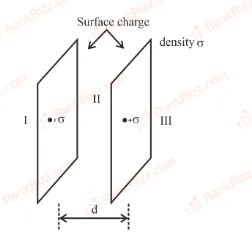
- (A)
- (B)
- (C)
- (D)
rr2.rankrizz.com/jee-main/physics/electrostatics/q/01-feb-2023-s1-q11
- (A)
Two equal positive point charges are separated by a distance . The distance of a point from the centre of the line joining two charges on the equatorial line (perpendicular bisector) at which force experienced by a test charge becomes maximum is . The value of is _____.
Answer: ____________
rr2.rankrizz.com/jee-main/physics/electrostatics/q/01-feb-2023-s1-q25
As shown in the figure, a point charge is placed at the centre of conducting spherical shell of inner radius and outer radius . The electric field in three different regions I, II and III is given by:
(I: , II: , III: )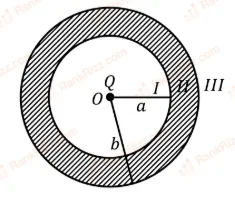
- (A)
- (B)
- (C)
- (D)
rr2.rankrizz.com/jee-main/physics/electrostatics/q/30-jan-2023-s2-q10
- (A)
A uniform electric field of 10 N C is created between two parallel charged plates (as shown in figure). An electron enters the field symmetrically between the plates with a kinetic energy 0.5 eV. The length of each plate is 10 cm. The angle () of deviation of the path of electron as it comes out of the field is _____ (in degree).
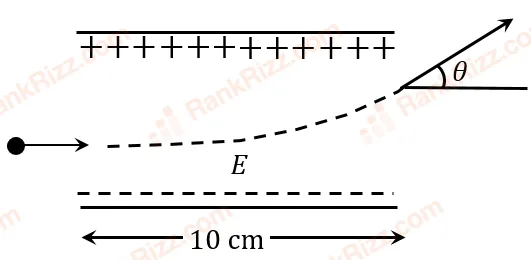
Answer: ____________
rr2.rankrizz.com/jee-main/physics/electrostatics/q/25-jan-2023-s1-q26
A point charge of 10 C is placed at the origin. At what location on the X-axis should a point charge of 40 C be placed so that the net electric field is zero at cm on the X-axis?
- (A)
cm
- (B)
cm
- (C)
cm
- (D)
cm
rr2.rankrizz.com/jee-main/physics/electrostatics/q/25-jan-2023-s2-q12
- (A)
A stream of a positively charged particles having and velocity is deflected by an electric field . The electric field exists in a region of 10 cm along direction. Due to the electric field, the deflection of the charge particles in the direction is _____ mm.
Answer: ____________
rr2.rankrizz.com/jee-main/physics/electrostatics/q/24-jan-2023-s1-q26
A stream of positively charged particles having C kg and velocity m s is deflected by an electric field kV m. The electric field exists in a region of 10 cm along direction. Due to the electric field, the deflection of the charge particles in the direction is _____ mm.
Answer: ____________
rr2.rankrizz.com/jee-main/physics/electrostatics/q/24-jan-2023-s1-q26-494041
The volume charge density of a sphere of radius is . The number of lines of force per unit surface area coming out from the surface of the sphere is ______ .
[Given: Permittivity of vacuum ]Answer: ____________
rr2.rankrizz.com/jee-main/physics/electrostatics/q/25-jul-2022-s1-q26
A positive charge particle of 100 is thrown in opposite direction to a uniform electric field of strength N C. If the charge on the particle is 40 C and the initial velocity is 200 m s, how much distance it will travel before coming to the rest momentarily
- (A)
0.5 m
- (B)
1 m
- (C)
5 m
- (D)
10 m
rr2.rankrizz.com/jee-main/physics/electrostatics/q/29-jun-2022-s1-q12
- (A)
Statement-I : A point charge is brought in an electric field. The value of electric field at a point near to the charge may increase if the charge is positive.
Statement-II : An electric dipole is placed in a uniform electric field. The net electric force on the dipole will not be zero.- (A)
Both statement-I and statement-II are true.
- (B)
Both statement-I and statement-II are false.
- (C)
Statement-I is true but statement-II is false.
- (D)
Statement-I is false but statement-II is true.
rr2.rankrizz.com/jee-main/physics/electrostatics/q/28-jun-2022-s1-q10
- (A)
The three charges and are placed at the corners and of a square of side as shown in figure. The magnitude of electric field () at the corner of the square, is
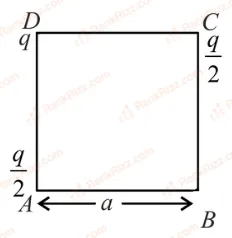
- (A)
- (B)
- (C)
- (D)
rr2.rankrizz.com/jee-main/physics/electrostatics/q/28-jun-2022-s1-q11
- (A)
A vertical electric field of magnitude N C just prevents a water droplet of a mass g from falling. The value of charge on the droplet will be : (Given m s)
- (A)
C
- (B)
C
- (C)
C
- (D)
C
rr2.rankrizz.com/jee-main/physics/electrostatics/q/24-jun-2022-s1-q11
- (A)
Figure shows a rod , which is bent in a 120° circular arc of radius . A charge is uniformly distributed over rod AB. What is the electric field at the centre of curvature O?
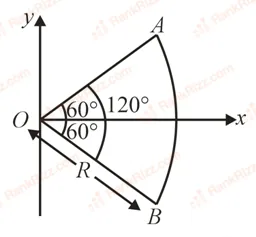
- (A)
- (B)
- (C)
- (D)
rr2.rankrizz.com/jee-main/physics/electrostatics/q/27-aug-2021-s2-q10
- (A)
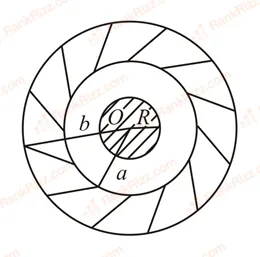
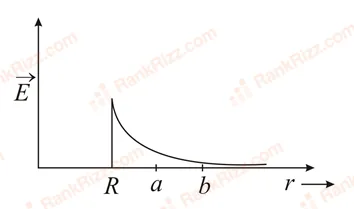
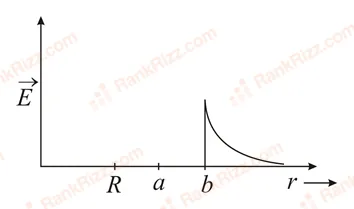
A solid metal sphere of radius having charge is enclosed inside the concentric spherical shell of inner radius and outer radius as shown in the figure. The approximate variation electric field , as a function of distance , from centre , is given by:
- (A)
- (B)
- (C)
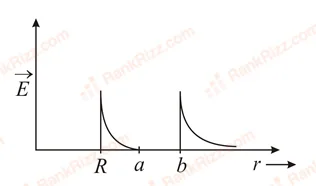
- (D)
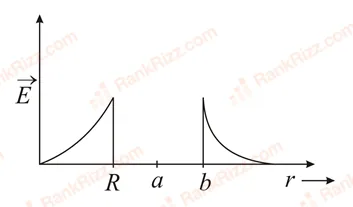
rr2.rankrizz.com/jee-main/physics/electrostatics/q/26-aug-2021-s1-q8
- (A)
A body having specific charge 8 C g is resting on a frictionless plane at a distance 10 cm from the wall (as shown in the figure). It starts moving towards the wall when a uniform electric field of 100 V m is applied horizontally towards the wall. If the collision of the body with the wall is perfectly elastic, then the time period of the motion will be ___ s.
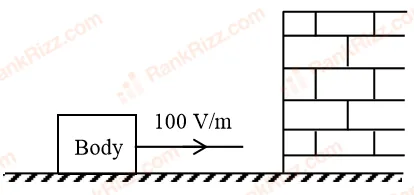
Answer: ____________
rr2.rankrizz.com/jee-main/physics/electrostatics/q/20-jul-2021-s1-q22
Two charged thin infinite plane sheets of uniform charge density and , where , intersect at the right angle. Which of the following best represents the electric field lines for the system:
- (A)
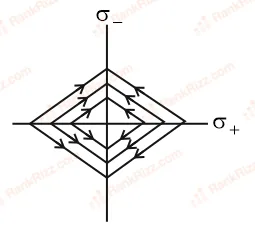
- (B)
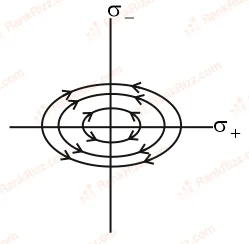
- (C)
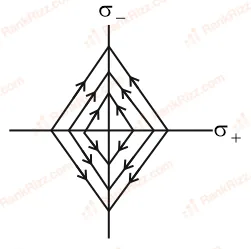
- (D)
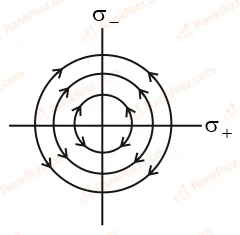
rr2.rankrizz.com/jee-main/physics/electrostatics/q/4-sep-2020-s1-q10
- (A)
A small point mass carrying some positive charge on it, is released from the edge of a table. There is a uniform electric field in this region in the horizontal direction. Which of the following options then correctly describe the trajectory of the mass? (Curves are drawn schematically and are not to scale)
- (A)
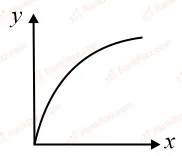
- (B)
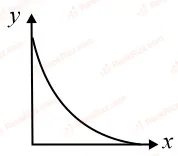
- (C)
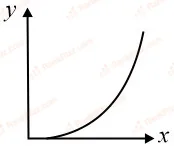
- (D)
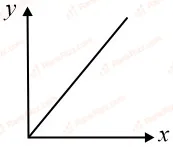
rr2.rankrizz.com/jee-main/physics/electrostatics/q/2-sep-2020-s2-q14
- (A)
Consider a sphere of radius which carries a uniform charge density . If a sphere of radius is carved out of it, as shown, the ratio of magnitude of electric field and , respectively, at points and due to the remaining portion is:
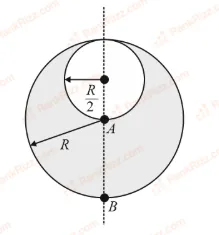
- (A)
- (B)
- (C)
- (D)
rr2.rankrizz.com/jee-main/physics/electrostatics/q/9-jan-2020-s1-q10
- (A)
Two infinite planes each with uniform surface charge density are kept in such a way that the angle between them is 30. The electric field in the region shown between them is given by:
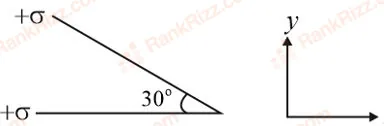
- (A)
- (B)
- (C)
- (D)
rr2.rankrizz.com/jee-main/physics/electrostatics/q/7-jan-2020-s1-q9
- (A)
Four point charges -q, +q, +q and -q are placed on y-axis at y = -2d, y = -d, and y = +2d, respectively. The magnitude of the electric field E at a point on the x-axis at x = D, with D >> d, will behave as:
- (A)
- (B)
- (C)
- (D)
rr2.rankrizz.com/jee-main/physics/electrostatics/q/9-apr-2019-s2-q15
- (A)
For a uniformly charged ring of radius , the electric field on its axis has the largest magnitude at a distance from its centre. Then value of is:
- (A)
- (B)
- (C)
- (D)
rr2.rankrizz.com/jee-main/physics/electrostatics/q/9-jan-2019-s1-q15
- (A)
Two point charges C) and C) are placed on the -axis at m and m respectively. The electric field (in V/m) at a point m on -axis is, [Take N mC]
- (A)
- (B)
- (C)
- (D)
rr2.rankrizz.com/jee-main/physics/electrostatics/q/9-jan-2019-s2-q15
- (A)
A solid ball of radius R has a charge density given by for . The electric field outside the ball is:
- (A)
- (B)
- (C)
- (D)
rr2.rankrizz.com/jee-main/physics/electrostatics/q/15-apr-2018-s2-q15
- (A)
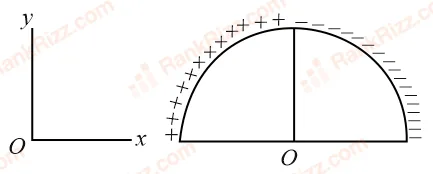
A wire of length cm is bent into a semi-circular arc and the two equal halves of the arc are uniformly charged with charges and as shown in the figure. The magnitude of the charge on each half is , where is the permittivity of free space. The net electric field at the centre is
- (A)
N C
- (B)
N C
- (C)
N C
- (D)
N C
rr2.rankrizz.com/jee-main/physics/electrostatics/q/11-apr-2015-online-q15
- (A)
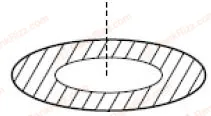
A thin disc of radius has a concentric hole of radius in it (see figure). It carries uniform surface charge on it. If the electric field on its axis at a height h (h a) from its centre is given as Ch then the value of C is
- (A)
- (B)
- (C)
- (D)
rr2.rankrizz.com/jee-main/physics/electrostatics/q/10-apr-2015-online-q16
- (A)
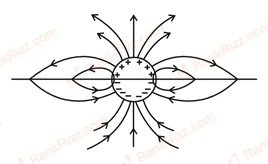
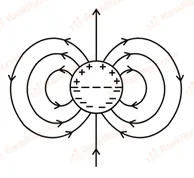
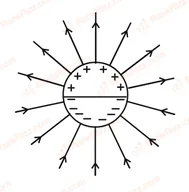
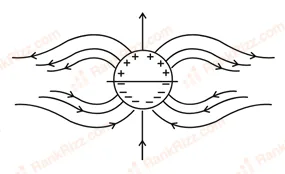
A long cylindrical shell carries positive surface charge in the upper half and negative surface charge in the lower half. The electric field lines around the cylinder will look like figure given in: (figures are schematic and not drawn to scale)
- (A)
- (B)
- (C)
- (D)
rr2.rankrizz.com/jee-main/physics/electrostatics/q/4-apr-2015-offline-q16
- (A)
The surface charge density of a thin charged disc of radius R is . The value of the electric field at the centre of the disc is . With respect to the field at the centre, the electric field along the axis at a distance R from the centre of the disc:
- (A)
reduces by 70.7%
- (B)
reduces by 29.3%
- (C)
reduces by 9.7%
- (D)
reduces by 14.6%
rr2.rankrizz.com/jee-main/physics/electrostatics/q/25-apr-2013-online-q13
- (A)
A liquid drop having 6 excess electrons is kept stationary under a uniform electric field of 25.5 kVm. The density of liquid is kg m. The radius of the drop is (neglect buoyancy).
- (A)
m
- (B)
m
- (C)
m
- (D)
m
rr2.rankrizz.com/jee-main/physics/electrostatics/q/23-apr-2013-online-q16
- (A)
A uniform electric field exists between the plates of a charged condenser. A charged particle enters the space between the plates and perpendicular to . The path of the particle between the plates is a:
- (A)
straight line
- (B)
hyperbola
- (C)
parabola
- (D)
circle
rr2.rankrizz.com/jee-main/physics/electrostatics/q/9-apr-2013-online-q19
- (A)
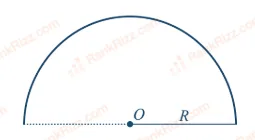
A thin semi-circular ring of radius has a positive charge distributed uniformly over it. The net field at the centre is
- (A)
- (B)
- (C)
- (D)
rr2.rankrizz.com/jee-main/physics/electrostatics/q/2010-physics-499633
- (A)
Electric dipole and dipole in external field 39
A rigid dipole undergoes a simple harmonic motion about its centre in the presence of an electric field . If another electric field is introduced to the system, what will be the percentage change in the frequency of the oscillation (approximate)?
- (A)
- (B)
- (C)
- (D)
rr2.rankrizz.com/jee-main/physics/electrostatics/q/4-apr-2026-s2-q36
- (A)
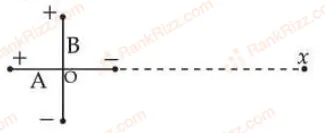
Two short electric dipoles A and B having dipole moment p and p respectively are placed with their axis mutually perpendicular as shown in the figure. The resultant electric field at a point x is making an angle of 60° with the line joining points O and x. The ratio of the dipole moments p/p is __________.
- (A)
- (B)
- (C)
- (D)
rr2.rankrizz.com/jee-main/physics/electrostatics/q/2-apr-2026-s1-q36
- (A)
Three charges+ 2q, +3q and -4q are situated at (0, -3a), (2a, 0) and (-2a, 0) respectively in the x y plane. The resultant dipole moment about origin is ___ .
- (A)
- (B)
- (C)
- (D)
rr2.rankrizz.com/jee-main/physics/electrostatics/q/24-jan-2026-s1-q29
- (A)
Two shorts dipoles , having charges and length 1 cm and having charges and length 1 cm are placed with their centres 80 cm apart as shown in the figure. The electric field at a point , equi-distant from the centres of both dipoles is ____ N/ C.
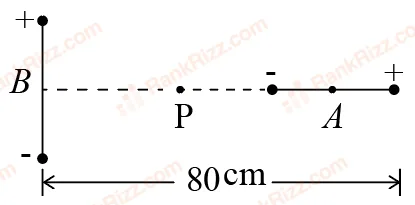
- (A)
- (B)
- (C)
- (D)
rr2.rankrizz.com/jee-main/physics/electrostatics/q/23-jan-2026-s2-q45
- (A)
A dipole with two electric charges of 2 C magnitude each, with separation distance 0.5 m, is placed between the plates of a capacitor such that its axis is parallel to an electric field established between the plates when a potential difference of 5 V is applied. Separation between the plates is 0.5 mm. If the dipole is rotated by 30° from the axis, the value of the torque is :
- (A)
Nm
- (B)
Nm
- (C)
Nm
- (D)
Nm
rr2.rankrizz.com/jee-main/physics/electrostatics/q/2025-apr-7-s2-q34
- (A)
Two small spherical balls of mass 10g each with charges and , are attached to two ends of very light rigid rod of length 20 cm. The arrangement is now placed near an infinite non-conducting charge sheet with uniform charge density such that length of rod makes an angle of 30° with electric field generated by charge sheet. Net torque acting on the rod is: (Take )
- (A)
112 Nm
- (B)
1.12 Nm
- (C)
2.24 Nm
- (D)
11.2 Nm
rr2.rankrizz.com/jee-main/physics/electrostatics/q/2025-apr-4-s1-q44
- (A)
Given below are two statements : one is labelled as Assertion (A) and the other is labelled as Reason (R).
Assertion (A) : Net dipole moment of a polar linear isotropic dielectric substance is not zero even in the absence of an external electric field.
Reason (R) : In absence of an external electric field, the different permanent dipoles of a polar dielectric substance are oriented in random directions.
In the light of the above statements, choose the most appropriate answer from the options given below :- (A)
(A) is correct but (R) is not correct
- (B)
Both (A) and (R) are correct but (R) is not the correct explanation of (A)
- (C)
Both (A) and (R) are correct and (R) is the correct explanation of (A)
- (D)
(A) is not correct but (R) is correct
rr2.rankrizz.com/jee-main/physics/electrostatics/q/2025-apr-02-s2-q26
- (A)
An electric dipole of mass m, charge q, and length is placed in a uniform electric field . When the dipole is rotated slightly from its equilibrium position and released, the time period of its oscillations will be:
- (A)
- (B)
- (C)
- (D)
rr2.rankrizz.com/jee-main/physics/electrostatics/q/29-jan-2025-s1-q26
- (A)
An electric dipole is placed at a distance of 2 cm from an infinite plane sheet having positive charge density .
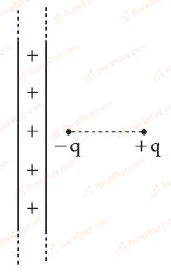
Choose the correct option from the following.- (A)
Potential energy and torque both are maximum.
- (B)
Torque on dipole is zero and net force is directed away from the sheet.
- (C)
Torque on dipole is zero and net force acts towards the sheet.
- (D)
Potential energy of dipole is minimum and torque is zero.
rr2.rankrizz.com/jee-main/physics/electrostatics/q/29-jan-2025-s2-q45
- (A)
An electric dipole of dipole moment is placed in uniform electric field of magnitude . Initially, the dipole moment is parallel to electric field. The work that needs to be done on the dipole to make its dipole moment opposite to the field, will be ____ J.
Answer: ____________
rr2.rankrizz.com/jee-main/physics/electrostatics/q/28-jan-2025-s2-q48
A point particle of charge Q is located at P along the axis of an electric dipole 1 at a distance r as shown in the figure. The point P is also on the equatorial plane of a second electric dipole 2 at a distance r . The dipoles are made of opposite charge q separated by a distance 2a. For the charge particle at P not to experience any net
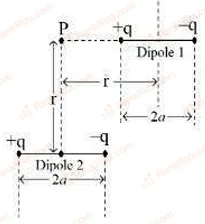
force, which of the following correctly describes the situation?
- (A)
- (B)
- (C)
- (D)
rr2.rankrizz.com/jee-main/physics/electrostatics/q/23-jan-2025-s1-q26
- (A)
Two point charges and , constituting an electric dipole, are placed at (−9, 0, 0)cm and (9, 0, 0)cm in a uniform electric field of strength . The work done on the dipole in rotating it from the equilibrium through is :
- (A)
18.4 mJ
- (B)
14.4 mJ
- (C)
12.4 mJ
- (D)
16.4 mJ
rr2.rankrizz.com/jee-main/physics/electrostatics/q/23-jan-2025-s2-q29
- (A)
For a short dipole placed at origin O, the dipole moment is along x-axis, as shown in the figure. If the electric potential and electric field at A are and , respectively, then the correct combination of the electric potential and electric field, respectively, at point B on the -axis is given by
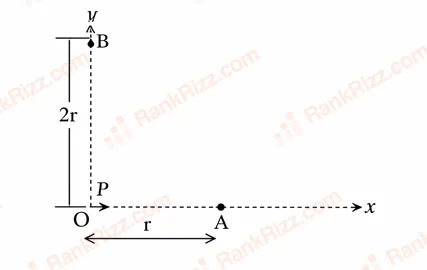
- (A)
- (B)
- (C)
- (D)
rr2.rankrizz.com/jee-main/physics/electrostatics/q/22-jan-2025-s2-q30
- (A)
The electric field at point due to an electric dipole is . The electric field at point on equitorial line will be . The value of
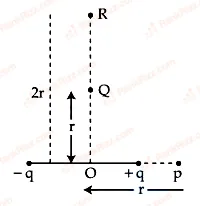
Answer: ____________
rr2.rankrizz.com/jee-main/physics/electrostatics/q/05-apr-2024-s2-q25
The distance between charges and is and between and is . The electrostatic potential at point at a distance from centre is V, where the value of is. (Use N m C)
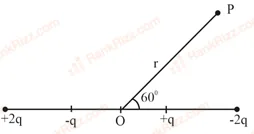
Answer: ____________
rr2.rankrizz.com/jee-main/physics/electrostatics/q/31-jan-2024-s2-q25
The electrostatic potential due to an electric dipole at a distance varies as :
- (A)
- (B)
- (C)
- (D)
rr2.rankrizz.com/jee-main/physics/electrostatics/q/30-jan-2024-s1-q10
- (A)
Two charges of C and C are placed at the points m and m located in an electric field V cm. The magnitude of the torque acting on the dipole is N m, where = _____.
Answer: ____________
rr2.rankrizz.com/jee-main/physics/electrostatics/q/27-jan-2024-s2-q26
The electric field due to a short electric dipole at a large distance from center of dipole on the equatorial plane varies with distance as :
- (A)
- (B)
- (C)
- (D)
rr2.rankrizz.com/jee-main/physics/electrostatics/q/15-apr-2023-s1-q11
- (A)
Two charges of each magnitude C and separated by a distance of mm constitute an electric dipole. If the dipole is placed in an uniform electric field of dyne C making angle with , the magnitude of torque acting on dipole is:
- (A)
N m
- (B)
N m
- (C)
N m
- (D)
N m
rr2.rankrizz.com/jee-main/physics/electrostatics/q/13-apr-2023-s1-q12
- (A)
Given below are two statements: one is labelled as Assertion A and the other is labelled as Reason R.
Assertion A : If an electric dipole of dipole moment C m is enclosed by a closed surface, the net flux coming out of the surface will be zero.
Reason R : Electric dipole consists of two equal and opposite charges.
In the light of above, statements, choose the correct answer from the options given below.- (A)
Both A and R are true and R is the correct explanation of A
- (B)
A is false but R is true
- (C)
A is true but R is false
- (D)
Both A and R are true and R is NOT the correct explanation of A
rr2.rankrizz.com/jee-main/physics/electrostatics/q/12-apr-2023-s1-q11
- (A)
An electric dipole of dipole moment is C m placed in a uniform electric field of N C in such a way that dipole moment is along electric field. The work done in rotating dipole by 180° in this field will be ______ mJ.
Answer: ____________
rr2.rankrizz.com/jee-main/physics/electrostatics/q/8-apr-2023-s1-q25
A dipole comprises of two charged particles of identical magnitude and opposite in nature. The mass of the positive charged particle is half of the mass of the negative charged particle. The two charges are separated by a distance . If the dipole is placed in a uniform electric field , in such a way that dipole axis makes a very small angle with the electric field, . The angular frequency of the oscillations of the dipole when released is given by:
- (A)
- (B)
- (C)
- (D)
rr2.rankrizz.com/jee-main/physics/electrostatics/q/6-apr-2023-s2-q11
- (A)
Two electric dipoles of dipole moments Cm and Cm are placed in two different uniform electric fields of strengths N C and N C respectively. The ratio of maximum torque experienced by the electric dipoles will be . The value of is _____.
Answer: ____________
rr2.rankrizz.com/jee-main/physics/electrostatics/q/28-jul-2022-s1-q26
Given below two statements : One is labelled as Assertion (A) and other is labelled as Reason (R).
Assertion (A): Non-polar materials do not have any permanent dipole moment.
Reason (R): When a non-polar material is placed in an electric field, the centre of the positive charge distribution of it's individual atom or molecule coincides with the centre of the negative charge distribution.
In the light of above statements, choose the most appropriate answer from the options given below.- (A)
Both (A) and (R) are correct and (R) is the correct explanation of (A).
- (B)
Both (A) and (R) are correct and (R) is not the correct explanation of (A).
- (C)
(A) is correct but (R) is not correct.
- (D)
(A) is not correct but (R) is correct.
rr2.rankrizz.com/jee-main/physics/electrostatics/q/26-jun-2022-s1-q12
- (A)
Two ideal electric dipoles and , having their dipole moment and respectively are placed on a plane with their centres at as shown in the figure. At point on the axis of dipole , the resultant electric field is making an angle of 37° with the axis. The ratio of the dipole moment of and , is: (take sin 37° = )
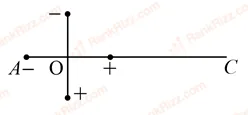
- (A)
- (B)
- (C)
- (D)
rr2.rankrizz.com/jee-main/physics/electrostatics/q/25-jul-2021-s2-q11
- (A)
An electric dipole is placed on -axis in proximity to a line charge of linear charge density C m. Line charge is placed on -axis and positive and negative charge of dipole is at a distance of 10 mm and 12 mm from the origin respectively. If total force of 4 N is exerted on the dipole, find out the amount of positive or negative charge of the dipole.
- (A)
815.1 nC
- (B)
8.8 C
- (C)
0.485 mC
- (D)
4.44 C
rr2.rankrizz.com/jee-main/physics/electrostatics/q/22-jul-2021-s1-q9
- (A)
Given below are two statements
Statement I: An electric dipole is placed at the centre of a hollow sphere. The flux of electric field through the sphere is zero, but the electric field is not zero anywhere in the sphere.
Statement II: If is the radius of a solid metallic sphere and be the total charge on it. The electric field at any point on the spherical surface of radius is zero but the electric flux passing through this closed spherical surface of radius is not.
In the light of the above statements, choose the correct answer from the options given below:- (A)
Both Statement I and Statement II are true
- (B)
Statement I is false but Statement II is true
- (C)
Statement I is true but Statement II is false
- (D)
Both Statement I and Statement II are false
rr2.rankrizz.com/jee-main/physics/electrostatics/q/26-feb-2021-s2-q13
- (A)
Two identical electric point dipoles have dipole moments and and are held on the x-axis at distance 'a' from each other. When released, they move along the x-axis with the direction of their dipole moments remaining unchanged. If the mass of each dipole is 'm', their speed when they are infinitely far apart is:
- (A)
- (B)
- (C)
- (D)
rr2.rankrizz.com/jee-main/physics/electrostatics/q/6-sep-2020-s2-q11
- (A)
An electric dipole of moment C m at the origin . The electric field due to this dipole at (note that ) is parallel to:
- (A)
- (B)
- (C)
- (D)
rr2.rankrizz.com/jee-main/physics/electrostatics/q/9-jan-2020-s1-q11
- (A)
Shown in the figure is a shell made of a conductor. It has inner radius a and outer radius b, and carries charge Q. At its centre a dipole is placed as shown then:
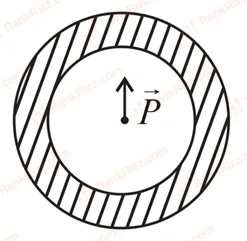
- (A)
Surface charge density on the inner surface of the shell is zero everywhere.
- (B)
Electric field outside the shell is the same as that of a point charge at the centre of the shell.
- (C)
Surface charge density on the inner surface is uniform and equal to .
- (D)
Surface charge density on the outer surface depends on .
rr2.rankrizz.com/jee-main/physics/electrostatics/q/12-apr-2019-s1-q14
- (A)
A Point dipole is kept at the origin. The potential and electric field due to this dipole on the y-axis at a distance d are, respectively: (Taken V = 0 at infinity)
- (A)
,
- (B)
,
- (C)
,
- (D)
,
rr2.rankrizz.com/jee-main/physics/electrostatics/q/12-apr-2019-s1-q15
- (A)
An electric dipole is formed by two equal and opposite charges q with separation d. The charges have same mass m. It is kept in a uniform electric field E. If it is slightly rotated from its equilibrium orientation, then its angular frequency is:
- (A)
- (B)
- (C)
- (D)
rr2.rankrizz.com/jee-main/physics/electrostatics/q/8-apr-2019-s2-q15
- (A)
Determine the electric dipole moment of the system of three charges, placed on the vertices of an equilateral triangle, as shown in the figure:
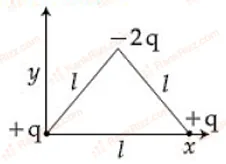
- (A)
- (B)
- (C)
- (D)
rr2.rankrizz.com/jee-main/physics/electrostatics/q/12-jan-2019-s1-q13
- (A)
An electric field of 1000 V/m is applied to an electric dipole at angle of . The value of electric dipole moment is C.m. What is the potential energy of the electric dipole?
- (A)
J
- (B)
J
- (C)
J
- (D)
J
rr2.rankrizz.com/jee-main/physics/electrostatics/q/11-jan-2019-s2-q15
- (A)
Two electric dipoles, A, B with respective dipole moments and are placed on the -axis with a separation , as shown in the figure.
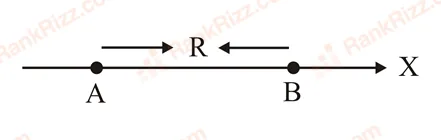
The distance from A at which both of them produce the same potential is:- (A)
- (B)
- (C)
- (D)
rr2.rankrizz.com/jee-main/physics/electrostatics/q/10-jan-2019-s1-q14
- (A)
Charges and , located at A and B, respectively, constitute an electric dipole. Distance , is the mid point of the dipole and is perpendicular to . A charge is placed at P where and . The charge experiences an electrostatic force . If is now moved along the equatorial line to P' such that , the force on will be close to ():
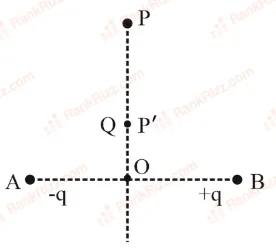
- (A)
27F
- (B)
- (C)
3F
- (D)
9F
rr2.rankrizz.com/jee-main/physics/electrostatics/q/10-jan-2019-s2-q16
- (A)
An electric dipole has fixed dipole moment , which makes angle with respect to -axis. When subjected to an electric field , it experiences a torque . When subjected to another electric field , it experiences a torque . The angle is:
- (A)
90°
- (B)
30°
- (C)
45°
- (D)
60°
rr2.rankrizz.com/jee-main/physics/electrostatics/q/2-apr-2017-offline-q15
- (A)
Two point dipoles of dipole moment and are at a distance x from each other and . The force between the dipoles is :
- (A)
- (B)
- (C)
- (D)
rr2.rankrizz.com/jee-main/physics/electrostatics/q/9-apr-2013-online-q14
- (A)
A electric dipole is placed at an angle of to a non-uniform electric field. The dipole will experience
- (A)
a torque only
- (B)
a translational force only in the direction of the field
- (C)
a translational force only in a direction normal to the direction of the field
- (D)
a torque as well as a translational force
rr2.rankrizz.com/jee-main/physics/electrostatics/q/2006-physics-499991
- (A)
Electric field due to point charges and superposition 25
Six point charges are kept apart from each other on the circumference of a
circle of radius as shown in figure . The net electric field at the center of the circle is______.
( is permittivity of free space)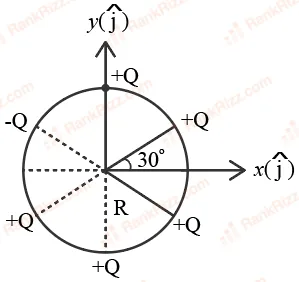
- (A)
- (B)
- (C)
- (D)
rr2.rankrizz.com/jee-main/physics/electrostatics/q/22-jan-2026-s1-q33
- (A)
An electron is made to enter symmetrically between two parallel and equally but oppositely charged metal plates, each of 10 cm length. The electron emerges out of the electric field region with a horizontal component of velocity . If the magnitude of the electric field between the plates is , then the vertical component of velocity of electron is (mass of electron and charge of electron
- (A)
0
- (B)
- (C)
- (D)
rr2.rankrizz.com/jee-main/physics/electrostatics/q/22-jan-2025-s1-q26
- (A)
Three infinitely long charged thin sheets are placed as shown in the figure. The magnitude of electric field at point is . The value of is _______ (all quantities are measured in SI units).
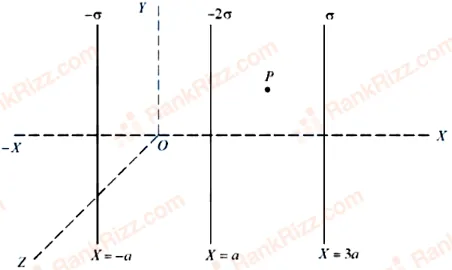
Answer: ____________
rr2.rankrizz.com/jee-main/physics/electrostatics/q/6-apr-2024-s1-q25
Suppose a uniformly charged wall provides a uniform electric field of normally. A charged particle of mass 2 g being suspended through a silk thread of length 20 cm and remain stayed at a distance of 10 cm from the wall. Then the charge on the particle will be where = ______ [use ]
Answer: ____________
rr2.rankrizz.com/jee-main/physics/electrostatics/q/01-feb-2024-s2-q25
Two charges and are separated by a distance '' in air. At a distance from charge , the resultant electric field is zero. The value of is :
- (A)
- (B)
- (C)
- (D)
rr2.rankrizz.com/jee-main/physics/electrostatics/q/31-jan-2024-s1-q13
- (A)
An electron is moving under the influence of the electric field of a uniformly charged infinite plane sheet having surface charge density . The electron at is at a distance of m from and has a speed of m s. The maximum value of , if the electron strikes at s is . The value of is _______.
Answer: ____________
rr2.rankrizz.com/jee-main/physics/electrostatics/q/29-jan-2024-s1-q25
A uniform electric field V m is created between two parallel plates of length 1 m as shown in figure, (where = mass of electron and = charge of electron). An electron enters the field symmetrically between the plates with a speed of 2 m s. The angle of the deviation of the path of the electron as it comes out of the field will be
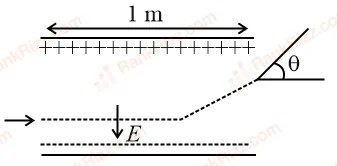
- (A)
- (B)
- (C)
- (D)
rr2.rankrizz.com/jee-main/physics/electrostatics/q/28-jul-2022-s2-q9
- (A)
Two uniformly charged spherical conductors and of radii and are separated by a distance of . If the spheres are connected by a conducting wire, then in equilibrium condition, the ratio of the magnitudes of the electric fields at the surface of the sphere and will be
- (A)
- (B)
- (C)
- (D)
rr2.rankrizz.com/jee-main/physics/electrostatics/q/26-jul-2022-s2-q10
- (A)
Two point charges and of magnitude C and C respectively are placed at a distance apart. The electric field at the middle point between the charges is N C. The distance '' between the point charges and is
- (A)
2 m
- (B)
3 m
- (C)
1 m
- (D)
4 m
rr2.rankrizz.com/jee-main/physics/electrostatics/q/28-jun-2022-s2-q11
- (A)
In the figure, a very large plane sheet of positive charge is shown. and are two points at distance and from the charge distribution. If is the surface charge density, then the magnitude of electric fields and at and respectively are
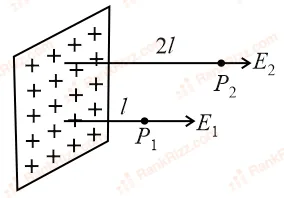
- (A)
- (B)
- (C)
- (D)
rr2.rankrizz.com/jee-main/physics/electrostatics/q/25-jun-2022-s1-q8
- (A)
Two particles and having charges 20 C and C respectively are held fixed with a separation of 5 cm. At what position a third charged particle should be placed so that it does not experience a net electric force?
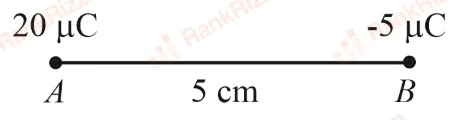
- (A)
At 5 cm from C on the right side
- (B)
At 5 cm from 20 C on the left side of system
- (C)
At 1.25 cm from C between two charges
- (D)
At midpoint between two charges
rr2.rankrizz.com/jee-main/physics/electrostatics/q/31-aug-2021-s1-q10
- (A)
A uniformly charged disc of radius having surface charge density is placed in the plane with its center at the origin. Find the electric field intensity along the -axis at a distance from origin:
- (A)
- (B)
- (C)
- (D)
rr2.rankrizz.com/jee-main/physics/electrostatics/q/27-aug-2021-s1-q10
- (A)
What will be the magnitude of the electric field at point as shown in the figure? Each side of the figure is and perpendicular to the other.
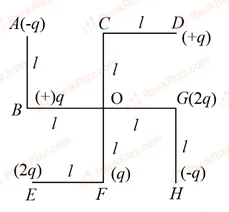
- (A)
- (B)
- (C)
- (D)
rr2.rankrizz.com/jee-main/physics/electrostatics/q/27-jul-2021-s2-q13
- (A)
Find out the surface charge density at the intersection of point m plane and -axis, in the region of uniform line charge of 8 nC m lying along the -axis in free space.
- (A)
0.424 nC m
- (B)
47.88 nC m
- (C)
0.07 nC m
- (D)
4.0 nC m
rr2.rankrizz.com/jee-main/physics/electrostatics/q/16-mar-2021-s2-q9
- (A)
An inclined plane making an angle of 30° with the horizontal is placed in a uniform horizontal electric field 200 as shown in the figure. A body of mass 1 kg and charge 5 mC is allowed to slide down from rest at a height of 1 m. If the coefficient of friction is 0.2, find the time taken by the body to reach the bottom.
[g = 9.8 m ; ; ]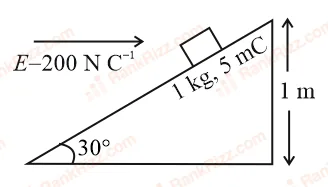
- (A)
0.92 s
- (B)
1.3 s
- (C)
0.46 s
- (D)
2.3 s
rr2.rankrizz.com/jee-main/physics/electrostatics/q/26-feb-2021-s2-q5
- (A)
An electron with kinetic energy enters between parallel plates of a capacitor at an angle with the plates. It leaves the plates at angle with kinetic energy . Then the ratio of kinetic energies will be:
- (A)
- (B)
- (C)
- (D)
rr2.rankrizz.com/jee-main/physics/electrostatics/q/25-feb-2021-s2-q11
- (A)
A cube of side has point charges +Q located at each of its vertices except at the origin where the charge is -Q. The electric field at the centre of cube is:
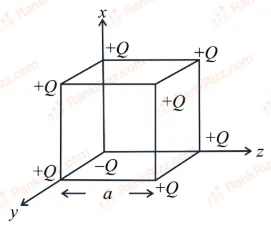
- (A)
- (B)
- (C)
- (D)
rr2.rankrizz.com/jee-main/physics/electrostatics/q/24-feb-2021-s1-q12
- (A)
Charges and are at points A and B of a right-angled triangle OAB. The resultant electric field at point O is perpendicular to the hypotenuse, then is proportional to:
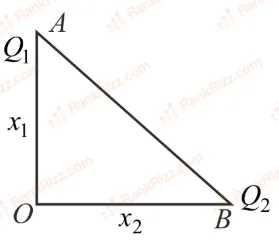
- (A)
- (B)
- (C)
- (D)
rr2.rankrizz.com/jee-main/physics/electrostatics/q/6-sep-2020-s1-q10
- (A)
Consider the force F on a charge 'q' due to a uniformly charged spherical shell of radius R carrying charge Q distributed uniformly over it. Which one of the following statements is true for F, if 'q' is placed at distance r from the centre of the shell?
- (A)
for
- (B)
for
- (C)
for
- (D)
for all r
rr2.rankrizz.com/jee-main/physics/electrostatics/q/6-sep-2020-s2-q12
- (A)
A charged particle (mass m and charge q) moves along X axis with velocity . When it passes through the origin it enters a region having uniform electric field which extends upto . Equation of path of electron in the region is:
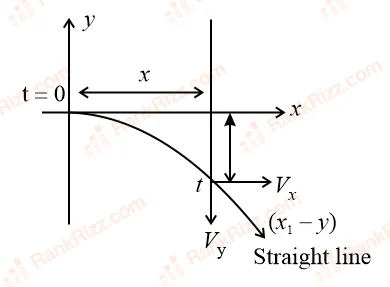
- (A)
- (B)
- (C)
- (D)
rr2.rankrizz.com/jee-main/physics/electrostatics/q/2-sep-2020-s1-q14
- (A)
Three charged particles A, B and C with charges , and are present on the circumference of a circle of radius . The charged particles A, C and centre O of the circle formed an equilateral triangle as shown in the figure. The electric field at the point O is
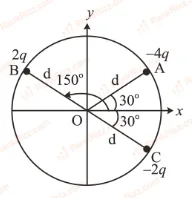
- (A)
- (B)
- (C)
- (D)
rr2.rankrizz.com/jee-main/physics/electrostatics/q/8-jan-2020-s1-q10
- (A)
The bob of a simple pendulum has mass 2 g and a charge of 5.0 C. It is at rest in a uniform horizontal electric field of intensity 2000 V/m. At equilibrium, the angle that the pendulum makes with the vertical is: (take g = 10 m/s)
- (A)
- (B)
- (C)
- (D)
rr2.rankrizz.com/jee-main/physics/electrostatics/q/8-apr-2019-s1-q14
- (A)
Three positive charges of equal value are placed at vertices of an equilateral triangle. The resulting lines of force should be sketched as in
- (A)
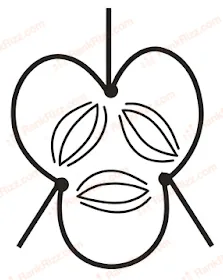
- (B)
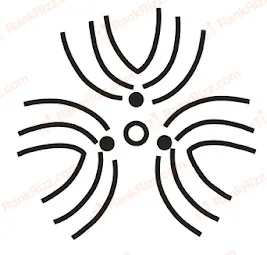
- (C)
- (D)

rr2.rankrizz.com/jee-main/physics/electrostatics/q/2012-physics-499179
- (A)
Charges are placed on the vertices of a square as shown. Let be the electric field and the potential at the centre. If the charges on and are interchanged with those on and respectively, then
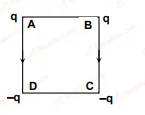
- (A)
remains unchanged, changes
- (B)
Both and change
- (C)
and remains unchanged
- (D)
changes, remains unchanged
rr2.rankrizz.com/jee-main/physics/electrostatics/q/2007-physics-499760
- (A)
Two point charges and are located at and respectively. The location of a point on the axis at which the net electric field due to these two point charges is zero is
- (A)
- (B)
- (C)
- (D)
rr2.rankrizz.com/jee-main/physics/electrostatics/q/2005-physics-500178
- (A)
Relation between field and potential, equipotential surfaces 13
The electric potential as a function of is given by V. The electric field at a point m is __________ V/m.
- (A)
- (B)
- (C)
- (D)
rr2.rankrizz.com/jee-main/physics/electrostatics/q/6-apr-2026-s2-q37
- (A)
Two charged conducting spheres S and S of radii 8 cm and 18 cm are connected to each other by a wire. After equilibrium is established, the ratio of electric fields on S and S spheres are E and E respectively. The value of is __________.
- (A)
- (B)
- (C)
- (D)
rr2.rankrizz.com/jee-main/physics/electrostatics/q/2-apr-2026-s1-q34
- (A)
A point charge of is placed at origin. The work done in moving a point charge from point A(4, 4, 2) m to B(2, 2, 1) m is _____J
- (A)
- (B)
- (C)
0
- (D)
rr2.rankrizz.com/jee-main/physics/electrostatics/q/21-jan-2026-s1-physics-q16
- (A)
Consider two identical metallic spheres of radius R each having charge Q and mass m. Their centers have an initial separation of 4R. Both the spheres are given an initial speed of u towards each other. The minimum value of u, so that they can just touch each other is :
(Take and assume > where G is the Gravitational constant)- (A)
- (B)
- (C)
- (D)
rr2.rankrizz.com/jee-main/physics/electrostatics/q/21-jan-2026-s2-q27
- (A)
Given below are two statements: one is labelled as Assertion A and the other is labelled as Reason R
Assertion A : Work done in moving a test charge between two points inside a uniformly charged spherical shell is zero, no matter which path is chosen.
Reason R : Electrostatic potential inside a uniformly charged spherical shell is constant and is same as that on the surface of the shell.
Choose the correct answer :- (A)
A is true but R is false
- (B)
Both A and R are true and R is the correct explanation of A
- (C)
A is false but R is true
- (D)
Both A and R are true but R is NOT the correct explanation of A
rr2.rankrizz.com/jee-main/physics/electrostatics/q/2025-apr-8-s2-q26
- (A)
Three concentric spherical metallic shells , and of radius , and respectively have surface charge densities , and , respectively. The shells and are at same potential. If the radii of & are 2 cm and 3 cm, respectively. The radius of shell Z is _______ cm.
Answer: ____________
rr2.rankrizz.com/jee-main/physics/electrostatics/q/10-apr-2023-s1-q25
Considering a group of positive charges, which of the following statements is correct?
- (A)
Net potential of the system cannot be zero at a point but net electric field can be zero at that point
- (B)
Net potential of the system at a point can be zero but net electric field can't be zero at that point
- (C)
Both the net potential and the net field can be zero at a point
- (D)
Both the net potential and the net electric field cannot be zero at a point
rr2.rankrizz.com/jee-main/physics/electrostatics/q/31-jan-2023-s2-q10
- (A)
A point charge C is moved from to in a uniform electric field of N C directed along positive -axis. If coordinates of and are m and m respectively, the work done by electric field will be
- (A)
mJ
- (B)
mJ
- (C)
mJ
- (D)
mJ
rr2.rankrizz.com/jee-main/physics/electrostatics/q/29-jan-2023-s2-q10
- (A)
Sixty four conducting drops each of radius m and each carrying a charge of C are combined to form a bigger drop. The ratio of surface charge density of bigger drop to the smaller drop will be
- (A)
- (B)
- (C)
- (D)
rr2.rankrizz.com/jee-main/physics/electrostatics/q/26-jun-2022-s2-q9
- (A)
Within a spherical charge distribution of charge density , N equipotential surfaces of potential , , , ... , are drawn and have increasing radii , , , ... , respectively. If the difference in the radii of the surfaces is constant for all values of and then:
- (A)
constant
- (B)
- (C)
- (D)
rr2.rankrizz.com/jee-main/physics/electrostatics/q/10-apr-2016-online-q14
- (A)
The potential (in volts) of a charge distribution is given by
for m
for m.
does not depend on x and y. If this potential is generated by a constant charge per unit volume (in units of ) which is spread over a certain region, then choose the correct statement.- (A)
in the entire region
- (B)
for m and else where
- (C)
for m and else where
- (D)
in the entire region
rr2.rankrizz.com/jee-main/physics/electrostatics/q/9-apr-2016-online-q14
- (A)
Two small equal point charges of magnitude are suspended from a common point on the ceiling by insulating mass less strings of equal lengths. They come to equilibrium with each string making angle from the vertical. If the mass of each charge is , then the electrostatic potential at the centre of line joining them will be .
- (A)
- (B)
- (C)
- (D)
rr2.rankrizz.com/jee-main/physics/electrostatics/q/22-apr-2013-online-q15
- (A)
The potential at a point (measured in ) due to some charges situated on the x-axis is given by Volts. The electric field at is given by
- (A)
Volt/ and in the direction
- (B)
Volt/ and in the direction.
- (C)
Volt/ and in the direction
- (D)
Volt/ and in the direction.
rr2.rankrizz.com/jee-main/physics/electrostatics/q/2007-physics-499761
- (A)
Conductors, concentric shells and earthing 11
Given below are two statements: one is labelled as Assertion A and the other is labelled as Reason R
Assertion A: In electrostatics, a conductor does not store any net charge inside.
Reason R: Inside the capacitor (with no dielectric medium), the free charge carriers, if placed between the plates of capacitor, experience force and drift.
Choose the correct answer from the options given below:- (A)
Both A and R are true, and R is the correct explanation of A
- (B)
Both A and R are true, but R is NOT the correct explanation of A
- (C)
A is true but R is false
- (D)
A is false but R is true
rr2.rankrizz.com/jee-main/physics/electrostatics/q/4-apr-2026-s2-q38
- (A)
Electric charge is transferred to an irregular metallic disk as shown in figure. If , , and are charge densities at given points then, choose the correct answer from the options given below :
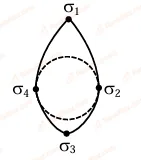
(A) (B)
(C) (D)
(E)- (A)
A, B and C Only
- (B)
A and C Only
- (C)
D and E Only
- (D)
B and C Only
rr2.rankrizz.com/jee-main/physics/electrostatics/q/2025-apr-8-s2-q29
- (A)
Two metal spheres of radius R and 3R have same surface charge density . If they are brought in contact and then separated, the surface charge density on smaller and bigger sphere becomes and , respectively. The ratio is :
- (A)
- (B)
9
- (C)
- (D)
3
rr2.rankrizz.com/jee-main/physics/electrostatics/q/2025-apr-8-s2-q34
- (A)
Two charged conducting spheres of radii and are connected to each other by a conducting wire. The ratio of charges of the two spheres respectively is:
- (A)
- (B)
- (C)
- (D)
rr2.rankrizz.com/jee-main/physics/electrostatics/q/8-apr-2024-s1-q11
- (A)
Two isolated metallic solid spheres of radii and are charged such that both have same charge density . The spheres are then connected by a thin conducting wire. If the new charge density of the bigger sphere is . The ratio is:
- (A)
- (B)
- (C)
- (D)
rr2.rankrizz.com/jee-main/physics/electrostatics/q/30-jan-2023-s1-q11
- (A)
Three concentric metal shells A, B and C of respective radii a, b and c (a < b < c) have surface charge densities , and respectively. The potential of shell B is:
- (A)
- (B)
- (C)
- (D)
rr2.rankrizz.com/jee-main/physics/electrostatics/q/8-apr-2018-offline-q15
- (A)
Shown in the figure are two point charges and inside the cavity of a spherical shell. The charges are kept near the surface of the cavity on opposite sides of the centre of the shell. If is the surface charge on the inner surface and net charge on it and the surface charge on the outer surface and net charge on it then:
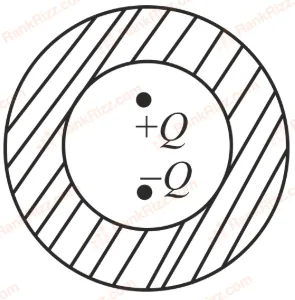
- (A)
- (B)
- (C)
- (D)
rr2.rankrizz.com/jee-main/physics/electrostatics/q/10-apr-2015-online-q15
- (A)
Consider a finite insulated, uncharged conductor placed near a finite positively charged conductor. The uncharged body must have a potential :
- (A)
less than the charged conductor and more than at infinity.
- (B)
more than the charged conductor and less than at infinity.
- (C)
more than the charged conductor and more than at infinity.
- (D)
less than the charged conductor and less than at infinity.
rr2.rankrizz.com/jee-main/physics/electrostatics/q/23-apr-2013-online-q15
- (A)
A point charge of magnitude is fixed at (0, 0, 0). An isolated uncharged spherical conductor, is fixed with its center at (4, 0, 0). The potential and the induced electric field at the centre of the sphere is :
- (A)
V and V/m
- (B)
0 V and 0 V/m
- (C)
V and V/m
- (D)
V and 0 V/m
rr2.rankrizz.com/jee-main/physics/electrostatics/q/22-apr-2013-online-q14
- (A)
A charge of total amount is distributed over two concentric hollow spheres of radii and such that the surface charge densities on the two spheres are equal. The electric potential at the common centre is
- (A)
- (B)
- (C)
- (D)
rr2.rankrizz.com/jee-main/physics/electrostatics/q/2012-physics-499282
- (A)
Two spherical conductors and of radii and are separated by a distance of and are uniformly charged. If the spheres are connected by a conducting wire then in equilibrium condition, the ratio of the magnitude of the electric fields at the surface of spheres and is
- (A)
1 : 4
- (B)
4 : 1
- (C)
1 : 2
- (D)
2 : 1
rr2.rankrizz.com/jee-main/physics/electrostatics/q/2006-physics-499993
- (A)
Motion and equilibrium of charged bodies in electric fields 7
A particle of mass 'm' and charge 'q'is fastened to one end 'A' of a massless string having equilibrium length l, whose other end is fixed at point 'O'. The whole system is placed on a frictionless horizontal plane and is initially at rest. If uniform electric field is switched on along the direction as shown in figure, then the speed of the particle when it crosses the x -axis is
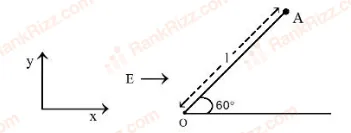
- (A)
- (B)
- (C)
- (D)
rr2.rankrizz.com/jee-main/physics/electrostatics/q/28-jan-2025-s1-q30
- (A)
A particle of charge and mass is subjected to an electric field in the -direction, where and are constants. Initially the particle was at rest at . Other than the initial position the kinetic energy of the particle becomes zero when the distance of the particle from the origin is:
- (A)
- (B)
- (C)
- (D)
rr2.rankrizz.com/jee-main/physics/electrostatics/q/4-sep-2020-s2-q2
- (A)
A particle of mass and charge is released from rest in a uniform electric field. If there is no other force on the particle, the dependence of its speed on the distance travelled by it is correctly given by (graphs are schematic and not drawn to scale)
- (A)
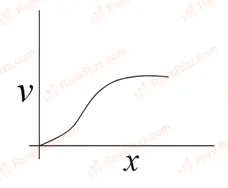
- (B)
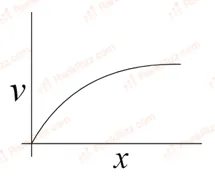
- (C)
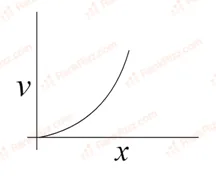
- (D)
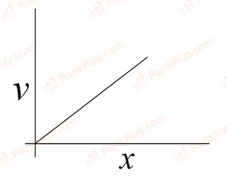
rr2.rankrizz.com/jee-main/physics/electrostatics/q/8-jan-2020-s2-q2
- (A)
A body of mass M and charge q is connected to a spring of spring constant k. It is oscillating along x-direction about its equilibrium position, taken to be at x = 0, with an amplitude A. An electric field E is applied along the x-direction. Which of the following statements is correct?
- (A)
The total energy of the system is
- (B)
The new equilibrium position is at a distance from x = 0
- (C)
The new equilibrium position is at a distance from x = 0
- (D)
The total energy of the system is
rr2.rankrizz.com/jee-main/physics/electrostatics/q/15-apr-2018-s1-q13
- (A)
Two insulating plates are both uniformly charged in such a way that the potential difference between them is . (i.e. plate 2 is at a higher potential). The plates are separated by and can be treated as infinitely large. An electron is released from rest on the inner surface of plate 1. What is its speed when it hits plate 2?
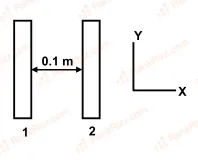
- (A)
- (B)
- (C)
- (D)
rr2.rankrizz.com/jee-main/physics/electrostatics/q/2006-physics-499992
- (A)
A charged ball hangs from a silk thread which makes an angle with a large charged conducting sheet , as show in the figure. The surface charge density of the sheet is proportional to
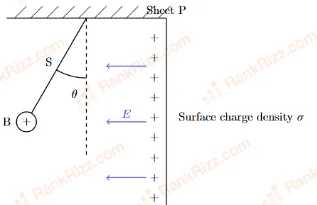
- (A)
- (B)
- (C)
- (D)
rr2.rankrizz.com/jee-main/physics/electrostatics/q/2005-physics-500176
- (A)
A charged oil drop is suspended in a uniform field of V/m so that it neither falls nor rises. The charge on the drop will be (take the mass of the charge kg and )
- (A)
C
- (B)
C
- (C)
C
- (D)
C
rr2.rankrizz.com/jee-main/physics/electrostatics/q/2004-physics-500224
- (A)
Answer key
- 01 186
- 02 A
- 03 B
- 04 B
- 05 C
- 06 A
- 07 A
- 08 B
- 09 C
- 10 A
- 11 A
- 12 B
- 13 C
- 14 A
- 15 36
- 16 C
- 17 C
- 18 D
- 19 8
- 20 160
- 21 D
- 22 B
- 23 C
- 24 12
- 25 B
- 26 A
- 27 C
- 28 198
- 29 A
- 30 243
- 31 128
- 32 D
- 33 C
- 34 D
- 35 D
- 36 C
- 37 C
- 38 D
- 39 B
- 40 D
- 41 C
- 42 A
- 43 C
- 44 B
- 45 C
- 46 A
- 47 B
- 48 B
- 49 D
- 50 C
- 51 —
- 52 A
- 53 D
- 54 C
- 55 —
- 56 B
- 57 C
- 58 B
- 59 D
- 60 B
- 61 B
- 62 D
- 63 C
- 64 C
- 65 D
- 66 D
- 67 A
- 68 15
- 69 C
- 70 D
- 71 D
- 72 48
- 73 D
- 74 A
- 75 16
- 76 12
- 77 B
- 78 A
- 79 A
- 80 B
- 81 B
- 82 C
- 83 A
- 84 288
- 85 640
- 86 12
- 87 D
- 88 C
- 89 1
- 90 B
- 91 A
- 92 A
- 93 D
- 94 4
- 95 640
- 96 1
- 97 B
- 98 226
- 99 48
- 100 B
- 101 D
- 102 B
- 103 D
- 104 C
- 105 C
- 106 B
- 107 B
- 108 A
- 109 C
- 110 D
- 111 B
- 112 C
- 113 B
- 114 C
- 115 A
- 116 B
- 117 90
- 118 B
- 119 5
- 120 B
- 121 A
- 122 D
- 123 3
- 124 B
- 125 2
- 126 3
- 127 C
- 128 5440
- 129 300
- 130 24
- 131 A
- 132 A
- 133 B
- 134 A
- 135 B
- 136 17
- 137 D
- 138 A
- 139 A
- 140 B
- 141 6000
- 142 B
- 143 12
- 144 20
- 145 36
- 146 C
- 147 C
- 148 A
- 149 C
- 150 D
- 151 C
- 152 D
- 153 C
- 154 A
- 155 A
- 156 D
- 157 C
- 158 A
- 159 C
- 160 A
- 161 B
- 162 B
- 163 B
- 164 C
- 165 5
- 166 16
- 167 6
- 168 8
- 169 A
- 170 D
- 171 2
- 172 B
- 173 45
- 174 A
- 175 2
- 176 2
- 177 45
- 178 A
- 179 C
- 180 A
- 181 B
- 182 A
- 183 C
- 184 1
- 185 C
- 186 D
- 187 B
- 188 D
- 189 A
- 190 A
- 191 D
- 192 D
- 193 A
- 194 A
- 195 B
- 196 A
- 197 B
- 198 C
- 199 C
- 200 A
- 201 B
- 202 B
- 203 B
- 204 A
- 205 B
- 206 D
- 207 D
- 208 D
- 209 12
- 210 D
- 211 B
- 212 B
- 213 16
- 214 27
- 215 B
- 216 2
- 217 C
- 218 D
- 219 A
- 220 18
- 221 A
- 222 6
- 223 C
- 224 C
- 225 D
- 226 C
- 227 B
- 228 C
- 229 B
- 230 D
- 231 B
- 232 B
- 233 B
- 234 B
- 235 A
- 236 D
- 237 C
- 238 D
- 239 A
- 240 C
- 241 2
- 242 3
- 243 C
- 244 8
- 245 B
- 246 B
- 247 B
- 248 C
- 249 A
- 250 C
- 251 B
- 252 A
- 253 B
- 254 D
- 255 D
- 256 C
- 257 C
- 258 B
- 259 A
- 260 C
- 261 C
- 262 D
- 263 A
- 264 A
- 265 D
- 266 A
- 267 D
- 268 B
- 269 5
- 270 A
- 271 C
- 272 B
- 273 C
- 274 B
- 275 C
- 276 D
- 277 B
- 278 A
- 279 D
- 280 A
- 281 D
- 282 C
- 283 D
- 284 A
- 285 C
- 286 C
- 287 D
- 288 B
- 289 C
- 290 B
- 291 A
- 292 B
- 293 D
- 294 A
“—” marks a question whose key we have not checked yet; its page shows the latest on it.
Past questions are reproduced with their sitting. Not affiliated with NTA or the IITs. Every question, online and free: rr2.rankrizz.com/jee-main/physics/electrostatics