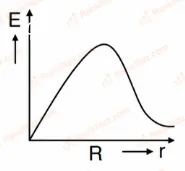
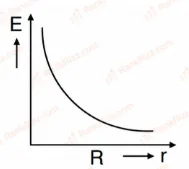
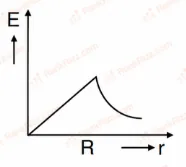
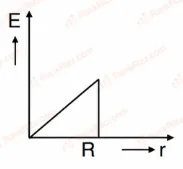
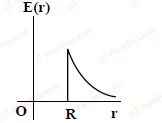
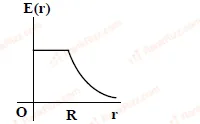
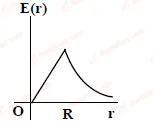
Two balls of same mass and carrying equal charge are hung from a fixed support of length . At electrostatic equilibrium, assuming that angles made by each thread is small, the separation, x between the balls is proportional to :
- A
- B
- C
- D
Every Electrostatics question JEE Main has set from 2004–2026, grouped by the idea it tests rather than the order of the syllabus. 294 questions across 9 distinct ideas. Free to read, answer key on every one.
DATA UPDATED
Questions
294
Distinct ideas
9
Share of marks
6%
Difficulty
MEDIUM
A chapter is not one subject — it is a handful of procedures the examiner reuses. These are the ones Electrostatics questions actually test.
261–280 OF 294 · NEWEST FIRST
Two balls of same mass and carrying equal charge are hung from a fixed support of length . At electrostatic equilibrium, assuming that angles made by each thread is small, the separation, x between the balls is proportional to :
A uniform electric field exists between the plates of a charged condenser. A charged particle enters the space between the plates and perpendicular to . The path of the particle between the plates is a:
straight line
hyperbola
parabola
circle
Two charges, each equal to q, are kept at and on the x-axis. A particle of mass m and charge is placed at the origin. If charge is given a small displacement () along the y-axis, the net force acting on the particle is proportional to :
A charge Q is uniformly distributed over a long rod AB of length L as shown in the figure. The electric potential at the point O lying at a distance L from the end A is :

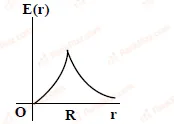
In a uniformly charged sphere of total charge and radius , the electric field is plotted as a function of distance from the centre. The graph which would correspond to the above will be


This question has statement 1 and statement 2. Of the four choices given after the statements, choose the one that best describes the two statements.
An insulating solid sphere of radius has a uniformly positive charge density . As a result of this uniform charge distribution there is a finite value of electric potential at the centre of the sphere, at the surface of the sphere and also at a point out side the sphere. The electric potential at infinity is zero.
Statement 1: When a charge is taken from the centre to the surface of the sphere, its potential energy changes by .
Statement 2: The electric field at a distance from the centre of the sphere is
Statement 1 is true, Statement 2 is true, Statement 2 is not the correct explanation for statement 1.
Statement 1 is true, Statement 2 is false
Statement 1 is false, Statement 2 is true
Statement 1 is true, Statement 2 is the correct explanation for statement 1
The electric potential in a region around the origin is given by volts. The electric charge enclosed in a cube of 1 m side with its centre at the origin is (in coulomb)
0
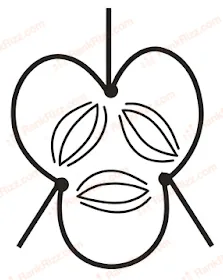
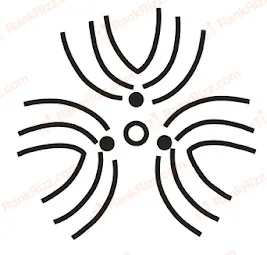
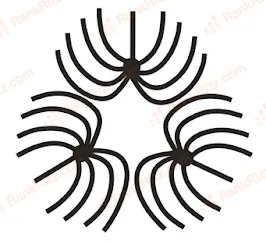
Three positive charges of equal value are placed at vertices of an equilateral triangle. The resulting lines of force should be sketched as in


A charge of total amount is distributed over two concentric hollow spheres of radii and such that the surface charge densities on the two spheres are equal. The electric potential at the common centre is
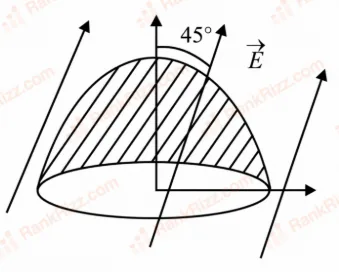
The flat base of a hemisphere of radius with no charge inside it lies in a horizontal plane. A uniform electric field is applied at an angle with the vertical direction. The electric flux through the curved surface of the hemisphere is

Two identical charged spheres suspended from a common point by two massless strings of length are initially a distance apart because of their mutual repulsion. The charge begins to leak from both the spheres at a constant rate. As a result the charges approach each other with a velocity . Then as a function of distance between them,
The electrostatic potential inside a charged spherical ball is given by where is the distance from the centre; are constants. Then the charge density inside ball is:
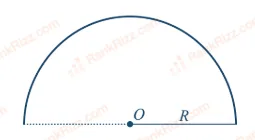
A thin semi-circular ring of radius has a positive charge distributed uniformly over it. The net field at the centre is

Let there be a spherically symmetric charge distribution with charge density varying as upto , and for , where is the distance from the origin. The electric field at a distance () from the origin is given by
Two identical charged spheres are suspended by strings of equal lengths. The strings make an angle of with each other. When suspended in a liquid of density g cm, the angle remains the same. If density of the material of the sphere is g cm, the dielectric constant of the liquid is
4
3
2
1
This question contains Statement-1 and Statement-2. Of the four choices given after the statements, choose the one that best describes the two statements. Statement - 1: For a charged particle moving from point to point , the net work done by an electrostatic field on the particle is independent of the path connecting point to point . Statement-2: The net work done by a conservative force on an object moving along a closed loop is zero
Statement-1 is true, Statement-2 is false
Statement-1 is true, Statement-2 is true; Statement-2 is the correct explanation of Statement-1.
Statement-1 is true, Statement-2 is true; Statement-2 is not the correct explanation of Statement-1.
Statement-1 is false, Statement-2 is true
Let be the charge density distribution for a solid sphere of radius and total charge . For a point '' inside the sphere at distance from the centre of the sphere, the magnitude of electric field is
Two points and are maintained at the potentials of V and V respectively. The work done in moving electrons from to is
J
J
J
J
A charge is placed at each of the opposite corners of a square. A charge is placed at each of the other two corners. If the net electrical force on is zero, then the equals
A thin spherical shell of radius has charge spread uniformly over its surface. Which of the following graphs most closely represents the electric field produced by the shell in the range , where is the distance from the centre of the shell?


JEE Advanced has set 61 Electrostatics questions too. Electrostatics JEE Advanced PYQs →
OTHER PHYSICS CHAPTERS