RankRizz

Electrostatics — JEE Main Previous Year Questions

Every Electrostatics question JEE Main has set from 2004–2026, grouped by the idea it tests rather than the order of the syllabus. 294 questions across 9 distinct ideas. Free to read, answer key on every one.

DATA UPDATED

Questions

294

Distinct ideas

9

Share of marks

6%

Difficulty

MEDIUM

The ideas inside Electrostatics

A chapter is not one subject — it is a handful of procedures the examiner reuses. These are the ones Electrostatics questions actually test.

Every Electrostatics question

121–140 OF 294 · NEWEST FIRST

JEE MAIN 2023 · 29 JAN S2Electric potential and potential energy

For a charged spherical ball, electrostatic potential inside the ball varies with rr as V=2ar2+bV = 2ar^2 + b. Here, aa and bb are constant and rr is the distance from the center. The volume charge density inside the ball is −λaε-\lambda a\varepsilon. The value of λ\lambda is ______.
ε\varepsilon = permittivity of medium.

JEE MAIN 2023 · 25 JAN S1Electric field of continuous charge distributions

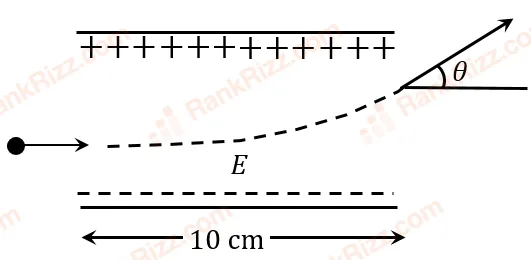
A uniform electric field of 10 N C−1^{-1} is created between two parallel charged plates (as shown in figure). An electron enters the field symmetrically between the plates with a kinetic energy 0.5 eV. The length of each plate is 10 cm. The angle (θ\theta) of deviation of the path of electron as it comes out of the field is _____ (in degree).

Figure for JEE Main 2023 Physics question on Electric field of continuous charge distributions
JEE MAIN 2023 · 25 JAN S2Electric field of continuous charge distributions

A point charge of 10 μ\muC is placed at the origin. At what location on the X-axis should a point charge of 40 μ\muC be placed so that the net electric field is zero at x=2x = 2 cm on the X-axis?

  1. A

    x=6x = 6 cm

  2. B

    x=4x = 4 cm

  3. C

    x=8x = 8 cm

  4. D

    x=−4x = -4 cm

JEE MAIN 2023 · 24 JAN S1Electric charge and Coulomb's law

If two charges q1q_1 and q2q_2 are separated with distance dd and placed in a medium of dielectric constant kk. What will be the equivalent distance between charges in air for the same electrostatic force?

  1. A

    dkd\sqrt{k}

  2. B

    kdk\sqrt{d}

  3. C

    1.5dk1.5d\sqrt{k}

  4. D

    2dk2d\sqrt{k}

JEE MAIN 2023 · 24 JAN S1Electric field of continuous charge distributions

A stream of a positively charged particles having qm=2×10¹¹ C kg−1\frac{q}{m} = 2 \times 10^{11} \text{ C kg}^{-1} and velocity v⃗0=3×10⁷i^ m s−1\vec{v}_0 = 3 \times 10^7 \hat{i} \text{ m s}^{-1} is deflected by an electric field 1.8j^ kV m−11.8\hat{j} \text{ kV m}^{-1}. The electric field exists in a region of 10 cm along xx direction. Due to the electric field, the deflection of the charge particles in the yy direction is _____ mm.

JEE MAIN 2023 · 24 JAN S1Electric field of continuous charge distributions

A stream of positively charged particles having qm=2×10¹¹\frac{q}{m} = 2 \times 10^{11} C kg−1^{-1} and velocity v0⃗=3×10⁷i^\vec{v_0} = 3 \times 10^7 \hat{i} m s−1^{-1} is deflected by an electric field 1.8j^1.8\hat{j} kV m−1^{-1}. The electric field exists in a region of 10 cm along xx direction. Due to the electric field, the deflection of the charge particles in the yy direction is _____ mm.

JEE MAIN 2023 · 24 JAN S2Electric potential and potential energy

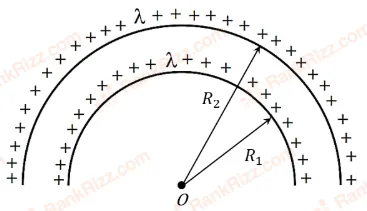
The electric potential at the centre of two concentric half rings of radii R1R_1 and R2R_2, having same linear charge density λ\lambda is

Figure for JEE Main 2023 Physics question on Electric potential and potential energy
  1. A

    2λϵ0\frac{2\lambda}{\epsilon_0}

  2. B

    λ2ϵ0\frac{\lambda}{2\epsilon_0}

  3. C

    λ4ϵ0\frac{\lambda}{4\epsilon_0}

  4. D

    λϵ0\frac{\lambda}{\epsilon_0}

JEE MAIN 2022 · 29 JUL S1Electric flux and Gauss's law

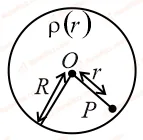
A spherically symmetric charge distribution is considered with charge density varying as ρ(r)={ρ0(34−rR)for r≤R0for r>R\rho(r) = \begin{cases} \rho_0\left(\frac{3}{4} - \frac{r}{R}\right) & \text{for } r \leq R \\ 0 & \text{for } r > R \end{cases}
Where, r(r<R)r(r < R) is the distance from the centre O (as shown in figure). The electric field at point P will be:

Figure for JEE Main 2022 Physics question on Electric flux and Gauss's law
  1. A

    ρ0r4ε0(34−rR)\frac{\rho_0 r}{4\varepsilon_0}\left(\frac{3}{4} - \frac{r}{R}\right)

  2. B

    ρ0r3ε0(34−rR)\frac{\rho_0 r}{3\varepsilon_0}\left(\frac{3}{4} - \frac{r}{R}\right)

  3. C

    ρ0r4ε0(1−rR)\frac{\rho_0 r}{4\varepsilon_0}\left(1 - \frac{r}{R}\right)

  4. D

    ρ0r5ε0(1−rR)\frac{\rho_0 r}{5\varepsilon_0}\left(1 - \frac{r}{R}\right)

JEE MAIN 2022 · 29 JUL S1Electric potential and potential energy

Given below are two statements.
Statement I: Electric potential is constant within and at the surface of each conductor.
Statement II: Electric field just outside a charged conductor is perpendicular to the surface of the conductor at every point.
In the light of the above statements, choose the most appropriate answer from the options given below.

  1. A

    Both statement I and statement II are correct

  2. B

    Both statement I and statement II are incorrect

  3. C

    Statement I is correct but statement II is incorrect

  4. D

    Statement I is incorrect but statement II is correct

JEE MAIN 2022 · 29 JUL S2Electric charge and Coulomb's law

Two identical metallic spheres A and B when placed at certain distance in air repel each other with a force of F. Another identical uncharged sphere C is first placed in contact with A and then in contact with B and finally placed at midpoint between spheres A and B. The force experienced by sphere C will be:

  1. A

    3F2\frac{3F}{2}

  2. B

    3F4\frac{3F}{4}

  3. C

    F

  4. D

    2F

JEE MAIN 2022 · 28 JUL S1Electric dipole and dipole in external field

Two electric dipoles of dipole moments 1.2×10−301.2 \times 10^{-30} Cm and 2.4×10−302.4 \times 10^{-30} Cm are placed in two different uniform electric fields of strengths 5×1045 \times 10^4 N C−1^{-1} and 15×10415 \times 10^4 N C−1^{-1} respectively. The ratio of maximum torque experienced by the electric dipoles will be 1x\frac{1}{x}. The value of xx is _____.

JEE MAIN 2022 · 28 JUL S2Electric field due to point charges and superposition

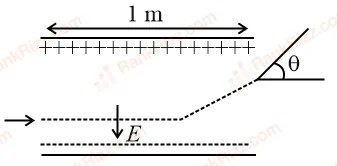
A uniform electric field E=8meE = \frac{8m}{e} V m−1^{-1} is created between two parallel plates of length 1 m as shown in figure, (where mm = mass of electron and ee = charge of electron). An electron enters the field symmetrically between the plates with a speed of 2 m s−1^{-1}. The angle of the deviation θ\theta of the path of the electron as it comes out of the field will be

Figure for JEE Main 2022 Physics question on Electric field due to point charges and superposition
  1. A

    tan⁡−1(4)\tan^{-1}(4)

  2. B

    tan⁡−1(2)\tan^{-1}(2)

  3. C

    tan⁡−1(13)\tan^{-1}\left(\frac{1}{3}\right)

  4. D

    tan⁡−1(3)\tan^{-1}(3)

JEE MAIN 2022 · 27 JUL S1Electric charge and Coulomb's law

Two identical positive charges QQ each are fixed at a distance of 2a2a apart from each other. Another point charge q0q_0 with mass mm is placed at midpoint between two fixed charges. For a small displacement along the line joining the fixed charges, the charge q0q_0 executes SHM. The time period of oscillation of charge q0q_0 will be

  1. A

    4π3ϵ0ma3q0Q\sqrt{\dfrac{4\pi^3 \epsilon_0 m a^3}{q_0 Q}}

  2. B

    q0Q4π3ϵ0ma3\sqrt{\dfrac{q_0 Q}{4\pi^3 \epsilon_0 m a^3}}

  3. C

    2π2ϵ0ma3q0Q\sqrt{\dfrac{2\pi^2 \epsilon_0 m a^3}{q_0 Q}}

  4. D

    8π3ϵ0ma3q0Q\sqrt{\dfrac{8\pi^3 \epsilon_0 m a^3}{q_0 Q}}

JEE MAIN 2022 · 27 JUL S1Electric flux and Gauss's law

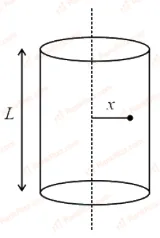
A long cylindrical volume contains a uniformly distributed charge of density ρ C m−3\rho \text{ C m}^{-3}. The electric field inside the cylindrical volume at a distance x=2ϵ0ρ mx = \dfrac{2\epsilon_0}{\rho} \text{ m} from its axis is ______ V m−1\text{V m}^{-1}.

Figure for JEE Main 2022 Physics question on Electric flux and Gauss's law
JEE MAIN 2022 · 27 JUL S2Electric charge and Coulomb's law

A charge of 4μC4\mu C is to be divided into two. The distance between the two divided charges is constant. The magnitude of the divided charges so that the force between them is maximum, will be:

  1. A

    1μC1\mu C and 3μC3\mu C

  2. B

    2μC2\mu C and 2μC2\mu C

  3. C

    00 and 4μC4\mu C

  4. D

    1.5μC1.5\mu C and 2.5μC2.5\mu C

JEE MAIN 2022 · 26 JUL S2Electric field due to point charges and superposition

Two uniformly charged spherical conductors AA and BB of radii 5 mm5 \text{ mm} and 10 mm10 \text{ mm} are separated by a distance of 2 cm2 \text{ cm}. If the spheres are connected by a conducting wire, then in equilibrium condition, the ratio of the magnitudes of the electric fields at the surface of the sphere AA and BB will be

  1. A

    1:21:2

  2. B

    2:12:1

  3. C

    1:11:1

  4. D

    1:41:4

JEE MAIN 2022 · 26 JUL S2Electric charge and Coulomb's law

Three point charges of magnitude 5μC5 \mu C, 0.16μC0.16 \mu C and 0.3μC0.3 \mu C are located at the vertices AA, BB, CC of a right angled triangle whose sides are AB=3 cmAB = 3 \text{ cm}, BC=32 cmBC = 3\sqrt{2} \text{ cm} and CA=3 cmCA = 3 \text{ cm} and point AA is the right angle corner. Charge at point AA experiences ______ N of electrostatic force due to the other two charges.

JEE MAIN 2022 · 25 JUL S1Electric field of continuous charge distributions

The volume charge density of a sphere of radius 6 m6 \text{ m} is 2μC cm−32 \mu C \text{ cm}^{-3}. The number of lines of force per unit surface area coming out from the surface of the sphere is ______ ×1010 N C−1\times 10^{10} \text{ N C}^{-1}.
[Given: Permittivity of vacuum ϵ0=8.85×10⁻¹² C2 N−1 m−2\epsilon_0 = 8.85 \times 10^{-12} \text{ C}^2 \text{ N}^{-1} \text{ m}^{-2}]

JEE MAIN 2022 · 29 JUN S1Electric field of continuous charge distributions

A positive charge particle of 100 μ g\mu\ g is thrown in opposite direction to a uniform electric field of strength 1×1051 \times 10^5 N C−1^{-1}. If the charge on the particle is 40 μ\muC and the initial velocity is 200 m s−1^{-1}, how much distance it will travel before coming to the rest momentarily

  1. A

    0.5 m

  2. B

    1 m

  3. C

    5 m

  4. D

    10 m