When one moves from a point 16 km below the earth's surface to a point 16 km above the earth's surface. The change in g is approximately %. The value of is _______. (Take radius of the earth = 6400 km.)
- A
- B
- C
- D
Gravitation has been asked in 20 of the 23 JEE Main years from 2004 to 2026: 205 questions in all. In 2026 it averaged 0.5 questions per paper (10 across 19 papers), 2.1% of Physics questions, down from 2.5% in 2025. Across the last 20 papers it carried 2% of Physics marks. By type: 189 MCQs and 16 numerical-answer questions. Of the 188 with a difficulty tag, 45% are easy, 52% medium and 3% hard. Most asked: Acceleration due to gravity and its variation (56, 27%), Kepler's laws and planetary motion (45, 22%) and Escape speed (36, 18%).
DATA UPDATED
Questions
205
Distinct ideas
7
Share of marks
2%
Difficulty
MEDIUM
The share of each year’s Physics questions that came from Gravitation, counted from the 168 papers we hold for the last 10 years, and session by session inside a year.
Falling: 2.8% of Physics questions in 2024–2026, down from 4.0% in 2017–2023. Its heaviest year was 2023, at 5.2%.
| YEAR | QS | PER PAPER | SHARE OF PHYSICS | CHANGE | |
|---|---|---|---|---|---|
| 2026 | 10 / 475 | 0.5 | 2.1% | −0.4 pts | JAN 2.0%APR 2.2% |
| 2025 | 12 / 475 | 0.6 | 2.5% | −1.2 pts | JAN 2.8%APR 2.2% |
| 2024 | 22 / 600 | 1.1 | 3.7% | −1.5 pts | JAN 3.7%APR 3.7% |
| 2023 | 39 / 750 | 1.6 | 5.2% | +1.9 pts | JAN 4.4%APR 6.1% |
| 2022 | 22 / 660 | 1.0 | 3.3% | −1.0 pts | JUN 3.3%JUL 3.3% |
| 2021 | 31 / 720 | 1.3 | 4.3% | +0.3 pts | FEB 6.0%MAR 4.0%JUL 4.3%AUG 3.3% |
| 2020 | 16 / 400 | 1.0 | 4.0% | +0.9 pts | JAN 4.0%SEP 4.0% |
| 2019 | 15 / 480 | 0.9 | 3.1% | −0.2 pts | JAN 3.3%APR 2.9% |
| 2018 | 4 / 120 | 1.0 | 3.3% | level | 4 PAPERS, ONE SESSION |
| 2017 | 3 / 90 | 1.0 | 3.3% | — | 3 PAPERS, ONE SESSION |
“QS” is Gravitation questions out of all Physics questions that year; “per paper” is that count over the year’s papers, and “change” is the share against the year before. A year with more sittings asks more questions, which is why the share, not the count, is the number to compare.
How Gravitation compares: every Physics chapter by weightage · most repeated JEE Main topics
A chapter is not one subject — it is a handful of procedures the examiner reuses. These are the ones Gravitation questions actually test.
Every JEE Main Gravitation question we hold, newest first inside each topic. Open one for its options, answer key and solution.
FREE PDF
All 205 questions on A4, by topic, with the answer key at the end. No sign-up, no email: your browser saves it as a PDF.
Download free PDFUNIQUE CONCEPTS
7 ideas, each with the latest past question that tested it, drawn from 225 JEE Main and Advanced questions.
Gravitation Unique Concepts sheet →JEE ADVANCED
JEE Advanced has set 21 Gravitation questions, 2007–2026.
Gravitation JEE Advanced PYQs →Not every year. It has been asked in 20 of the 23 JEE Main years from 2004 to 2026; the years without a Gravitation question were 2006, 2007 and 2010.
Acceleration due to gravity and its variation: 56 of the 205 questions (27%). Next come Kepler's laws and planetary motion (45) and Escape speed (36).
About 2% across the last 20 papers. Every JEE Main question carries the same marks, so that is also its share of Physics questions. In 2026 it was 2.1% (10 of 475 Physics questions).
In JEE Main 05 Apr 2026, Shift 2, the latest sitting with a Gravitation question.
205 from 2004 to 2026, across 7 topics. Every one is listed on this page by topic and links to its own page, with the answer key and solution wherever we have them. Free, no sign-up.
1–20 OF 205 · NEWEST FIRST
When one moves from a point 16 km below the earth's surface to a point 16 km above the earth's surface. The change in g is approximately %. The value of is _______. (Take radius of the earth = 6400 km.)
A body of mass is taken from the surface of the earth to a height equal to twice the radius of earth. The increase in potential energy will be :
(g is acceleration due to gravity at the surface of earth)
The height in terms of radius of the earth (R), at which the acceleration due to gravity becomes , where g is acceleration due to gravity on earth's surface, is ______.
A planet (P) is moving around the star of mass 2M in the orbit of radius R. Another planet (P) is moving around another star of mass 4M in a orbit of radius 2R. Ratio of time periods of revolution of P and P is __________.
If a body of mass 1 kg falls on the earth from infinity, it attains velocity and kinetic energy on reaching the surface of earth. The values of and respectively are ______.
(Take radius of earth to be 6400 km and m/s)
km/s; J
km/s; J
km/s; J
km/s; J
Three masses 200 kg, 300 kg and 400 kg are placed at the vertices of an equilateral triangle with sides 20 m. They are rearranged on the vertices of a bigger triangle of side 25 m and with the same centre. The work done in this process ____ J. (Gravitational constant )
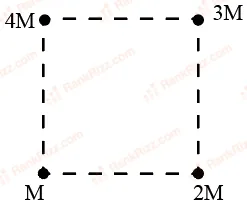
Net gravitational force at the center of a square is found to be when four particles having mass and are placed at the four corners of the square as shown in the figure and it is when the positions of and are interchanged. The ratio is The value of is _________.

1
2
3
The escape velocity from a spherical planet is The escape velocity from another planet whose density and radius are 10% of those of planet , is ______
1000
Given below are two statements:
Statement I : A satellite is moving around earth in the orbit very close to the earth surface. The time period of revolution of satellite depends upon the density of earth.
Statement II: The time period of revolution of the satellite is (for satellite very close to the earth surface), where radius of earth and g acceleration due to gravity.
In the light of the above statements , choose the correct answer from the options given below:
Both Statement I and Statement II are true
Statement I is true but Statement II is false
Statement I is false but Statement II is true
Both Statement I and Statement II are false
Initially a satellite of 100 kg is in a circular orbit of radius This satellite can be moved to a circular orbit of radius by supplying of energy The value of is ____. (Take Radius of Earth )
150
1000
100
500
Given below are two statements : one is labelled as Assertion (A) and the other is labelled as Reason (R).
Assertion (A) : The radius vector from the Sun to a planet sweeps out equal areas in equal intervals of time and thus areal velocity of planet is constant.
Reason (R) : For a central force field the angular momentum is a constant.
In the light of about statement, Choose the most appropriate answer from the option given below :
Both (A) and (R) are correct and (R) is the correct explanation of (A)
Both (A) and (R) are correct but (R) is not the correct explanation of (A)
(A) is correct but (R) is not correct
(A) is not correct but (R) is correct
Given below are two statements:
Assertion A: The kinetic energy needed to project a body of mass m from earth surface to infinity is , where R is the radius of earth.
Reason R: The maximum potential energy of a body is zero when it is projected to infinity from earth surface.
In the light of the above statements, choose the correct answer from the option given below
A False but R is true
Both A and R are true and R is the correct explanation of A
A is true but R is false
Both A and R are true but R is NOT the correct explanation of A
An object is kept at rest at a distance of 3R above the earth's surface where R is earth's radius. The minimum speed with which it must be projected so that it does not return to earth is : (Assume M = mass of earth, G = Universal gravitational constant)
Three identical spheres of mass m, are placed at the vertices of an equilateral triangle of length a. When released, they interact only through gravitational force and collide after a time seconds. If the sides of the triangle are increased to length 2a and also the masses of the spheres are made 2m, then they will collide after _________ seconds.
A satellite of mass 1000 kg is launched to revolve around the earth in an orbit at a height of 270 km from the earth's surface. Kinetic energy of the satellite in this orbit is _________ J.
(Mass of earth = kg, Radius of earth = m, Gravitational constant = Nm kg)
Two planets, A and B are orbiting a common star in circular orbits of radii and , respectively, with . The planet B is times more massive than planet A. The ratio of angular momentum of planet B to that of planet is closest to integer ________.
Earth has mass 8 times and radius 2 times that of a planet. If the escape velocity from the earth is 11.2 km/s. the escape velocity in km/s from the planet will be :
2.8
11.2
5.6
8.4
A satellite is launched into a circular orbit of radius around the earth. A second satellite is launched into an orbit of radius The time period of revolution of the second satellite is larger than the first one approximately by:
9%
3%
4.5%
2.5%
Acceleration due to gravity on the surface of earth is . If the diameter of earth is reduced to one third of its original value and mass remains unchanged, then the acceleration due to gravity on the surface of the earth is
If a satellite orbiting the Earth is 9 times closer to the Earth than the Moon, what is the time period of rotation of the satellite? Given rotational time period of Moon =27 days and gravitational attraction between the satellite and the moon is neglected.
27 days
1 days
81 days
3 days
OTHER PHYSICS CHAPTERS