A point charge is placed at the origin. A second point charge is placed at in Cartesian coordinate system. The point in between them where the electric field vanishes is:
- A
- B
- C
- D
Every Electrostatics question JEE Main has set from 2004–2026, grouped by the idea it tests rather than the order of the syllabus. 294 questions across 9 distinct ideas. Free to read, answer key on every one.
DATA UPDATED
Questions
294
Distinct ideas
9
Share of marks
6%
Difficulty
MEDIUM
A chapter is not one subject — it is a handful of procedures the examiner reuses. These are the ones Electrostatics questions actually test.
41–60 OF 294 · NEWEST FIRST
A point charge is placed at the origin. A second point charge is placed at in Cartesian coordinate system. The point in between them where the electric field vanishes is:
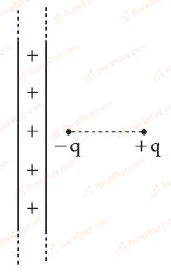
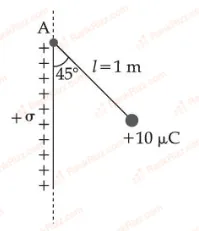
A small bob of mass 100 and charge C is connected to an insulating string of length 1 m. It is brought near to an infinitely long non-conducting sheet of charge density '' as shown in figure. If string subtends an angle of 45° with sheet at equilibrium the charge density of sheet will be:
(Given, F/m and acceleration due to gravity, m/s)

0.885 nC/m
17.7 nC/m
885 nC/m
1.77 nC/m
Given below are two statements : one is labelled as Assertion (A) and the other is labelled as Reason (R).
Assertion (A) : Net dipole moment of a polar linear isotropic dielectric substance is not zero even in the absence of an external electric field.
Reason (R) : In absence of an external electric field, the different permanent dipoles of a polar dielectric substance are oriented in random directions.
In the light of the above statements, choose the most appropriate answer from the options given below :
(A) is correct but (R) is not correct
Both (A) and (R) are correct but (R) is not the correct explanation of (A)
Both (A) and (R) are correct and (R) is the correct explanation of (A)
(A) is not correct but (R) is correct
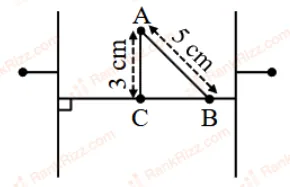
Two large plane parallel conducting plates are kept 10 cm apart as shown in figure. The potential difference between them is V. The potential difference between the points A and B (shown in the figure) is :

Consider a circular loop that is uniformly charged and has a radius . Find the position along the positive z-axis of the cartesian coordinate system where the electric field is maximum if the ring was assumed to be placed in xy-plane at the origin :
An electric dipole of mass m, charge q, and length is placed in a uniform electric field . When the dipole is rotated slightly from its equilibrium position and released, the time period of its oscillations will be:
A point charge causes an electric flux of to pass through a spherical Gaussian surface of 8.0 cm radius, centred on the charge. The value of the point charge is : (Given )
An electric dipole is placed at a distance of 2 cm from an infinite plane sheet having positive charge density .
Choose the correct option from the following.
Potential energy and torque both are maximum.
Torque on dipole is zero and net force is directed away from the sheet.
Torque on dipole is zero and net force acts towards the sheet.
Potential energy of dipole is minimum and torque is zero.
Three infinitely long wires with linear charge density are placed along the x-axis, y-axis and z-axis respectively. Which of the following denotes an equipotential surface?
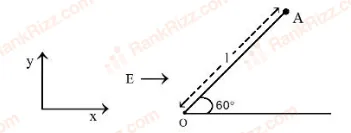
A particle of mass 'm' and charge 'q'is fastened to one end 'A' of a massless string having equilibrium length l, whose other end is fixed at point 'O'. The whole system is placed on a frictionless horizontal plane and is initially at rest. If uniform electric field is switched on along the direction as shown in figure, then the speed of the particle when it crosses the x -axis is

An electric dipole of dipole moment is placed in uniform electric field of magnitude . Initially, the dipole moment is parallel to electric field. The work that needs to be done on the dipole to make its dipole moment opposite to the field, will be ____ J.
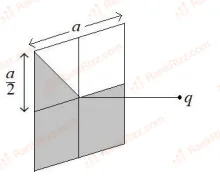
A square loop of sides is held normally in front of a point charge The flux of the electric field through the shaded region is , where the value of is

A small uncharged conducting sphere is placed in contact with an identical sphere but having charge and then removed to a distance such that the force of repulsion between them is . The distance between them is
3 cm
2 cm
4 cm
1 cm
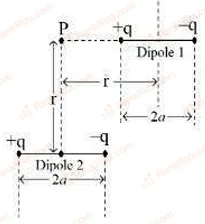
A point particle of charge Q is located at P along the axis of an electric dipole 1 at a distance r as shown in the figure. The point P is also on the equatorial plane of a second electric dipole 2 at a distance r . The dipoles are made of opposite charge q separated by a distance 2a. For the charge particle at P not to experience any net
force, which of the following correctly describes the situation?
A positive ion A and a negative ion B has charges and , and masses and respectively. At an instant, the ions are separated by a certain distance r. At that instant the ratio of the magnitudes of electrostatic force to gravitational force is , where the value of 10P is (Take and universal gravitational constant as )
Assume that charge may not be an integral multiple of electrons.
Two charges and are placed at (−7 cm, 0, 0) and (7 cm, 0, 0) respectively. Given, , the electrostatic potential energy of the charge configuration is :
-1.8 J
-2.0 J
-1.5 J
-1.2 J
Two point charges and , constituting an electric dipole, are placed at (−9, 0, 0)cm and (9, 0, 0)cm in a uniform electric field of strength . The work done on the dipole in rotating it from the equilibrium through is :
18.4 mJ
14.4 mJ
12.4 mJ
16.4 mJ
An electron is made to enter symmetrically between two parallel and equally but oppositely charged metal plates, each of 10 cm length. The electron emerges out of the electric field region with a horizontal component of velocity . If the magnitude of the electric field between the plates is , then the vertical component of velocity of electron is (mass of electron and charge of electron
0
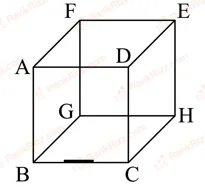
A line charge of length is kept at the center of an edge BC of a cube ABCDEFGH having edge length 'a' as shown in the figure. If the density of line charge is per unit length, then the total electric flux through
all the faces of the cube will be . (Take, as the free space permittivity)
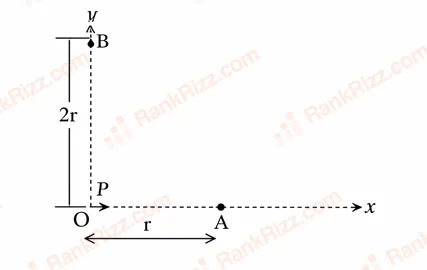
For a short dipole placed at origin O, the dipole moment is along x-axis, as shown in the figure. If the electric potential and electric field at A are and , respectively, then the correct combination of the electric potential and electric field, respectively, at point B on the -axis is given by

JEE Advanced has set 61 Electrostatics questions too. Electrostatics JEE Advanced PYQs →
OTHER PHYSICS CHAPTERS