JEE MAIN 2026 · 06 APR S1Electric potential and potential energy
A three coulomb charge moves from the point (0, -2, -5) to the point (5, 1, 2) in an electric field expressed as N/C. The work done in moving the charge is _______ J.
Electric potential and potential energy has been asked 62 times in JEE Main, in 17 different years between 2004 and 2026, and in all of the last five exam years (2022–2026), 28 questions in all. That is 21% of Electrostatics, its most-asked topic. Last asked in JEE Main 06 Apr 2026, Shift 1. 54 are multiple choice and 8 numerical-value; 21 easy, 33 medium and 1 hard by our difficulty labels. All of them are below, newest first, free to read.
Questions
62
Years asked
17
Since
2004
Of the chapter
21%
Questions on Electric potential and potential energy in every year it was asked, newest first.
| Year | Relative frequency | Questions |
|---|---|---|
| 2026 | 9 | |
| 2025 | 5 | |
| 2024 | 5 | |
| 2023 | 6 | |
| 2022 | 3 | |
| 2021 | 3 | |
| 2020 | 8 | |
| 2019 | 11 | |
| 2017 | 1 | |
| 2015 | 2 | |
| 2014 | 1 | |
| 2013 | 2 | |
| 2012 | 1 | |
| 2009 | 2 | |
| 2007 | 1 | |
| 2005 | 1 | |
| 2004 | 1 | |
| Total | 62 |
1–20 OF 62 · NEWEST FIRST
A three coulomb charge moves from the point (0, -2, -5) to the point (5, 1, 2) in an electric field expressed as N/C. The work done in moving the charge is _______ J.
Two metal plates (A, B) are kept horizontally with separation of cm, with plate A on the top. An atomizer jet sprays oil (density g/cm) droplets of radius 1 mm horizontally. All oil droplets carry a charge 5 nC. The potentials and are required on plates A and B respectively in order to ensure the droplets do not descend. The values of and are ______.
(Neglect the air resistance to the droplets and take m/s)
V and V
V and V
V and V
V and V
Two point charges of 1 nC and 2 nC are placed at the two corners of equilateral triangle of side 3 cm. The work done in bringing a charge of3 nC from infinity to the third corner of the triangle is __
3.3
2.7
27
5.4
There are three co-centric conducting spherical shells A, B and C of radii a, b and c respectively (c > b > a) and they are charged with charge respectively. The potentials of the spheres A, Band C respectively, are :
, ,
,
, ,
Two charges and are placed at (-9,0,0)cm and (9,0,0)cm respectively in an external field , where Considering the potential at infinity is 0, the electrostatic energy of the configuration is ______J.
1.4
-90.7
49.3
24.3
Electric field in a region is given by , where , and . If the electric potential at a point (10, 20) is 500 , then the electric potential at origin is____ .
2000
0
500
1000
Five positive charges each having charge q are placed at the vertices of a pentagon as shown in the figure. The electric potential (V) and the electric field at the center O of the pentagon due to these five positive charges are:
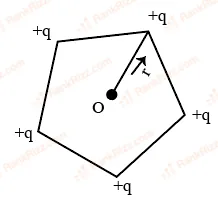
and
and
and
V = 0 and
Three small identical drops of water having same charge on each coalesce to form a bigger drop. Then the ratio of the potentials on one initial drop and that on the resultant bigger drop is :
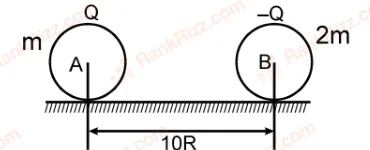
Two smooth spherical non conducting shells each of radius having uniformly distributed charge & on their surfaces are released on a smooth non-conducting surface when the distance between their centers is . The mass of A is and that of B is . The speed of A just before A and B collide is: [Neglect gravitational interaction]
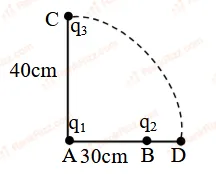
Two charges and are separated by a distance of 30 cm. A third charge initially at 'C' as shown in the figure, is moved along the circular path of radius 40 cm from C to D. If the difference in potential energy due to movement of from C to D is given by , the value of K is :
The electrostatic potential on the surface of uniformly charged spherical shell of radius R = 10 cm is 120 V. The potential at the centre of shell, at a distance r = 5 cm from centre, and at a distance r = 15 cm from the centre of the shell, respectively, are :
120V, 120V, 80V
40V, 40V, 80V
0V, 0V, 80V
0V, 120V, 40V
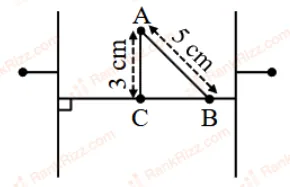
Two large plane parallel conducting plates are kept 10 cm apart as shown in figure. The potential difference between them is V. The potential difference between the points A and B (shown in the figure) is :
Three infinitely long wires with linear charge density are placed along the x-axis, y-axis and z-axis respectively. Which of the following denotes an equipotential surface?
Two charges and are placed at (−7 cm, 0, 0) and (7 cm, 0, 0) respectively. Given, , the electrostatic potential energy of the charge configuration is :
-1.8 J
-2.0 J
-1.5 J
-1.2 J
At the centre of a half ring of radius cm and linear charge density nCm, the potential is V. The value of is _______
An infinitely long positively charged straight thread has a linear charge density . An electron revolves along a circular path having axis along the length of the wire. The graph that correctly represents the variation of the kinetic energy of electron as a function of radius of circular path from the wire is:
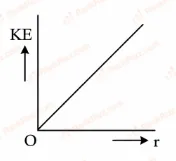
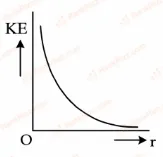
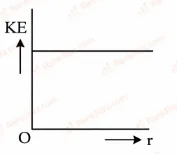
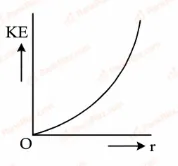
An electric charge C is placed at origin m of co-ordinate system. Two points and are situated at m and m respectively. The potential difference between the points and will be :
V
V
V
V
Given below are two statements : one is labelled as Assertion (A) and the other is labelled as Reason (R).
Assertion (A) : Work done by electric field on moving a positive charge on an equipotential surface is always zero.
Reason (R) : Electric lines of forces are always perpendicular to equipotential surfaces.
In the light of the above statements, choose the most appropriate answer from the options given below :
Both (A) and (R) are correct but (R) is not the correct explanation of (A)
(A) is correct but (R) is not correct
(A) is not correct but (R) is correct
Both (A) and (R) are correct and (R) is the correct explanation of (A)
The electric potential at the surface of an atomic nucleus () of radius cm is V. What is the value of ?
(Charge of proton C)
64 identical drops each charged upto potential of mV are combined to form a bigger drop. The potential of the bigger drop will be _____ mV.
RELATED ELECTROSTATICS TOPICS