JEE MAIN 2024 · 31 JAN S2Electric dipole and dipole in external field
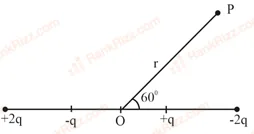
The distance between charges and is and between and is . The electrostatic potential at point at a distance from centre is V, where the value of is. (Use N m C)
Every Electrostatics question JEE Main has set from 2004–2026, grouped by the idea it tests rather than the order of the syllabus. 294 questions across 9 distinct ideas. Free to read, answer key on every one.
DATA UPDATED
Questions
294
Distinct ideas
9
Share of marks
6%
Difficulty
MEDIUM
A chapter is not one subject — it is a handful of procedures the examiner reuses. These are the ones Electrostatics questions actually test.
81–100 OF 294 · NEWEST FIRST
The distance between charges and is and between and is . The electrostatic potential at point at a distance from centre is V, where the value of is. (Use N m C)
The electrostatic potential due to an electric dipole at a distance varies as :
A particle of charge and mass moves in a circle of radius around an infinitely long line charge of linear density . Then time period will be given as: (Consider as Coulomb's constant)
Two identical charged spheres are suspended by strings of equal lengths. The string make an angle of with each other. When suspended in a liquid of density g cm, the angle remains same. If density of material of the sphere is g cm, the dielectric constant of the liquid is _____ ()
Two charges of and are situated at the points and respectively. The electric flux through a sphere of radius having centre at origin is:
An electron is moving under the influence of the electric field of a uniformly charged infinite plane sheet having surface charge density . The electron at is at a distance of m from and has a speed of m s. The maximum value of , if the electron strikes at s is . The value of is _______.
An electric field is given by N C. The electric flux through a surface area m lying in YZ-plane (in SI unit) is:
An electric charge C is placed at origin m of co-ordinate system. Two points and are situated at m and m respectively. The potential difference between the points and will be :
V
V
V
V
A thin metallic wire having cross sectional area of is used to make a ring of radius cm. A positive charge of C is uniformly distributed over the ring, while another positive charge of pC is kept at the centre of the ring. The tension in the ring is _______ N; provided that the ring does not get deformed (neglect the influence of gravity). (Given, SI units)
Given below are two statements : one is labelled as Assertion (A) and the other is labelled as Reason (R).
Assertion (A) : Work done by electric field on moving a positive charge on an equipotential surface is always zero.
Reason (R) : Electric lines of forces are always perpendicular to equipotential surfaces.
In the light of the above statements, choose the most appropriate answer from the options given below :
Both (A) and (R) are correct but (R) is not the correct explanation of (A)
(A) is correct but (R) is not correct
(A) is not correct but (R) is correct
Both (A) and (R) are correct and (R) is the correct explanation of (A)
The electric potential at the surface of an atomic nucleus () of radius cm is V. What is the value of ?
(Charge of proton C)
Two charges of C and C are placed at the points m and m located in an electric field V cm. The magnitude of the torque acting on the dipole is N m, where = _____.
The electric field due to a short electric dipole at a large distance from center of dipole on the equatorial plane varies with distance as :
Two charges of each magnitude C and separated by a distance of mm constitute an electric dipole. If the dipole is placed in an uniform electric field of dyne C making angle with , the magnitude of torque acting on dipole is:
N m
N m
N m
N m
A thin infinite charged sheet and an infinite line charge of respective charge densities and are placed parallel at m distance from each other. Points P and Q are at m and m perpendicular distances from line charge towards sheet charge, respectively. and are the magnitudes of resultant electric field intensities at point P and Q respectively. If for , then the value of is _____.
A C charge is divided into two parts and placed at cm distance so that the repulsive force between them is maximum. The charges of the two parts are:
C, C
C, C
C, C
C, C
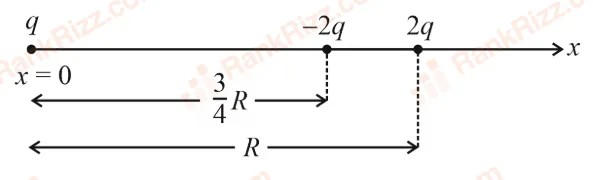
Three point charges , and are placed on x axis at a distance , and respectively from origin as shown. If C and cm, the magnitude of net force experienced by the charge is _____ N.
Given below are two statements: one is labelled as Assertion A and the other is labelled as Reason R.
Assertion A : If an electric dipole of dipole moment C m is enclosed by a closed surface, the net flux coming out of the surface will be zero.
Reason R : Electric dipole consists of two equal and opposite charges.
In the light of above, statements, choose the correct answer from the options given below.
Both A and R are true and R is the correct explanation of A
A is false but R is true
A is true but R is false
Both A and R are true and R is NOT the correct explanation of A
64 identical drops each charged upto potential of mV are combined to form a bigger drop. The potential of the bigger drop will be _____ mV.
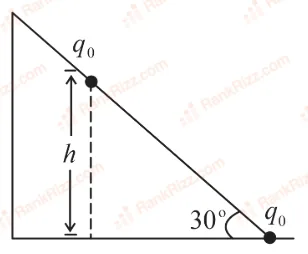
As shown in the figure, a configuration of two equal point charges is placed on an inclined plane. Mass of each point charge is 20 g. Assume that there is no friction between charge and plane. For the system of two point charges to be in equilibrium (at rest) the height m. The value of x is _______
Take N m C, m s
JEE Advanced has set 61 Electrostatics questions too. Electrostatics JEE Advanced PYQs →
OTHER PHYSICS CHAPTERS