RankRizz

Thermodynamics — JEE Main Previous Year Questions

Thermodynamics has been asked in 22 of the 23 JEE Main years from 2004 to 2026: 190 questions in all. In 2026 it averaged 0.7 questions per paper (14 across 19 papers), 2.9% of Physics questions, down from 4.4% in 2025. Across the last 20 papers it carried 3% of Physics marks. By type: 165 MCQs and 25 numerical-answer questions. Of the 168 with a difficulty tag, 35% are easy, 64% medium and 1% hard. Most asked: Isothermal and adiabatic processes (54, 28%), Carnot engine and Carnot cycle (37, 19%) and Zeroth and first law of thermodynamics (34, 18%).

DATA UPDATED

Questions

190

Distinct ideas

6

Share of marks

3%

Difficulty

MEDIUM

Thermodynamics weightage, year by year

The share of each year’s Physics questions that came from Thermodynamics, counted from the 168 papers we hold for the last 10 years, and session by session inside a year.

Steady: 3.2% of Physics questions in 2024–2026 against 3.2% in 2017–2023, and between 2.2% and 4.4% in every year shown.

Thermodynamics questions per year, per paper, and as a share of Physics questions
YEARQSPER PAPERSHARE OF PHYSICSCHANGE
202614 / 4750.72.9%−1.5 pts
202521 / 4751.14.4%+2.1 pts
202414 / 6000.72.3%−0.6 pts
202322 / 7500.92.9%+0.2 pts
202218 / 6600.82.7%−1.3 pts
202129 / 7201.24.0%+0.2 pts
202015 / 4000.93.8%+1.3 pts
201912 / 4800.82.5%−0.8 pts
20184 / 1201.03.3%+1.1 pts
20172 / 900.72.2%—

“QS” is Thermodynamics questions out of all Physics questions that year; “per paper” is that count over the year’s papers, and “change” is the share against the year before. A year with more sittings asks more questions, which is why the share, not the count, is the number to compare.

How Thermodynamics compares: every Physics chapter by weightage · most repeated JEE Main topics

The ideas inside Thermodynamics

A chapter is not one subject — it is a handful of procedures the examiner reuses. These are the ones Thermodynamics questions actually test.

All 190 Thermodynamics questions, by topic

Every JEE Main Thermodynamics question we hold, newest first inside each topic. Open one for its options, answer key and solution.

Isothermal and adiabatic processes54 QUESTIONSTopic page →

  1. Initial pressure and volume of a monoatomic ideal gas are P and V. The change in internal energy of this gas in adiabatic expansion to…2026 · 08 APR S2
  2. A cylinder with adiabatic walls is closed at both ends and is divided into two compartments by a frictionless adiabatic piston. Ideal gas…2026 · 06 APR S2
  3. A vessel contains 0.15 m³ of a gas at pressure 8 bar and temperature 140 °C with c_p = 3R and c_v = 2R. It is expanded adiabatically till…2026 · 02 APR S1
  4. One mole of an ideal diatomic gas expands from volume V to 2 V isothermally at a temperature 27^(o)C and does W joule of work. lf the gas…2026 · 23 JAN S2
  5. The volume of an ideal gas increases 8 times and temperature becomes (1/4)^(th) of initial temperature during a reversible change. If there…2026 · 22 JAN S1
  6. A monoatomic gas having γ = 5/3 is stored in a thermally insulated container and the gas is suddenly compressed to (1/8)^(th) of its…2025 · 08 APR S2
  7. A gas is kept in a container having walls which are thermally non-conducting. Initially the gas has a volume of 800 cm³ and temperature…2025 · 03 APR S1
  8. In an adiabatic process, which of the following statements is true?2025 · 02 APR S1
  9. Identify the characteristics of an adiabatic process in a monoatomic gas. (A) Internal energy is constant. (B) Work done in the process is…2025 · 02 APR S2
  10. The workdone in an adiabatic change in an ideal gas depends upon only:2025 · 29 JAN S1
  11. Given below are two statements. One is labelled as Assertion (A) and the other is labelled as Reason (R). Assertion (A): With the increase…2025 · 29 JAN S2
  12. A poly-atomic molecule (C_V = 3R, C_P = 4R, where R is gas constant) goes from phase space point A (P_A = 10⁵ Pa, V_A = 4 × 10⁻⁶ m to point…2025 · 29 JAN S2
  13. Given below are two statements. One is labelled as Assertion (A) and the other is labelled as Reason (R). Assertion (A): In an insulated…2025 · 24 JAN S2
  14. An ideal gas initially at 0°C temperature, is compressed suddenly to one fourth of its volume. If the ratio of specific heat at constant…2025 · 23 JAN S1
  15. A sample of 1 mole gas at temperature T is adiabatically expanded to double its volume. If adiabatic constant for the gas is γ = 3/2, then…2024 · 09 APR S1
  16. The volume of an ideal gas (γ = 1.5) is changed adiabatically from 5 litres to 4 litres. The ratio of initial pressure to final pressure is:2024 · 09 APR S1
  17. Two different adiabatic paths for the same gas intersect two isothermal curves as shown in P-V diagram. The relation between the ratio…2024 · 08 APR S1
  18. During an adiabatic process, if the pressure of a gas is found to be proportional to the cube of its absolute temperature, then the ratio…2024 · 05 APR S2
  19. A sample of gas at temperature T is adiabatically expanded to double its volume. Adiabatic constant for the gas is γ = 3/2. The work done…2024 · 04 APR S2
  20. Choose the correct statement for processes A & B shown in figure.2024 · 30 JAN S2
  21. During an adiabatic process, the pressure of a gas is found to be proportional to the cube of its absolute temperature. The ratio of…2024 · 27 JAN S2
  22. The initial pressure and volume of an ideal gas are P₀ and V₀. The final pressure of the gas when the gas is suddenly compressed to volume…2023 · 13 APR S2
  23. Consider two containers A and B containing monoatomic gases at the same Pressure P, Volume V and Temperature T. The gas in A is compressed…2023 · 10 APR S1
  24. A gas is compressed adiabatically, which one of the following statement is NOT true?2023 · 10 APR S2
  25. A sample of gas at temperature T is adiabatically expanded to double its volume. The work done by the gas in the process is, (given γ =…2023 · 01 FEB S1
  26. A hypothetical gas expands adiabatically such that its volume changes from 08 litres to 27 litres. If the ratio of final pressure of the…2023 · 31 JAN S2
  27. Heat is given to an ideal gas in an isothermal process. A. Internal energy of the gas will decrease. B. Internal energy of the gas will…2023 · 30 JAN S1
  28. In an Isothermal change, the change in pressure and volume of a gas can be represented for three different temperature; T₃ > T₂ > T₁ as:2023 · 24 JAN S2
  29. The pressure P₁ and density d₁ of diatomic gas (γ = 7/5) changes suddenly to P₂(> P₁) and d₂ respectively during an adiabatic process. The…2022 · 29 JUL S1
  30. A monoatomic gas at pressure P and volume V is suddenly compressed to one eighth of its original volume. The final pressure at constant…2022 · 26 JUL S1
  31. A certain amount of gas of volume V at 27°C temperature and pressure 2 × 10⁷ N m⁻² expands isothermally until its volume gets doubled…2022 · 25 JUL S1
  32. Starting with the same initial conditions, an ideal gas expands from volume V₁ to V₂ in three different ways. The work done by the gas is…2022 · 29 JUN S2
  33. Statement - I: When μ amount of an ideal gas undergoes adiabatic change from state (P₁, V₁, T₁) to state (P₂, V₂, T₂), then work done is W…2022 · 28 JUN S1
  34. A sample of gas with γ = 1.5 is taken through an adiabatic process in which the volume is compressed from 1200 cm³ to 300 cm³. If the…2021 · 31 AUG S2
  35. One mole of an ideal gas is taken through an adiabatic process where the temperature rises from 27°C to 37°C. If the ideal gas is composed…2021 · 27 JUL S2
  36. A monoatomic ideal gas, initially at temperature T₁ is enclosed in a cylinder fitted with a frictionless piston. The gas is allowed to…2021 · 25 JUL S1
  37. One mole of an ideal gas at 27 °C is taken from A to B as shown in the given PV indicator diagram. The work done by the system will be ___…2021 · 20 JUL S2
  38. For an adiabatic expansion of an ideal gas, the fractional change in its pressure is equal to (where γ is the ratio of specific heats):2021 · 18 MAR S2
  39. Which one is the correct option for the two different thermodynamic processes?2021 · 17 MAR S2
  40. In an adiabatic process, the density of a diatomic gas becomes 32n times its initial value. The final pressure of the gas is found to be n…2020 · 05 SEP S2
  41. A balloon filled with helium (32°C and 1.7 atm) bursts. Immediately afterwards the expansion of helium can be considered as:2020 · 03 SEP S1
  42. An engine takes in 5 moles of air at 20 °C and 1 atm, and compresses it adiabatically to 1/10^(th) of the original volume. Assuming air to…2020 · 02 SEP S1
  43. Starting at temperature 300K, one mole of an ideal diatomic gas (γ = 1.4) is first compressed adiabatically from volume V₁ to V₂ = (V₁)/16…2020 · 09 JAN S2
  44. A litre of dry air at STP expands adiabatically to a volume of 3 litres. If γ = 1.40, the work done by air is: (3^(1.4) = 4.6555) [Take air…2020 · 07 JAN S1
  45. The given diagram shows four processes i.e., isochoric, isobaric, isothermal and adiabatic. The correct assignment of the processes, in the…2019 · 08 APR S2
  46. A rigid diatomic ideal gas undergoes an adiabatic process at room temperature. The relation between temperature and volume for this process…2019 · 11 JAN S1
  47. One mole of an ideal monoatomic gas is compressed isothermally in a rigid vessel to double its pressure at room temperature, 27°C. The work…2018 · 15 APR S1
  48. Consider a spherical shell of radius R at temperature T. The black body radiation inside it can be considered as an ideal gas of photons…2015 · 04 APR OFFLINE
  49. During an adiabatic compression, 830 J of work is done on 2 moles of a diatomic ideal gas to reduce its volume by 50%. The change in its…2014 · 11 APR ONLINE
  50. An ideal gas at atmospheric pressure is adiabatically compressed so that its density becomes 32 times of its initial value. If the final…2013 · 22 APR ONLINE
  51. This question has Statement 1 and Statement 2. Of the four choices given after the Statements, choose the one that best describes the two…2012
  52. An ideal monatomic gas with pressure P, volume V and temperature T is expanded isothermally to a volume 2V and a final pressure Pᵢ. If the…2012
  53. A given ideal gas with γ = (C_p)/(C_v) = 1.5 at a temperature T. If the gas is compressed adiabatically to one-fourth of its initial…2012
  54. The work of 146 kJ is performed in order to compress one kilo mole of gas adiabatically and in this process the temperature of the gas…2006

Carnot engine and Carnot cycle37 QUESTIONSTopic page →

  1. A Carnot engine (E) is working between two temperatures 473 K and 273 K. In a new system two engines - engine E₁ works between 473 K to 373…2025 · 28 JAN S1
  2. An engine operating between the boiling and freezing points of water will have A. Efficiency more than 27%. B. Efficiency less than the…2023 · 12 APR S1
  3. Work done by a Carnot engine operating between temperatures 127°C and 27°C is 2 kJ. The amount of heat transferred to the engine by the…2023 · 08 APR S2
  4. A Carnot engine operating between two reservoirs has efficiency 1/3. When the temperature of cold reservoir raised by x, its efficiency…2023 · 01 FEB S2
  5. Given below are two statements: one is labelled as Assertion A and the other is labelled as Reason R. Assertion A: Efficiency of a…2023 · 30 JAN S2
  6. A Carnot engine with efficiency 50% takes heat from a source at 600 K. In order to increase the efficiency to 70%, keeping the temperature…2023 · 25 JAN S1
  7. A Carnot engine has efficiency of 50%. If the temperature of sink is reduced by 40°C, its efficiency increases by 30%. The temperature of…2022 · 28 JUL S1
  8. In 1st case, Carnot engine operates between temperatures 300 K and 100 K. In 2nd case, as shown in the figure, a combination of two engines…2022 · 27 JUL S2
  9. Let η₁ is the efficiency of an engine at T₁ = 447°C and T₂ = 147°C while η₂ is the efficiency at T₁ = 947°C and T₂ = 47°C. The ratio…2022 · 25 JUL S2
  10. 300 calories of heat is given to a heat engine, and it rejects 225 calories of heat. If source temperature is 227°C, then the temperature…2022 · 29 JUN S1
  11. In a carnot engine, the temperature of reservoir is 527°C and that of sink is 200 K. If the work done by the engine when it transfers heat…2022 · 27 JUN S1
  12. The efficiency of a Carnot's engine, working between steam point and ice point, will be2022 · 26 JUN S1
  13. A heat engine operates with the cold reservoir at temperature 324 K. The minimum temperature of the hot reservoir, if the heat engine takes…2022 · 26 JUN S2
  14. A Carnot engine whose heat sinks at 27°C, has an efficiency of 25\%. By how many degrees should the temperature of the source be changed to…2022 · 24 JUN S1
  15. A Carnot engine takes 5000 kcal of heat from a reservoir at 727°C and gives heat to a sink at 127°C. The work done by the engine is2022 · 24 JUN S2
  16. A reversible engine has an efficiency of 1/4. If the temperature of the sink is reduced by 58°C, its efficiency becomes double. Calculate…2021 · 31 AUG S1
  17. A heat engine operates between a cold reservoir at temperature T₂ = 400 K and a hot reservoir at temperature T₁. It takes 300 J of heat…2021 · 27 AUG S2
  18. A refrigerator consumes an average 35 W power to operate between temperature -10°C to 25°C. If there is no loss of energy then how much…2021 · 26 AUG S2
  19. Two Carnot engines A and B operate in series such that engine A absorbs heat at T₁ and rejects heat to a sink at temperature T. Engine B…2021 · 27 JUL S2
  20. A heat engine has an efficiency of 1/6. When the temperature of sink is reduced by 62°C, its efficiency gets doubled. The temperature of…2021 · 25 JUL S2
  21. A Carnot's engine working between 400 K and 800 K has a work output of 1200 J per cycle. The amount of heat energy supplied to the engine…2021 · 17 MAR S1
  22. For an ideal heat engine, the temperature of the source is 127°C. In order to have 60% efficiency the temperature of the sink should be…2021 · 16 MAR S2
  23. A reversible heat engine converts one-fourth of the heat input into work. When the temperature of the sink is reduced by 52 K, its…2021 · 25 FEB S2
  24. If minimum possible work is done by a refrigerator in converting 100 grams of water at 0°C to ice, how much heat (in calories) is released…2020 · 03 SEP S2
  25. A Carnot engine having an efficiency of 1/10 is being used as a refrigerator. If the work done on the refrigerator is 10 J, the amount of…2020 · 08 JAN S2
  26. A Carnot engine operates between two reservoirs of temperatures 900K and 300K. The engine performs 1200J of work per cycle. The heat energy…2020 · 07 JAN S1
  27. Two ideal Carnot engines operate in cascade (all heat given up by one engine is used by the other engine to produce work) between…2020 · 07 JAN S2
  28. A Carnot engine has an efficiency of 1/6. When the temperature of the sink is reduced by 62°C, its efficiency is doubled. The temperatures…2019 · 12 APR S2
  29. Three Carnot engines operate in series between a heat source at a temperature T₁ and a heat sink at temperature T₄ (see figure). There are…2019 · 10 JAN S1
  30. Two carnot engines A and B are operated in series. The first one, A, receives heat at T₁ (= 600K) and rejects to a reservoir at temperature…2019 · 09 JAN S2
  31. A Carnot's engine works as a refrigerator between 250 K and 300 K. It receives 500 cal heat from the reservoir at the lower temperature…2018 · 15 APR S1
  32. Two Carnot engines A and B are operated in series. Engine A receives heat from a reservoir at 600 K and rejects heat to a reservoir at…2018 · 15 APR S2
  33. A Carnot freezer takes heat from water at 0°C inside it and rejects it to the room at a temperature of 27°C. The latent heat of ice is 336…2016 · 10 APR ONLINE
  34. A Carnot engine absorbs 1000 J of heat energy from a reservoir at 127°C and rejects 600 J of heat energy during each cycle. The efficiency…2014 · 12 APR ONLINE
  35. A Carnot engine, whose efficiency is 40\%, takes in heat from a source maintained at a temperature of 500 K. It is desired to have an…2012
  36. This question has Statement 1 and Statement 2. Of the four choices given after the Statements, choose the one that best describes the two…2012
  37. A Carnot engine operating between temperatures T₁ and T₂ has efficiency 1/6. When T₂ is lowered by 62 K, its efficiency increases to 1/3…2011

Zeroth and first law of thermodynamics34 QUESTIONSTopic page →

  1. One mole of diatomic gas having rotational modes only is kept in a cylinder with a piston system. The cross-section area of the cylinder is…2026 · 08 APR S2
  2. Consider the following statements: A. Zeroth law of thermodynamics gives concept of temperature B. First law of thermodynamics gives…2026 · 05 APR S1
  3. Density of water at 4 °C and 20 °C are 1000 kg/m³ and 998kg/m³ respectively. The increase in internal energy of 4 kg of water when it is…2026 · 24 JAN S1
  4. The internal energy of a monoatomic gas is 3nRT. One mole of helium is kept in a cylinder having internal cross section area of 17 cm² and…2026 · 23 JAN S2
  5. During the melting of a slab of ice at 273 K at atmospheric pressure:2025 · 03 APR S1
  6. A piston of mass M is hung from a massless spring whose restoring force law goes as F = -kx³, where k is the spring constant of appropriate…2025 · 03 APR S1
  7. Given are statements for certain thermodynamic variables, (A) Internal energy, volume (V) and mass (M) are extensive variables. (B)…2025 · 22 JAN S2
  8. A total of 48 J heat is given to one mole of helium kept in a cylinder. The temperature of helium increases by 2°C. The work done by the…2024 · 06 APR S2
  9. 1 kg of water at 100°C is converted into steam at 100°C by boiling at atmospheric pressure. The volume of water changes from 1.00 × 10⁻³ m³…2023 · 11 APR S1
  10. The thermodynamic process, in which internal energy of the system remains constant is2023 · 11 APR S2
  11. Given below are two statements: Statement I: If heat is added to a system, its temperature must increase. Statement II: If positive work is…2023 · 08 APR S1
  12. A source supplies heat to a system at the rate of 1000 W. If the system performs work at a rate of 200 W. The rate at which internal energy…2023 · 06 APR S1
  13. The pressure of a gas changes linearly with volume from A to B as shown in figure. If no heat is supplied to or extracted from the gas then…2023 · 31 JAN S1
  14. Given below are two statements. One is labelled as Assertion A and the other is labelled as Reason R. Assertion A: If dQ and dW represent…2023 · 29 JAN S1
  15. 1 g of a liquid is converted to vapour at 3 × 10⁵ Pa pressure. If 10% of the heat supplied is used for increasing the volume by 1600 cm³…2023 · 24 JAN S1
  16. 1 g of a liquid is converted to vapour at 3 × 10⁵ Pa pressure. If 10% of the heat supplied is used for increasing the volume by 1600 cm³…2023 · 24 JAN S1
  17. A sample of an ideal gas is taken through the cyclic process ABCA as shown in figure. It absorbs, 40 J of heat during the part AB, no heat…2022 · 28 JUN S2
  18. An electric appliance supplies 6000 J min⁻¹, heat to the system. If the system delivers a power of 90 W. How long it would take to increase…2021 · 26 AUG S1
  19. In thermodynamics, heat and work are:2021 · 16 MAR S1
  20. 1 mole of rigid diatomic gas performs a work of Q/5 when heat Q is supplied to it. The molar heat capacity of the gas during this…2021 · 26 FEB S2
  21. A monoatomic gas of mass 4.0 u is kept in an insulated container. The container is moving with velocity 30 m s⁻¹. If the container is…2021 · 25 FEB S1
  22. Match the thermodynamics processes taking place in a system with the correct conditions. In the table: Δ Q is the heat supplied, Δ W is the…2020 · 04 SEP S2
  23. A sample of an ideal gas is taken through the cyclic process abca as shown in the figure. The change in the internal energy of the gas…2019 · 12 APR S1
  24. Following figure shows two processes A and B for a gas. If Δ Q_A and Δ Q_B are the amount of heat absorbed by the system in two cases, and…2019 · 09 APR S1
  25. A gas can be taken from A to B via two different processes ACB and ADB. When path ACB is used 60 J of heat flows into the system and 30 J…2019 · 09 JAN S1
  26. A monoatomic gas is compressed from a volume of 2 m³ to a volume of 1 m³ at a constant pressure of 100 N m². Then it is heated at constant…2014 · 19 APR ONLINE
  27. One mole of diatomic ideal gas undergoes a cyclic process ABC as shown in figure. The process BC is adiabatic. The temperatures at A, B and…2014 · 06 APR OFFLINE
  28. Given that 1 g of water in liquid phase has volume 1 cm³ and in vapour phase 1671 cm³ at atmospheric pressure and the latent heat of…2013 · 22 APR ONLINE
  29. There are two identical chambers, completely thermally insulated from surroundings. Both chambers have a partition wall dividing the…2013 · 09 APR ONLINE
  30. A thermally insulated vessel contains an ideal gas of molecular mass M and ratio of specific heats γ. It is moving with speed v and is…2011
  31. When a system is taken from state i to state f along the path iaf, it is found that Q = 50 cal and W = 20 cal. Along the path 'ibf' Q = 36…2007
  32. Which of the following is incorrect regarding the first law of thermodynamics?2005
  33. A system goes from A to B via two processes I and II as shown in the figure. If Δ U₁ and Δ U₂ are the changes in internal energies in the…2005
  34. Which of the following statements is correct for any thermodynamic system?2004

Work done in thermodynamic processes and P-V diagrams30 QUESTIONSTopic page →

  1. In the following p- V diagram the equation of state along the curved path is given by (V-2)²=4ap where a is a constant. The total work done…2026 · 28 JAN S1
  2. A thermodynamic system is taken through the cyclic process ABC as shown in the figure. The total work done by the system during the cycle…2026 · 28 JAN S2
  3. An ideal gas has undergone through the cyclic process as shown in the figure. Work done by the gas in the entire cycle is ______ × 10⁻¹ J…2025 · 07 APR S1
  4. An ideal gas exists in a state with pressure P₀, volume V₀. It is isothermally expanded to 4 times of its initial volume (V₀), then…2025 · 03 APR S2
  5. The magnitude of heat exchanged by a system for the given cyclic process ABCA (as shown in figure) is (in SI unit):2025 · 24 JAN S2
  6. Using the given P - V diagram, the work done by an ideal gas along the path ABCD is:2025 · 23 JAN S2
  7. A real gas within a closed chamber at 27°C undergoes the cyclic process as shown in figure. The gas obeys PV³ = RT equation for the path A…2024 · 09 APR S2
  8. The heat absorbed by a system in going through the given cyclic process is:2024 · 05 APR S1
  9. A thermodynamic system is taken from an original state A to an intermediate state B by a linear process as shown in the figure. Its volume…2024 · 29 JAN S1
  10. A thermodynamic system is taken through cyclic process. The total work done in the process is:2023 · 15 APR S1
  11. A thermodynamic system is taken from an original state D to an intermediate state E by the linear process shown in the figure. Its volume…2022 · 29 JUL S2
  12. In the reported figure, there is a cyclic process ABCDA on a sample of 1 mol of a diatomic gas. The temperature of the gas during the…2021 · 27 JUL S1
  13. In the reported figure, heat energy absorbed by a system in going through a cyclic process is ___ π J.2021 · 20 JUL S1
  14. n mole of a perfect gas undergoes a cyclic process ABCA (see figure) consisting of the following processes. A → B: Isothermal expansion at…2021 · 24 FEB S1
  15. If one mole of an ideal gas at (P₁, V₁) is allowed to expand reversibly and isothermally (A to B) its pressure is reduced to one-half of…2021 · 24 FEB S2
  16. Three different processes that can occur in an ideal monoatomic gas are shown in the P vs V diagram. The paths are labelled as A → B, A → C…2020 · 05 SEP S1
  17. Which of the following is an equivalent cyclic process corresponding to the thermodynamic cyclic given in the figure? Where, 1 → 2 is…2020 · 09 JAN S1
  18. A thermodynamic cycle xyzx is shown on a V-T diagram. The P-V diagram that best describes this cycle is: (Diagrams are schematic and not to…2020 · 08 JAN S1
  19. For the given cyclic process CAB as shown for a gas, the work done is:2019 · 12 JAN S1
  20. One mole of an ideal monatomic gas is taken along the path ABCA as shown in the PV diagram. The maximum temperature attained by the gas…2018 · 16 APR ONLINE
  21. For the P - V diagram given for an ideal gas Out of the following which one correctly represents the T - P diagram?2017 · 09 APR ONLINE
  22. n moles of an ideal gas undergoes a process A → B as shown in the figure. The maximum temperature of the gas during the process will be:2016 · 03 APR OFFLINE
  23. An ideal gas goes through a reversible cycle a → b → c → d has the V - T diagram shown below. Process d → a and b → c are adiabatic. The…2015 · 10 APR ONLINE
  24. A sample of gas expands from V₁ to V₂. In which of the following, the work done will be greatest?2013 · 25 APR ONLINE
  25. A certain amount of gas is taken through a cyclic process (A B C D A) that has two isobars, one isochore and one isothermal. The cycle can…2013 · 22 APR ONLINE
  26. The pressure of an ideal gas varies with volume as P = α V, where α is a constant. One mole of the gas is allowed to undergo expansion such…2012
  27. n moles of an ideal gas undergo a process A → B as shown in the figure. Maximum temperature of the gas during the process is2012
  28. Directions: Questions 7 to 9 are based on the following figure showing a thermodynamic cycle ABCDA on a P-V diagram. (Figure not available…2009
  29. The work done on the gas in taking it from D to A is2009
  30. The net work done on the gas in the cycle ABCDA is2009

Isobaric, isochoric and polytropic processes23 QUESTIONSTopic page →

  1. An ideal gas at pressure P and temperature T is expanding such that PT³ = constant. The coefficient of volume expansion of the gas is:2026 · 05 APR S2
  2. An ideal gas undergoes a process maintaining relation between pressure (P) and volume (V) as P = P₀ (1 + ((V₀)/V)²)⁻¹, where P₀ and V₀ are…2026 · 04 APR S1
  3. 10 mole of an ideal gas is undergoing the process showu in the figure. The heat involved in the process from P₁ to P₂ is α Joule(P_{1}=…2026 · 24 JAN S2
  4. Match List-I with List-II. Choose the correct answer from the options given below:2025 · 07 APR S2
  5. Match List-I with List-II. Choose the correct answer from the options given below:2025 · 04 APR S2
  6. An ideal gas goes from an initial state to final state. During the process, the pressure of gas increases linearly with temperature. A. The…2025 · 24 JAN S1
  7. The pressure and volume of an ideal gas are related as PV^(3/2) = K (Constant). The work done when the gas is taken from state A(P₁, V₁…2024 · 01 FEB S1
  8. The given figure represents two isobaric processes for the same mass of an ideal gas, then2024 · 31 JAN S1
  9. Two thermodynamical processes are shown in the figure. The molar heat capacity for process A and B are C_A and C_B. The molar heat capacity…2024 · 30 JAN S1
  10. Match List I with List II: A. Isothermal Process I. Work done by the gas decreases internal energy B. Adiabatic Process II. No change in…2023 · 25 JAN S2
  11. 7 mole of certain monoatomic ideal gas undergoes a temperature increase of 40 K at constant pressure. The increase in the internal energy…2022 · 26 JUL S1
  12. A monoatomic gas performs a work of Q/4 where Q is the heat supplied to it. The molar heat capacity of the gas will be ______ R. Where R is…2022 · 24 JUN S2
  13. The temperature of 3.00 mol of an ideal diatomic gas is increased by 40.0°C without changing the pressure of the gas. The molecules in the…2021 · 01 SEP S2
  14. For an ideal gas the instantaneous change in pressure P with volume V is given by the equation dP/dV = -aP. If P = P₀ at V = 0 is the given…2021 · 31 AUG S1
  15. The volume V of a given mass of monoatomic gas changes with temperature T according to the relation V = KT^(2/3). The workdone when…2021 · 26 FEB S2
  16. In a certain thermodynamical process, the pressure of a gas depends on its volume as kV³. The work done when the temperature changes from…2021 · 25 FEB S1
  17. Thermodynamic process is shown below on a P-V diagram for one mole of an ideal gas. If V₂ = 2V₁, then the ratio of temperature (T₂)/(T₁) is:2021 · 25 FEB S2
  18. Match List I with List II. List I List II (a) Isothermal (i) Pressure constant (b) Isochoric (ii) Temperature constant (c) Adiabatic (iii)…2021 · 24 FEB S1
  19. One mole of an ideal gas passes through a process where pressure and volume obey the relation P = P₀[1 - 1/2 ((V₀)/V)²]. Here P₀ and V₀ are…2019 · 10 APR S2
  20. In a process, temperature and volume of one mole of an ideal monoatomic gas are varied according to the relation VT = K, where K is a…2019 · 11 JAN S2
  21. Half mole of an ideal monoatomic gas is heated at a constant pressure of 1 atm from 20°C to 90°C. Work done by the gas is2019 · 10 JAN S2
  22. An ideal gas undergoes a quasi-static, reversible process in which its molar heat capacity C remains constant. If during this process the…2016 · 03 APR OFFLINE
  23. The equation of state for a gas is given by PV = nRT + α V, where n is the number of moles and α is a positive constant. The initial…2014 · 09 APR ONLINE

Second law, heat engines, refrigerators and reversibility12 QUESTIONSTopic page →

  1. Water of mass m gram is slowly heated to increase the temperature from T₁ to T₂ The change in entropy of the water, given specific heat of…2025 · 23 JAN S2
  2. An ideal gas in a cylinder is separated by a piston in such a way that the entropy of one part is S₁ and that of the other part is S₂…2021 · 18 MAR S2
  3. An engine operates by taking a monatomic ideal gas through the cycle shown in the figure. The percentage efficiency of the engine is close…2020 · 06 SEP S2
  4. A heat engine is involved with exchange of heat of 1915 J, -40 J, +125 J and -Q J, during one cycle achieving and efficiency of 50.0%. The…2020 · 02 SEP S2
  5. An engine operates by taking n moles of an ideal gas through the cycle ABCDA shown in figure. The thermal efficiency of the engine is…2017 · 08 APR ONLINE
  6. A solid body of constant heat capacity 1 J (°C)⁻¹ is being heated by keeping it in contact with reservoirs in two ways: (i) Sequentially…2015 · 04 APR OFFLINE
  7. The below P-V diagram represents the thermodynamic cycle of an engine, operating with an ideal mono-atomic gas. The amount of heat…2013 · 07 APR ONLINE
  8. Helium gas goes through a cycle ABCDA (consisting of two isochoric and two isobaric lines) as shown in figure. Efficiency of this cycle is…2012
  9. The door of a working refrigerator is left open in a well insulated room. The temperature of air in the room will2012
  10. A diatomic ideal gas is used in a Car engine as the working substance. If during the adiabatic expansion part of the cycle, volume of the…2010
  11. A Carnot engine, having an efficiency of η = 1/10 as heat engine, is used as a refrigerator. If the work done on the system is 10 J, the…2007
  12. The temperature-entropy diagram of a reversible engine cycle is given in the figure. Its efficiency is2005

FREE PDF

Thermodynamics JEE Main PYQs with answer key

All 190 questions on A4, by topic, with the answer key at the end. No sign-up, no email: your browser saves it as a PDF.

Download free PDF

UNIQUE CONCEPTS

Thermodynamics: one question per idea

7 ideas, each with the latest past question that tested it, drawn from 231 JEE Main and Advanced questions.

Thermodynamics Unique Concepts sheet →

JEE ADVANCED

Thermodynamics in JEE Advanced

JEE Advanced has set 42 Thermodynamics questions, 2007–2026.

Thermodynamics JEE Advanced PYQs →

Thermodynamics: quick answers

Is Thermodynamics asked every year in JEE Main?

Not every year. It has been asked in 22 of the 23 JEE Main years from 2004 to 2026; the year without a Thermodynamics question was 2008.

Which Thermodynamics topic is asked most in JEE Main?

Isothermal and adiabatic processes: 54 of the 190 questions (28%). Next come Carnot engine and Carnot cycle (37) and Zeroth and first law of thermodynamics (34).

What share of Physics marks does Thermodynamics carry in JEE Main?

About 3% across the last 20 papers. Every JEE Main question carries the same marks, so that is also its share of Physics questions. In 2026 it was 2.9% (14 of 475 Physics questions).

When was Thermodynamics last asked in JEE Main?

In JEE Main 08 Apr 2026, Shift 2, the latest sitting with a Thermodynamics question.

How many Thermodynamics questions has JEE Main asked?

190 from 2004 to 2026, across 6 topics. Every one is listed on this page by topic and links to its own page, with the answer key and solution wherever we have them. Free, no sign-up.

Every Thermodynamics question

1–20 OF 190 · NEWEST FIRST

JEE MAIN 2026 · 08 APR S2Zeroth and first law of thermodynamics

One mole of diatomic gas having rotational modes only is kept in a cylinder with a piston system. The cross-section area of the cylinder is 4 cm2^2. The gas is heated slowly to raise the temperature by 1.2 ∘^\circC during which the piston moves by 25 mm. The amount of heat supplied to the gas is __________ J. (Atmospheric pressure = 100 kPa, R=8.3R = 8.3 J/mol. K) (Neglect mass of the piston)

  1. A

    24.8

  2. B

    25.9

  3. C

    15.04

  4. D

    29.98

JEE MAIN 2026 · 08 APR S2Isothermal and adiabatic processes

Initial pressure and volume of a monoatomic ideal gas are PP and VV. The change in internal energy of this gas in adiabatic expansion to volume Vfinal=27VV_{final} = 27V is __________ J.

  1. A

    −2PV(33−1)-2PV(3\sqrt{3} - 1)

  2. B

    43PV\frac{4}{3}PV

  3. C

    −43PV-\frac{4}{3}PV

  4. D

    34PV\frac{3}{4}PV

JEE MAIN 2026 · 06 APR S2Isothermal and adiabatic processes

A cylinder with adiabatic walls is closed at both ends and is divided into two compartments by a frictionless adiabatic piston. Ideal gas is filled in both (left and right) the compartments at same P, V, T. Heating is started from left side until pressure changes to 27P/827 P/8. If initial volume of each compartment was 9 litres then the final volume in right-hand side compartment is __________ litres. (for this ideal gas CP/CV=1.5C_P/C_V = 1.5)

  1. A

    3

  2. B

    4

  3. C

    14

  4. D

    9

JEE MAIN 2026 · 05 APR S1Zeroth and first law of thermodynamics

Consider the following statements:
A. Zeroth law of thermodynamics gives concept of temperature
B. First law of thermodynamics gives concept of internal energy
C. In isothermal expansion of ideal gas, ΔQ≠ΔW\Delta Q \neq \Delta W
D. Product of intensive and extensive variables is extensive
E. The ratio of any extensive variable to mass will be an extensive variable
Choose the correct combination of statements from the options given below:

  1. A

    C, D and E Only

  2. B

    A, B and C Only

  3. C

    A, B and D Only

  4. D

    B, C and D Only

JEE MAIN 2026 · 05 APR S2Isobaric, isochoric and polytropic processes

An ideal gas at pressure PP and temperature TT is expanding such that PT3=constantPT^3 = \text{constant}. The coefficient of volume expansion of the gas is :

  1. A

    2T\frac{2}{T}

  2. B

    1T\frac{1}{T}

  3. C

    4T\frac{4}{T}

  4. D

    3T\frac{3}{T}

JEE MAIN 2026 · 04 APR S1Isobaric, isochoric and polytropic processes

An ideal gas undergoes a process maintaining relation between pressure (P)(P) and volume (V)(V) as P=P0(1+(V0V)2)−1P = P_0\left(1 + \left(\frac{V_0}{V}\right)^2\right)^{-1}, where P0P_0 and V0V_0 are constants. If two samples A and B (two moles each) with initial volumes V0V_0 and 3V03V_0 respectively undergo above mentioned process and attain same pressure, then the difference of the temperatures of these samples, TB−TAT_B - T_A is : 

(R = gas constant)

  1. A

    9P0V08R\frac{9P_0 V_0}{8R}

  2. B

    11P0V010R\frac{11P_0 V_0}{10R}

  3. C

    7P0V06R\frac{7P_0 V_0}{6R}

  4. D

    13P0V011R\frac{13P_0 V_0}{11R}

JEE MAIN 2026 · 02 APR S1Isothermal and adiabatic processes

A vessel contains 0.15 m3^3 of a gas at pressure 8 bar and temperature 140 °C with cp=3Rc_p = 3R and cv=2Rc_v = 2R. It is expanded adiabatically till pressure falls to 1 bar. The work done during this process is __________ kJ. (R is gas constant)

JEE MAIN 2026 · 28 JAN S1Work done in thermodynamic processes and P-V diagrams

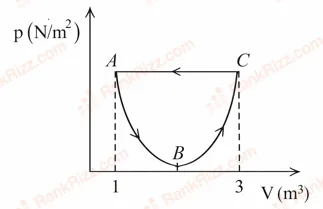
In the following p- V diagram the equation of state along the curved path is given by (V−2)2=4ap(V-2)^{2}=4ap where a is a constant. The total work done in the closed path is

Figure for JEE Main 2026 Physics question on Work done in thermodynamic processes and P-V diagrams
  1. A

    −1a-\frac{1}{a}

  2. B

    −13a-\frac{1}{3a}

  3. C

    12a\frac{1}{2a}

  4. D

    +13a+\frac{1}{3a}

JEE MAIN 2026 · 28 JAN S2Work done in thermodynamic processes and P-V diagrams

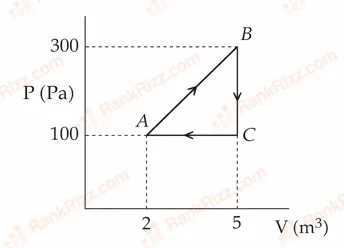
A thermodynamic system is taken through the cyclic process ABCABC as shown in the figure. The total work done by the system during the cycle ABCABC is ______ J.

Figure for JEE Main 2026 Physics question on Work done in thermodynamic processes and P-V diagrams
JEE MAIN 2026 · 24 JAN S1Zeroth and first law of thermodynamics

Density of water at 4 °C and 20 °C are 1000kg/m3 and 998kg/m31000 kg/m^{3}\text{ and }998kg/m^{3} respectively. The increase in internal energy of 4 kg of water when it is heated from 4 °C to 20 °C is_____ J.
(specific heat capacity of water = 4.2× 1034.2\times\ 10^3J / kg K. and 1 atmospheric pressure =105Pa=10^{5}Pa)

  1. A

    234699.2

  2. B

    258700.8

  3. C

    268799.2

  4. D

    315826.2

JEE MAIN 2026 · 24 JAN S2Isobaric, isochoric and polytropic processes

10 mole of an ideal gas is undergoing the process showu in the figure. The heat involved in the process from P1P_{1} to P2P_{2} is α\alpha Joule(P_{1}= 21.7Pa and P2=30P_{2} = 30 Pa, Cv=21J/K.mol,R=8.3J/mol.K.C_{v}=21J/K.mol, R=8.3 J/mol.K.) The value of α\alpha is _________.

Figure for JEE Main 2026 Physics question on Isobaric, isochoric and polytropic processes
  1. A

    28

  2. B

    15

  3. C

    24

  4. D

    21

JEE MAIN 2026 · 23 JAN S2Isothermal and adiabatic processes

One mole of an ideal diatomic gas expands from volume VV to 2V2 V isothermally at a temperature 27oC27^{o}C and does W joule of work. lf the gas undergoes same magnitude of expansion adiabatically from 27oC27^{o}C doing the same amount of work WW, then its final temperature will be (close to) ____ ∘C.^{\circ}C.
(log⁡e2=0.693)(\log_{e}2 = 0.693)

  1. A

    -189

  2. B

    -117

  3. C

    -30

  4. D

    -56

JEE MAIN 2026 · 23 JAN S2Zeroth and first law of thermodynamics

The internal energy of a monoatomic gas is 3nRT. One mole of helium is kept in a cylinder having internal cross section area of 17 cm2cm^{2} and fitted with a light movable frictionless piston. The gas is heated slowly by suppling 126 J heat. If the temperature rises by 4oC4^{o}C, then the piston will move ____ cm.
(atmospheric pressure= 10510^{5} Pa)

  1. A

    14.5

  2. B

    1.45

  3. C

    1.55

  4. D

    15.5

JEE MAIN 2026 · 22 JAN S1Isothermal and adiabatic processes

The volume of an ideal gas increases 8 times and temperature becomes (1/4)th(1/4)^{th} of initial temperature during a reversible change. If there is no exchange of heat in this process (△Q=0)(\triangle Q = 0) then identify the gas from the following options (Assuming the gases given in the options are ideal gases):

  1. A

    NH3NH_{3}

  2. B

    $$He

  3. C

    O2O_{2}

  4. D

    CO2CO_{2}

JEE MAIN 2025 · 08 APR S2Isothermal and adiabatic processes

A monoatomic gas having γ=53\gamma = \frac{5}{3} is stored in a thermally insulated container and the gas is suddenly compressed to (18)th\left(\frac{1}{8}\right)^{\text{th}} of its initial volume. The ratio of final pressure and initial pressure is :
(γ\gamma is the ratio of specific heats of the gas at constant pressure and at constant volume)

  1. A

    16

  2. B

    40

  3. C

    32

  4. D

    28

JEE MAIN 2025 · 07 APR S1Work done in thermodynamic processes and P-V diagrams

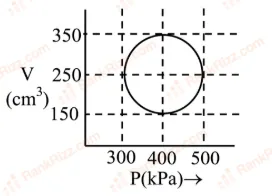
An ideal gas has undergone through the cyclic process as shown in the figure. Work done by the gas in the entire cycle is ______ ×10−1\times 10^{-1} J. (Take π=3.14\pi = 3.14)

Figure for JEE Main 2025 Physics question on Work done in thermodynamic processes and P-V diagrams
JEE MAIN 2025 · 07 APR S2Isobaric, isochoric and polytropic processes

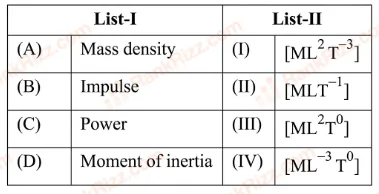
Match List-I with List-II.

Figure for JEE Main 2025 Physics question on Isobaric, isochoric and polytropic processes

Choose the correct answer from the options given below :

  1. A

    (A)-(IV), (B)-(II), (C)-(III), (D)-(I)

  2. B

    (A)-(I), (B)-(III), (C)-(IV), (D)-(II)

  3. C

    (A)-(IV), (B)-(II), (C)-(I), (D)-(III)

  4. D

    (A)-(II), (B)-(III), (C)-(IV), (D)-(I)

JEE MAIN 2025 · 04 APR S2Isobaric, isochoric and polytropic processes

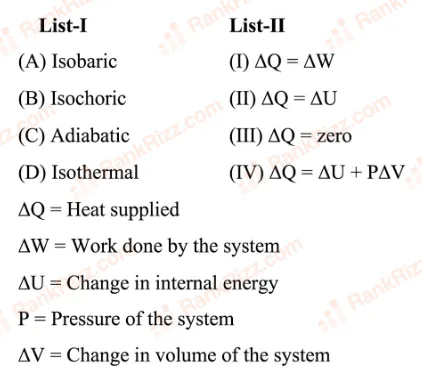
Match List-I with List-II.

Figure for JEE Main 2025 Physics question on Isobaric, isochoric and polytropic processes

Choose the correct answer from the options given below : 

  1. A

    (A)-(IV), (B)-(III), (C)-(II), (D)-(I)

  2. B

    (A)-(IV), (B)-(I), (C)-(III), (D)-(II)

  3. C

    (A)-(IV), (B)-(II), (C)-(III), (D)-(I)

  4. D

    (A)-(II), (B)-(IV), (C)-(III), (D)-(I)

JEE MAIN 2025 · 03 APR S1Zeroth and first law of thermodynamics

During the melting of a slab of ice at 273 K at atmospheric pressure :

  1. A

    Internal energy of ice-water system remains unchanged.

  2. B

    Positive work is done by the ice-water system on the atmosphere.

  3. C

    Internal energy of the ice-water system decreases.

  4. D

    Positive work is done on the ice-water system by the atmosphere.

JEE MAIN 2025 · 03 APR S1Zeroth and first law of thermodynamics

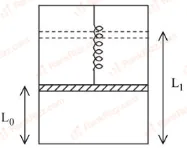
A piston of mass M is hung from a massless spring whose restoring force law goes as F=−kx3F = -kx^3, where k is the spring constant of appropriate dimension. The piston separates the vertical chamber into two parts, where the bottom part is filled with 'n' moles of an ideal gas. An external work is done on the gas isothermally (at a constant temperature T) with the help of a heating filament (with negligible volume) mounted in lower part of the chamber, so that the piston goes up from a height L0L_0 to L1L_1, the total energy delivered by the filament is (Assume spring to be in its natural length before heating)

Figure for JEE Main 2025 Physics question on Zeroth and first law of thermodynamics
  1. A

    3nRTln⁡(L1L0)+2Mg(L1−L0)+k3(L13−L03)3nRT\ln\left(\frac{L_1}{L_0}\right) + 2Mg(L_1 - L_0) + \frac{k}{3}(L_1^3 - L_0^3)

  2. B

    nRTln⁡(L12L02)+Mg2(L1−L0)+k4(L14−L04)nRT\ln\left(\frac{L_1^2}{L_0^2}\right) + \frac{Mg}{2}(L_1 - L_0) + \frac{k}{4}(L_1^4 - L_0^4)

  3. C

    nRTln⁡(L1L0)+Mg(L1−L0)+k4(L14−L04)nRT\ln\left(\frac{L_1}{L_0}\right) + Mg(L_1 - L_0) + \frac{k}{4}(L_1^4 - L_0^4)

  4. D

    nRTln⁡(L1L0)+Mg(L1−L0)+3k4(L14−L04)nRT\ln\left(\frac{L_1}{L_0}\right) + Mg(L_1 - L_0) + \frac{3k}{4}(L_1^4 - L_0^4)