JEE MAIN 2026 · 08 APR S2Electric charge and Coulomb's law
Two point charges and are placed at points and respectively. Force on charge is __________ N.
- A
- B
- C
- D
Electrostatics has been asked in every one of the 23 JEE Main years from 2004 to 2026: 294 questions in all. In 2026 it averaged 1.4 questions per paper (26 across 19 papers), 5.5% of Physics questions, down from 6.9% in 2025. Across the last 20 papers it carried 6% of Physics marks. By type: 240 MCQs and 54 numerical-answer questions. Of the 262 with a difficulty tag, 35% are easy, 63% medium and 2% hard. Most asked: Electric potential and potential energy (62, 21%), Electric flux and Gauss's law (53, 18%) and Electric charge and Coulomb's law (42, 14%).
DATA UPDATED
Questions
294
Distinct ideas
9
Share of marks
6%
Difficulty
MEDIUM
The share of each year’s Physics questions that came from Electrostatics, counted from the 168 papers we hold for the last 10 years, and session by session inside a year.
Rising: 5.9% of Physics questions in 2024–2026, up from 4.6% in 2017–2023. Its heaviest year was 2025, at 6.9%.
| YEAR | QS | PER PAPER | SHARE OF PHYSICS | CHANGE | |
|---|---|---|---|---|---|
| 2026 | 26 / 475 | 1.4 | 5.5% | −1.4 pts | JAN 6.4%APR 4.4% |
| 2025 | 33 / 475 | 1.7 | 6.9% | +1.6 pts | JAN 6.0%APR 8.0% |
| 2024 | 32 / 600 | 1.6 | 5.3% | +0.5 pts | JAN 5.7%APR 5.0% |
| 2023 | 36 / 750 | 1.4 | 4.8% | +0.9 pts | JAN 5.1%APR 4.4% |
| 2022 | 26 / 660 | 1.2 | 3.9% | −0.3 pts | JUN 4.2%JUL 3.7% |
| 2021 | 30 / 720 | 1.3 | 4.2% | −1.3 pts | FEB 8.0%MAR 2.0%JUL 3.8%AUG 3.3% |
| 2020 | 22 / 400 | 1.4 | 5.5% | +0.3 pts | JAN 5.3%SEP 5.6% |
| 2019 | 25 / 480 | 1.6 | 5.2% | +1.0 pts | JAN 5.4%APR 5.0% |
| 2018 | 5 / 120 | 1.3 | 4.2% | +0.9 pts | 4 PAPERS, ONE SESSION |
| 2017 | 3 / 90 | 1.0 | 3.3% | — | 3 PAPERS, ONE SESSION |
“QS” is Electrostatics questions out of all Physics questions that year; “per paper” is that count over the year’s papers, and “change” is the share against the year before. A year with more sittings asks more questions, which is why the share, not the count, is the number to compare.
How Electrostatics compares: every Physics chapter by weightage · most repeated JEE Main topics
A chapter is not one subject — it is a handful of procedures the examiner reuses. These are the ones Electrostatics questions actually test.
Every JEE Main Electrostatics question we hold, newest first inside each topic. Open one for its options, answer key and solution.
FREE PDF
All 294 questions on A4, by topic, with the answer key at the end. No sign-up, no email: your browser saves it as a PDF.
Download free PDFUNIQUE CONCEPTS
9 ideas, each with the latest past question that tested it, drawn from 353 JEE Main and Advanced questions.
Electrostatics Unique Concepts sheet →JEE ADVANCED
JEE Advanced has set 61 Electrostatics questions, 2007–2026.
Electrostatics JEE Advanced PYQs →Yes. It has been asked in every one of the 23 JEE Main years from 2004 to 2026, 294 questions in all.
Electric potential and potential energy: 62 of the 294 questions (21%). Next come Electric flux and Gauss's law (53) and Electric charge and Coulomb's law (42).
About 6% across the last 20 papers. Every JEE Main question carries the same marks, so that is also its share of Physics questions. In 2026 it was 5.5% (26 of 475 Physics questions).
In JEE Main 08 Apr 2026, Shift 2, the latest sitting with a Electrostatics question.
294 from 2004 to 2026, across 9 topics. Every one is listed on this page by topic and links to its own page, with the answer key and solution wherever we have them. Free, no sign-up.
1–20 OF 294 · NEWEST FIRST
Two point charges and are placed at points and respectively. Force on charge is __________ N.
A thin half ring of radius 35 cm is uniformly charged with a total charge of coulomb. If the magnitude of the electric field at centre of the half ring is 100 V/m, then the value of is _______ nC.
C/Nm and
2.14
2.44
3.25
0.7
A three coulomb charge moves from the point (0, -2, -5) to the point (5, 1, 2) in an electric field expressed as N/C. The work done in moving the charge is _______ J.
The electric potential as a function of is given by V. The electric field at a point m is __________ V/m.
A rigid dipole undergoes a simple harmonic motion about its centre in the presence of an electric field . If another electric field is introduced to the system, what will be the percentage change in the frequency of the oscillation (approximate)?
Given below are two statements: one is labelled as Assertion A and the other is labelled as Reason R
Assertion A: In electrostatics, a conductor does not store any net charge inside.
Reason R: Inside the capacitor (with no dielectric medium), the free charge carriers, if placed between the plates of capacitor, experience force and drift.
Choose the correct answer from the options given below:
Both A and R are true, and R is the correct explanation of A
Both A and R are true, but R is NOT the correct explanation of A
A is true but R is false
A is false but R is true
Two charged conducting spheres S and S of radii 8 cm and 18 cm are connected to each other by a wire. After equilibrium is established, the ratio of electric fields on S and S spheres are E and E respectively. The value of is __________.
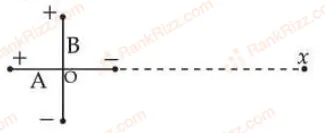
Two short electric dipoles A and B having dipole moment p and p respectively are placed with their axis mutually perpendicular as shown in the figure. The resultant electric field at a point x is making an angle of 60° with the line joining points O and x. The ratio of the dipole moments p/p is __________.
Two metal plates (A, B) are kept horizontally with separation of cm, with plate A on the top. An atomizer jet sprays oil (density g/cm) droplets of radius 1 mm horizontally. All oil droplets carry a charge 5 nC. The potentials and are required on plates A and B respectively in order to ensure the droplets do not descend. The values of and are ______.
(Neglect the air resistance to the droplets and take m/s)
V and V
V and V
V and V
V and V
Two point charges C and C are located at cm and cm, respectively on the x-axis. The ratio of electric flux due to these charges through two spheres of radii 3 cm and 5 cm with their centers at the origin is _______.
Two point charges of 1 nC and 2 nC are placed at the two corners of equilateral triangle of side 3 cm. The work done in bringing a charge of3 nC from infinity to the third corner of the triangle is __
3.3
2.7
27
5.4
Identify the correct statements :
A. Electrostatic field lines form closed loops .
B. The eleclric field lines point radially outward when charge is greater than zero.
C. The Gauss - Law is valid only for inverse - square force.
D. The workdone in moving a charged particle in a static eleclric field around a closed path is zero.
E. The motion of a particle under Coulomb's force must take place in a plane.
Choose the correct answer from the options given below:
A, C, E Only
A, B, D, E Only
B, C, D, E Only
A, B, C, D Only
The electrostatic potential in a charged spherical region of radius r varies as , where a and b are constants. The total charge in the sphere of unit radius is . the value of is_____. (permittivity of vacuum is )
-9
-6
-12
-8
Three charges+ 2q, +3q and -4q are situated at (0, -3a), (2a, 0) and (-2a, 0) respectively in the x y plane. The resultant dipole moment about origin is ___ .
There are three co-centric conducting spherical shells A, B and C of radii a, b and c respectively (c > b > a) and they are charged with charge respectively. The potentials of the spheres A, Band C respectively, are :
, ,
,
, ,
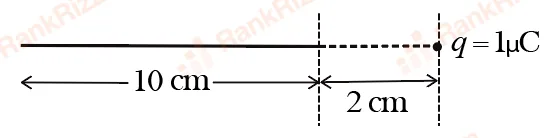
A point charge q = l is located at a distance 2 cm from one end of a thin insulating wire of length 10 cm having a charge Q = 24 , distributed uniformly along its length, as shown in figure. Force between q and wire is __ N.
(Use: )
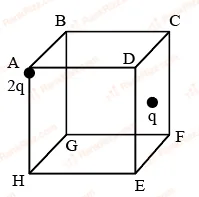
Two point charges 2q and q are placed at vertex A and centre of face CDEF of the cube as shown in figure. The electric flux passing through the cube is :
Two charges and are placed at (-9,0,0)cm and (9,0,0)cm respectively in an external field , where Considering the potential at infinity is 0, the electrostatic energy of the configuration is ______J.
1.4
-90.7
49.3
24.3
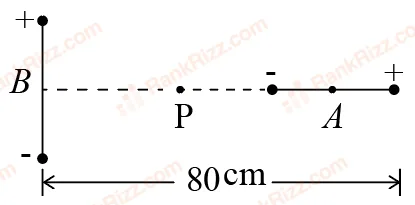
Two shorts dipoles , having charges and length 1 cm and having charges and length 1 cm are placed with their centres 80 cm apart as shown in the figure. The electric field at a point , equi-distant from the centres of both dipoles is ____ N/ C.
Electric field in a region is given by , where , and . If the electric potential at a point (10, 20) is 500 , then the electric potential at origin is____ .
2000
0
500
1000
OTHER PHYSICS CHAPTERS