A monochromatic source of light operating at 15 kW emits photons/s. The region of an electromagnetic spectrum to which the emitted electromagnetic radiation belongs to __________. (Take J.s and m/s).
- A
Microwave
- B
Infrared
- C
Visible
- D
Ultraviolet
Dual Nature of Radiation & Matter has been asked in every one of the 23 JEE Main years from 2004 to 2026: 216 questions in all. In 2026 it averaged 0.8 questions per paper (16 across 19 papers), 3.4% of Physics questions, down from 4.4% in 2025. Across the last 20 papers it carried 3.4% of Physics marks. By type: 199 MCQs and 17 numerical-answer questions. Of the 196 with a difficulty tag, 49% are easy, 49% medium and 2% hard. Most asked: Photoelectric effect and Einstein's equation (98, 45%), de Broglie wavelength of matter waves (82, 38%) and Photons: energy, momentum and radiation pressure (29, 13%).
DATA UPDATED
Questions
216
Distinct ideas
4
Share of marks
3.4%
Difficulty
MEDIUM
The share of each year’s Physics questions that came from Dual Nature of Radiation & Matter, counted from the 168 papers we hold for the last 10 years, and session by session inside a year.
Steady: 3.7% of Physics questions in 2024–2026 against 3.8% in 2017–2023, and between 2.5% and 4.6% in every year shown.
| YEAR | QS | PER PAPER | SHARE OF PHYSICS | CHANGE | |
|---|---|---|---|---|---|
| 2026 | 16 / 475 | 0.8 | 3.4% | −1.0 pts | JAN 2.8%APR 4.0% |
| 2025 | 21 / 475 | 1.1 | 4.4% | +0.9 pts | JAN 5.2%APR 3.6% |
| 2024 | 21 / 600 | 1.1 | 3.5% | −0.1 pts | JAN 3.3%APR 3.7% |
| 2023 | 27 / 750 | 1.1 | 3.6% | +0.3 pts | JAN 3.6%APR 3.6% |
| 2022 | 22 / 660 | 1.0 | 3.3% | −1.3 pts | JUN 3.3%JUL 3.3% |
| 2021 | 33 / 720 | 1.4 | 4.6% | +0.1 pts | FEB 6.0%MAR 3.3%JUL 5.2%AUG 3.8% |
| 2020 | 18 / 400 | 1.1 | 4.5% | +1.2 pts | JAN 4.7%SEP 4.4% |
| 2019 | 16 / 480 | 1.0 | 3.3% | +0.8 pts | JAN 3.8%APR 2.9% |
| 2018 | 3 / 120 | 0.8 | 2.5% | −1.9 pts | 4 PAPERS, ONE SESSION |
| 2017 | 4 / 90 | 1.3 | 4.4% | — | 3 PAPERS, ONE SESSION |
“QS” is Dual Nature of Radiation & Matter questions out of all Physics questions that year; “per paper” is that count over the year’s papers, and “change” is the share against the year before. A year with more sittings asks more questions, which is why the share, not the count, is the number to compare.
How Dual Nature of Radiation & Matter compares: every Physics chapter by weightage · most repeated JEE Main topics
A chapter is not one subject — it is a handful of procedures the examiner reuses. These are the ones Dual Nature of Radiation & Matter questions actually test.
Every JEE Main Dual Nature of Radiation & Matter question we hold, newest first inside each topic. Open one for its options, answer key and solution.
FREE PDF
All 216 questions on A4, by topic, with the answer key at the end. No sign-up, no email: your browser saves it as a PDF.
Download free PDFUNIQUE CONCEPTS
4 ideas, each with the latest past question that tested it, drawn from 240 JEE Main and Advanced questions.
Dual Nature of Radiation & Matter Unique Concepts sheet →JEE ADVANCED
JEE Advanced has set 25 Dual Nature of Radiation & Matter questions, 2007–2025.
Dual Nature of Radiation & Matter JEE Advanced PYQs →Yes. It has been asked in every one of the 23 JEE Main years from 2004 to 2026, 216 questions in all.
Photoelectric effect and Einstein's equation: 98 of the 216 questions (45%). Next come de Broglie wavelength of matter waves (82) and Photons: energy, momentum and radiation pressure (29).
About 3.4% across the last 20 papers. Every JEE Main question carries the same marks, so that is also its share of Physics questions. In 2026 it was 3.4% (16 of 475 Physics questions).
In JEE Main 08 Apr 2026, Shift 2, the latest sitting with a Dual Nature of Radiation & Matter question.
216 from 2004 to 2026, across 4 topics. Every one is listed on this page by topic and links to its own page, with the answer key and solution wherever we have them. Free, no sign-up.
1–20 OF 216 · NEWEST FIRST
A monochromatic source of light operating at 15 kW emits photons/s. The region of an electromagnetic spectrum to which the emitted electromagnetic radiation belongs to __________. (Take J.s and m/s).
Microwave
Infrared
Visible
Ultraviolet
and be the maximum kinetic energies of photoelectrons emitted from a surface of a given material for the light of wavelength and , respectively. If then the work function of material is given by :
The de Broglie wavelength for an electron accelerated through the potential difference of volt is . When the potential difference is changed to volt, the associated de Broglie wavelength is increased by 50%. If , then the value of is __________.
An electron of mass is moving in an electric field ( = constant > 0), with an initial velocity ( = constant > 0). If , its de Broglie wavelength at time is _______. ( = charge of electron)
Light source having wavelength 331 nm is used to generate photo-electrons whose stopping potential is 0.2 V. The work function of the used metal in the experiment is J. The value of is _______. (h = J s, e = C and c = m/s)
An electron is travelling with a velocity in free space and when it enters a medium, its velocity is reduced by 20%. The de Broglie wavelength of electron in the medium is .where is its de Broglie wavelength in free space. The value of is :
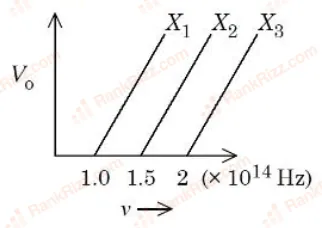
The graph shows variation of stopping potential with the frequency of the incident radiation for three photosensitive metals , and . Which metal will give out electrons with greater kinetic energy, for the same wavelength of incident radiation?

All same
The de Broglie wavelength associated with an electron accelerated through a potential difference V is and the de Broglie wavelength associated with a proton accelerated through the same potential difference is . If their corresponding masses are and , respectively, then the ratio of their de Broglie wavelengths is ______.
For a certain metal, when monochromatic light of wavelength is incident, the stopping potential for photoelectrons is . When the same metal is illuminated by light of wavelength , then the stopping potential becomes . The threshold wavelength for photoelectric emission for the given metal is . The value of is __________.
The ratio of de Broglie wavelength of a deutron with kinetic energy E to that of an alpha particle with kinetic energy 2E, is n : 1. The value of n is __.
(Assume mass of proton= mass of neutron) :
Number of photons of equal energy emitted per second by a 6 mW laser source operating at 663 nm is ____ . (Given: )
When a light of a given wavelength falls on a metallic surface the stopping potential for photoelectrons is 3.2 V. If a second light having wavelength twice of first light is used, the stopping potential drops to 0. 7 V. The wavelength of first light is ___ m.
The de Broglie wavelength of an oxygen molecule at . The value of x is (take Planck's constant , Boltzmann constant , mass of oxygen molecule )
20
24
30
26
Light is incident on a metallic plate having work function . If the produced photoelectrons have zero kinetic energy then the angular frequency of the incident light is ___ rad/s. (h = ).
A light wave described by (in SI units) falls on a metal surface of work function 2.8 eV. The maximum kinetic energy of ejected photoelectron is (approximately) ___ eV.
7.8
6.0
3.8
5.1
A particle having electric charge C and mass kg is accelerated by applying an electric Potential of 1.21 V. Wavelength of the matter wave
associated with the particle is . The value of is __________. (Take Planck's constant = J.s. )
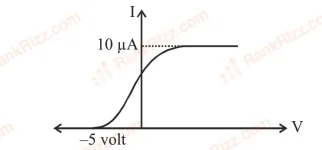
In the photoelectric experiment, if we use a monochromatic light, the curve is as shown. If the work function of the metal is , estimate the power of light used.
(Assume efficiency of photo emission = , i.e. the number of photoelectrons emitted are of the number of photons incident on the metal.)

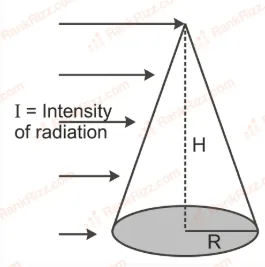
The radiation force experienced by body exposed to radiation of intensity , assuming surface of body to be perfectly absorbing is :

An electron is released from rest near an infinite non-conducting sheet of uniform charge density ''. The rate of change of de-Broglie wave length associated with the electron varies inversely as power of time. The numerical value of n is _____.
A photo-emissive substance is illuminated with a radiation of wavelength so that it releases electrons with de-Broglie wavelength . The longest wavelength of radiation that can emit photoelectron is . Expression for de-Broglie wavelength is given by : (m : mass of the electron, h : Planck's constant and c : speed of light)
OTHER PHYSICS CHAPTERS