RankRizz

Electrostatics — JEE Main Previous Year Questions

Every Electrostatics question JEE Main has set from 2004–2026, grouped by the idea it tests rather than the order of the syllabus. 294 questions across 9 distinct ideas. Free to read, answer key on every one.

DATA UPDATED

Questions

294

Distinct ideas

9

Share of marks

6%

Difficulty

MEDIUM

The ideas inside Electrostatics

A chapter is not one subject — it is a handful of procedures the examiner reuses. These are the ones Electrostatics questions actually test.

Every Electrostatics question

241–260 OF 294 · NEWEST FIRST

JEE MAIN 2016 · 09 APR ONLINERelation between field and potential, equipotential surfaces

The potential (in volts) of a charge distribution is given by
V(z)=30−5z2V(z) = 30 - 5z^2 for ∣z∣≤1|z| \leq 1 m
V(z)=35−10∣z∣V(z) = 35 - 10|z| for ∣z∣≥1|z| \geq 1 m.
V(z)V(z) does not depend on x and y. If this potential is generated by a constant charge per unit volume ρ0\rho_0 (in units of ϵ0\epsilon_0) which is spread over a certain region, then choose the correct statement.

  1. A

    ρ0=20 ϵ0\rho_0 = 20\,\epsilon_0 in the entire region

  2. B

    ρ0=10 ϵ0\rho_0 = 10\,\epsilon_0 for ∣z∣≤1|z| \leq 1 m and ρ0=0\rho_0 = 0 else where

  3. C

    ρ0=20 ϵ0\rho_0 = 20\,\epsilon_0 for ∣z∣≤1|z| \leq 1 m and ρ0=0\rho_0 = 0 else where

  4. D

    ρ0=40 ϵ0\rho_0 = 40\,\epsilon_0 in the entire region

JEE MAIN 2016 · 03 APR OFFLINEElectric flux and Gauss's law

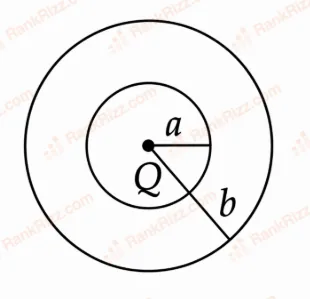
The region between two concentric spheres of radii 'a' and 'b', respectively (see figure), has volume charge density ρ=Ar\rho = \frac{A}{r}, where A is a constant and r is the distance from the centre. At the centre of the spheres is a point charge Q. The value of A such that the electric field in the region between the spheres will be constant, is:

Figure for JEE Main 2016 Physics question on Electric flux and Gauss's law
  1. A

    2Qπ(a2−b2)\frac{2Q}{\pi(a^2 - b^2)}

  2. B

    2Qπa2\frac{2Q}{\pi a^2}

  3. C

    Q2πa2\frac{Q}{2\pi a^2}

  4. D

    Q2π(b2−a2)\frac{Q}{2\pi(b^2 - a^2)}

JEE MAIN 2015 · 11 APR ONLINEElectric field of continuous charge distributions

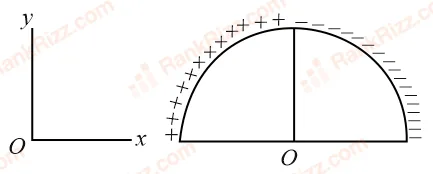
A wire of length L=20L = 20 cm is bent into a semi-circular arc and the two equal halves of the arc are uniformly charged with charges +Q+Q and −Q-Q as shown in the figure. The magnitude of the charge on each half is ∣Q∣=103ε0|Q| = 10^3\varepsilon_0, where ε0\varepsilon_0 is the permittivity of free space. The net electric field at the centre OO is

Figure for JEE Main 2015 Physics question on Electric field of continuous charge distributions
  1. A

    (25×103)i^(25 \times 10^3)\hat{i} N C−1^{-1}

  2. B

    (50×103)i^(50 \times 10^3)\hat{i} N C−1^{-1}

  3. C

    (25×103)j^(25 \times 10^3)\hat{j} N C−1^{-1}

  4. D

    (50×103)j^(50 \times 10^3)\hat{j} N C−1^{-1}

JEE MAIN 2015 · 11 APR ONLINEElectric potential and potential energy

An electric field E⃗=(25i^+30j^)\vec{E} = \left(25\hat{i} + 30\hat{j}\right) N C−1^{-1} exists in a region of space. If the potential at the origin is taken to be zero then the potential at x=2x = 2 m, y=2y = 2 m is:

  1. A

    −110-110 J C−1^{-1}

  2. B

    −140-140 J C−1^{-1}

  3. C

    −130-130 J C−1^{-1}

  4. D

    −120-120 J C−1^{-1}

JEE MAIN 2015 · 10 APR ONLINEConductors, concentric shells and earthing

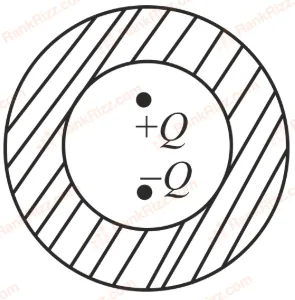
Shown in the figure are two point charges +Q+Q and −Q-Q inside the cavity of a spherical shell. The charges are kept near the surface of the cavity on opposite sides of the centre of the shell. If σ1\sigma_1 is the surface charge on the inner surface and Q1Q_1 net charge on it and σ2\sigma_2 the surface charge on the outer surface and Q2Q_2 net charge on it then:

Figure for JEE Main 2015 Physics question on Conductors, concentric shells and earthing
  1. A

    σ1=0,Q1=0,σ2=0,Q2=0\sigma_1 = 0, Q_1 = 0, \sigma_2 = 0, Q_2 = 0

  2. B

    σ1≠0,Q1=0,σ2≠0,Q2=0\sigma_1 \neq 0, Q_1 = 0, \sigma_2 \neq 0, Q_2 = 0

  3. C

    σ1≠0,Q1≠0,σ2≠0,Q2≠0\sigma_1 \neq 0, Q_1 \neq 0, \sigma_2 \neq 0, Q_2 \neq 0

  4. D

    σ1≠0,Q1=0,σ2=0,Q2=0\sigma_1 \neq 0, Q_1 = 0, \sigma_2 = 0, Q_2 = 0

JEE MAIN 2015 · 10 APR ONLINEElectric field of continuous charge distributions

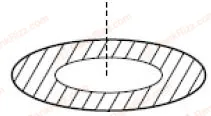
A thin disc of radius b=2ab = 2a has a concentric hole of radius aa in it (see figure). It carries uniform surface charge σ\sigma on it. If the electric field on its axis at a height h (h <<<< a) from its centre is given as Ch then the value of C is

Figure for JEE Main 2015 Physics question on Electric field of continuous charge distributions
  1. A

    σ4aϵ0\frac{\sigma}{4a\epsilon_0}

  2. B

    σaϵ0\frac{\sigma}{a\epsilon_0}

  3. C

    σ5aϵ0\frac{\sigma}{5a\epsilon_0}

  4. D

    σ2aϵ0\frac{\sigma}{2a\epsilon_0}

JEE MAIN 2015 · 04 APR OFFLINEElectric potential and potential energy

A uniformly charged solid sphere of radius R has potential V0V_0 (measured with respect to ∞\infty) on its surface. For this sphere the equipotential surfaces with potential 3V02\frac{3V_0}{2}, 5V04\frac{5V_0}{4}, 3V04\frac{3V_0}{4} and V04\frac{V_0}{4} have radius R1R_1, R2R_2, R3R_3 and R4R_4 respectively. Then
Note: This question had two options correct at the time of examination. Proper corrections are made in the question to avoid it.

  1. A

    2R>R42R > R_4

  2. B

    R1=0R_1 = 0 and R2>(R4−R3)R_2 > (R_4 - R_3)

  3. C

    R1≠0R_1 \neq 0 and (R2−R1)>(R4−R3)(R_2 - R_1) > (R_4 - R_3)

  4. D

    R1=0R_1 = 0 and R2<(R4−R3)R_2 < (R_4 - R_3)

JEE MAIN 2015 · 04 APR OFFLINEElectric field of continuous charge distributions

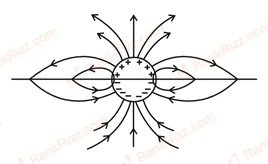
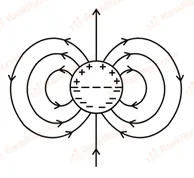
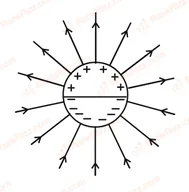
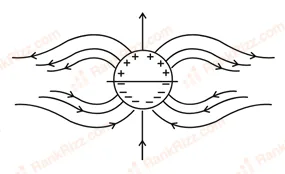
A long cylindrical shell carries positive surface charge σ\sigma in the upper half and negative surface charge −σ-\sigma in the lower half. The electric field lines around the cylinder will look like figure given in: (figures are schematic and not drawn to scale)

  1. A
    Figure for JEE Main 2015 Physics question on Electric field of continuous charge distributions
  2. B
    Figure for JEE Main 2015 Physics question on Electric field of continuous charge distributions
  3. C
    Figure for JEE Main 2015 Physics question on Electric field of continuous charge distributions
  4. D
    Figure for JEE Main 2015 Physics question on Electric field of continuous charge distributions
JEE MAIN 2014 · 19 APR ONLINEElectric flux and Gauss's law

The electric field in a region of space is given by, E⃗=E0i^+2E0j^\vec{E} = E_0\hat{i} + 2E_0\hat{j} where E0=100E_0 = 100 N C−1^{-1}. The flux of this field through a circular surface of radius 0.02 m parallel to the Y-Z plane is nearly:

  1. A

    0.02 N m2^2 C−1^{-1}

  2. B

    0.005 N m2^2 C−1^{-1}

  3. C

    0.125 N m2^2 C−1^{-1}

  4. D

    3.14 N m2^2 C−1^{-1}

JEE MAIN 2014 · 12 APR ONLINEElectric flux and Gauss's law

A spherically symmetric charge distribution is characterised by the following charge density variations: ρ(r)=ρo(1−rR)\rho(r) = \rho_o\left(1 - \frac{r}{R}\right) for r<Rr < R, ρ(r)=0\rho(r) = 0 for r≥Rr \geq R. Where r is the distance from the centre of the charge distribution and ρo\rho_o is a constant. The electric field at an internal point (r<Rr < R) is:

  1. A

    ρo4εo(r3−r24R)\frac{\rho_o}{4\varepsilon_o}\left(\frac{r}{3} - \frac{r^2}{4R}\right)

  2. B

    ρoεo(r3−r24R)\frac{\rho_o}{\varepsilon_o}\left(\frac{r}{3} - \frac{r^2}{4R}\right)

  3. C

    ρo3εo(r3−r24R)\frac{\rho_o}{3\varepsilon_o}\left(\frac{r}{3} - \frac{r^2}{4R}\right)

  4. D

    ρo12εo(r3−r24R)\frac{\rho_o}{12\varepsilon_o}\left(\frac{r}{3} - \frac{r^2}{4R}\right)

JEE MAIN 2014 · 11 APR ONLINEElectric flux and Gauss's law

A cone of base radius R and height h is located in a uniform electric field E⃗\vec{E} parallel to its base. The electric flux entering the cone is:

  1. A

    12EhR\frac{1}{2}EhR

  2. B

    EhR

  3. C

    2EhR

  4. D

    4EhR

JEE MAIN 2014 · 09 APR ONLINEElectric flux and Gauss's law

The magnitude of the average electric field normally present in the atmosphere just above the surface of the Earth is about 150 N/C, directed inward towards the center of the Earth. This gives the total net surface charge carried by the Earth to be: [Given: ϵ0=8.85×10⁻¹²\epsilon_0 = 8.85 \times 10^{-12} C2^2/N-m2^2, RE=6.37×10⁶R_E = 6.37 \times 10^6 m]

  1. A

    −680-680 kC

  2. B

    +670+670 kC

  3. C

    +680+680 kC

  4. D

    −670-670 kC

JEE MAIN 2014 · 06 APR OFFLINEElectric potential and potential energy

Assume that an electric field E⃗=30x2i^\vec{E} = 30x^2\hat{i} exists in space. Then the potential difference VA−VOV_A - V_O, where VOV_O is the potential at the origin and VAV_A the potential at x = 2 m is:

  1. A

    120 J C−1^{-1}

  2. B

    −120-120 J C−1^{-1}

  3. C

    −80-80 J C−1^{-1}

  4. D

    80 J C−1^{-1}

JEE MAIN 2013 · 25 APR ONLINEElectric potential and potential energy

This question has Statement-1 and Statement-2. Of the four choices given after the Statements, choose the one that best describes the two Statements.
Statement 1: No work is required to be done to move a test charge between any two points on an equipotential surface.
Statement 2: Electric lines of force at the equipotential surfaces are mutually perpendicular to each other.

  1. A

    Statement 1 is true, Statement 2 is true, Statement 2 is the correct explanation of Statement 1.

  2. B

    Statement 1 is true, Statement 2 is true, Statement 2 is not the correct explanation of Statement 1.

  3. C

    Statement 1 is true, Statement 2 is false.

  4. D

    Statement 1 is false, Statement 2 is true.

JEE MAIN 2013 · 25 APR ONLINEElectric field of continuous charge distributions

The surface charge density of a thin charged disc of radius R is σ\sigma. The value of the electric field at the centre of the disc is σ2ϵ0\frac{\sigma}{2\epsilon_0}. With respect to the field at the centre, the electric field along the axis at a distance R from the centre of the disc:

  1. A

    reduces by 70.7%

  2. B

    reduces by 29.3%

  3. C

    reduces by 9.7%

  4. D

    reduces by 14.6%

JEE MAIN 2013 · 23 APR ONLINEConductors, concentric shells and earthing

Consider a finite insulated, uncharged conductor placed near a finite positively charged conductor. The uncharged body must have a potential :

  1. A

    less than the charged conductor and more than at infinity.

  2. B

    more than the charged conductor and less than at infinity.

  3. C

    more than the charged conductor and more than at infinity.

  4. D

    less than the charged conductor and less than at infinity.

JEE MAIN 2013 · 23 APR ONLINEElectric field of continuous charge distributions

A liquid drop having 6 excess electrons is kept stationary under a uniform electric field of 25.5 kVm−1^{-1}. The density of liquid is 1.26×1031.26 \times 10^3 kg m−3^{-3}. The radius of the drop is (neglect buoyancy).

  1. A

    4.3×10−74.3 \times 10^{-7} m

  2. B

    7.8×10−77.8 \times 10^{-7} m

  3. C

    0.078×10−70.078 \times 10^{-7} m

  4. D

    3.4×10−73.4 \times 10^{-7} m

JEE MAIN 2013 · 22 APR ONLINEConductors, concentric shells and earthing

A point charge of magnitude +1μC+1\mu C is fixed at (0, 0, 0). An isolated uncharged spherical conductor, is fixed with its center at (4, 0, 0). The potential and the induced electric field at the centre of the sphere is :

  1. A

    1.8×1051.8 \times 10^5 V and −5.625×10⁶-5.625 \times 10^6 V/m

  2. B

    0 V and 0 V/m

  3. C

    2.25×1052.25 \times 10^5 V and −5.625×10⁶-5.625 \times 10^6 V/m

  4. D

    2.25×1052.25 \times 10^5 V and 0 V/m

JEE MAIN 2013 · 22 APR ONLINERelation between field and potential, equipotential surfaces

Two small equal point charges of magnitude qq are suspended from a common point on the ceiling by insulating mass less strings of equal lengths. They come to equilibrium with each string making angle θ\theta from the vertical. If the mass of each charge is mm, then the electrostatic potential at the centre of line joining them will be (14πϵ0=k)\left(\frac{1}{4\pi\epsilon_0} = k\right).

  1. A

    2kmgtan⁡θ2\sqrt{kmg\tan\theta}

  2. B

    kmgtan⁡θ\sqrt{kmg\tan\theta}

  3. C

    4kmgtan⁡θ4\sqrt{kmg\tan\theta}

  4. D

    4kmg/tan⁡θ4\sqrt{kmg/ \tan\theta}

JEE MAIN 2013 · 09 APR ONLINEElectric dipole and dipole in external field

Two point dipoles of dipole moment p1⃗\vec{p_1} and p2⃗\vec{p_2} are at a distance x from each other and p1⃗∥p2⃗\vec{p_1} \| \vec{p_2}. The force between the dipoles is :

  1. A

    14πϵ04p1p2x4\frac{1}{4\pi\epsilon_0}\frac{4p_1p_2}{x^4}

  2. B

    14πϵ03p1p2x3\frac{1}{4\pi\epsilon_0}\frac{3p_1p_2}{x^3}

  3. C

    14πϵ06p1p2x4\frac{1}{4\pi\epsilon_0}\frac{6p_1p_2}{x^4}

  4. D

    14πϵ08p1p2x4\frac{1}{4\pi\epsilon_0}\frac{8p_1p_2}{x^4}